


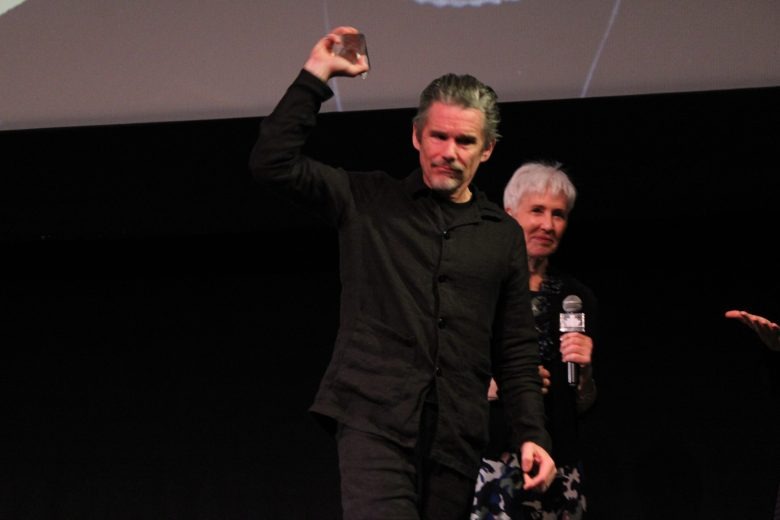
Actor and filmmaker Ethan Hawke was honored Wednesday night as with the 2025 Coolidge Award, a recognition of outstanding and original contributions to cinema.
Hawke is a four-time Academy Award-nominated actor famous for critically acclaimed films including “Dead Poets Society,” the “Before” trilogy, “Boyhood” and “Training Day.” He is also a producer, director, writer and novelist with a body of work spanning film, television and theater.
Beth Gilligan, the Coolidge Corner Theatre’s deputy director, said with Hawke’s latest film, “Blue Moon,” making waves on the festival circuit, it was the perfect moment to honor him for his “remarkable career” of four decades.
“We find him to be just such an incredible, inspiring artist who’s always willing to take risks, push boundaries,” Gilligan said. “He’s truly a Renaissance man.”
Hawke sat down with Jared Bowen, executive arts editor for WGBH, in front of a packed audience at the Coolidge to discuss his career. A montage of Hawke’s most famous roles played beforehand, and Hawke said it was moving to see his work that was recognized.
“We all have this idea that there’s this void out there, and our actions are kind of lost to this great void of nothingness,” he said. “That’s not really true. People do notice.”
Hawke discussed his approach to building a character. When asked which of his characters is most like him, he said it’s impossible to say because he embraces the Stanislavski Method, which emphasizes emotional truth and immersing oneself in the circumstances faced by the character.
“What if I were placed in the same situation that Macbeth is placed in?” Hawke suggested. “The game for me is to make each one of [my characters] me, and that’s the fun of it.”
He went on to talk about acting alongside Denzel Washington in “Training Day,” being a “perpetual student” since his child actor beginnings and the translation of theater experience into his film work. Along the way, Hawke made the crowd laugh with several anecdotes, including the time he brought a six-pack of beer to see “Dazed and Confused” and left the theater angry that he wasn’t in it.
“This is not a just God,” Hawke recalled thinking on his way out of the theater. Director Richard Linklater’s film had come out before he and Hawke met and began their collaborative relationship.
Cameron Wagner and Gabriella Boyle, sophomore film students at Emerson College, attended the event and said they were inspired by Hawke’s commitment to his artistry.
Wagner said she enjoyed hearing about the collaboration between Hawke and Linklater, which she called “one of the best in cinematic history.” The two have worked together on several films including “Boyhood,” the “Before” trilogy and “Blue Moon.”
“It’s up there with Scorsese and De Niro,” Wagner said. “[They] reminded me why I’m studying what I study and what you can do with film. There’s so many possibilities, and I think the two of them together really like to explore that.”
Jack Lilburn, a 46-year-old filmmaking teacher at Minuteman High School in Lexington, attended the event and said Hawke grew from an actor he “didn’t necessarily think twice about into someone who I’ve actually found to be rather profound.”
He recalls seeing “First Reformed” at the Coolidge, and that film is what got Lilburn to pay more attention to Hawke.
“I remember when that movie ended, they had to ask me to leave,” Lilburn said. “I was like a human paperweight because I just was so leveled by it.”
During the talk, Hawke said he was inspired by legendary college baseball coach Augie Garrido, whose philosophy focused not on winning, but on “developing young people” and using the game as a positive learning experience, which Lilburn said he found inspiring.
“As a teacher, I certainly connected with that,” Lilburn said. “It’s going to be nice to teach kids who will go on to have success, but I’m more interested in developing young people who can reflect on the world and articulate points of view.”
Boyle said she is a fan of Hawke’s work from the 1990s and appreciated what he had to say about committing to the craft and balancing self acceptance with an openness to criticism.
“He was such an influential actor throughout that decade, and still to this day, he lives up to his title,” Boyle said. “He really leaves his mark on the films that he makes, and that’s why they’re so memorable.”
This story is part of a partnership between Brookline.News and the Boston University Department of Journalism.