

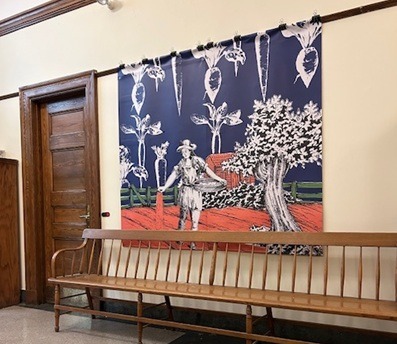
Art installation at Town Hall. / Carol Beggy photo
Arlington’s gone green — and red, white and blue – for a multimedia art installation focused on the relationship between plants and people for the 250th anniversary of the American Revolution.
“People, Plants & Revolution,” organized by Arts Arlington, explores Colonial life and revolutionary events through a botanical lens. Clamped onto light poles starting at Arlington Town Hall and heading southeast along Mass. Ave. 13 banners call attention to colorful plant illustrations.
The installation’s audio tour – which you can access here and download in text format – links the banner imagery to Menotomy’s agricultural history before and after the 1775 Colonial settlement of what is now Arlington.
The banners – designed by a team of four artists, Liz Shepherd, Suzanne Moseley, Lily McDonald and Andrew Palladino – combine Colonial-style images with plant illustrations from the Harvard University Herbaria. All of the banners are set against a distinctive blue background inspired by cyanotype chemistry, used since the 1840s for botanical illustration.
‘What I learned …”
“People, Plants & Revolution” transformed my understanding of Arlington, reporter Kara Mihm writes. Here are five things she took away from the audio tour while walking down Mass. Ave.
The Declaration of Independence and the U.S. Constitution were written with ink from oak galls, abnormal plant growths on oak trees. This permanent ink was a historically dominant choice for significant documents.
Apples were arguably the most successful fruit in the New World. New varieties emerged rapidly because of apple seeds’ genetic diversity. Popular varieties were distributed throughout New England by sharing cuttings of the original trees.
Many plants, including clover, were commercially available in the 1760s to remind English settlers of the meadows back home. While we might perceive these plants as native now, they are an invasive species.
The spinning wheel became a symbol of freedom from the British after Colonial women made homespun linen from locally grown flax to replace boycotted textiles. Outdoor public spinning protests became popular among women throughout the Colonies.
Colonists saw wasted land – any land that remained unplanted – as a Christian sin. Puritan founders believed that planting a field was a virtuous way to establish ownership of land. This was a contributing factor of forced displacement of indigenous people.
‘Lexington and Concord, everyone knows about those battles, but the battles in Arlington were just as significant.’
– Cecily Miller, public art curator at Arts Arlington and the developer of the audio tour.
“The Town of Arlington really wanted to make this anniversary visible and show their pride in having been part of the founding of our nation,” said Cecily Miller, public art curator at Arts Arlington and the developer of the audio tour. “Lexington and Concord, everyone knows about those battles, but the battles in Arlington were just as significant. We came up with the idea of talking about the evolution of Arlington in terms of what were the most important plants for people.”
The narration contrasts eras: While natural plants are often taken for granted today, they were essential for survival 250 years ago – for food, clothing and homes.
By importing plants from England, the farming village of Menotomy altered the landscape, often causing dramatic ecological change. Colonists’ success at farming added to their confidence that they could live without British rule, but the rush to cultivate open land carried environmental impacts.
Once settlers arrived in the New World, they began extracting natural resources and clearing forests for crops, livestock and lumber. They physically transformed their new home, inspiring future generations to follow this strategy westward.
The narration does not shy away from acknowledging the Colonists’ forceful removal of the land’s original people, the Massachusett. To honor the indigenous people who are still living in the state, Faries Gray, the war chief of the Massachusett Tribe at Ponkapoag, shared his perspective on his peoples’ history and their relationship to plants.
The installation is on display through May. The original silkscreen artwork is on exhibit at 13Forest Gallery (April 5 to May 23) and at Old Schwamb Mill (April 1 to May 31).
This news sumnmary and sidebar, published April 18, 2025, are part of a partnership between YourArlington and the Boston University Department of Journalism.