Author: Aayushi Datta

  • Winchester students earn spots in competitive music festival

    More than half of the Winchester High School students who auditioned for the Senior District Festival have been selected for the competitive music event.

    The Senior District Festival, hosted by the Massachusetts Music Educators Association Northeast District, is scheduled for Jan. 10, with the concert band and orchestra performing at 10 a.m., followed by the jazz band and chorus at noon.

    Students performed Nov. 15 for judges who ranked their auditions, selected top performers for ensembles, and recommended standout musicians for All-State Festival auditions, said Mary Costello, music director for Winchester Public Schools.

    “So it’s kind of an all-star type of experience for the kids,” Costello said. “It’s really quite an honor for the kids to be selected and then be part of a whole series of festivals.”

    Musicians from the Northeast Senior District Festival stand with their instruments moments after completing their performance. COURTESY PHOTO/CAMILLE GLANCEY

    For many students, such as Ha Yong Choi, a senior at Winchester High School, the process involves a blend of independent practice and mentorship. She is part of the choir and auditioned as a singer for the festival.

    “I practice two days per week. And I keep listening to my solo.” Choi said. “Mr. [Joel] Buford, my choir teacher, he helped me a lot. I came to Mr. Buford and checked sometimes, like, ‘Do I seem right?’”

    Camille Glancey, a Winchester senior who plays the cello, recalled being overwhelmed the moment she walked into North Andover High School.

    “Everyone is carrying some sort of case, or they’re singing to themselves, which is, I think, really fun to see,” she said.

    ​​When her number was called, she and the only other Winchester cellist were led to the quieter audition rooms. Waiting outside, she said, her nerves peaked.

    “Once the person before you leaves the classroom, then the judge will call you in,” Glancey said. “Then the next thing you know, it’s over and you’re walking back.”

    Get matching funds during NewsMatch. Donate today!

    Costello said the courage to audition is as commendable as success itself.

    “Auditioning is a scary thing,” she said. “It’s an intimidating thing. It takes a lot of preparation. It’s brave.”

    That bravery paid off for Winchester students this year. Out of roughly 60 auditionees, 30 were selected for the festival, and 18 moved on to All-State auditions, including Choi and Glancey.

    Glancey said she improved each year, moving from the 16th chair as a sophomore to the 4th chair this year, earning her the chance to audition for All-State.

    For Choi, who had auditioned since her sophomore year, success came with its own mix of relief and excitement.

    “I was kind of nervous this year because I thought I did really bad on my solo piece,” she said. “But I also really [wanted] to get [into] All-State also this year. So I was like, even if I get into senior district, I might not get into All-State. But I got a really high score. I was really happy.”

    Both she and Glancey highlighted the support and encouragement from teachers and peers as essential to their preparation. Students often practiced together, offered feedback and motivated each other despite the event’s competitive nature.

    Selected students will spend three days in intensive rehearsals, culminating in a final performance in early January. Those moving on to All-State will face even more practice and competition, including auditions in late January and a performance in March.

    Costello reflected on what makes the process meaningful.

    “I’m actually more proud of the number of kids who took the audition than I am for the ones that I’m obviously proud of, the kids who were successful in their audition,” she said. “We’re happy for the kids who were successful. It shows their commitment, how hard they’ve been working.

    Aayushi Datta is a student at Boston University. This story is part of a partnership between Winchester News and the Boston University Department of Journalism.

  • Winchester students earn spots in competitive music festival

    Winchester High School students perform at the Massachusetts All-State festival, with a full ensemble of strings, winds, and brass during their final concert. COURTESY PHOTO/CAMILLE GLANCEY

    More than half of the Winchester High School students who auditioned for the Senior District Festival have been selected for the competitive music event.

    The Senior District Festival, hosted by the Massachusetts Music Educators Association Northeast District, is scheduled for Jan. 10, with the concert band and orchestra performing at 10 a.m., followed by the jazz band and chorus at noon.

    Students performed Nov. 15 for judges who ranked their auditions, selected top performers for ensembles, and recommended standout musicians for All-State Festival auditions, said Mary Costello, music director for Winchester Public Schools.

    “So it’s kind of an all-star type of experience for the kids,” Costello said. “It’s really quite an honor for the kids to be selected and then be part of a whole series of festivals.”

    Musicians from the Northeast Senior District Festival stand with their instruments moments after completing their performance. COURTESY PHOTO/CAMILLE GLANCEY

    For many students, such as Ha Yong Choi, a senior at Winchester High School, the process involves a blend of independent practice and mentorship. She is part of the choir and auditioned as a singer for the festival.

    “I practice two days per week. And I keep listening to my solo.” Choi said. “Mr. [Joel] Buford, my choir teacher, he helped me a lot. I came to Mr. Buford and checked sometimes, like, ‘Do I seem right?’”

    Camille Glancey, a Winchester senior who plays the cello, recalled being overwhelmed the moment she walked into North Andover High School.

    “Everyone is carrying some sort of case, or they’re singing to themselves, which is, I think, really fun to see,” she said.

    ​​When her number was called, she and the only other Winchester cellist were led to the quieter audition rooms. Waiting outside, she said, her nerves peaked.

    “Once the person before you leaves the classroom, then the judge will call you in,” Glancey said. “Then the next thing you know, it’s over and you’re walking back.”

    Get matching funds during NewsMatch. Donate today!

    Costello said the courage to audition is as commendable as success itself.

    “Auditioning is a scary thing,” she said. “It’s an intimidating thing. It takes a lot of preparation. It’s brave.”

    That bravery paid off for Winchester students this year. Out of roughly 60 auditionees, 30 were selected for the festival, and 18 moved on to All-State auditions, including Choi and Glancey.

    Glancey said she improved each year, moving from the 16th chair as a sophomore to the 4th chair this year, earning her the chance to audition for All-State.

    For Choi, who had auditioned since her sophomore year, success came with its own mix of relief and excitement.

    “I was kind of nervous this year because I thought I did really bad on my solo piece,” she said. “But I also really [wanted] to get [into] All-State also this year. So I was like, even if I get into senior district, I might not get into All-State. But I got a really high score. I was really happy.”

    Both she and Glancey highlighted the support and encouragement from teachers and peers as essential to their preparation. Students often practiced together, offered feedback and motivated each other despite the event’s competitive nature.

    Selected students will spend three days in intensive rehearsals, culminating in a final performance in early January. Those moving on to All-State will face even more practice and competition, including auditions in late January and a performance in March.

    Costello reflected on what makes the process meaningful.

    “I’m actually more proud of the number of kids who took the audition than I am for the ones that I’m obviously proud of, the kids who were successful in their audition,” she said. “We’re happy for the kids who were successful. It shows their commitment, how hard they’ve been working.

    Aayushi Datta is a student at Boston University. This story is part of a partnership between Winchester News and the Boston University Department of Journalism.

  • Winchester residents join growing ICE protests in Burlington

    Hundreds of people holding signs gather every Wednesday outside the U.S. Immigration and Customs Enforcement facility in Burlington. Among them are Winchester residents who say their presence is driven by concern, compassion and a sense of responsibility.

    What began in April as a small demonstration organized by the group Bearing Witness @ ICE has grown into weekly demonstrations that draw as many as 600 to 700 people – a response to the Trump administration’s immigration raids in communities across the country.

    Rebecca Slisz, executive director of the Network for Social Justice in Winchester, took her first trip to the ICE facility in the summer. Slisz has attended several protests since, often bringing high school interns or volunteers.

    The events are filled with speakers, songs and a short march down District Avenue. People hold signs with slogans such as “Keep Families Together,” “Dignity Not Deportation” and “Love the Immigrant as Yourself.” Some attendees come in costume, including one dressed as an eagle.

    A participant stands with her dog near the Burlington ICE facility on Wednesday, holding a sign that reads, ‘I come from immigrants — and so do you,’ as crowds gather for the weekly demonstration. WINCHESTER NEWS STAFF PHOTO/AAYUSHI DATTA

    “It’s always been peaceful when I’ve been there,” Slisz said. “I have not witnessed anything but people holding signs, people singing, people speaking.”

    Winchester faith communities have also quietly shown up. While they don’t carry banners identifying their congregations, Slisz said “there are individuals from several Winchester congregations who attend regularly.”

    Philip Coonley, a retired U.S. Department of Transportation employee and Winchester resident, said his involvement began seven years ago when his church provided round-the-clock sanctuary to a Honduran woman facing deportation and separation from her two U.S.-born children.

    “We wanted to follow up our values with not only taking care of this woman in sanctuary, but also by letting the world know that not everybody was happy with the immigration policy that was then being enforced,” Coonley said.

    He said his environmental group, 350 Mass, decided this year to attend in solidarity, connecting climate change to global migration pressures. That brought him back to Burlington after several years away.

    “When you go there, you’re reminded that there are a lot of decent people of all sorts of faiths and ages and all that share a common sense of responsibility to do better by our immigrants,” Coonley said.

    While attending the demonstration, Slisz noticed something else.

    “The group skews older and appears white,” she said. “And the reason is very real — many people of color don’t feel safe attending a protest at all.”

    Some younger participants of color, including students Slisz brought, felt unsafe showing their faces.

    “They pulled up their hoods and wore masks. When a helicopter went overhead, they didn’t want to be seen,” she said. “That says something about how unsafe many people still feel.”

    Protestors at the ICE facility in Burlington. Check out a photo essay from the event here. COURTESY PHOTOS/KRISTIN CHALMERS CREATIVE

    Rosalyn Nazarro, a 75-year-old naturalized citizen who immigrated from the United Kingdom, has been attending the protest regularly since it started this spring.

    “What is remarkable is responsive people driving past and walking past,” Nazarro said. “We get practically unanimous support and people beeping their cars.”

    Nazarro, who attends The Parish of the Epiphany church in Winchester, said members of the church try to attend the gathering every second Wednesday of the month. Some attend more often.

    “My motivation is that this is a country made up of immigrants, and especially now, the treatment is so cruel and divisive and inhumane, and I just feel that I need to be there,” Nazarro said.

    She said she wishes more Winchester residents would show up.

    Slisz said Winchester could do more to protect its residents.

    “Our town adopted a Human Rights Statement in 2009 and updated it in 2020,” she said. “It says Winchester will protect people regardless of race, identity, or immigration status. We need to live up to that.”

    Aayushi Datta is a journalism student at Boston University. This story is part of a partnership between Winchester News and the Boston University Department of Journalism.

  • Winchester Council on Aging launches caregiver support program, funded by Winchester Mount Vernon House

    The Council on Aging has launched a new Caregiver Support Program to ease the emotional, logistical and financial stress on family caregivers.

    The program, supported by an $8,500 grant from Winchester Mount Vernon House, officially kicked off with its first public event in late November, a talk led by occupational therapist Dr. Katie Wadland at the Jenks Center.

    The funding is part of a two-year commitment: half allocated in 2025 and the remaining $4,250 scheduled for 2026.

    For COA board member Cynthia Bohne, the initiative fills a gap she noticed upon joining the board last year.

    “I was addressing the issues around how we could better support our seniors by supporting the caregivers that were helping to take care of them,” she said.

    The Caregiver Support Program has three main components: in-person gatherings for sharing experiences, an online community via a private Facebook group and and expert talks on topics like Medicare, dementia care, legal planning and family conversations about aging. FILE PHOTO/WINCHESTER NEWS

    The Caregiver Support Program grew out of early 2025 discussions within the COA. While the Jenks Center already offered classes, recreation and social opportunities for seniors, Bohne noted that caregivers, the people who arrange appointments, coordinate finances, manage medications or navigate crises, often lacked both community and guidance.

    The program also offers respite time for caregivers.

    That gap became clear during the COA’s first caregiver-related event in May 2025. Co-sponsored with local nonprofit Parent to Parent, the program, titled “The Sandwich Generation: Managing the Complexities of Caring for Both Aging and Young Loved Ones,” drew many people.

    The turnout confirmed what the COA already suspected: residents were hungry for resources, shared experiences, and support.

    “I want to say we had about 60 or 70 people show up, which was amazing, given that it was on a Tuesday night and we didn’t do much publicity around it,” Bohne said.

    Deborah DePeter, a local interior decorator, became a caregiver a year and a half ago when her 87-year-old father was moved into an assisted living facility. DePeter has been attending the events COA hosted.

    “Some of us, like quite suddenly, we’re in a caretaking position because of an emergency, and you’re kind of blindsided,” she said. “So in that sense, it’s been nice to have this resource, and I hope more people become aware of it.”

    Winchester Mount Vernon House’s director Stephen Anderson, a retired attorney, said the COA’s proposal aligned with the organization’s founding mission.

    Established in 1905 as the Winchester Home for the Aged, Mount Vernon House operates both a small residential facility on Mount Vernon Street and a charitable foundation that supports, as its charter calls them, “the respectable elderly,” primarily through funding local initiatives that assist seniors.

    The foundation’s planning and funding committee, of which Anderson is a member, has historically supported programming through the Winchester Seniors Association and the Winchester Seniors Association Trust, the two private nonprofits that operate and maintain the Jenks Center facility. The COA had not previously been a direct funding recipient.

    But that changed when the COA approached the foundation last year, requesting funding for two programs: the caregiver program and a town bus driver.

    “Caregivers are an essential part of supporting seniors,” Anderson said. “The proposal was thoughtful, community-centered, and directly aligned with our mission. It was an easy decision.”

    Though Mount Vernon House declined a separate COA request to subsidize a town bus driver, Anderson said the foundation remains open to future collaborations.

    A pamphlet of ideas about caregiving tips for the holidays. COURTESY PHOTO/COUNCIL ON AGING

    The Caregiver Support Program has three main components: in-person gatherings for sharing experiences, an online community via a private Facebook group and Winchestercaregiversnetwork.org, and expert talks on topics like Medicare, dementia care, legal planning and family conversations about aging. Wadland’s talk was the first event under the Mount Vernon House partnership.

    “I’ll have my dad here to my house for Thanksgiving,” DePeter said. “This presentation helped with a lot of practical suggestions, including devices that can make it easier for an elderly person to get up from a low couch or a cane that kind of almost has a brick at the bottom of it that can help people use stairs.”

    Launching last week, a new library will offer assistive devices for caregivers and seniors — from walker aids to specialty items like tilt-assist kettles — many recommended through COA partnerships with occupational therapists and the MIT AgeLab.

    Residents will be able to borrow items to test at home before deciding whether to purchase them.

    “Anything on that list would be great for people to be able to borrow,” DePeter said.

    Aayushi Datta is a journalism student at Boston University. This story is part of a partnership between Winchester News and the Boston University Department of Journalism.

  • Former Winchester resident William Yang finishes 6th at world’s top piano competition

    A former Winchester resident has placed sixth in the world’s most prestigious piano competition.

    William Yang, 24, finished sixth last month at the International Fryderyk Chopin Piano Competition in Warsaw – nine months after winning one of the top American contests, the 2025 National Chopin Piano Competition in Miami.

    It was the culmination of 20 years of practice.

    William Yang earlier this year won one of the top American piano contests: the National Chopin Piano Competition in Miami. Courtesy Photo/Wojciech Grzędziński, Krzysztof Szlęzak, and Maciej Jaźwiecki

    “I started when I was around 4 1/2 in Minnesota,” Yang said. “When I was around 12 years old, I moved to Winchester to continue my education with different teachers in the Boston area, until I graduated from high school.”

    He continued his education at the Curtis Institute of Music in Philadelphia and recently graduated as a Kovner Fellow from Juilliard. He is currently a graduate student at Yale School of Music.

    Yang’s early years in Minnesota laid a strong foundation for his future. Paul Wirth, Yang’s first piano teacher and artistic director of the Wirth Center for the Performing Arts, described him as a kid with “very genetically fast fingers and a great love for the piano.”

    For seven years, Wirth watched Yang develop into “a world-class performer in the making.” At age 10, Yang performed the Grieg concerto with the Southeast Iowa Symphony and Chopin’s La ci darem la mano variations with the Wayzata Symphony Orchestra – performances that amazed everyone.

    Yang’s early inspiration also came from pianist André Watts, who took an interest in him. Wirth recalls traveling with Yang to Indiana University, where Watts welcomed the 10-year-old, heard him play and offered guidance.

    “That was a big thing for William to be inspired by and taken under the mentorship of Andre Watts,” Wirth said. “That was his first big thing to celebrate. That’s for sure. It was wonderful for him and for all of us.”

    Wirth said that teaching Yang was an exhilarating experience. He recalled a memorable moment when Yang received a 7-foot Steinway for his lessons.

    “He smiled from ear to ear all day long. He was a kid with the best toy any kid could ever have,” he said.

    At 12, Yang moved to Winchester to study under renowned pianist and New England Conservatory professor Alexander Korsantia. Yang attended McCall Middle School after being homeschooled until the sixth grade, and spent his freshman year at Winchester High School before his family moved to Natick.

    “It was actually my first time really being in the public school system. It was nice being in a sort of environment where everyone knew each other. The high school was a little different. It’s larger.” Yang said. “Trying to balance the school side with the music side was something that I didn’t have much experience with…So it was definitely all new to me.”

    Korsantia said teaching Yang was an “adventurous time.” He said Yang had analytical abilities for performing music and an incredible capacity to understand polyphonic music, multiple melodies playing at the same time, at a young age.

    “He’s not very talkative,” Korsantia said. “But something inside you always would tell you that in everything that he doesn’t express in words, he actually learns it, and learns it in a deeper way than many other students.”

    Get matching funds during NewsMatch. Donate today!

    Yang studied with Korsantia for six years before heading to the Juilliard School to study with Robert McDonald. Now, he is back to studying with Korsantia at Yale.

    “He’s the same William, all good old same William. But he has much longer wings.” Korsantia said. “He’s flying high. His repertoire is tremendous. His perfectionism, which always existed, but now it is supported by deep aesthetic ideals and beliefs.”

    Competitions have played a central role in Yang’s journey.

    “Competition is a part of the world,” Yang said. “The Miami competition changed my life tremendously. So far, Warsaw seems to be on the same path as well.”

    Courtesy Photo/Wojciech Grzędziński, Krzysztof Szlęzak, and Maciej Jaźwiecki

    At age 12, William Yang moved to Winchester to study under renowned pianist and New England Conservatory professor Alexander Korsantia.

    His first competition at age 7 or 8 in Minnesota was playing a part in a concerto. It was his first time interacting with judges and being on stage. 

    “When you’re young, it’s such a neat experience — wide eyes and wonders,” he said.

    Yang’s life is now a whirlwind of performances and preparation for future projects.

    “I have a recording contract from the Miami competition that will be done in 2026. Recently, I just got done with a couple of performances,” he said. “Hopefully, more in the future, there’s some already scheduled, and hopefully more will come in. Hopefully, it can just be somewhat performing here and there.”

    For Wirth, hearing that Yang had won the national Chopin competition — and placed sixth on the world stage — felt surreal.

    “I wasn’t on cloud nine. I was on cloud 11,” he said. “These competitions are the apex of the piano world.”

    In Minnesota, Wirth and fellow longtime supporters still gather whenever Yang returns. They call themselves “the Yang Gang” — a small circle that has followed him for nearly two decades. This September, Yang returned to give a master class.

    Beyond competitions, Yang emphasizes the support that has enabled his success.

    “It starts with your family and then financial support, whether that’s from the beginning or scholarships later,” he said. “Then there are teachers, maybe the most important people, who guide you not just in music but in life as well.”

    Today, Yang continues to perform nationally and internationally, building a career that his teachers say has only just begun.

    “We’re incredibly proud of him,” Wirth said. “We just wish him all the best as his career now soars.”

    Aayushi Datta is a journalism student at Boston University. This story is part of a partnership between Winchester News and the Boston University Department of Journalism.

  • Winchester Open Studios brings local art to the community

    Winchester Open Studios brings local art to the community

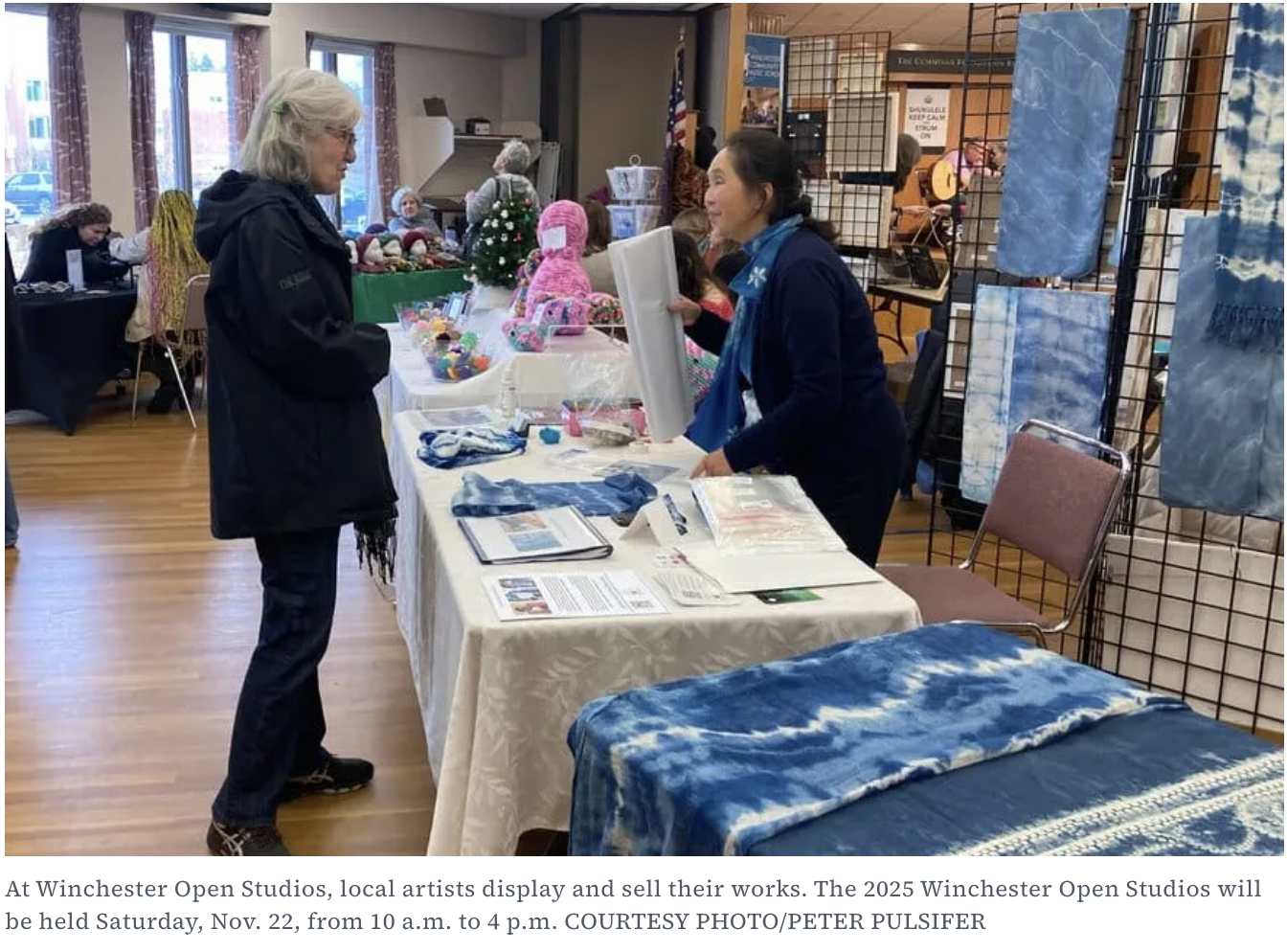
    For one fall weekend each year, Winchester becomes a canvas. Local artists open their doors to the public for Winchester Open Studios, transforming churches, markets and studios into creative spaces that celebrate community and connection.

    Now in its third year, the event – on Nov. 22, from 10 a.m. to 4 p.m. – is organized by groups across the town, including Arts Winchester, Winchester Farmers Market, First Congregational Church, Studio on the Common, Griffin Museum of Photography, Unitarian Society, Winchester Artists Network and the Winchester Cultural Council. The council is the event sponsor.

     This year multiple home studios have also opened their doors to the public.

    “It’s a really nice community event,” said Tracy Burhans, an artist and curator at the First Congregational Church. “It’s really nice for the artists and the craftspeople to interact with people from Winchester and from towns surrounding Winchester.”

    Planning for the event begins immediately after the previous year’s Open Studios concludes. Committee members, all volunteers, collaborate closely over several months to ensure the event runs smoothly.

    “We’re all just volunteering to coordinate this together,” said Jean Wallace, director of art education at Studio on the Common.

    Winchester artists show their works at different venues throughout Winchester during Open Studios. COURTESY PHOTO/PETER PULSIFER

    Their efforts include recruiting artists, organizing venues, marketing the event and supporting participating artists with a Zoom workshop on preparing displays, creating business cards and presenting their work effectively.

    “One of the things that we noticed last year was that sometimes it’s hard for artists to know how to get themselves prepared for this event,” Wallace said.

    Wallace said the biggest challenge the team faced was getting people to realize there are artists all around town. The team worked together and will give out maps to the visitors.

    “We printed those out last year, and we’ll do that again, but we’re also putting it online so that folks will be able to have access online,” Wallace said.

    Members utilize individual strengths in marketing, design and logistics to coordinate maps, lawn signs, flyers and online resources to help visitors navigate the multiple studio locations.

    That spirit of collaboration, said Arts Winchester President Hilda Wong-Doo, is what defines the event’s success.

    “When we started planning for the second year, Fred [Yen] said, ‘We want it to be bigger — more artists, even from outside Winchester,’” Wong-Doo said. “This year we’ve filled every location to capacity, even after a few artists had to cancel. That’s very exciting.”

    At the church’s Ripley Chapel, Burhans curates an exhibit featuring both professional and emerging artists, including those who rent studio spaces within the building. She’s expanded the lineup this year to include artists from across town.

    Burhans plans to hang the show by Nov. 17 and collect all the materials from the artist by Nov. 21. She will then print sheets for people to walk around the church with, showing which items are for sale and their prices.

    “I’m very sensitive to the fact that [Ripley] was a worship space,” she said. “​​I just want to be really sensitive, to keep some of that buying and selling separate as much as possible, and to really have it be a time of fellowship and people being able to take in what they see, and to not have it be solely commerce.”

    The church takes no proceeds on artwork sold during the event, something Burhans calls “pretty incredible.”

    Across town, the Winchester Farmers Market Community Hub at the Jenks Center provides another anchor location. The farmers’ market has featured different artists each week throughout the summer and fall.

    “I just felt like it would be nice to center this last market around the theme of the artists, and have all of the artists be part of that,”  said Fred Yen, executive director of Winchester Farmers Market Community Hub.

    From food to artworks to clothes, Winchester Open Studios has something for everyone in the community. COURTESY PHOTO/PETER PULSIFER

    The Jenks Center combines the market with an art exhibit — “half farmers market, half gallery,” Yen said — with painters, potters, and photographers sharing space with bakers and farmers, accompanied by live local music.

    For Wallace, Open Studios highlights the work of teaching artists at her Studios on Common.

    “On Open Studios day, we close regular operations and open the space to artists who teach or sell here,” Wallace said. “It’s not just a sale — it’s a chance for artists to meet the community.”

    This year, Studio on the Common will showcase pottery, paintings, and jewelry by instructors including Bel Cauley, Rocky Prull, Adeline Cota and Wendy Jo New, alongside Wallace’s own art.

    “This is a family-friendly event,” she added. “We want to meet the community and let them know what we do here and who we are as artists and individuals as well as teachers.”

    Aayushi Datta is a journalism student at Boston University. This story is part of a partnership between Winchester News and the Boston University Department of Journalism.

  • Winchester community steps up as SNAP benefits freeze

    The Farmers Market runs Anna’s Fund, which began as a SNAP-matching program but now operates independently. COURTESY PHOTO/WINCHESTER FARMERS MARKET

    Winchester’s food pantries, farmers market and volunteers have launched a coordinated effort to ensure that low-income residents have access to food amid the federal government shutdown.

    The Trump administration said it was suspending Supplemental Nutrition Assistance Program (SNAP) benefits as the shutdown extended into November. Last week, however, two federal judges ruled that the government cannot cut off SNAP benefits, which more than 40 million Americans use to buy food.

    President Trump then said the government would partially fund benefits, but a federal judge Thursday ordered the government to fully fund them.

    It is unclear when that would happen, and the Trump administration has appealed the ruling to the U.S. Supreme Court. Individuals and families that rely on these benefits have not had their SNAP cards refilled with funds this month as of Nov. 7.

    “For low-income residents and families, [SNAP] is a large percentage of their food budget,” said Fred Yen, executive director of the Winchester Farmers Market Community Hub.

    Winchester Farmers Market offers tokens for those using Anna’s Fund. COURTESY PHOTO/WINCHESTER FARMERS MARKET

    Winchester’s response builds on years of grassroots work. The Farmers Market runs Anna’s Fund, which began as a SNAP-matching program but now operates independently.

    “Now we distribute $15 in tokens each time somebody comes from Winchester and Woburn,” Yen said. “They don’t have to prove income. They just say they need it, and they’re given tokens to spend at the farmers market for fruits and vegetables and anything that you can spend on through SNAP.”

    After the shutdown began Oct. 1, the market expanded its focus. Yen helped launch a community database compiling all local food security efforts, from pantries to nonprofits to church drives.

    “We’re finding out that there are these efforts that nobody knew about,” he said. “There’s a lot of people who would like to help, but they just aren’t as informed.”

    Help us get matching funds during NewsMatch. Donate today!

    That growing database, shared with the town manager’s office and area nonprofits, lists organizations like the En Ka Pantry, the Woburn Council of Social Concern, and St. Vincent de Paul Food Pantry, alongside state-level links such as Project Bread and the Greater Boston Food Bank. It also identifies local drop-off sites and community meals, aiming to become a one-stop guide for both getting and giving help.

    “It’s still a work in progress,” Yen said, “but it already makes a difference.”

    At En Ka Pantry, co-chair Linda Azzara said the number of families seeking help has started to rise. Four or five households have approached the pantry in the last month, she said, and En Ka will also add more appointments to accommodate more families.

    “Typically, our normal inquiry is about two to three households a month,” she said.

    Even with growing demand, Azzara said Winchester’s generosity has been overwhelming. Individuals, community organizations and school clubs have reached out to En Ka offering donations.

    “The outpouring from the community has been tremendous,” she said. “They’ve been asking how they can help, whether that’s monetary donations, whether that’s products or food donations. It’s across the board.”

    En Ka is seeing a rise in families looking for assistance at its food pantry. WINCHESTER NEWS STAFF PHOTO/NELL ESCOBAR COAKLEY

    In neighboring Woburn, the Council of Social Concern — serving both Woburn and Winchester — has seen a 10% increase in clients.

    “We serve about 250 families every month,” said Paula Matthews, the council’s food pantry director. “So probably maybe 25 additional new families are starting to come because of [the] SNAP situation.”

    The council receives food from the Greater Boston Food Bank, local donors and drives. It also has an Amazon wish list where people can place orders.

    “We just had a postal food drive, and we received 24,000 pounds of food,” Matthews said. “The orders that have come in from Amazon are unbelievable. The poor guy will pull up, and he’ll say, ‘I have 40 boxes for you today.’ I’m like, ‘oh gosh,’ but we’re grateful for it.”

    To accommodate more people, the pantry has added appointments and offers emergency boxes for families who can’t wait for their scheduled visits.

    Aayushi Datta is a journalism student at Boston University. This story is part of a partnership between the Winchester News and the Boston University Department of Journalism.

    This article was originally published on November 7.