Author: Amil Coutinho Amado

  • From a house on wheels to Harvard Avenue: Vivant Vintage will relocate this June

    From a house on wheels to Harvard Avenue: Vivant Vintage will relocate this June

    Vivant is a French word used to describe something or someone that is lively, animated, or full of energy. Founders of the curated thrift store Vivant Vintage Justin Pomerleau and his wife Emmy Sawich chose this word to name their store to encapsulate the idea of “bringing life back into things that have once had a good life” when they first opened it in 2014. That store will soon have a much bigger space as it moves to a new location this June. 

    After selling pants via a house on wheels he pulled on a tricycle and working as a resident vendor at the SoWa Vintage Market, Pomeraleau decided to move his wares to the store’s current physical location on Allston’s Lincoln Street in 2014. 

    “I kind of saw the writing on the wall that I wanted to get out of there,” he said. “I lived around the corner from the Allston store and was just keeping an eye on this corner.” 

    Pomerleau has since secured a new spot on 151 Harvard Avenue that will have its grand opening on June 27. While the first location was chosen for the sake of convenience, the new space will be large enough to accommodate the secondhand clothing he currently stores in a warehouse in Brighton, a sales floor, and extra space for what he calls a “bargain basement.”

    “It’s kind of serving a very unique purpose, where Newbury Street’s the high volume boutique, where you’ll find the freshest, most on-trend clothing. Then Allston will have our clearance stuff, and will have a larger variety of every type of category.”

    With the new relocation to Harvard Avenue, he hopes the increase in space can serve as a way to bring people together outside of solely buying clothing. 

    “We could both host our own events, but we could also offer space rental,” he said. “I’m really hoping that we could do a film festival, we could do a market, we could do an art show, it opens up a lot of possibilities.”

    Pomerleau said his vision for Vivant Vintage initially started out as an art project. It later dawned on him that investing in this store could help him achieve his dream of being self-employed. 

    “I quickly realized that I had a good knack for it, the buying, for the selling, and really got a lot of satisfaction out of it,” he said. 

    There have been some challenges for the couple with expanding like increasing and sourcing their inventory, taking proper care of their growing staff, all while managing their personal lives. “It all changes as you grow,” he said.

    Having to balance taking care of a newborn with expanding the size of their brand and workforce, Pomerleau described 2025 as one of the hardest years of his life. 

    “Me and my wife are supporting, like, 20 people. Not everyone’s full time, but if somebody’s full time, their livelihood, their well being, it depends on me,” he said.  “Those were the kind of things that made me the proudest and also were sometimes the most challenging with staffing.”

    While Pomerleau finds there are some challenges with staffing, he has created a welcoming and caring environment for his employees.

    Zoe Hopper, the full-time manager of Vivant Vintage in Allston, finds the job fulfilling because people from various backgrounds are able to come together and connect over vintage clothes. 

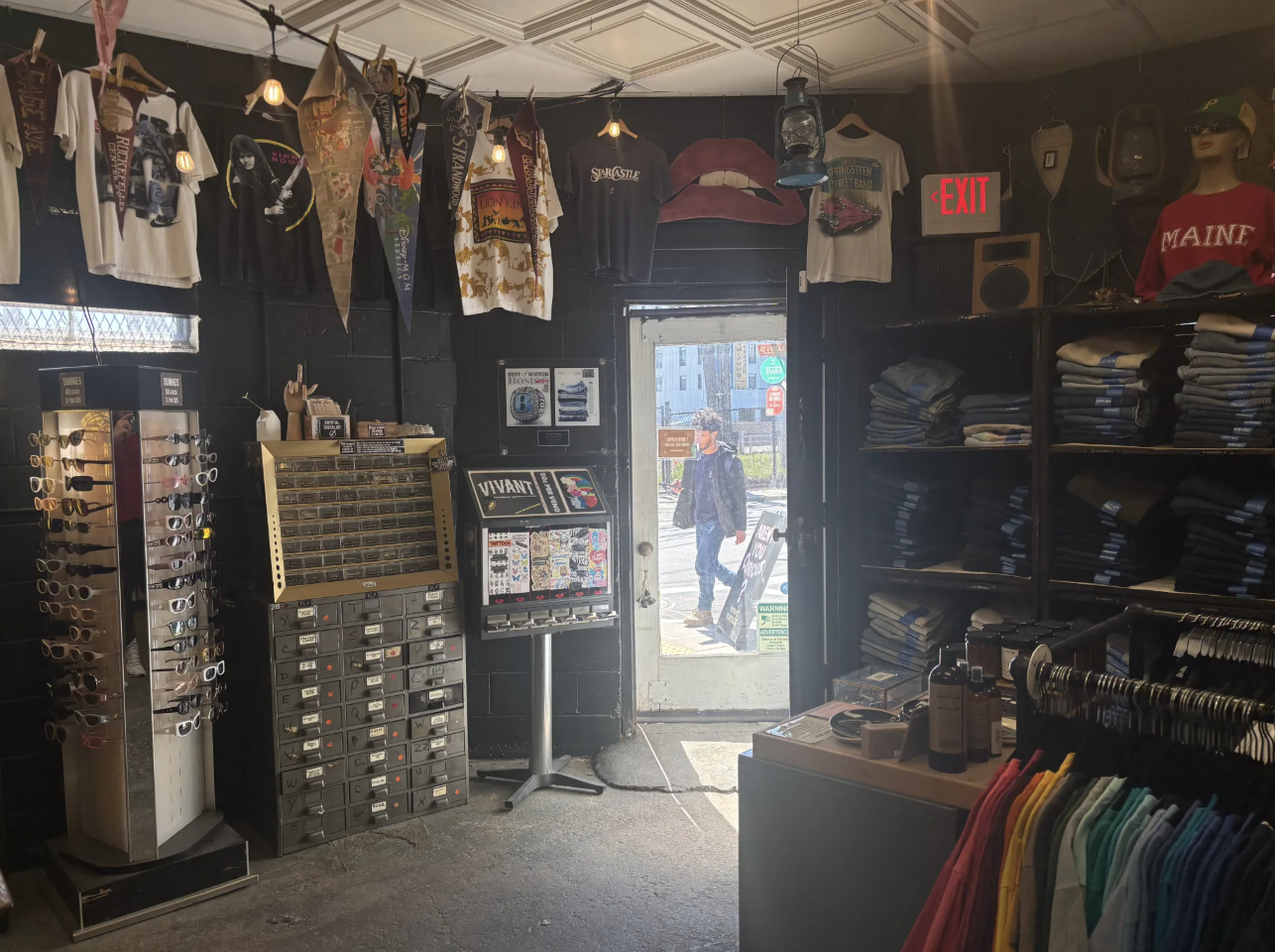
    Vivant Vintage’s interior on Lincoln Street. By Amil Coutinho Amado.

    “People seek it out, and they seek out the experience that comes with the name of it. So the fact that people come here looking for something, and I can act like a tour guide to them through the experience of the store, is really fun,” they said.

    Hopper also described the role of the manager as more fun than it is work. They said their role is to act as a “vibe curator,” which helped with the creation of a close-knit community of patrons to Vivant. “It’s not a transactional experience, especially if you love clothes.”

    Along with challenges that come with staffing, Pomerleau said sourcing secondhand clothing and silver for the jewelry, which Vivant makes and sells, has also been a challenge. 

    After being involved in the secondhand retail business for nearly 15 years, Pomerleau said has seen the rise, fall, and second rise of thrifting. 

    “It was super red hot during the pandemic. It got a lot more interest, and it’s kind of leveled out. It’s definitely worlds greater than it was pre-pandemic,” he said. “There are more people shopping vintage versus firsthand retail.”

    Boston Magazine named Vivant the “Best Vintage Shop” in 2023, which has cemented their place as a beloved destination for vintage aficionados, according to Vivant’s website. It’s very clear that Pomerleau and Sawich take pride in their work. 

    “I love what I do. I love clothes, jewelry, fashion, I love buying and selling things. I like being a part of the Boston business community, and there’s so few independently owned businesses out there, so I get a lot of satisfaction and it makes me feel really good to be able to do this.”

  • MBTA will suspend service, including between Kenmore and Boston College, in late April for infrastructure updates

    On April 7, the Massachusetts Bay Transit Authority (MBTA) announced it will suspend service on parts of the Green Line for infrastructure upgrades from April 22 to April 30. 

    The B branch will be closed between Kenmore and Boston College stops. The MBTA will offer free service on the 57 bus between Kenmore and Packard’s Corner between April 22 to April 24, and April 27 to April 30. Due to accessibility issues, shuttle buses on the B branch will not stop at Packard’s Corner, Griggs Street, or Allston Street, according to the MBTA website. During the weekend of April 25, Green Line shuttles will also replace service between Copley, Boston College, Brookline Hills, and St. Mary’s Street for more infrastructure upgrades. 

    According to a statement from MBTA’s Deputy Press Secretary Lisa Battison, the MBTA is planning to update train infrastructure, continue installing the Green Line Train Protection System (GLTPS). The MBTA official website says that the GLTPS “combines vehicle and wayside equipment to avoid train-on-train collisions, provide stop signal overrun protection, and incorporate speed enforcement for the Green Line.”

    In a statement written to Allstonia, Battison wrote that the MBTA’s upgrades during the closure will “build on the success” of the Track Improvement Program. 

    “This regular, planned renewal and revitalization work is ongoing and continuous, ensuring the long-term stability of our infrastructure and preserving the system for future generations of riders.”

    According to Battison, the infrastructure upgrades will also include the replacement of 130-year-old troughs near Kenmore station. Previously, the MBTA had closed train service for two weeks along a larger portion of the Green Line for similar trough replacement.

    These upgrades to the Green Line come in the wake of a newly proposed capital budget plan that will span 2027 to 2031, and aims to increase efforts to modernize the public transit system in Boston to build for the future, according to the MBTA’s Capital Investment Plan (CIP). 

    The CIP aims to upgrade “inaccessible above-ground Green Line stations” on the line, while also being able to increase service capacity. The CIP’s goal is to make sure that all stations on the Green Line’s B and C branches are fully accessible. 

    While the closure of the stops along the B line will be supplemented with free shuttle service and additional free service on the 57 bus, it will affect thousands of people who rely on the Green Line. 

    Liam Tuohey-Kay, a Boston University student, lives off campus and relies on the Green Line to commute to school and work. 

    “It adds at least another forty five to an hour of travel time per day,” he said. “We have six stops here on campus, and at least twice a year, all of those stops are unusable because of maintenance.”

    Aidan O’Kane, another BU student living off campus, found the closure inconvenient due to the fact that it is planned right before finals week at Boston University starts. While he has stopped using the Green Line to commute, he said that it is generally not helpful.

    “I kind of stopped taking the T earlier in the semester because it was just so inconsistent, so overcrowded, it was just making me late to class every day. It was too stressful,” he said. 

    O’Kane also feels that shutdowns occur on the Green Line too frequently. He says that he thinks the shutdowns don’t help much with improving the Green Line as a whole. 

    “I don’t understand what kind of public transport needs to be shut down four times a year,” he said. “Since I’ve been here, there’s been a lot of infrastructure things. They’ve shut it down a bunch of times, and I don’t think it’s got any better in any way.”

    Both O’Kane and Tuohey-Kay say that they were not aware of the closure until recently. While the MBTA announced the closure on their website, they did not make any other posts on their social media accounts like X or Instagram. 

    “I think they should do a way better job at communicating when things are going to be down, because it does affect a lot of people’s lives, including my own,” Tuohey-Kay said. “They do, quote, unquote, infrastructure updates every couple months, and the T is still, it’s always late.”

  • Allston activist proposes Arts Corridor to support local artists and businesses

    Tim McHale, a 71-one-year-old Allstonian and longtime housing activist, has proposed building an arts corridor in North Allston-Brighton to create a vibrant arts ecosystem while bringing economic opportunity and equitable development to Allston-Brighton. 

    “It’s a public realm that’ll kick butt,” he said. 

    Over the years, McHale said, he has watched North Allston-Brighton change as the artist community broadened geographically, moving away from Harvard Avenue. Three years ago, he arrived at the idea of an artist corridor spanning from Allston Yards to Harvard Avenue.

    “I believe a tsunami of arts and culture is going to land here. Public realm and arts and culture have to expand to balance this mega development,” he said. 

    The proposed corridor’s aim is to “position Allston-Brighton as a leading arts and culture hub in Boston,” according to a document and map submitted to the Boston Planning Department. McHale said the corridor is meant to serve two purposes as a public realm and an arts space where people can browse local art and patronize local businesses. 

    “That’s a healthy thing for a community to have a place to do that,” he said. 

    While planning to collaborate with city officials and artists in the area, McHale said one of the biggest hurdles he has experienced is getting financial support from developers that own the majority of the property in Allston-Brighton.

    “The big developer in our neighborhood is Harvard, and Harvard is a landowner of these sites that we’ve cobbled together. So it remains to be seen how open they will be to transfer these properties to us,” he said. 

    McHale said the biggest challenge is securing developer’s support because the arts corridor is not built yet, making it too early to request funding. He remains hopeful that developers will get on board once buildings and their uses are established. 

    McHale said he has also received positive support and feedback from Allston-Brighton residents and members of the Boston Planning Department. “My advocacy has moved the dial,” he said.

    “The planners at the BPDA and some of the folks at the Mayor’s Office of Arts and Culture are very interested in expanding the arts and culture in neighborhoods, and so this concept has resonated with them, and we’re talking about it, and they’re talking together about it.”

    Allston-based artists who can’t find affordable housing or locations in the neighborhood to showcase their work also are talking about the proposed corridor. 

    Nick Grieco, 37, a local musician and bartender, said he has seen Allston-based artists leave the neighborhood because they can’t afford the rent or find a local space to showcase their work. 

     “I have watched entire circles of friends hightail it to L.A, New York, Nashville, even Austin and Portland, when they were up and coming creative scenes,” he said. “When it comes to creating a neighborhood that is art focused, there’s so many stopping points that our elected officials haven’t taken to lay that groundwork.” 

    Grieco has noticed the overhead costs of being a musician skyrocket over the last decade, making it harder for artists in the area to develop their careers. “It basically means that anybody looking to grow as a musician in this city pretty much has to give up, unless you have a bunch of wealth.”

    Ricky Meinke, director of the Rat City Arts Festival, also has seen artists leave the neighborhood as the landscape for renting drastically changed. 

    “The structural landscape of the neighborhood is extremely challenging to artists,” he said. “Some of our gentrifying apartments will pretend that they have an artist space or a connection to artists, but it’s really piecemeal, and it’s not something to depend on and count on.” 

    While the Rat City Arts Festival is a grassroots operation, Meinke is concerned about potential cuts to city arts funding, in the wake of federal cuts to arts funding programs like the National Endowment for the Arts, hoping the proposed corridor will allow for more paid opportunities for artists in the future.

    “I think at the end of the day, artists want their art displayed, they want to perform, they also need to be paid, and they need to be valued financially. So, I just hope with any of our efforts, we’re thinking in that way,” he said.

    Grieco hopes that soon, the neighborhood will be more supportive and understanding of the corridor. He also hopes for more help from the city to make the proposed arts corridor a reality. 

    “In terms of affordability and density, anything that’s good for working artists is also good for families,” he said.  “I really hope that the city of Boston puts more of an effort into consciously supporting things like this, because Tim’s not going to get the support from developers.”

    McHale compared the prospect of an arts corridor in Allston to more popular mixed-use areas like Broadway in New York City or Burlington, Vermont. He said these spaces are important because they weave together “mega developments with mixed-use public realms.” 

    “It’s important that we balance it with a good public realm, a cohesive one, not a little spot here and a spot here. It’s up to us to make sure that we equalize that pressure on the quality of life, and so that’s what arts, culture, and a good public realm will do.”