Author: Dylan Shobe

  • Community pushes back against proposed Parker Hill Ave. projects

    Mission Hill locals are pushing back against two approved developments and one project currently under city review along Parker Hill Avenue. The residents say they are worried the additions would eliminate parking, clog traffic and alter the community demographic and dynamics with transient residents.

    “If it’s not [Northeastern University] students, it’s going to be Longwood Medical Area and short-term people,” said Richard Giordano, a Mission Hill resident who has community planning experience. “I understand there’s a need for [students] — the problem is that it doesn’t stabilize a neighborhood.”

    Savage Properties, a Boston development company, is creating each of the three developments at 11-11A, 36 and 85 Parker Hill Ave. The sites begin at the bottom of the street’s steep slope that allows one-sided street parking.

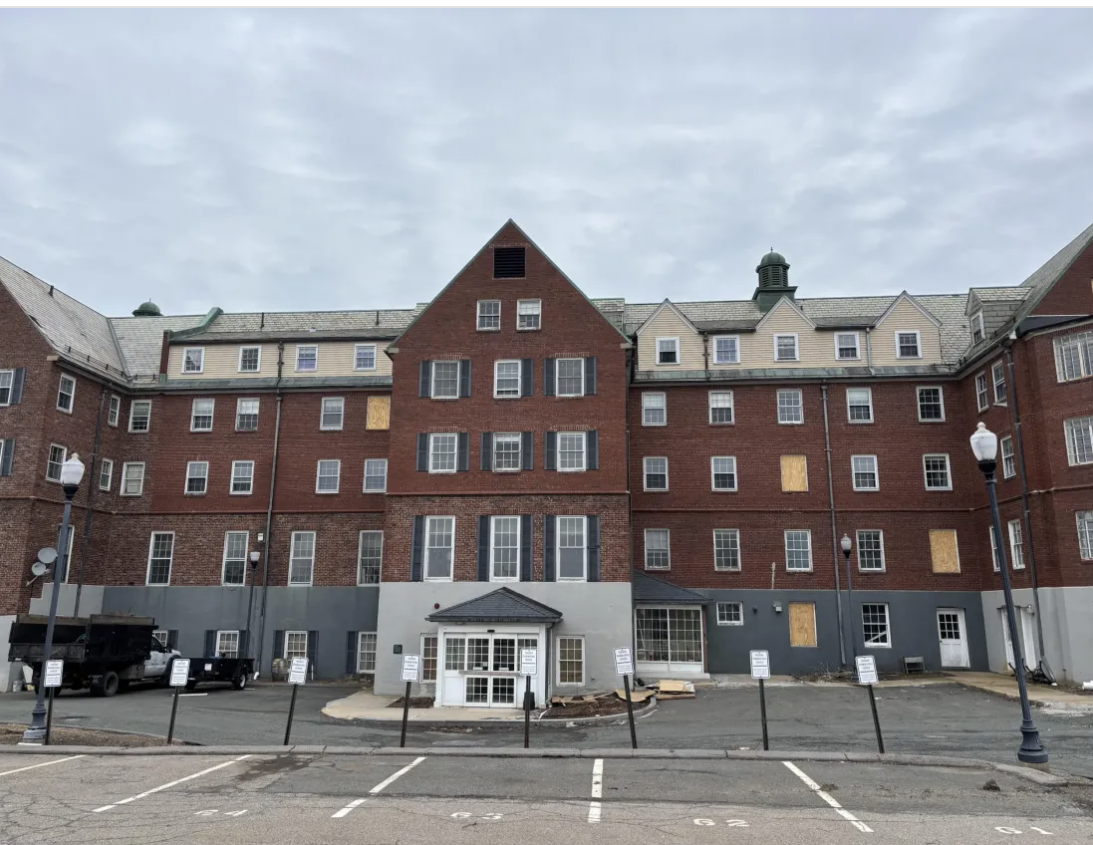
    Westside entrance of the current building under review and located at 85 Parker Hill Avenue. Dylan Shobe / Jamaica Plain Gazette Staff.

    The building at 85 Parker Hill Ave. first served as a home for New England Baptist Hospital nurses and, later, seniors before its eventual sale to Jason Savage last year, said Giordano.

    The three apartment buildings will total 223 units consisting of 112 studios, 70 one-bedrooms and 41 two-bedrooms. The site at 11-11A and 36 Parker Hill Ave. will cost $8 million and $9.5 million, respectively, according to the BPDA. 

    Giordano spoke out against the apartment unit mix of 11-11A at a zoning appeals meeting in late February. He contrasted the social dynamic that studio- and one-bedroom apartments create between different age groups in Mission Hill.

    “When you have a neighborhood where people are bringing up families, the stability that’s there is that everybody is looking out for each other,” Giordano said in an interview after the meeting. “That kind of thing just does not happen when you’ve got… 3,000 students living on Mission Hill.”

    Parking lot currently located where 36 Parker Hill Avenue will commence building. Dylan Shobe / Jamaica Plain Gazette Staff.

    Martin Beinborn, a resident and the president of the Community Alliance of Mission Hill, said that in his 15 years on Mission Hill, he has witnessed families and students fade into the distance as they fight against rising rent prices. 

    “They have to compete with investors,” said Beinborn.

    Absentee investors generate much more revenue renting to students than families, he added. 

    Beinborn said the alliance’s only leverage against displacement is to push back on intrusive development plans. He said the alliance has set two meetings with developers —  one to provide details and feedback about the plan; the other to present modifications and formally vote. The second meeting – on the site at 85 Parker Hill Ave. – has been postponed to April 15, per the developers’ request, said Beinborn. 

    Boston’s Planning and Development Agency must approve the project.

    The agency said it received differing requests for smaller (studio and one-bedroom) and larger (two-bedroom) units for the site at 11-11A Parker Hill Ave. Officials decided to add more two-bedroom units in addition to studios and one-bedroom apartments, according to an agency spokesperson.

    Giordano and Beinborn also expressed concerns over parking due to an expected influx of residents and students moving into the proposed apartment buildings. The 35 parking spaces proposed between the three buildings will put pressure on a street that already lacks the bandwidth for more parking, deliveries, and daily traffic, Beinborn said.

    Oftentimes development isn’t synchronized with traffic planning,” said Beinborn. “It would have made sense to look at it from a traffic standpoint first, but I think that hasn’t happened.”

    He said officials are exploring calm traffic on other narrow streets, such as Terrace Street, but that thus far it’s been more talk than action.

    Beinborn also said he has been hearing that the heavy student population – near the Orange Line tracks up on Fort Hill – has spilled into Mission Hill and is causing various problems. 

    Beinborn also pointed to the alliance’s now defunct “Problem Properties Task Force,” made up of university representatives, residents and campus police. That group used to analyze where police calls clustered to understand issues like disruptive and boisterous student parties. 

    Beinborn said the community worsened after the task force dissolved, but he is now hoping to open dialogue with residents from all ages to improve relations.

    “We need more talking to each other,” he said. “I’m sure there are quite a few people here who could take us around or give us the other perspective… and to find some compromise.”

    This story is part of a partnership between The Independent Newspaper Group and the Boston University Department of Journalism’s Newsroom program.

  • Some Residents Raise Concerns about Anti-drone Effort

    With millions expected to descend onto the World Cup this spring, some Boston residents voiced concerns about the implementation of anti-drone technology that might be deployed to monitor the games.

    They said they are suspicious about what would happen to the technology when the matches are over and who will have access to it, given preexisting surveillance devices in Boston.

    They also recall this month’s spectacle in El Paso, Texas, when US Customs and Border Protection agents used an anti-military laser to shoot down what they said were cartel-linked drones, only to discover they were party balloons.

    “We’re hungry for order, we’re hungry for structure and I’m hungry to hear what logistics will look like because we haven’t heard anything,” said Eryn-Ashlei Bailey, a member of the Jamaica Plain Neighborhood Council.

    The state announced last month that it received $21.2 million in grant funding from the federal government to cover safety measures, including additional personnel and methods to detect, destroy or disable malicious-drone activity at the World Cup. The investment will ensure state and local law enforcement agencies “are equipped to safeguard residents and visitors during events like the World Cup,’’ said public safety and security Secretary Gina Kwon in a press release.

    The grants include nearly $11 million for the Boston Police Department, nearly $4 million for the Foxborough Police Department and nearly $7 million for the Massachusetts Police Department.

    Funding comes from the federal Counter-Unmanned Aircraft Systems Grant Program, which is administered by the Federal Emergency Management Agency.

    “These grants will help state and local police agencies bolster security, training and equipment to keep residents and visitors safe throughout the games and surrounding celebrations,” Gov. Maura Healey said in a press release announcing the grants.

    The grants are part of a larger $500-million initiative that will be split over the 2026 and 2027 fiscal years, according to FEMA documents. The World Cup and America 250 celebrations will receive priority, with unallocated funds directed to next year.

    FIFA World Cup 2026™ will be staged across 16 host cities in the United States, Canada, and Mexico, and include 104 matches. It is expected to attract 5 million people.

    Boston will host seven matches this summer at Gillette Stadium in Foxborough, according to Boston Host Committee for the World Cup’s website.

    In addition, thousands are expected to descend onto Boston City Hall Plaza to celebrate the game in the heart of the city, and World Cup watch parties will be held throughout the neighborhoods.

    Authorities have said that as part of their World Cup planning, they aim to keep the public safe.

    Bailey said that she is concerned about counter-drone technology deployed in communities that face constant pressure from Immigration Customs and Enforcement agents. She said she also worries about overpolicing people in communities of color who are fearful of ICE.

    “People are afraid,’’ she said. “Then you’re bringing in this mass, powerful technology. The default would be, ‘We don’t want this technology. We want to protect our neighbors.’ ”

    She said she hopes authorities will hold public conversations in communities near the World Cup, including Boston, about how these safety measures would be used.

    David Chase Brewster III, another neighborhood council member, said while JP will be a distance away from the Boston World Cup matches, he is concerned about the increasing use of technology by people with bad intentions and by the government, which is supposed to protect the people.

    Drones are inexpensive, small and easy to hide, he said.

    “I see this being a concern of the Boston police,” said Brewster. “I would be happy if bad guys aren’t driving drones into my house.”

  • Sotheby’s Real Estate Office hostsJP Tiny Desk Concert series

    Local real estate agent Brian Fizer has turned Sotheby’s real estate office into an intimate concert venue on select Thursday nights in Jamaica Plain. Free to attend, the “JP Tiny Desk Concert Series” features Boston musicians with a side of charcuterie boards and the opportunity to bring your own booze. 

    “Every event people say ‘Oh, this is the highlight of my week…it’s so nice to see this space right in the middle of JP used this way,’ ” said Fizer in a recent interview. “It’s all been great feedback.”

    Located at 673 Centre St., Sotheby’s doubles as a hub for neighbors to unite over local music that Fizer said feeds off community camaraderie. Just behind its reception desk wall, Sotheby’s office adds itself to JP’s reserved scene of daily shows at Midway Café and weekly sessions at Brendan Behan Pub.  

    “Community is really important in JP, but let’s do something just to give back to the community,” said Fizer on his motivations to create the concert series. “It was just a way for us to reach out to people.”

    Fizer called on Carol Palmer and Andrew Brilliant — his coworkers on the Brilliant Places real estate team — to help form the series. Palmer and Brilliant’s experience helping throw JP First Thursdays helped bring Fizer’s idea to life. Tiny Desk will have its third session Feb. 12 featuring the Sado Domestics, a grassroots trio that will bring an upbeat, rock-driven sound. Fizer has noticed the crowd grow to upwards of 40 people, spanning from children to retirees. 

    “I remember thinking like there’s just not a lot of instances in our current society where you get to hang out across generations,” said Fizer. 

    The Sado-Domestics will be the first group to break from the jazz theme lineup. According to the band’s website, their “sound is an acoustic-leaning blend of folk, roots and rock.” The group will perform as a trio, with lead singers and guitarists Chris Gleason and Lucy Martinez joining Jimmy Ryan on the mandolin.

    Åsa Runefelt, a jazz vocalist and Berklee College of Music graduate, highlighted Fizer’s commitment to creating the “intimate” and “live” space the poster tagline advertises. She said she felt thankful not only for his generosity to open up the office, but to the venue’s ironically good acoustics.

    “It happens to be a really great venue,” said Runefelt. “He thinks about the lighting, there’s some art on the walls, the chairs are comfortable, but it’s close enough to the musicians.”

    Runefelt performed alongside Brian Freeman, accompanying her vocals on the piano as she sang from her debut album “Night Flower,” released in December. Runefelt said the crowd responded with heartfelt claps to her new releases, whereas Tiny Desk fulfilled her wish to find a sharable concert building. It was just last year she walked the streets of JP to find an office that could benefit from hosting events after store hours.

    “I thought ‘maybe there’s a possibility here for sharing a space, and then he just comes up with his idea,” she said. “It’s amazing.”

    As a performer Runefelt elaborated on the freedom jazz breeds to create an improvised sound experience, especially when live. She said that music has a power to bring people together who may be strangers due to its finite lifespan.

    “Making a painting, this painting hangs there, you can enjoy it forever, but for musicians, it’s just a fleeting moment of living,” said Runefelt.

    Gleason, the co-lead singer of the Sado-Domestics, praised the mutual benefit to the audience and artist. Gleason performs all around Greater Boston, with monthly concerts at the Square Root in Roslindale and at the Sanctuary Cultural Arts Center in Maynard. He said that now more than ever in-person events can positively impact people who otherwise would stay inside.

    “Music is therapeutic, but it’s good for the audience, too,” he said. “We all spend so much time on our devices or watching television.”

    Fizer also said Tiny Desk can inspire a digital detox for attendees in its third space. He deemed  Sotheby’s intimate setup as an unplugged experience where people can socialize with less digital interaction.

    “It’s just, ‘you’re here to enjoy music, right?” said Fizer. “You see people talking to each other, which is really cool and doesn’t always happen in an East Coast city.”

    But as far as an official goal for Tiny Desk, Fizer settles on community. 

    “Human connection, interaction, community — and what better way to do it than listening to music that perhaps is a genre you’ve never listened to,” he said. “We feel that’s kind of the anecdote to a lot of our problems.”