Author: Hazel Nystrom

  • ‘The need is huge’: Retired Brookline attorney fights to protect immigrant children amid changing legal system

    Jacob Walters started the most gratifying work of his life after he retired. 

    At 76, the former zoning attorney and longtime Brookline resident now spends his hours volunteering in local probate courts representing immigrant children as he seeks to secure them a legal protection called Special Immigration Juvenile Status (SIJS).

    It’s work that has gotten more challenging and complex as the Trump administration implements sweeping policy changes and harsh regulations amid an increasing push to crackdown on immigration. In the wake of the shooting of two National Guard members, the administration has rolled out a series of new measures  further restricting avenues to legally immigrate. 

    The SIJS status is granted to children who have been “abused, abandoned or neglected by a parent,” and can provide a pathway to a green card.

    Walters works as a volunteer attorney with Kids in Need of Defense (KIND ), a national nonprofit organization dedicated to ensuring that “no child appears in immigration court without high-level representation,” said Paola Gentile-Goldental, managing director of KIND’s Boston office.

    Walters was recently named KIND’s pro bono advocate of the year for the Boston area.

    Through his work, Walters typically seeks guardianship or custody to place a child with a relative living in the United States while proving the children have faced abuse, neglect or abandonment, and if returning to their country of origin is not in their best interest.

    “The need is huge,” Walters said. 

    Throughout this process, children often are forced to wait years for their immigration cases to be fully resolved, Walters and Gentile-Goldental said.

    “These kids are kind of left in a limbo right now,” Gentile-Goldental said. “While they have approved classification…they are not able to continue to the next step in their immigration journey.”

    In the past, those granted SIJS were automatically considered for deferred action, a classification that prevents deportation and provides eligibility for work authorization documents while waiting for visa approval.

    However, that policy was rescinded  in June by the U.S. Citizenship and Immigration Services, so some children remain in the U.S. without clear immigration status or protections.

    For Walters, the policy shift is adding a new level of uncertainty to an already challenging process.

    “We don’t know what’s going to happen down the road,” Walters said. 

    The children Walters represents often face devastating circumstances. In one case, Walters represented a child, now 15, whose mother died in childbirth and whose stepfather sexually abused her.

    When neighbors discovered what was happening, they hid the child and contacted a relative in Boston who arranged for her to come to the United States. 

    “There was literally no one for her to go back to,” Walters said. 

    While Walters was able to help the young girl, her younger brother, around 4 or 5 years old, remains in a dangerous situation.

    “The thing that I couldn’t do for her, which has kept me up nights — she had a little brother, and he was not being taken care of,” Walters said. “So it scares you can only do one thing at a time.”

    Outside of the courtroom, Walters said fear has been permeating all aspects of his clients and their family’s lives.

    “They have people who are hungry because they won’t go to the store, because they’re afraid they can’t leave their children,” Walters said. “Not only are these parents living in fear, but now the kids are in fear.”

    Walters said the anti-immigration political climate, fueled by the Trump administration’s immigration crackdown, is creating an environment of fear. “There’s just a terror campaign,” he said.

    KIND’s Boston office seeks to help counter that fear by providing free legal assistance and psychosocial support to unaccompanied children, Gentile Goldental said.

    In the Boston office, around 85% of cases are handled by pro bono attorneys. The rest are handled by in-house attorneys, funded through private and public sources, including grants and donations. In 2024, she said, 670 children were presented by a team of 565 volunteer lawyers.

    However, the organization faces funding instability. KIND had a contract with the Office of Refugee Resettlement and the Acacia Center for Justice, but in March the Trump administration cut the funding and issued a stop-work order.

    Eleven legal aid groups that were part of the contract sued the Trump administration, arguing that the government failed to comply with a 2008 anti-trafficking law requiring legal counsel for unaccompanied minors.

    A judge in April ordered the federal government to temporarily restore funding. The organization is now operating under a new contract that provides three-month funding extensions.

    “In the short term, these option periods make planning more difficult, since we just don’t know what’s going to happen, but we continue to do everything we can to support our clients,” said Megan McKenna, KIND’s senior director of communications and public engagement.

    While KIND tries to diversify its funding sources, Gentile-Goldental said misconceptions about why unaccompanied children immigrate to the U.S. remain widespread.

    “People always think that other immigrants come here to take their jobs, and this is not true for many unaccompanied minors,” she said. “They come here because they face terrible situations at home.”

    Walters and Gentile-Goldental said the public can help by offering time and resources. KIND needs volunteer attorneys and interpreters, and relies on donations.

    “If you can help them, donate,” Walters said. “If you have time, give it to them.”

    Despite the emotional toll of the work, Walters has no plans to stop volunteering with KIND.

     “It brings me to my knees sometimes, what some of these kids go through,” Walters said. “It makes me want to do whatever I can to help.”

    This story is part of a partnership between Brookline.News and the Boston University Department of Journalism.

  • Children’s bookstore Turtle Books comes out of its shell in Brookline Village

    Children’s bookstore Turtle Books comes out of its shell in Brookline Village

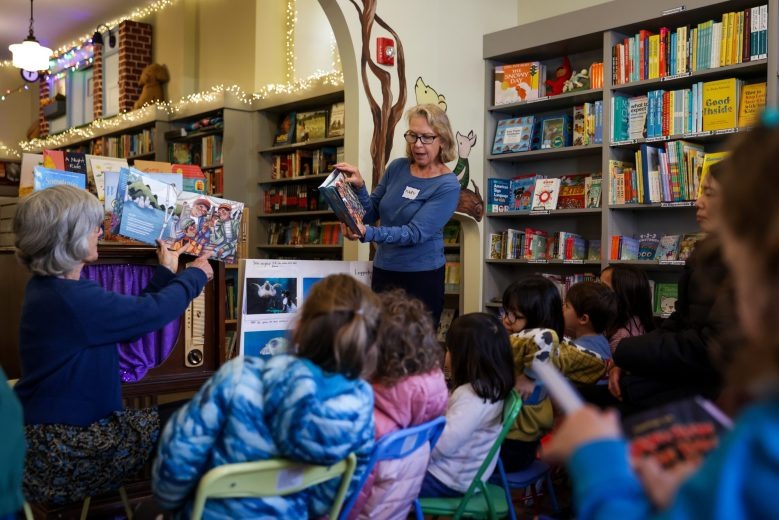
    Mary Wagley Copp, author of “Yoshi’s Big Swim,” reads her book to families during the opening of Turtle Books in Brookline Village on Nov. 15, 2025. Photo by Taylor Coester

    Illustrations from classics such as “Winnie the Pooh,” “The Snowy Day” and “The Dot” cover the arched mural above stacks of books.

    Standing beneath the mural was Bruce Jacobs, one half of the retired married couple who opened the new children’s bookstore Turtle Books in Brookline Village this weekend. Misty-eyed, he thanked the crowd.

    “It’s been amazing,” Bruce said at Saturday’s grand opening. “Thank you for all the support from the community.” 

    Bruce and his wife, Cathy Jacobs hope to make the store a community space for children and parents alike. They want the store to serve as a resource for families to help toddlers through young adults “form lifelong habits of reading,” Bruce said. 

    Turtle Books, at 224 Washington St., held author events, live music, book giveaways and a puppet show as part of its grand opening weekend, Nov. 15 and 16. 

    Co-owner Bruce Jacobs gets teary-eyed as he shares a few words of gratitude during the opening of Turtle Books in Brookline Village on Nov. 15, 2025. Photo by Taylor Coester

    Inside the store, the crowd buzzed. Children peeked curiously at a turtle in a tank before casting their votes for its name. Parents read aloud to kids perched on their knees. Shoppers browsed the shelves, reminiscing about old favorites and checking out new titles. 

    T-shirts with a turtle logo hung for sale. Printed on them is some “turtle wisdom,” the couple stumbled upon, Bruce said: “Be comfortable in your own shell. Travel at your own speed and keep moving forward.”

    The Jacobses credited the “brilliance” and creative hands that helped shape the store’s joyful interior. 

    Samantha Polinsky, 28, worked on the brick building facades that sit atop the store’s bookshelves. While working on the installation, she said passersby were “begging to come inside.”

    “It is so clearly something that people desire to have in their space,” Polinsky said. “The children are really excited about it. I haven’t seen one kid on a cellphone since being in here.”

    Sisters Margaux, 4, and Caroline Blood, 6, play with puppets during the opening of Turtle Books in Brookline Village on Nov. 15, 2025. Photo by Taylor Coester

    The Jacobses said they’ve noticed declining reading engagement among children. They hope to help children break the addictive habits of technology and encourage better reading habits. The store has a youth advisory board, where children can suggest titles to stock and take home Advanced Reader Copies of unpublished books. 

    “We wanted this to be a place where kids really had a voice and a presence and influence in terms of what books we provided,” Cathy said. 

    Sophia Day, 30, an adjunct professor and artist, painted the mural for Turtle Books, a project she called a “dream job.” She and her mother have been working on authoring their own children’s book over the past year. 

    As a teacher, Day emphasized the importance of spaces like children’s bookstores in building community. 

    “That love of reading needs to start so early, and having spaces like this where you can come in as a kid and really feel the magic and the care… is essential,” Day said. “It’s incredible what they are doing here.”

    State Sen. Cynthia Creem and State Rep. Tommy Vitolo attended the grand opening. Speaking to the crowd, both stressed the importance of community engagement and fighting book bans.

    “Book bans are not just attacks on literature,” Creem said. “They are attacks on our values, our free expression, our honest history, and the right for every young person to see themselves in the stories around them.”

    Creem read Kelly DiPucchio’s “Grace for President,” which tells the story of a young girl who runs for class president after learning the US has never had a female president. 

    For Lynn Johnson and Julia Gittleman, Turtle Books fills the void left by The Children’s Bookshop, which closed in 2022, just across the street.

    “We were so excited to hear they were starting the children’s book store,” Johnson said. “We had missed the old children’s bookstore.”

    The Children’s Bookshop and the Pierce School community were deeply intertwined, Gittleman said. The two organizations held a poetry contest that showcased children’s poems in the storefront. 

    The Jacobses hope to connect with local school systems to host events and provide summer reading books. Their advisory board includes a retired teacher from Pierce and a librarian from Lincoln School, they said.  

    “I think [the store’s] going to be really successful,” Gittleman said. “I have no question about that.” 

    One of Cathy’s favorite children’s books is Peter H. Reynolds’ “The Dot.” The Dedham author tells the story of a girl who, convinced she can’t draw, is encouraged by her art teacher to make a mark — a single dot that leads to a journey of discovery and exploration of creativity. 

    “In a way, this is like ‘The Dot,’” Cathy said. “It started with a little idea, and it can grow.”

  • As delivery apps boom, town still wrestling with safety and enforcement on the streets

    As delivery apps boom, town still wrestling with safety and enforcement on the streets

    By Hazel Nystrom

    Getting takeout has never been easier. But many Brookline residents say that convenience is increasingly posing a danger to pedestrians and bicyclists.

    Delivery apps like DoorDash, Uber Eats and Grubhub can bring your favorite restaurants to your doorstep. But some Brookline residents say delivery drivers on mopeds, electric bikes and electric scooters are driving recklessly to earn more income.

    A surge in higher-powered e-bikes has changed how cyclists, motor vehicles and pedestrians share the streets. Residents are unclear where mopeds and e-scooters, which many delivery drivers use and can reach up to 30 mph, belong in traffic.

    The Class 1 e-bikes found at Bluebike stations are pedal-assist only and shut off when riders reach 18 mph. Class 2 and 3 e-bikes are throttle-assisted, with maximum assisted speeds of 20 and 28 mph, respectively.

    Jonathan Klein, a town meeting member and longtime Brookline resident, said high-powered e-bikes shouldn’t share bike lanes with traditional cyclists.

    “I think we need to keep creating more segregated bike lanes with really clear signage about who’s allowed in them and who’s not,” Klein said. “Class 3 electric bikes that are really more like mopeds should be riding on the streets, not in bike lanes.”

    Mopeds are allowed in bike lanes and public ways under state law but are restricted from recreational paths. E-bikes are allowed everywhere traditional bikes are, except natural surface trails, which are determined by local jurisdictions, according to MassBike. 

    Delivery drivers “tend to be worse than other e-bikes,” Klein said. “They’re always on a schedule. They’re always in a hurry.” 

    Neil Wishinsky, who has lived in Brookline for 40 years and is a former Select Board member, shared that sentiment.

    “I’ve seen motorized scooters with license plates in bike lanes blowing through red lights, and that’s not right,” he said. Wishinsky said gas-powered motorbikes are “an abuse of bike lanes.”

    Samantha Ramirez, a spokesperson for DoorDash, wrote in a statement that the company seeks to ensure the safety of drivers and pedestrians, and “does not incentivize speeding.”

    “The overwhelming majority of Dashers do the right thing and like everyone else, follow the rules of the road,” she wrote.

    In Boston, a proposal from Mayor Michelle Wu that passed the City Council  earlier this year will require third-party delivery apps to get a permit, prove that their drivers have liability insurance and provide the city with delivery data. Brookline town leaders have said they are watching the program, which is designed to crackdown on unsafe driving, closely.While residents emphasized delivery drivers in their complaints, some called for safer driving practices from mopeds, e-scooters and e-bikes overall.  

    Chris Uminski, 35, lives in Jamaica Plain and said he often worries for his own safety when encountering delivery drivers on high-powered vehicles.

    “If I didn’t notice them, I don’t think they would notice me,” he said. “Every time [delivery drivers are] zipping through traffic, through traffic lights, doing U-turns in the middle of rush hour.”

    Jonathan Phillips, 33, member of the Pedestrian Advisory Committee, often cycles in Brookline. Phillips, along with Wishinsky and Klein, called for increased police presence and traffic enforcement, but he said he believes it should be targeted at cars.

    “I would like to see more of a police presence at some of the intersections that are particularly egregious,” Phillips said, referencing the intersection at Washington Street and Beacon Street as “the worst one,” he said.

    Traffic officer Kevin Sullivan said Brookline police have seen an increase in complaints about mopeds and scooters on the street. The police department launched a Micro-Mobility Education Initiative in September, with the intent to educate residents on the rules for different modes of transportation.

    Along with handing out informative flyers, Sullivan said police “started to have this campaign where officers on bikes will be assigned to certain intersections focused on making contact with violators, and in some cases even citing them.”

    Notable areas include Harvard Street and Beacon Street, Washington Street and Beacon Street and Brookline Village, Sullivan said.

    Jessica Chicco, chair of Brookline’s Immigrant Advancement Committee, expressed concerns about increased police presence on the street, however. 

    “We have to be really thoughtful about just jumping to kind of criminal enforcement, or increased traffic enforcement,” she said. “Criminal enforcement of traffic violations can lead to interactions with the criminal system, which for many people can have a disproportionate impact.”

    Chicco said that disproportionate impact is “certainly true for non-citizens, as we have seen with, I think now, the three ICE arrests that have happened in Brookline.” Brookline.News has since reported on a fourth ICE arrest

    Asked about concerns for ICE exposure, Sullivan reiterated BPD’s emphasis on education through the department’s new initiative.

    “I know people are concerned about that, but you know, that’s not what this is about,” he said. “This is about a safety initiative where we are trying to keep everyone safe.”

    Maxim Sheinin, a town meeting member, said Brookline residents should consider priorities for enforcement. Sheinin uses an e-bike to commute to work in Cambridge and drop his two kids off at school. 

    “If we want greater enforcement of traffic rules, what should be the priority?” he asked. “It’s definitely not obvious to me that priority should be on, you know, the E bikes and mopeds.”

    Emma Green, 22, a senior at Boston University living in Coolidge Corner, said while she often encounters delivery drivers, she worries more about how cars react to mopeds.

    “If they’re in my blind spot, and I don’t see them, it would take two seconds, and I could just kill them,” she said. “I am worried for their safety more so than my own.”

    Klein said he hopes the blame for unsafe driving practices isn’t being placed entirely on the individual drivers.

    “Because of the economic structure of their industry, they’re under huge amounts of pressure to save time, because that’s how they can make a decent living,” he said. “They’re not paid enough.”

    While some delivery apps offer an optional hourly pay option, delivery drivers from Uber Eats, DoorDash, and Grubhub are all primarily paid by delivery.

    Though many residents shared their concerns about unsafe practices from delivery drivers, they also largely spoke in favor of sharing the roads and expanding Brookline’s infrastructure to prioritize bikes and e-bikes.

    “I often feel like the conversation is trying to pit bicyclists and pedestrians against mopeds and E-bikes, when the reality is that we can have multimodal transportation,” Phillips said. “But we can’t just let the cars be king.”

    This article is part of a partnership between Brookline.News and the Boston University Department of Journalism.

    Correction: A previous version of this article mischaracterized comments by resident Jonathan Phillips. The article has been updated.

    This article was originally published on November 5, 2025.

  • Coolidge Corner Theatre dives deep with ‘A Life Illuminated’ for GlobeDocs opening night

    By Hazel Nystrom

    A stark blue hue illuminated a crowd of faces as the lights dimmed in Theatre 1 at Coolidge Corner Theatre.

    On the screen, waves crashed over a submersible bobbing on the ocean surface, ready to descend 3,000 feet. 

    For the next 90 minutes, “A Life Illuminated” unveiled the story of the trailblazing marine biologist Edith Widder, in her lifelong journey to understand the language of light found in the depths of the sea: bioluminescence. 

    “A Life Illuminated,” directed by Tasha Van Zandt, opened the 11th year of the GlobeDocs Film Festival  Wednesday night. Thirty films will screen through Sunday around Greater Boston and online as part of the festival hosted by Boston Globe Media.

    After Wednesday’s screening, Widder, Van Zandt, producer and cinematographer Sebastian Zeck, and Boston Globe Media’s CEO and co-owner, Linda Henry, stuck around to discuss the film and answer audience questions. 

    Widder, 74, who grew up in Arlington and graduated from Tufts University in 1973, first took to the deep sea in a diving suit called the WASP. In her first open ocean dive, Widder turned off the lights and was met with an explosion of bioluminescence akin to a Fourth of July fireworks display, she said. 

    “I was 800 feet down, turned out the lights, and I was just surrounded by this most astonishing light show you could ever imagine,” she said. “It was just breathtaking.”

    This bioluminescent display, known as the flashback phenomenon, has since led her research. “A Life Illuminated” explores Widder’s goal to film the phenomenon in the deep sea.

    Van Zandt said she chose the topic of the film after her first conversation with Widder.  

    “I learned all about the rest of her life and her journey, and learned about this language of light in our oceans,” Van Zandt said. “And I realized that she is the story.”

    Filming 3,000 feet below the surface was no easy feat, Zeck said. The process required Van Zandt and Zeck to travel in a second submersible alongside Widder’s, dedicated solely to filming.

    Systems engineer Sean Hogarty, 54, attended the screening to better understand the technology behind filming bioluminescence.

    “I just found it really motivating as an engineer, to see people understand what comes out of the years and years and years of investment and time,” Hogarty said. 

    For Van Zandt’s mother, Milena Gross, her daughter’s journey to the deep sea sparked a mix of nerves and excitement. 

    “I told Tash, ‘You got this,’ and as nervous as I was, I was also so very excited about this incredible film that she’s making,” Gross said. 

    After her fourth viewing, Gross’s favorite part is “more of a feeling,” she said. “It’s walking away thinking everything is possible.”

    UMass Boston students and friends Dee Brooks, Ora Kerr and Emma Van Zandt, Tasha’s sister, felt a similar sense of inspiration after watching the film. 

    “I really appreciated going through her younger years,” said Brooks, 21.. “It was really inspiring to see her kind of grow into the person that she is right now.”

    Widder’s excitement and love for discovery were “infectious,” Kerr said. “This was incredible. I was blown away.”

    For Emma, the experience was “super exciting,” having watched Tasha’s work take shape. 

    “I am so proud of her,” Emma said. “I think that it’s been a weird, wonderful journey watching her get to be able to do this.”

    Up next for Van Zandt and Zeck is an impact campaign they are launching alongside the Ocean Research & Conservation Association  (ORCA), Widder’s nonprofit organization dedicated to protecting and restoring aquatic ecosystems. 

    Widder hopes that after watching the film, people are inspired to bring back their sense of exploration, to “give them a sense of empowerment,” she said. 

    “I’d like the largest takeaway to be people tapping into the need for us to explore our own planet,” Widder said. “That sense of who we are as explorers. That is who we are.”

    This article is part of a partnership between Brookline.News and the Boston University Department of Journalism.

    This article was originally published on October 24, 2025.

  • 53 oil paintings in a Palestinian exhibit were lost in the 1940s. A new exhibit on display in Brookline reimagines what could have been.

    By Hazel Nystrom

    On November 29, 1947, Palestinian-Lebanese Maroun Tomb’s art exhibit opened in Haifa, a Palestinian city at the time. The exhibit featured 53 oil paintings lining the walls of a Maronite church.

    That same day, the United Nations adopted the Partition Plan of Palestine, which led to a series of events known as the Nakba, Arabic for “catastrophe,” in which 750,000 Palestinians were displaced from their homes.

    Among those displaced were Maroun Tomb and his family, who fled to Lebanon. The fate of the 53 paintings were lost in the ensuing years of chaos amid the Nakba and the 1948 Arab-Israeli war.

    Today, curators Rula Khoury, Haidi Motola, and Joëlle Tomb, Maroun’s granddaughter, are paying homage to the lost artworks in their traveling exhibition, “The Lost Paintings, A Prelude to Return.” 

    The exhibition, which features 53 artists from Palestine and the diaspora, is on view at the Brookline Arts Center and Unbound Visual Arts in Brighton through Dec. 17. A public reception and exhibition opening will take place Oct. 25 at Brookline Arts Center. 

    Curator and artist Joëlle Tomb hopes to “recreate, reimagine, reclaim this exhibition that was lost in history,” she said. Each of the 53 artists chose a title from Maroun’s 1947 exhibit as inspiration for their piece. 

    The exhibit features “various different mediums, sculptures, installations, video, art, which gives freedom to the artist to express in whatever medium,” said lead curator Khoury. Textiles, prints, paintings, sculptures and mixed media works fill the gallery. 

    Motola and Tomb found each other through a connection between their grandfathers, who were artists and friends in Haifa. 

    Motola’s grandfather Jacques Motola was born in Egypt but moved to Haifa in 1935, she said. He often discussed a group of artists that would meet in his home and paint together, telling stories of “art, friends and culture and memories of youth,” Motola said. 

    After her grandfather’s death, Motola’s “heart stopped” while looking through his storage boxes, she said. Among his belongings were a pencil and ink drawing by Maroun Tomb, the invitation to Tomb’s 1947 exhibit, and a letter — correspondence between her grandfather and Maroun Tomb. 

    “I realized that I have something very precious and I have something very rare,” she said.

    After connecting online, and developing plans for the exhibit, the two curators finally met in person on a beach in Cyprus. Motola gave Tomb the letter, something she thought was too valuable to share online.

    “Meeting Haidi was, like, super serendipitous,” Tomb said. “It almost felt like, oh my god, I have this mission now. I need to go through with this.”

    Tomb said working on this project has helped evolve her personal identity and journey. Much of her “understanding around Palestinian culture … was something that was erased from my upbringing,” she said. 

    Tomb hopes “The Lost Paintings” will “provide a platform for people to approach and understand the conflict and the history from the perspective of people, from artists.”

    “When you hear the stories of people, that cannot be changed,” Tomb said. “This is their story. Their story of being expelled. Their story of losing their home. Their story of having the inability to return.”

    When bringing the exhibit to the United States, the team faced many roadblocks navigating a complicated political climate, Tomb said. 

    “It being a Palestinian project as well, we were not necessarily received with arms open right away,” she said. Politics “made it challenging to get larger institutions to embrace us.”

    It was important for them to find partners who understood the project, and wanted to work with them, Tomb said. This led the curators to work with the Boston Palestine Film Festival, Brookline Arts Center and Unbound Visual Arts. 

    Motola faced emotional roadblocks throughout the process as well, and found it challenging to continue with the exhibit amid the Israeli-Hamas war in Gaza, she said.

    “The moment when the genocide started, it felt like pointless, in a way, to talk about something that is already like reaching the most extreme point of it,” she said. Feedback from artists who said it might be “more important than ever to keep talking about this,” helped Motola move forward, she said.

    Themes found in Palestinian art like landscape, richness of land, cactus, and olive trees permeate the exhibit, Khoury explained. Most of the artists “connect to the land of Palestine,” she said. 

    Among those artists is Dina Nazmi Khorchid, a Palestinian artist who works primarily with printed and woven textiles. 

    Khorchid was inspired by the title “Under the Oak Tree,” as she often connects with themes of nature in her work. Her abstract piece uses woven textiles in greens, yellows, and browns.

    Khorchid is interested in the stability of trees and the juxtaposition of their adapting and migrating reflection in water, she said. “I think that’s very much the experience of being someone who doesn’t have access to their homeland,” she said. 

    Khorchid was among the artists who personally connected with the themes of nature, displacement, and resilience found in “The Lost Paintings.”

    “We had a lot of artists that were connected with the story that their grandparents had to leave Haifa and had to leave villages and cities in Palestine,” Khoury said. “They were left with their stories. And in their artworks, they express the memories of their grandparents.”

    After its time in Brookline and Brighton, “The Lost Paintings” will continue to Belfast, Ireland; London and Bristol, England; with more cities to come. 

    This story is part of a partnership between Brookline.News and the Boston University Department of Journalism

    This article was originally published on October 24, 2025.

  • In new exhibit, local artist Michael Berger captures Brookline’s character

    By Hazel Nystrom

    Michael Berger remembers the moment well. It was 10 degrees in Coolidge Corner. A few stragglers stood shivering, waiting for the T. It hardly seemed like a good photo opportunity. 

    But as his eyelashes frosted over, the scene looked different to Berger. The light refracted, creating a blurry, impressionistic version of the moment. 

    Looking through his icy lashes, he snapped the photo as he envisioned the final piece. “That’s the image,” said Berger, an artist  and professor emeritus of chemistry at Simmons University. 

    Tucked into a small gallery in the Brookline Bank in Coolidge Corner, Berger’s latest work showcases sights dear to Brookline residents. Along the walls, the 13 pieces that make up “Visions of Brookline” capture glimpses of everyday scenes, somewhat obfuscated through fractals and haze.

    The exhibit is open through October as part of ArtsBrookline’s initiative to showcase local artists. ArtsBrookline is a nonprofit organization established in 2017, aiming to support artists and develop Brookline into a cultural district.

    As a Brookline resident of nearly 50 years, Berger, 81, takes inspiration from the places around him. Coolidge Corner, Village Square and Dane Park are among the familiar sights found in his work. Berger said his art serves not just to document a place but to capture a feeling.

    For Sasha Liang, 39, longtime Brookline resident and manager of Brookline Bank’s Coolidge Corner branch, Berger’s exhibit did just that. 

    Liang said the exhibit showed “how the various landscapes have changed in the 30, 40 years [he’s] been in the community.” 

    “It’s nice to see what [Brookline] used to look like,” Liang said. 

    Of the locations he photographs, Berger finds Brookline Village to be “the most evocative of another time,” Berger said. Many of his works open a window to Brookline’s past. 

    Berger uses photography and digital painting software in place of a traditional artist’s sketchbook, in an effort to evoke a “sense of place.” He then prints a giclée, a high-quality art print, on canvas and augments his piece with classical mediums — oils, watercolors, chalk pastels or acrylics. 

    The intersection of art, science and photography has always been at the epicenter of Berger’s work. During his 25-year career at Polaroid, he sought to capture both the sharp detail of traditional photography and the feeling of the moment. 

    To do so, he said, “you have to go off track. You kind of have to look at it squinting and look at it over your shoulder.” 

    Berger said he captured that feeling in his work, developing new types of film for Polaroid. This intersection of science and art has influenced his work since, including during his 19 years as a chemistry professor at Simmons. 

    “Science is very dynamic, and art is like that too,” Berger said. “I find that art and science kind of stimulate one another if they’re allowed to blend.” 

    Amy Browning Emmert, vice president of ArtsBrookline, wanted to feature the locally well-known artist. Throughout the installation of his exhibit, passersby stopped to observe the work and chat with Berger, she said. Everyone seemed to know him. 

    Browning Emmert said Berger’s work evokes the memories of the viewer, providing a sense of place and community. 

    “It’s sort of a way of distilling memories in a contemporary way,” she said. The images “make you think about your life, when you went through that place, or how you stood waiting for the T.”

    What many see as mundane, Berger can transform. Dynamism, connectivity, and movement drive his work, even in the most unsuspecting of places.

    “I love the T,” Berger said. “It connects. It flows, just like art and science. It has that dynamic.”

    As a founder of the Brookline GreenSpace Alliance, a nonprofit intended to support Brookline’s open spaces and greenery, Berger’s passion for environmentalism seeps into his art. He’s currently working on another series of images taken at the Arnold Arboretum. 

    Berger’s first exhibit was at the Arnold Arboretum in 1992. And he’s still going. When rain starts falling in sheets, or snow drifts slowly down, he’ll grab his camera and get to it. 

    “The rain, the darkness, the fog, cuts out a lot of the extra stuff,” he said. The image “becomes more like a poem, a visual poem, than a documentation.”

    This story is part of a partnership between Brookline.News and the Boston University Department of Journalism.

    This article was originally published on September 18, 2025.

  • ‘How can we fix this?’: Andy Katz-Mayfield on his journey to co-found Harry’s and his Brookline roots

    By Hazel Nystrom

    When Andy Katz-Mayfield was getting frustrated with the limited, expensive options for buying razor blades, he asked himself a question: 

    “How can we fix this?”

    So began the Brookline native’s path to becoming co-founder and co-CEO of the popular shaving company Harry’s and its parent company, Mammoth Brands. Harry’s is well known for its subscription service and direct-to-consumer business model.

    Even while living in California, Katz-Mayfield, 43, still connects with his Brookline roots. When visiting, he makes sure to stop in at Anna’s Taqueria, bring his kids to the John D. Runkle School playground, or catch a Boston sports game with his family.

    In 2013, Katz-Mayfield founded Harry’s with Jeff Raider, whom he met when they were interns at the consulting firm Bain & Company. Harry’s – the name is intended to evoke the feeling of a friend – has since taken off and served as a disruptive force in an otherwise dominated market.

    Judy Katz, Andy’s mother, said she has had confidence in his entrepreneurship throughout his endeavors. She said she always knew Andy would do something interesting. “He’s a real thinker,” she said. 

    Andy is the fourth of five close-knit children and has always had a “very strong sense of family,” Judy said. 

    A teacher’s mark

    Katz-Mayfield traces his thirst for knowledge and knack for problem-solving to his early life in Brookline.

    Among the teachers who “left lasting impressions” on Katz-Mayfield was his junior year AP U.S. History teacher, Deborah Quitt. 

    “[Mrs. Quitt], was similarly just instilled in this thirst for just like knowledge and understanding the world around you,” Katz-Mayfield said.

    Quitt started her 38-year career at Brookline High School in 1968 and retired in 2006. She remembers Katz-Mayfield as a “terrific student,” who “always worked hard, always prepared,” she said.

    When Katz-Mayfield decided to apply to Duke University, he turned to Quitt for a letter of recommendation. “I wrote thousands of college recommendations,” she said. “I think his was the only one that I wrote to Duke.”

    For Quitt, it’s “comforting” and “very rewarding” to have left an impression on Katz-Mayfield. 

    “And I think he was like a sponge,” she said. “He was ready and eager, and willing to learn.”

    Buying a 100-year-old razor factory

    After graduating from Brookline High in 2000, Katz-Mayfield studied public policy at Duke but was initially on the pre-medicine track. He was drawn to the health care sector by the idea of fixing a broken system and solving problems, intentions he carried through in his entrepreneurship.

    “There’s an industry that’s broken. There’s a customer experience that’s broken,” Katz-Mayfield said. Again, the question arose: “How do I fix it?”

    Nearly 10 months after Harry’s launch, Katz-Mayfield took on a daunting yet thrilling endeavor: buying a nearly 100-year-old razor factory in Germany. Limited options in shaving brands are partly due to the product being particularly challenging to manufacture, Katz-Mayfield explained. 

    “It’s sort of hard to innovate if you don’t really control the whole process and are vertically integrated,” he said. “So we did it.”

    While the purchase was “stressful and hard and certainly risky,” Katz-Mayfield said it was a “formative experience.”

    Despite any nerves that came with the purchase, the Katz-Mayfield family has remained steadfast in their trust in Andy and his endeavors, Judy said.

    “We really have a lot of faith in him,” she said.

    In the early days of the company, Katz-Mayfield learned on his network of support in his hometown.

    “I’m still very close to a lot of my friends from growing up in Brookline and from high school,” he said. “They were all early users from prototypes of the products and giving feedback, [to] kind of rooting me on.”

    Harry’s scope extends well beyond Brookline now — there’s even a running joke in the Katz-Mayfield family on Andy’s success. 

    “There’s nobody that my husband’s ever met on the street or seen anywhere who’s not familiar with Harry’s within three minutes,” Judy said with a laugh. 

    In 2018, Harry’s launched a women’s brand, Flamingo. Andy said Flamingo was created in response to women having similar frustrations with expensive products that weren’t suited to women’s needs. 

    It was important to stray from creating a “Harriet’s” or a “Sally’s” that was simply an extension of the brand, Katz-Mayfield said. Instead, they developed Flamingo with the intent to create a separate, distinct brand, with a team dedicated to serving women’s shaving needs. 

    Growing up in Brookline helped open Katz-Mayfield to a variety of ideas and perspectives, something he has brought with him to his work at Mammoth Brands, he said. 

    “Brookline was like a great community to grow up in, you know, in part because of the quality of the education, but also the diversity of ideas, of the population, the proximity to Boston, and all the sort of major cultures,” Katz-Mayfield said. 

    But his path to success hasn’t been without bumps in the road. 

    FTC throws up a roadblock

    After disrupting the market controlled by only a few giants, including Boston-based Gillette, Harry’s nearly united with one of them. In May 2019, Edgewell Personal Care, the parent of leading razor company Schick, announced it was acquiring Harry’s for $1.37 billion. 

    In February 2020, the Federal Trade Commission sued to block the acquisition, ultimately killing the deal. The lawsuit cited losing Harry’s as a competitor in the shaving industry would take away an essential disruptive force in the industry. 

    To buy a single razor from Gillette ranges from around $15 to $25, while Harry’s, as well as Schick, average around $10. 

    Reflecting on the tumultuous time, Andy’s mother touted his resilience. 

    “He had a tough year, and he doesn’t show it,” she said. “He really takes things in stride.”

    After being shut down by the FTC, Katz-Mayfield flipped the script. In 2021, Mammoth Brands acquired the deodorant brand Lume and in 2022 founded Mando, a brand focused on whole-body deodorant for men. 

    Mammoth Brands hopes to keep philanthropic work at the forefront. The company has donated over $20 million to nonprofit organizations. 

    A recent partnership that Katz-Mayfield is excited about is Flamingo’s Body Appreciation Program launched with The Girl Scouts, which seeks to help improve young women’s relationships with their bodies. 

    Andy’s 9-year-old daughter, Chloe, is a Girl Scout, with 6-year-old Isla likely to follow her. Through this partnership, Girl Scouts created six new Body Appreciation badges, distinct for different age groups, which Katz-Mayfield says his kids think is “very cool.” 

    Family and community are integral to Andy’s person, his mother said. When he returns to Brookline, Katz-Mayfield will meet up with his old high school friends and “Runkle Boys,” per Andy’s yearbook quote. 

    Andy hopes his children will grow up to be “Boston sports fans like me,” he said. When in town, he takes them to Red Sox, Bruins, or Celtics games “so that they can get indoctrinated into the culture.” 

    When Andy founded Harry’s, his mother said she and his father, Phil Mayfield, “were proud of him, and we were hoping that he also felt fulfilled,” throughout his career.

    Maybe next, “he could solve health care,” she quipped. 

    This story is part of a partnership between Brookline.News and the Boston University Department of Journalism.

    This article was originally published on October 18, 2025.