Author: Kate Brodkin

  • Meet the 11-year-old who made his own weather website

    Meet the 11-year-old who made his own weather website

    Meer Bhardwaj of Newton, 11, has created a weather forecasting website. Courtesy photo

    Meer Bhardwaj has always dreamed of becoming a meteorologist.

    Now, at 11 years old, the Newton boy has launched Nubo Weather, a website that averages forecasts from six sources. According to the website, Nubo “shows consensus data, source-by-source breakdowns, live radar, extreme weather alerts, and the latest weather news—all in one place.”

    “I’ve been interested in weather since I was 5 or 6,” Meer said.

    In December, Meer said, he began to plan out descriptions and content that he wanted to see on the website.

    “I came up with the idea because people spend a lot of time going from site to site to see the weather to get a reliable forecast, so I decided there should just be a site where there’s lots of forecasts within it,” he said.

    The website also features a section on “weather news,” which updates news articles that mention weather.

    Meer’s mother, Anuja, said that after her son began to gather all of the necessary information, they plugged the details into the artificial intelligence site Claude.AI and made the website a reality.

    “I think it was a learning experience for both of us—how easy it is to build things these days,” Anuja said.

    The website uses data from the National Weather Service, Open-Meteo, AccuWeather, Tomorrow.io, Visual Crossing and Weatherbit, and all data comes from public sources, Anuja said.

    Eric Fisher, chief meteorologist for CBS Boston’s WBZ-TV News, took note of Meer’s accomplishment. “It’s amazing the things you can do these days with [so] much data on the internet…” he said in an email to Meer. “Especially impressive in 5th grade!”

    Fisher said Meer’s approach to compile information from different sources is “probably a good baseline to reduce mean error for any given day.” But he also said it still may not be the best forecast because a good forecast will still never be right all the time.

    “I usually just tell people to find someone or something you like [or] trust and stick with it,” Fisher said.

    Although they used Claude to build the website, Anuja said Meer is still learning to code and is a beginner.

    “We want him to continue doing that to build those analytical skills and reasoning,” she said. Building the website, she added, was just a “weekend project.”

    Meer’s fifth-grade teacher at Countryside Elementary School, Rachel Greene, said he is diligent, responsible and always puts his best effort into everything.

    “He’s willing to challenge himself and try things that are harder than the basic things we’re learning in class,” Greene said.

    But she also said Meer doesn’t shy away from talking about his interests in the classroom. Greene knew Meer liked learning about weather because he would always talk about it in class, she said—especially when there were snowstorms.

    As a teacher, Greene uses a weather app every day to see what it will look like outside before she takes her students to recess.

    “I think it’s a great concept,” she said of Nubo Weather. “I don’t think I’ve ever had a student who has a really strong passion in a certain subject and goes out of their way outside of school to develop something this advanced.”

    Meer is already thinking about a future in meteorology. He said he has been looking at top schools to study the field and has come across programs in Colorado as a potential path forward.

    For now, Anuja said, her son will continue being the “weather nerd” in the family. “I think he was inspired by seeing his vision come to fruition.”

    ****

    This story is part of a partnership between the Newton Beacon and the Boston University Department of Journalism.

  • Brookline Village and Washington Square have plenty of parking, new studies say. So why can’t anyone find it?

    The intersection of Washington Street and Davis Avenue in Brookline Village. Photo by Svyatoslav Yushchyshyn

    Two new parking studies in Brookline Village and Washington Square revealed that both neighborhoods have more parking than most drivers realize — but that better pricing, shared access and clearer information are needed in order to make them more accessible.

    The studies were conducted by Stantec, the same engineering firm that carried out Brookline’s earlier Coolidge Corner parking study. Liza Cohen, a principal in Stantec’s urban mobility group and project manager for both studies, presented the findings at a March 18 Brookline Transportation Board meeting alongside senior principal Jason Schreiber and transportation planner Mitul Ostwal.

    In Brookline Village, the study found more than 3,000 parking spaces but noted that not all of them are open to the public. Some are restricted to residents, while others are designated for specific businesses.

    “What a lot of people experience is, they drive into the core of Brookline Village, they try to park right out front, and that is a challenge,” Cohen said. “What we’re looking to do is try to unlock those additional spaces to help ease that parking crunch.”

    The studies came about as part of the town’s plan for a major upcoming redesign of Washington Street, which was opposed by business owners because it removes many parking spaces along the route.

    In Brookline Village, peak parking demand falls around 9 a.m. and noon, while Washington Square “has more of a restaurant-hour skew to it,” Schreiber said in the meeting, “so parking is busier in the evening.”

    The central recommendation for both neighborhoods is demand-sensitive pricing, a system in which spaces closer to the “core” cost more and spaces further cost less. 

    “If the spots out front are the same price as the spots that are down and around the corner, you’re basically incentivizing people to always hunt for those out-front spots,” Cohen said.

    But Cohen was also careful to say this would not be an across-the-board price increase.

    “A nuance to what we’re proposing is we’re not necessarily saying, ‘The price needs to go up all over the place,’” she said. “We’re saying, ‘You need to create a system where some parking is priced higher than others.’”

    Other recommendations include active curb management, restructuring the commercial permit program and bicycle parking.

    Cohen said parking is confusing in both neighborhoods, which contributes to the perceived shortage of spaces.

    “Information in parking is huge, particularly in a place like Brookline Village that isn’t set up in a more simple parking system like a mall or an airport,” she said. “Streets are cranky, parking is down, and around the corner the regulations are different.”

    A consistent finding in the studies, Cohen said, was how everyone develops their own interpretation of the parking rules. Businesses may tell drivers to park in a specific lot, she said. Centralizing that information through clear signage and maps can make a significant difference for drivers.

    Stantec has begun working with the town to develop a public-friendly parking map for both neighborhoods.

    Aria Sonderling, who lives just outside Washington Square and parks there nearly every day, said she has to rent a spot from the owner of her building because her apartment has no driveway.

    “In an ideal situation, I would just be able to park right on the street next to my apartment,” she said in an interview.

    When she’s out driving, Sonderling said she tries to find side street parking rather than paying for a spot closer in and said she’d be open to a system where you can park outside of central areas for cheaper.

    Her biggest frustration, she said, is the overnight parking ban. 

    “I wish it was a lot more like Allston-Brighton, where you can get a resident sticker, because just my parking alone adds on a lot more to my rent,” Sonderling said.

    John Bowman, a Precinct 10 Town Meeting member who spent his career designing urban traffic forecasting systems, said the reports confirmed that the parking supply is not the main issue.

    “My main takeaway is that the parking studies showed that there’s plenty of parking space in those areas that needs to be managed better,” he said.

    But Bowman still wasn’t clear who would be responsible for moving the recommendations forward. 

    “My question springs from a concern that this could be a study that sits on a shelf and nothing happens,” he said.

    Cohen acknowledged that the implementation of the studies will require significant staff time and coordination across the departments, but said the town has already begun acting on some recommendations that may not yet be visible to the public.

    “So hopefully that means it won’t sit on a shelf and not be acted upon,” she said.

    Cohen also said that the report isn’t fully complete and the town will be providing the finalized version sometime this spring.

    To watch the meeting, click here .

    This story is part of a partnership between Brookline.News and the Boston University Department of Journalism.

  • Newton Energy Commission launches survey to understand barriers to home electrification

    Newton Energy Commission launches survey to understand barriers to home electrification

    Solar panels. Public domain photo

    The city of Newton aims to become carbon neutral by 2050, but reaching that goal will require transforming nearly 25,000 homes into fully electric households. And environmental advocates say it starts with something basic: knowing what’s actually inside people’s homes.

    To gain a better understanding of what’s being used in Newton homes, the Newton Energy Commission—in partnership with Green Newton, 350 Mass Newton, and Mother’s Out Front Newton—launched a survey aimed at single-family homeowners. 

    “There’s a lot of conversation at the policy level—both for the city and the state—about this subject, and a lot of it is quite honestly uninformed by what’s the current state,” said Jon Slote, a volunteer member of the Newton Energy Commission and a retired solar engineer. “We wanted to take an objective view and find that out.”

    Slote said the survey is designed to answer two fundamental questions: What heating sources and appliances are Newton residents using, and what is stopping them from switching to electric alternatives.

    Massachusetts has been working toward this kind of transformation for years. In 2008 the state passed the Global Warming Solutions Act and in 2021 updated the act to set a goal of cutting greenhouse gas emissions at least 57% below their 1990 levels by 2030. According to Massachusetts Clean Energy and Climate Metrics, residential fuel combustion remains one of the key factors the state must address in order to complete its climate goal.

    Judy Jacobs, executive director of Green Newton, said the survey is as much about fixing poor-quality data as it is about gathering new data. “Right now, the decisions are being made with incomplete or overly conservative data,” she said, “And in some cases those costs are being estimated much higher than the real cost.”

    For Jacobs, better data means better outcomes for residents. “We really want to get the data we need about costs and barriers and help that inform decisions so that it ultimately benefits Newton residents,” she said.

    That data could ultimately shape how residents heat, power and cook in their homes in the years ahead.

    “One of the things that’s pretty clear, when we think about carbon neutrality, is you need to reduce the emissions of greenhouse gases that are being produced by everything we do on a day-to-day basis,” Slote said. “All of us who live in homes in Newton, over time, we need to think about replacing gas and oil and propane uses with electricity.”

    The survey, which went live March 16, asks homeowners about their heating systems, hot water, cooking appliances, dryers and other energy uses. The survey is funded by a $3,000 microgrant from the Village Bank, which will help cover costs to mail surveys to Newton residents. 

    Additionally — to encourage participation — three respondents will be randomly selected to win free gift cards ranging from $50 to $250. Residents who complete the survey can also request a free consultation with one of the city’s volunteer energy consultants.

    For some Newton residents, the survey won’t be necessary. They’ve already decided to switch to all-electric products. 

    Rachel White has fully electrified her home after years of gradual changes. She began with her stove, then tackled heating and hot water in 2023 when her central air conditioning system was failing.

    “The motivation for doing that was that I really wanted to reduce exposure to the emissions associated with gas while cooking,” she said.

    White said one unexpected benefit was the quiet. “The air blows so smoothly and slowly from heat pump systems that they’re barely noticeable when they’re operational,” she said.

    She also acknowledges cost as a legitimate concern but says she breaks it into two categories—upfront costs and operating costs—and says the investment has been worth it. White said solar panels, which she installed alongside the heat pump system, have helped offset rising electricity costs. 

    “For folks who do have good solar exposure, the solar panels pair really, really nicely with an all-electric house,” she said.

    Debra Kriensky had a similar experience. Eight years ago, she and her family moved to a Newton home that ran mostly on oil —something she described as both expensive and frustratingly loud.

    “Even within our first year we were like, ‘We would love to do something about this and get off oil,’” she said. “Not just because of the environmental concerns, but also it was expensive and the prices kept changing.”

    Like White, Kriensky replaced appliances gradually throughout her time living in her home rather than doing it all at once. 

    Kriensky said she discovered heat pumps through a Green Newton webinar. “I’m grateful for organizations like Green Newton, for example, because if I hadn’t randomly come across one of their webinars on heat pumps, I don’t know that I would’ve even known about it as an option.”

    Her family has since gone fully electric and recently added solar panels to manage expensive electric bills.

    “Our home has been much more comfortable—everything’s been quieter,” Kriensky said. “I definitely think it was worth it.”

    Slote said he hopes the survey will help to inform further conversations about electrifying homes in Newton. “We’re very excited about the notion of trying to find some neighborhoods where people would like to collectively electrify and get off the gas system,” he said. “And we want to be a big support for that.”

    If you’re a single-family homeowner and are interested in filling out the survey, click here

    ****

    This story is part of a partnership between the Newton Beacon and the Boston University Department of Journalism.

  • New exhibit at Jackson Homestead highlights Newton’s diverse history

    After over six months of renovations, the Jackson Homestead and Museum has reopened with a new exhibit celebrating Newton’s multicultural history.

    The exhibit, “Newton: The City We Make,” reconstructed the entire first floor of the historic building as a space where visitors can not only learn about Newton’s history but envision themselves as a part of it.

    The Homestead, built by Timothy Jackson in 1809, remained in the family for about 140 years before a descendant, Frances Middendorf, donated it to the city of Newton in 1949. Shortly after being built, the Homestead became known as a station on the Underground Railroad, a history the museum continues to honor and preserve.

    The previous installation in the Homestead had been on the walls since the 1980s. While it told a story in its time, it was a narrow version of Newton’s past, one seen from a 19th century, white, affluent view, said Sara Lundberg, curator of Historic Newton, a partnership between the city and the Newton Historical Society that operates the homestead.

    “It very sorely needed to be replaced,” Lundberg said.

    An exhibit at the Jackson Homestead, “Newton: The City We Make,” shows how people have shaped Newton over centuries. Photo by Bryan McGonigle

    Lisa Dady, Historic Newton’s director, said she was more understanding of the old installation. “I don’t want to diss my predecessors, or even me, for the first few years because it did serve a purpose,” she said.

    The old exhibit consisted of foam board panels pinned to the wall, Dady said. For 40 years, the exhibit centered on a single era of Newton’s past—mostly following the history of white residents of Newton, Dady said. But she realized there was so much more to tell about Newton’s history.

    The new exhibit is centered on three themes: “On This Land,” which shows how the city’s physical landscape has changed over time; “Making Newton Home,” which highlights the communities and immigrants who have lived and worked in Newton; and “Creating Change,” which emphasizes moments when residents advocated to shape the city, and country, they wanted to live in. Each of the three galleries features artifacts, photographs and replicas from residents with historical backgrounds rooted in Newton.

    In “On This Land,” the gallery features an aerial image of the suburbanization of Newton, the Massachusetts Turnpike and the Black community that was decimated by its construction.

    The overarching idea of the exhibit, Dady said, “is that Newton is shaped by the decisions of individual people in response to an array of forces.”

    Rather than presenting the past as a continuum of events, the new gallery is there to emphasize the role of Newtonians and their decision-making. “The idea is that history doesn’t just happen to us,” Dady said. “It’s really the result of key moments of decision making and agency.”

    Lundberg said her hope for the exhibit is for visitors to leave feeling like participants of those decisions—people who can shape Newton’s future just as others shaped its past.

    Putting that vision into action meant being selective over curatorial choices. The exhibit doesn’t ignore any of the major themes in Newton’s history—it just approaches them through different stories, different objects and different people than the old exhibit did.

    “It wasn’t a trade-off,” Dady said. “It’s the same history. It’s the same time and place. It’s just selecting a different vantage point.”

    An exhibit at the Jackson Homestead, “Newton: The City We Make,” shows how people have shaped Newton over centuries. Photo by Bryan McGonigle

    The “Making Newton Home” gallery highlights the city’s various identities as a community built from people who immigrated to the city. The exhibit features one section called “suitcase stories,” which tells the story of five ethnic groups with deep roots in Newton. For this section, Lundberg said, artifacts and photographs were donated by community members, while she had to track down others through careful research.

    Lundberg and Dady, however, decided to leave three walls of the gallery unfinished. They plan to invite the community to help curate the remaining space with their own desires for what the space could be, a nod to the fact that the story of Newton is built upon its residents.

    Mayor Marc Laredo praised the exhibit in a press release, saying it “helps us see how those varied perspectives form a shared civic story of our city.”

    Throughout the exhibit, hands-on interactive elements, such as QR codes and puzzles, give visitors, 30% of whom come from outside Newton, ways to directly engage with the material, Dady said.

    “With museum exhibits, you don’t want to overwhelm the visitors with too much,” Lundberg said. “You want to entice them to learn more later on.”

    The museum is also committed to keeping the exhibit from going stale, Dady said.

    One gallery corner will rotate its content monthly, and the community curation model in the immigration part of the gallery is designed to evolve over time. “We’re really trying to have it be more dynamic and not done and then there for 40 years,” Dady said.

    “We hope—we think—that when people are here looking at the exhibit, they see themselves on that continuum of agency of someone that can shape Newton in the future,” Dady said.

    ****

    This story is part of a partnership between the Newton Beacon and the Boston University Department of Journalism.

  • Newton Community Education rebounds, finding financial footing after years of uncertainty

    Newton Community Education rebounds, finding financial footing after years of uncertainty

    Newton Community Education is reporting a significant rebound in revenue this fiscal year, following years of financial turbulence.

    But its financial improvement has come at a cost.

    Founded in 1991 as a self-sustaining arm of Newton Public Schools, the nonprofit NCE offers hundreds of classes and programs each year, including woodworking, yoga and beekeeping classes.

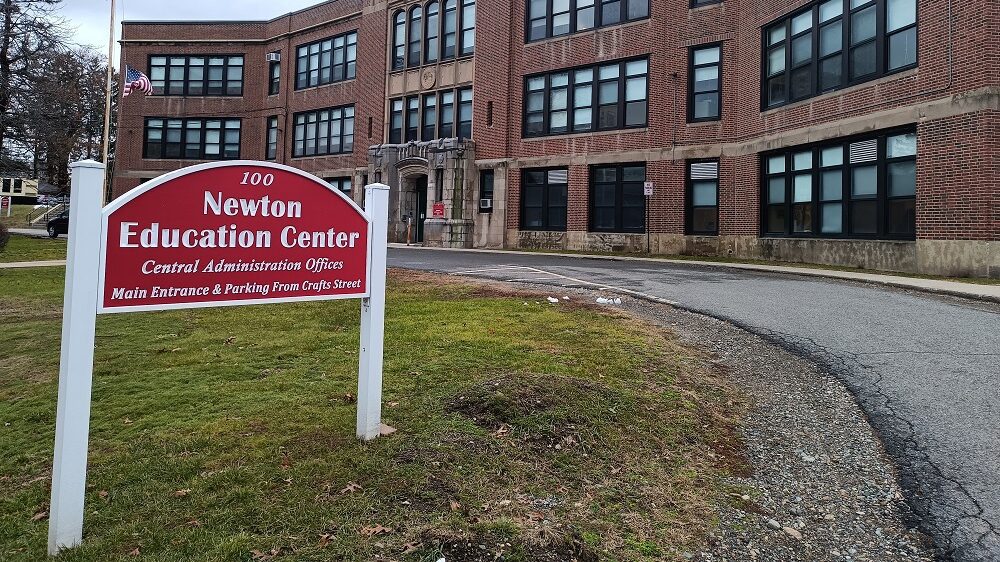
    The Newton Education Center. Photo by Dan Atkinson

    In recent years, after COVID-19 decimated enrollment, rising costs caught up with the organization. NCE had to pay employee benefits and pension costs in addition to pitching in for custodial services, creating a deficit of more than $300,000, the Beacon reported in 2024.

    “The reason why we’re in a better position at this time this year, compared to last year, is because we have made significant cuts to our staff,” said Kate Carpenter Bernier, NCE’s executive director. NCE eliminated its director of finance and administration and cut 1.2 office positions, Carpenter Bernier said.

    For now, NCE is relying on a part-time bookkeeper and two volunteers—one of whom is an NCE commission member—to fill the gap.

    “Those community volunteers are providing a lot of expertise and assistance, and financial analysis, projections and budgeting,” Carpenter Bernier said. She also acknowledged, however, that the arrangement isn’t meant to be permanent.

    Restoring staff would reduce the projected profit that NCE has worked hard to rebuild. “That’s the catch-22,” Carpenter Bernier said.

    Claire Wadlington, a member of the Newton Community Education commission, said cutting staff was necessary in order for NCE to break even. “There weren’t very many options for what to cut,” she said.

    Wadlington also pointed out that NCE’s fiscal year follows an unusual cycle. Its lowest revenue period, which is the fall, is its highest expense period—driven by a roughly $160,000 pension bill and the cost of summer camp labor, Carpenter Bernier wrote in a memo to the school committee.

    Wadlington said the timing is key to understanding NCE’s financial health.

    By the end of this fiscal year, NCE projects a surplus of roughly $107,000, according to Carpenter Bernier’s memo. NCE’s annual budget is $1.9 million.

    Last year NCE conducted focus groups to see what parents wanted from after-school programming. Based on that feedback, the group retooled its afternoon clubs to be longer and also to run for a whole semester. The result is fewer individual enrollments, but each one was worth significantly more in revenue.

    Adult programming also surged almost 50% compared to last fall, Carpenter Bernier said. Still, summer camps continue to be the biggest revenue driver, accounting for about half of NCE’s revenue, she said.

    NCE is now working with John Rice, the city’s chief of community services, to create new programs and increase revenue and enrollment. 

    With Rice’s help, Carpenter Bernier said, NCE is set to relocate adult art classes to the Cooper Center and is collaborating with the city Parks and Recreation Department on a carpentry program for adults with disabilities.

    Rice said he sees cross-promotion between city events and NCE as a direct financial benefit for the nonprofit.

    NCE runs more than 700 classes, clubs and camps annually, serving nearly 3,000 children and adults. Carpenter Bernier said she sees opportunity to grow those numbers, particularly through expanded after-school clubs and new programming for middle and high school students.

    But sustaining that growth will require rebuilding the internal capacity of NCE, Carpenter Bernier said. 

    “You need staff in order to really deliver your product well and to continue to expand programming and take advantage of needs and opportunities, which will also drive revenue,” Carpenter Bernier said. “If you don’t have the revenue, then it’s difficult to build staff.”

    Wadlington said she expects Carpenter Bernier to be disciplined about when to restore positions. “I think they’re doing amazing in the context of growing despite having cut essential people,” she said.

    Carpenter Bernier said she thinks NCE’s revenue and expenses are stable and she doesn’t see any upcoming risks. “I think that it’s important that we, organizationally, determine a path to restoring capacity so that we can be fully … operating as high capacity as we were in the past,” she said.

  • Snow, Well: Newton residents work at staying chill amid this brutal winter

    Snow, Well: Newton residents work at staying chill amid this brutal winter

    Newton Highlands Village Center after a February blizzard. Photo by Lea Tran

    In Newton Centre, the snow was so much that several businesses stayed closed a day or two after Monday’s blizzard. In Newton Highlands, pedestrians gingerly stepped through narrow shoveled strips of sidewalk. In Newtonville, residents complained about the slush and ice that is everywhere but mostly took this unrelenting winter in stride.

    “I think it’s given us a lot of highlight moments,” said Kerry Murphy, a cybersecurity software engineer who works remotely from home. “It’s given people time to do the traditional New England ‘get snowed in’ activities — spending time with family, catching up on Netflix, baking. I think over the past few years we may have missed that a little bit.”

    Less than a month after a massive storm walloped Newton with nearly 2 feet of snow, a historic blizzard dropped another 16 inches on the city this week. Snowbanks are piling up on street corners. Many sidewalks are unwalkable. Residents and businesses are struggling to keep up with the seemingly nonstop need to remove snow from their driveways, lots and sidewalks.

    But if you think that people have had enough of this brutal winter, think again. Not everyone is fed up. Some people actually love it. Those who don’t are coping with a shrug.

    Here is how three of Newton’s villages are contending with the harsh winter of 2025-26:

    Newton Centre

    As the snow piled up — and more continued to fall — Newton Centre fell quiet. Snowbanks lined the stairs leading from the MBTA station up to Union Street, where only a handful of pedestrians entered businesses.

    Several storefront doors glowed with neon “closed” signs. But local shop Carla Shaw was open.

    Carla Wahnon said she is tired of the snow slowing down her local jewelry business. Photo by Kate Brodkin

    Inside, owner Carla Wahnon said this stretch of winter weather has been a burden for her jewelry and sustainable fashion business. “Comparing last year’s January and February to this year’s, I’ve seen a decline on business, because the cold is too much,” Wahnon said.

    Originally from Brazil, Wahnon said she thinks the snow is beautiful, “if you ski.” “But if you have to get ready and go to work, it doesn’t make things easier.”

    Though she doesn’t love the snow, Wahnon said she was impressed by how well the city did cleaning the sidewalks and streets. “The streets were completely clean,” she said.

    Dan Solo, a resident of Newton Centre, said he’s tired of the snow and the state of the crosswalks in Newton. Photo by Kate Brodkin

    Inside Blackbird Donuts, Newton Centre resident Dan Solo said he felt the opposite. 

    “I just feel like it’s very inconsistent,” he said. “There’ll be a section where it’s plowed and cleaned and then stretches where you’re just stopped.” Solo said the crosswalks weren’t plowed wide enough for more than one person to cross the street at a time.

    But some business owners are embracing the weather.

    Jill Herer said she loves waking up in the morning and seeing snow. Photo by Kate Brodkin

    Jill Herer, owner of the Finer Consigner in Newton Centre, said she loves the snow.

    “Everyone likes to be snowed in for a good snowstorm,” she said. “It’s a great excuse to stay home, stay in your pajamas, and relax. It reminds me of being a kid.”

    Still, Herer acknowledged the challenges the snow brings for small businesses. “The fact that people cannot get from their car straight shot to the sidewalk hurts me business-wise,” she said.

    Hedy Jarras, who lives in Newton Centre and owns Sweet Tomatoes Pizza, feels far less enthusiastic about the snow.

    “I hate it,” she said. “It’s terrible for business — it’s messy.”

    The restaurant’s deliveries, originally scheduled for Monday, were delayed until Thursday because of the blizzard.

    “It’s been a lot of running around and trying to scoop up some stuff that is needed,” she said. “It’s really crippling for business.”

    Hedy Jarras, owner of Sweet Tomatoes. Photo by Kate Briodkin

    Newtonville

    Snowplows rumbled through the streets of Newtonville as snow blew across sidewalks and roadways.

    In the village center, crews in reflective jackets spread salt that turned slushy shades of pink against the snow-covered pavement. Pedestrians stepped carefully over icy sidewalks. Some welcomed the return of winter weather.

    “We are back to a tried-and-true New England winter,” said Murphy, the cybersecurity engineer.

    For remote workers like Murphy, the storm has posed few disruptions. For students and others who commute, the experience has been more challenging.

    “It was hard to get out of my house,” said Hadley Hamley, an employee at Rancatore’s Ice Cream and Yogurt. Hamley, who recently graduated from the Catherine Hinds Institute of Esthetics in Woburn, said she paid $100 for a one-way Uber ride during the storm.

    Business at Rancatore’s has remained steady, Hamley said. Although winter months typically bring a slowdown, she noticed an uptick in customers ahead of the blizzard.

    “People actually like to stock up before the storm,” she said.

    While the storm presents a rare opportunity to bundle up and spend family time, this is not everyone’s reality. For snow removal crews, the storm has meant long hours.

    “It’s been long hours for me and my crew,” said Raymond Ratchford, a snow removal worker, as equipment hummed nearby. He said the most difficult part of the job is ensuring equipment is ready, as trucks and snowplows occasionally malfunction.

    Overall, he said crews have managed conditions without major complaints.

    “They take pretty good care of the roads out here,” Ratchford said.

    Newton Highlands

    Approaching the Newton Highlands T stop on the Green Line, the fresh powdered snowfall makes the place appear as a winter wonderland. Once pedestrians are off the T platform, however, the place is navigable only through narrow paths through the sidewalks, with snow walls up to their knees.

    Nico Andrea, 20, spent his afternoon shoveling snow in an attempt to make a path for his roommate’s car to get out.

    Nico Andrea shovels snow after a blizzard in Newton. Photo by Lea Tran

    Andrea then had to clear out his driveway, which he estimated would take two hours solo because his roommate was suffering from a back injury.

    Throughout the neighborhood’s streets, residents spent their afternoons the way Andrea did.

    Jonathan Roses, 82, was shoveling his porchway after the snow plowers he hired made the entryway too narrow. The plows that cleared the dental office across the street had dumped the snow in front of Roses’ home, forcing him to make his own pathway to get out. It happens with city plows, too, he said.

    Jonathon Roses, retired Newton resident, shovels snow after a late February blizzard. Photo by Lea Tran

    “What happens every year is plows that the city hires, they block the corner,” Roses said. “And it’s impossible for me to open it up for pedestrians to go across, but people usually either walk on the street, or if there’s another path, they go.”

    Roses does not mind snow days too much, though, as it gives him an opportunity to exercise while shoveling and also catch up on “Grey’s Anatomy.” He’s currently on season 15.

    The covered sidewalks and large snow walls have forced pedestrians to walk in the main roads in Newton Highlands to get to their destinations.

    Mildred Parro, a Newton nanny, is taking the winter weather in stride. Photo by Lea Tran

    Mildred Parro, 32, nanny to a newborn, pushed a stroller when she was met with an unclear segment of the sidewalk. Unable to get through with a stroller, Parro turned around to find a new route.

    Parro said her driving commute from Watertown into Newton was fine but navigating the Newton streets as a pedestrian was much worse.

    “It’s bad when we go for a walk, especially when I’m with him,” she said, gesturing to the large stroller. “But today’s kind of clean, just not all the streets.” 

    Parro has noticed some improvements with the city’s snow removal. 

    “Last time two weeks ago, it was really bad. I couldn’t even go out with him because all the sidewalks were covered,” she said.

    While inconsistent snow removal plagues much of the neighborhood, the Newton Highlands village center was fairly clear in comparison.

    Nearly all the businesses were open, with a few customers in each shop, whether it were a cafe, salon or pilates studio.

    Eamon Porcello, barista, and Ross DeMore, manager, at Lakon Paris Patisserie. Photo by Lea Tran

    Lakon Paris Patisserie, a French-inspired cafe, was open for business Tuesday. Employees Eamon Porcello, 25, and Ross DeMore, 37, both laughed when asked how business has been at the cafe, which has gone viral for its croissants and other flaky pastries that normally have the place packed.

    “It’s been super dead and super slow today,” DeMore said.

  • A Newton couple traveled to every city and town in Massachusetts. Here are their top 5 restaurants

    Jo Gray, left, and Jenny McBride, right, partners in life and adventure, recently embarked on a visit to all 351 cities and towns in Massachusetts. Courtesy photos

    After losing their business in 2020, Jenny McBride and Jo Gray made it their mission to travel to every city and town in Massachusetts. 

    The couple closed Inman Oasis, their massage therapy and hot tub business, during the COVID-19 pandemic. “We had that business for 15 years, and it was a big loss,” Gray said. 

    Yet the loss set the couple on a search for something new—something that could bring them joy again. They found that joy taking walks outside and exploring the neighboring towns around Newton, where the couple lives—a habit that grew into what they called the Massachusetts 351 project.

    In each town they visited, Gray and McBride made it one of their “rules” to support the local economy and any local restaurants they could find. Gray said supporting community-owned businesses “unlocks your flexibility and your openness to new things and people.”

    When asked about their top five restaurants they visited, the couple immediately smiled, taking out multiple sheets of paper. “We have this written down,” McBride said with a laugh.

    1. Restaurante Algarve, New Bedford

    Restaurante Algarve is a Portuguese restaurant serving authentic dishes based on family recipes, according to the restaurant’s website.

    The restaurant, located in a small neighborhood, features classic Portuguese dishes such as francesinha sandwiches and pudim flan.

    The couple ordered a seafood stew that came with rice and tomatoes. “I loved that restaurant,” Gray said.

    1. The Old Mill Café, Hatfield

    The Old Mill Café is a restaurant inside an inn that used to be a grist mill. It serves breakfast featuring house-made scones and McBride’s favorite, its biscuits.

    “I’m from southern Missouri. I know a good biscuit,” McBride said. “You laid it down, and there was butter everywhere. I would think about those biscuits so much so that we had to go back.”

    The inn also serves Rao’s coffee, which Gray, who described herself as a coffee roaster enthusiast, enjoyed. “That was a huge gem,” McBride said.

    1. Black Joy Kitchen, Oak Bluffs

    During a weekend trip to Martha’s Vineyard, where the couple tackled two of the island’s six towns each day, Gray and McBride were driving through Oak Bluffs when they saw a handwritten yard sign.

    “It said something like ‘Black Joy: Grand opening,’” Gray said. They pulled over and smelled barbeque. The restaurant had opened two days earlier.

    The couple ordered brunch alongside their friend Angie Waszkiewicz, who has known McBride since their college days. The group shared small plates—brisket, greens, cornbread and more.

    “Everything had a very unique flavor to it,” Waszkiewicz said. “The food itself was really delicious.” Gray said the town’s Black history and the restaurant’s community feel made it unforgettable.

    1. Sangar General Store, Windsor

    Although technically not a restaurant, Gray and McBride raved about Sangar General Store. In “the middle of nowhere on a winter day,” McBride said, they found the convenience store with a small wooden sign reading “samosas.”

    Not wanting to be hungry before their day of snowshoeing, the couple ordered samosas and dal (dried split items such as lentils, beans, or peas that are cooked into a flavorful stew or soup), savoring the warmth of the food on a cold winter day.

    “It was just a couple of tables set up in the back of the convenience store,” McBride said. “But the food was amazing.”

    A lobster roll at The Bayside in Westport. Courtesy photo
    1. The Bayside Restaurant, Westport

    While adventuring through Westport, the couple stumbled upon The Bayside Restaurant, a seasonal restaurant near Horseneck Beach, where Gray said she had the best lobster roll she has ever had in her life.

    She said it felt like they picked the lobster 10 minutes before serving it to her. “It was something very, very special,” Gray said. At around $30, she said, “it was worth every single penny that we paid.”

    Aside from the lobster roll, the restaurant’s menu also features classic New England seafood dishes like calamari, fish and chips, and chowder.

    Honorable mention: Crying Thaiger Rustic Thai Kitchen, Malden

    Because the Sangar General Store isn’t really a restaurant, Gray and McBride said if they were to add one more sit-down place to the list, it would be Crying Thaiger.

    “We were really blown away,” McBride said. The restaurant serves classic Thai dishes from pad see ew to chicken satay to roti with green curry. 

    “I loved every bit of that experience,” Gray added.

    Beyond discovering great food, the Massachusetts 351 project reinforced what Gray and McBride already believed from owning their own small business: Local businesses are the heartbeat of their communities.

    “Those small towns—those independent businesses—they’re going to bring people together,” McBride said.

    Waszkiewicz, who has joined the couple on several of their trips through Massachusetts, said the project is such a representation of who Gray and McBride are. “They are going to do everything,” she said. “They’re going to take on some cool, unusual thing and they’re going to do it to the max.”

    This story is part of a partnership between the Newton Beacon and the Boston University Department of Journalism.