Author: Mara Mellits

  • After big win, Ruthzee Louijeune says she’s ready for more work

    City Council President Ruthzee Louijeuene won re-election handily Tuesday, finishing far out in front in a field of eight candidates. But she said she’s not celebrating — she’s getting back to work.

    Topping her to-do list: exploring whether the city should operate grocery stores in underserved neighborhoods and fixing Boston’s housing crisis.

    Louijeune was elected Tuesday to a third term, topping the slate with 54,303 votes, around 7,000 more than the second-place finisher, Julia Mejia. Fewer than a quarter of Boston voters cast ballots Tuesday, with Mayor Michelle Wu running unopposed. All four at-large City Council incumbents – including Erin Murphy, Julia Mejia and Henry Santana – won re-election.

    The day after the election, Louijeune said she was energized by her big win.  

    “To think about 54,500 people know my name – I mean the idea of that is still sort of surreal, because I’m just a little girl from Mattapan,” Louijeune said.

    Louijeune is a lifelong Bostonian, born and raised in Mattapan and Hyde Park. The daughter of Haitian immigrants, she worked as a lawyer before entering politics. Her parents and three sisters have always been on her side, she said.

    “I couldn’t do this without an incredible family to support me,” Louijeune said. 

    Above, Councillor Louijeune with her parents on Election night 2025. Photo courtesy Louijeune campaign

    Although Louijeune received the most votes Tuesday night, her win was overshadowed by the contest for fourth-place between At-Large Councillor Henry Santana and former District 3 Councillor Frank Baker. Baker ended up 15,000 votes short of Santana, coming in fifth. 

    After the election, Louijeune said she’s looking ahead to her next term and is excited about continuing to represent the city. She said the possibility of a future Congressional run isn’t on her mind right now, though she’s being floated as a possibility to replace Rep. Ayanna Pressley’s seat if she decides to run for U.S. Senate. 

    “I really love my job. I just got re-elected to the best job possible,” Louijeune said. “I’m gonna continue doing that, and I’m really excited about the prospect of continuing to represent the city.”

    Emily Polston, Louijeune’s chief of staff, who’s worked for her since 2021, said she’d follow her anywhere. 

    “She’s going to be someone that continues to fight for Bostonians as long as the voters allow her to,” Polston said. 

    Louijeune raised a more than $245,000 in 2025 to fund her re-election, according to records kept by the Office of Political and Campaign Finance.

    Planned Parenthood and the Environmental League of Massachusetts endorsed Louijeune, and Greater Boston’s large Haitian American community came together to support her, Polston said.

    Louijeune said she’s getting straight back to work. First on her list is to explore the possibility of city-owned grocery stores and address the housing crisis. She said she’s also concerned about the federal government’s suspension of Supplemental Nutrition Assistance Program payments, which 140,000 low-income Bostonians rely on to buy food. Most of these residents are in six zip codes including Dorchester, Mattapan, Hyde Park and Roxbury. 

    A recent raid in Allston by U.S. Immigration and Customs Enforcement agents is also on her mind.

    “We remain vigilant on letting people know their rights, on bystander training and investing in nonprofit organizations that are helping with legal resources for individuals who face a number of immigration legal issues,” Louijeune said. 

    Protests against the Trump administration must continue, Louijeune said, and the city council can fill in the gaps because it’s “what we’re called to do with the local government when our federal government is failing us.”

    Boston political strategist Joyce Ferriabough Bolling of Roxbury said she’s a fan of Louijeune because she is true to her word. 

    “We’re going to need people who aren’t afraid to get it done,” Bolling said. “She can go anywhere that she wants to go from here, and I hope to see that she does.”

    This story is part of a partnership between the Dorchester Reporter and the Boston University Department of Journalism.

    This article was originally published on November 7.

  • After big win, Ruthzee Louijeune says she’s ready for more work

    City Council President Ruthzee Louijeuene won re-election handily Tuesday, finishing far out in front in a field of eight candidates. But she said she’s not celebrating — she’s getting back to work.

    Topping her to-do list: exploring whether the city should operate grocery stores in underserved neighborhoods and fixing Boston’s housing crisis.

    Louijeune was elected Tuesday to a third term, topping the slate with 54,303 votes, around 7,000 more than the second-place finisher, Julia Mejia. Fewer than a quarter of Boston voters cast ballots Tuesday, with Mayor Michelle Wu running unopposed. All four at-large City Council incumbents – including Erin Murphy, Julia Mejia and Henry Santana – won re-election.

    The day after the election, Louijeune said she was energized by her big win.  

    “To think about 54,500 people know my name – I mean the idea of that is still sort of surreal, because I’m just a little girl from Mattapan,” Louijeune said.

    Louijeune is a lifelong Bostonian, born and raised in Mattapan and Hyde Park. The daughter of Haitian immigrants, she worked as a lawyer before entering politics. Her parents and three sisters have always been on her side, she said.

    “I couldn’t do this without an incredible family to support me,” Louijeune said. 

    Above, Councillor Louijeune with her parents on Election night 2025. Photo courtesy Louijeune campaign

    Although Louijeune received the most votes Tuesday night, her win was overshadowed by the contest for fourth-place between At-Large Councillor Henry Santana and former District 3 Councillor Frank Baker. Baker ended up 15,000 votes short of Santana, coming in fifth. 

    After the election, Louijeune said she’s looking ahead to her next term and is excited about continuing to represent the city. She said the possibility of a future Congressional run isn’t on her mind right now, though she’s being floated as a possibility to replace Rep. Ayanna Pressley’s seat if she decides to run for U.S. Senate. 

    “I really love my job. I just got re-elected to the best job possible,” Louijeune said. “I’m gonna continue doing that, and I’m really excited about the prospect of continuing to represent the city.”

    Emily Polston, Louijeune’s chief of staff, who’s worked for her since 2021, said she’d follow her anywhere. 

    “She’s going to be someone that continues to fight for Bostonians as long as the voters allow her to,” Polston said. 

    Louijeune raised a more than $245,000 in 2025 to fund her re-election, according to records kept by the Office of Political and Campaign Finance.

    Planned Parenthood and the Environmental League of Massachusetts endorsed Louijeune, and Greater Boston’s large Haitian American community came together to support her, Polston said.

    Louijeune said she’s getting straight back to work. First on her list is to explore the possibility of city-owned grocery stores and address the housing crisis. She said she’s also concerned about the federal government’s suspension of Supplemental Nutrition Assistance Program payments, which 140,000 low-income Bostonians rely on to buy food. Most of these residents are in six zip codes including Dorchester, Mattapan, Hyde Park and Roxbury. 

    A recent raid in Allston by U.S. Immigration and Customs Enforcement agents is also on her mind.

    “We remain vigilant on letting people know their rights, on bystander training and investing in nonprofit organizations that are helping with legal resources for individuals who face a number of immigration legal issues,” Louijeune said. 

    Protests against the Trump administration must continue, Louijeune said, and the city council can fill in the gaps because it’s “what we’re called to do with the local government when our federal government is failing us.”

    Boston political strategist Joyce Ferriabough Bolling of Roxbury said she’s a fan of Louijeune because she is true to her word. 

    “We’re going to need people who aren’t afraid to get it done,” Bolling said. “She can go anywhere that she wants to go from here, and I hope to see that she does.”

    This story is part of a partnership between the Dorchester Reporter and the Boston University Department of Journalism.

  • Meet the micro influencers thriving in Boston

    By Mara Mellits

    Micro influencers are documenting all aspects of Boston's culture. Pictured clockwise from the top left are Christina Pinto, Madelyn Grube, Kimmy Chen, Chloe Jensen and Joe Maselli. (Courtesy Christina Pinto, Madelyn Grube, Kimmy Chen, Chloe Jensen, Joe Maselli)
    Micro influencers are documenting all aspects of Boston’s culture. Pictured clockwise from the top left are Christina Pinto, Madelyn Grube, Kimmy Chen, Chloe Jensen and Joe Maselli. (Courtesy Christina Pinto, Madelyn Grube, Kimmy Chen, Chloe Jensen, Joe Maselli)

    Micro influencers are popping up all over Boston, sharing details of their days, favorite restaurants and workout routines to their online followers.

    Micro influencers are content creators who have small followings — typically fewer than 100,000 people and usually more than 10,000, according to the e-commerce company Shopify. Many have specific niches or types of content they produce, like food, fitness or fashion.

    With more people starting channels every day, it’s virtually impossible to figure out how many influencers are out there. Most of them are on the more popular social media apps TikTok and YouTube, but others are also using smaller social media apps such as Beli or Strava. Some do it as a hobby, but some turn it into a full-time job, making money off of sponsorships and advertisements. One micro influencer found her roommate off of TikTok, posting a video about moving to Boston. She had tons of direct messages from people reaching out, needing roommates.

    “You just never know that one [direct message] that could turn into a lifelong friend and a place to live,” said Christina Pinto, a 23-year-old micro influencer.

    Abbie DeCamp, an associate teaching professor at Northeastern University who specializes in internet culture, said Boston has an outsized influencer culture thanks to the sheer volume of young people, restaurants and cultural institutions here.

    Many of those who make content about food use Beli, an app started by Harvard alums that lets users rate and compare restaurants. Meanwhile, many fitness influencers use Strava, an app that records details about users’ runs — times, distances and paces. Both apps allow followers to add photos and comments on posts.

    These apps are adding to the economy too. In Massachusetts, TikTok contributed $610 million to the GDP and generated around $140 million in federal, state and local tax revenue in the state, according to TikTok.

    It is these interactions — logging scores or leaving comments – that help communities form, DeCamp said.

    “Anywhere there’s a community, there are going to be people that have more social power in that community,” DeCamp said. “At the highest levels of that social power, that’s where we start to call people influencers.”

    The lifestyle influencer

    Chloe Jensen, 26, is sick of people calling Boston “boring.” She set out to prove them wrong with her TikTok account, where she makes videos for her nearly 10,000 followers romanticizing Boston by recording her weekends, making fashion guides and offering tips for rainy-day activities.

    Jensen, who works in biotech, uses her 45-minute commute to edit content. On the way home, she answers emails about brand deals. Her weekends are spent filming. Balancing her job with her craft is tough, she said, but she’s eaten her way through Boston and even partnered with the Red Sox a few times to spotlight their new jerseys.

    “We’re going to see a big shift from our traditional advertising media forums,” Jensen said. “Especially in cities like Boston, leaning into the micro influencer network is such an effective and affordable way to get the word out and hype around your business or product.”

    The fitness influencer

    Madelyn Grube, 24, has been posting on TikTok for six years. Two years ago she switched to making solely fitness content, which is when her videos started to gain traction. She now has over 2,000 followers. She makes videos centered around training for running, with lots of her content centered on marathon training.

    “By just focusing on one thing that I was passionate about, it was authentic to me,” said Grube, who works as a business system analyst. “It was something I truly enjoyed doing.”

    She’s maintained a community of Boston runners, some of whom follow her on Strava. She’s hesitant to expand her Strava following because of privacy concerns, so she keeps it to a closer group.

    The foodie

    In 2017, Kimmy Chen began posting on Yelp. In 2021, she switched to Instagram. In 2024, TikTok. Then came Beli.

    The 23-year-old food content creator balances school, work and social media. She enjoys posting about food and has logged a new restaurant on Beli every week for two and a half years. Chen has over 4,000 followers on both Instagram and TikTok, and said it’s important for her to support small family-owned businesses.

    “Having my food account sparks a different sort of passion and interest of mine in a different capacity,” Chen said. “I definitely do see myself doing it long term.”

    The financial analyst’s days

    Joe Maselli, 23, who works in finance, started posting to TikTok in February. His content focuses on his daily routines and financial habits. He said he wants to show his 1,000-plus followers  how to live a balanced life.

    Some of his videos show his morning routine – what he eats, his workout and the start to his day. His family owns an ice cream shop, and he films himself making sundaes, cleaning tables and working the register.

    Support WBUR

    “[It’s] parts of my life that are exciting, boring, that I want to share with the world and maybe inspire people to get up earlier, save more money or just try something new,” Maselli said.

    The newbie

    After moving to Boston six months ago and ending her relationship with an ex-boyfriend, Christina Pinto decided to go all in on TikTok, where she has over 3,000 followers.

    Coming from a small town in Pennsylvania, Pinto didn’t know a soul in Boston. She wanted to showcase her “type B, very chaotic, not perfect” life.

    “There are so many influencers on the app that showcase such a perfect life, and it just never resonated with me,” Pinto said.

    She said she intentionally posts “rage bait videos” — that are intended to make people angry, such as a video where she parks in a handicapped spot — in order to boost her engagement.

    “If you want to grow yourself and get your name out there, I found the easiest way to do it, and I’m not afraid to do it,” Pinto said.


    This story is part of a partnership between WBUR and the Boston University Department of Journalism.

    This story was originally published on November 2, 2025.

  • Why are young people spending so much money?

    Why are young people spending so much money?

    By Mara Mellits

    Sabrina DaSilva poses with her monthly budget and calculator app earlier this month. Archer Liang

    Sabrina DaSilva spends about $60 a month at coffee shops even though she has a coffee machine at home and can get her caffeine fix for free at work, she said.

    “Sometimes you need that little pick-me-up,” said DaSilva, 23, who works in finance.

    She estimates she spends $500 to $600 a month going out to dinner and another $500 a month traveling. She tries not to feel guilty about how much she spends. But her habits are in line with others of her generation.

    About 87 percent of Gen Z — people between the ages of 18 to 28 — say they are willing to spend money on nonessential items, like streaming services, dining out, and fitness memberships, no matter the state of their finances, according to a new poll. The Harris Poll questioned 2,074 US adults for Intuit Credit Karma, a personal finance platform.

    The poll found that 74 percent of Gen Z-aged people said they were willing to cut back on non-essential spending if their financial situation worsened. That compares with 82 percent of millennials, 86 percent of Gen X, and 87 percent of baby boomers.

    At the same time, more than half of Gen Z members say they are struggling to make ends meet, yet a majority buy themselves a small treat, such as a pastry, coffee, or sweet, at least once a week. That can lead to overspending, according to a new study of more than 1,000 people done for Bank of America.

    Shikha Jain, partner and head of consumer North America at Simon-Kucher & Partners, a global consulting firm with an office in Boston, said Gen Zers spend more on experiences outside the home, such as dining out or travel. This could be due to two reasons, she said: young people can’t afford to buy homes, and social media has made travel more alluring.

    The average age of a homeowner is now 38, up from 35 in 2023, according to the National Association of Realtors. Because fewer young people are buying homes, they have more to spend on experiences, Jain said.

    “Gen Z does face more economic uncertainty than their older peers,” Jain said. “They tend to live paycheck to paycheck, [and] have more student debt than millennials.”

    Psychology might also explain the spending. Doom-spending, or purchasing nonessential items in order to cope with unpleasant feelings, is also trendy among Gen Z, Jain said. It’s easily done, because they can buy anything at the touch of their fingertips on a phone, she said.

    Greg Stoller, a master lecturer at Boston University’s Questrom School of Business, said Gen Z “tends to have an impulse, on-demand approach to almost everything.”

    “You see something that you like, or if you’re hungry, you just buy it, and you don’t even have to take out a credit card anymore,” Stoller said. “You swipe your phone or swipe your watch and, voila, it’s yours.”

    DaSilva, the finance professional, said she’s learned how to budget through her job. Working in that industry has taught her what percentage of her paycheck to put toward expenses. She said she budgets 50 percent of her pay toward rent, bills, and food — the essentials. Another 12 percent to retirement and 5 percent towards savings.

    Connor Morrow, 25, of Boston, has a TikTok account where he shares financial advice and budgeting content. A typical video of his shows how much he spends on groceries, rent, dining, health, transportation, and shopping. In one video, he shows what he spent in September — almost $1,400 on rent, $280 on household supplies, $110 on transportation, $225 on groceries, $715 on dining out, $340 on health/medical, and $460 on miscellaneous expenses.

    He started making the videos because he found the tallying helpful and said transparency was important.

    “There are always comments I get critiquing what I spent this month,” Morrow said. “I think that’s sort of a sign that people do want to see some fairly transparent, fairly open, but realistic information out there.”

    This article was originally published on October 31, 2025.

  • Boston city councillors add voices to latest rent control push

    Boston city councillors add voices to latest rent control push

    By Mara Mellits

    Councillor-at-Large Henry Santana spoke in favor of a new rent control initiative on Wed., Oct. 29, 2025 on Boston City Hall Plaza. Photo by Mara Mellits/Boston University Department of Journalism

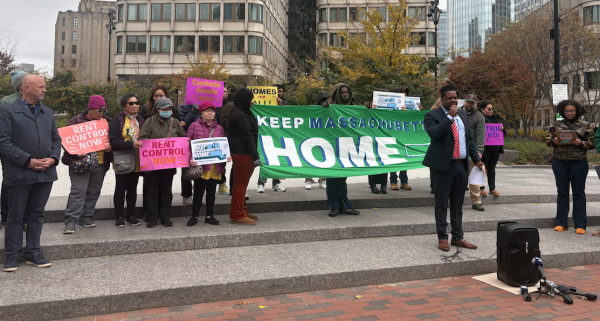
    Four Boston city councillors Wednesday endorsed a rent control measure that supporters hope to get on the 2026 Massachusetts ballot.

    The “Keep Massachusetts Home” initiative would limit annual rent increases to the cost of living, with a 5 percent cap.

    Councillors Henry Santana, Julia Mejia, Liz Breadon and Enrique Pepén stood beside community members outside City Hall Plaza on Wednesday morning speaking about the pressures of rent increases in Boston.

    Advocates said high rent is not just a city issue but a statewide one. Many advocates spoke about the negative effects of costly rents, such as the number of homeless students in Boston Public Schools.

    “This is about making sure that everyone is able to keep a roof over their head where rent prices are increasing,” Pepén, who represents District 5, which includes Hyde Park, Readville, and parts of Roslindale and Mattapan, said after the event.

    Pepén said he grew up in public housing. Now he’s a renter and hears how “impossible” it is for some people to make rent.

    At-large city councillor Santana said young professionals, families and seniors are being pushed out of Boston. Last month he drafted a resolution alongside Councillor Benjamin Weber from District 6, urging the city council to support the ballot question. The resolution was referred for further review.

    “We’re in the midst of a housing crisis, and again, we don’t want to lose our people,” Santana said during the event.

    District 9 councillor Breadon, who serves Allston and Brighton, said 80 percent of her constituents are renters. The number one issue for her is the cost of housing.

    “Working families are competing with students to rent housing, and that’s an unfair and very uneven playing field,” Breadon said.

    Mejia, an at-large councillor, invited other council members to sign the ballot measure and “get rent under control.”

    Carolyn Chou, executive director of Homes for All Massachusetts, a coalition of tenant organizing groups across the state, said the group supports rent control in Massachusetts and is working with others to organize tenants across the state.

    On top of working to collect the 75,000 signatures needed for a ballot question, the group also has a statewide rent control bill at the State House, Chou said.

    “This is happening from Springfield to Boston to Lynn to Brockton to Worcester,” Chou said, “and we are working with groups that organize tenants across the state who are all seeing this crisis of displacement, of high rent increases.”

    This story is part of a partnership between the Dorchester Reporter and the Boston University Department of Journalism.

    This article was originally published on October 29, 2025.

  • Young adults in Mass. favor statewide high school graduation requirement, poll shows

    By Mara Mellits

    Less than a year after voters scrapped MCAS as a requirement to get a high school diploma, a new poll finds that two-thirds of young adults support the development of a new statewide graduation standard. Several of the options presented in the poll received strong support.

    The poll, sponsored by the policy nonprofit MassPotential and conducted by MassINC Polling Group, asked high school graduates aged 18 to 29 their opinions on requirements. Respondents overwhelmingly supported several options, including passing required courses with at least a D grade, passing financial literacy courses, and courses that teach “interpersonal and social-emotional skills.”

    In that question, 60% said they would support a requirement that students pass courses needed for entrance into college. But in a separate question, three-quarters said they would support aligning the high school graduation requirements with the minimum standards needed to attend a Massachusetts public college or university.

    Entrance requirements for universities in Massachusetts typically include four years English class, three years of math and two years of science.

    Just 37% of respondents said they would support a standardized test like MCAS as a graduation requirement.

    Voters last November decisively approved Question 2, which eliminated passing the Massachusetts Comprehensive Assessment System test as a graduation requirement.

    Without a statewide standardized test, graduation criteria are now left up to local districts. State lawmakers and members of the Massachusetts K–12 Statewide Graduation Council, which Gov. Maura Healey established in January, are developing a new framework to set up high school graduates for their futures.

    The poll was paid for by MassPotential, a lobbying nonprofit that works with policy makers on K-12 education. The poll of 600 people has about a 4% margin of error.

    Mary Tamer, founder and executive director of MassPotential, said the organization has been “laser focused” on graduation standards this year. She said the group commissioned the poll to hear from more young people, whom she said weren’t represented in the graduation council.

    “I thought they have a really important voice here when it comes to what we should be considering for a new iteration of graduation standards,” said Tamer, who sits on the graduation council.

    The inconsistency of the districts’ decisions is confusing people, Tamer said. Some schools have replaced MCAS with grading criteria as a graduation requirement. Others require “successful completion” of certain courses.

    “They want to make sure that school has truly equipped them with the practical skills to thrive in whatever choice path they take, whether it’s college or career.”

    Andrea Wolfe

    The poll also showed people wished their high schools had offered more services in financial literacy (82%), career pathways training (69%), and vocational classes (66%).

    “People who have just came out and have had a few years to experience the job market or go to college and so forth have seen what the impact of the standards are that we have in Massachusetts,” said Steve Koczela, president of MassINC.

    Andrea Wolfe, president of Mass Insight Education & Research, a local lobbying nonprofit that nationally supports K-12 schools, said the poll shows how strongly young people are calling for real-world preparation.

    “They want to make sure that school has truly equipped them with the practical skills to thrive in whatever choice path they take, whether it’s college or career,” Wolfe said.

    For some Massachusetts high school graduates, the transition to college was hard. Kathy Zhang, a 22-year-old from Northborough who just graduated from Washington University in St. Louis, said she went from being a straight A student in high school to failing tests her first semester in college.

    Once she understood the difference from high school to college classes and learned how to study, Zhang said she received better grades.

    Even though she graduated when MCAS was still a requirement, Zhang said she wasn’t a fan of the testing.

    “I just thought it was unfair for a lot of people, because everyone learns differently, and everyone shows their intelligence differently,” Zhang said. “I thought it wasn’t a fair way to assess all the students.”

    Mei Cable, a senior at Boston University from Framingham, said she didn’t mind MCAS testing and even found it fun.

    “I don’t think that people should be penalized if they don’t do well on it,” Cable said. “It helps with placement into classes, just so the teachers know what level you’re at.”

    This story is part of a partnership between WBUR and the Boston University Department of Journalism.

    This article was originally published on October 08, 2025.

  • As Mass. rolls out new guidance on AI, teachers say it’s already in play

    By Mara Mellits

    Massachusetts teachers now have new state guidelines to help them navigate the use of artificial intelligence in classrooms as the technology becomes increasingly commonplace.

    The Massachusetts Department of Elementary and Secondary Education issued new guidance in August that calls for embedding AI literacy into curricula by providing resources and to offer opportunities for teachers to better understand AI tools.

    The new state guidelines, drafted by an task force of educators, focus on how to handle AI topics such as bias, ethics, misinformation, data privacy and environmental impacts.

    AI is already familiar ground to Rayna Freedman, a fifth-grade teacher at Jordan/Jackson Elementary School in Mansfield. She uses AI tools to curate individualized lesson plans, such as synthesizing material into a slideshow or a podcast so students can learn in a way that’s appealing to them.

    Freedman, a member of the state task force, said she started using generative AI — such as ChatGPT — in her class two years ago. Freedman used the chatbot to create a lesson on the chemical properties of air, in the voice of Beyoncé.

    “You better believe I had 100% attention and people actually talking about what was in air,” Freedman said.

    The state guidelines make clear that AI is not replacing educators, but rather “empowering them to facilitate rich, human-centered learning experiences in AI-enhanced environments.” The guidance is part of what Massachusetts education officials are calling a “multi-year AI roadmap” to support AI in K-12 schools, an effort that began last fall. That work continues this school year with planned workshops and trainings before officials plan to more officially integrate AI tools into Massachusetts curriculums, according to the state.

    The task force will continue to collaborate with state education officials as instructors implement their guidelines in the classrooms, according to DESE. 

    Kim Zajac, a middle school speech language pathologist and audiologist in Norton, said the new guidance from DESE around AI is helpful. Zajac, who is joining the task force, works with students who are developing their speech and language skills. She said she leverages AI to unpack figurative language, like idioms, metaphors and similes, by using the tool to generate images explaining them.

    Advertisement

    AI works well “in terms of leveling the playing field, deepening knowledge and giving more opportunity overall to any learner, regardless of their skills, languages [and] abilities,” Zajac said.

    In Lenox, technology teacher Kate Olender introduces her second graders to concepts like data sets and bias in AI using picture cards. Her fourth- and fifth-grade classes spend 10 to 11 weeks just on AI literacy.

    When ChatGPT first came out, Olender said she was adamant about learning it so she could teach it to her students. She started attending conferences and taking classes within the first six months it was released.

    “Even though I work in an elementary school, it’s going to be here, and we’re going to deal with it,” said Olender, who is also a member of the AI task force.

    In Salem, the district is hosting monthly educator workshops on AI starting in October, said Kate Carbone, deputy superintendent of Salem Public Schools. Teachers can take after-school training and be paid for their time.

    The first one next month will cover fundamentals of AI. The district is also convening a technology advisory committee to unpack some of the guidelines DESE put out.

    “We’re not taking a back seat, and yet we’re proceeding with caution and with excitement,” Carbone said. “Technology can be scary, but there’s also an upside. So we want to encourage people to be curious and while at the same time careful.”

    This story is part of a partnership between WBUR and the Boston University Department of Journalism.

    This story was originally published on September 19, 2025.