Author: Matthew Wuschke

  • A Cambridge teen is the nation’s best junior épée fencer

    A Cambridge teen is the nation’s best junior épée fencer

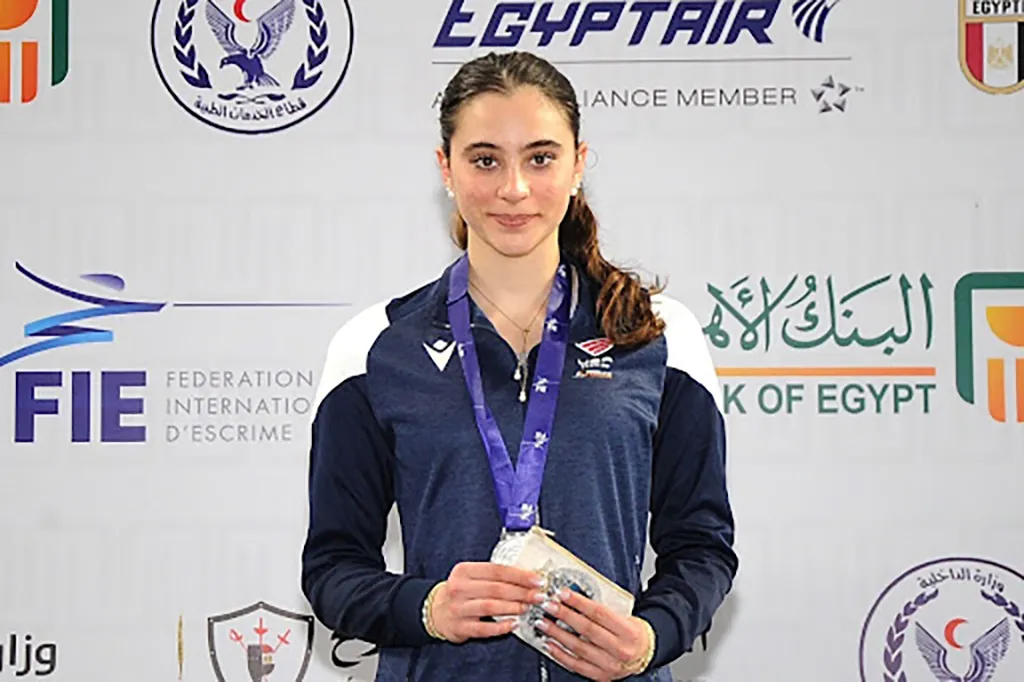
    Natalya with her silver medal in the Cairo Junior World Cup Credit: Mohamed Mostafa

    Sophomore at CRLS will compete in the world championships

    A 16-year-old Cambridge resident has become one of the nation’s top-ranked fencers. Now she’s preparing for the world championships next month in Brazil.

    Natalya Cafasso ranks first in the United States in both the junior (under 20) and cadet (under 17) categories in épée. Épée is the only blade in fencing for which the whole body is the target, unlike the two other blades, foil and sabre.

    For her, competing at the 2026 International Fencing Federation Junior & Cadet World Fencing Championships is a dream come true. She has been fencing since she was 6 years old and competing since she was 13. “It feels amazing. I never thought I would be in this position,” said Cafasso, a sophomore at Cambridge Rindge & Latin School. “Representing USA is a big deal, and it feels amazing that I can represent my country at the highest level.”

    On top of her dominance in the U.S. junior and cadet categories, Cafasso is ranked seventh in the world in junior women’s épée and 13th in the U.S. in senior women’s épée. 

    Even with her experience, the opportunity to represent the U.S. at one of the highest levels of fencing is a daunting task. Regardless of the pressure, Cafasso wants to stay focused.

    “It’s always a lot of pressure, because you travel all that way for one event, but I try not to think about it at all. I try to be present in the moment,” she said. “The results don’t matter as much to me. Obviously they matter, but it’s not like hanging above me, like I need to do this.”

    Natalya facing off in tournament competition. Credit: Mohamed Mostafa

    Cafasso had a rocky start to the season, but over the last five months she found success. She has reached the podium in her last four competitions, bringing home a silver and three bronze medals.

    She sees this run as a “butterfly effect.” Before her four medals, she narrowly made the U.S. roster for the junior world cup in Hong Kong in November.

    “If I never qualified for that competition, none of this would have happened,” said Cafasso. “I think that’s really interesting to look back on, because my whole entire life would have been different if I didn’t make that one competition.”

    Even though she placed 22nd in the competition, just having the opportunity to be on the team and compete showed her she belonged. 

    Daniel Hondor, Cafasso’s coach at the Olympia Fencing Center, noticed a shift in her attitude after the competition in Hong Kong. Ever since then, her game has taken a step up.

    “Before the first one, she was, ‘Am I ready for this? Do I belong there? Do I not belong there?’ and once she actually made the first bronze in Spain, she got the confidence and maturity that she needed,” Hondor said. “Once she convinced herself that she belonged, she mastered it.”

    Hondor and Cafasso have put in countless hours of work and training to get her to where she is. Cafasso spends five to six days a week at the Olympia Fencing Center working on her craft.

    Natalya celebrates after a win. Credit: Mohamed Mostafa

    Aside from fencing, Cafasso holds a 4.0 GPA at CRLS. When she’s not competing, training or traveling, she spends her time studying and catching up on work. She often studies on overnight flights and in the airport. 

    Regardless of the outcome in Rio, Cafasso is striving for an even bigger goal in her future – the Olympics in 2028.

    “The Olympics are very much the goal,” said Martin Cafasso, Natalya’s father. “At this point, she’s 13th in seniors, with two years to go before L.A.. It would be still a long shot for an 18-year-old, particularly in épée, to get there, but she feels like she can do it.”

    This story is part of a partnership between Cambridge Day and the Boston University Department of Journalism.

  • For the CRLS fencing team, winning was beside the point

    For the CRLS fencing team, winning was beside the point

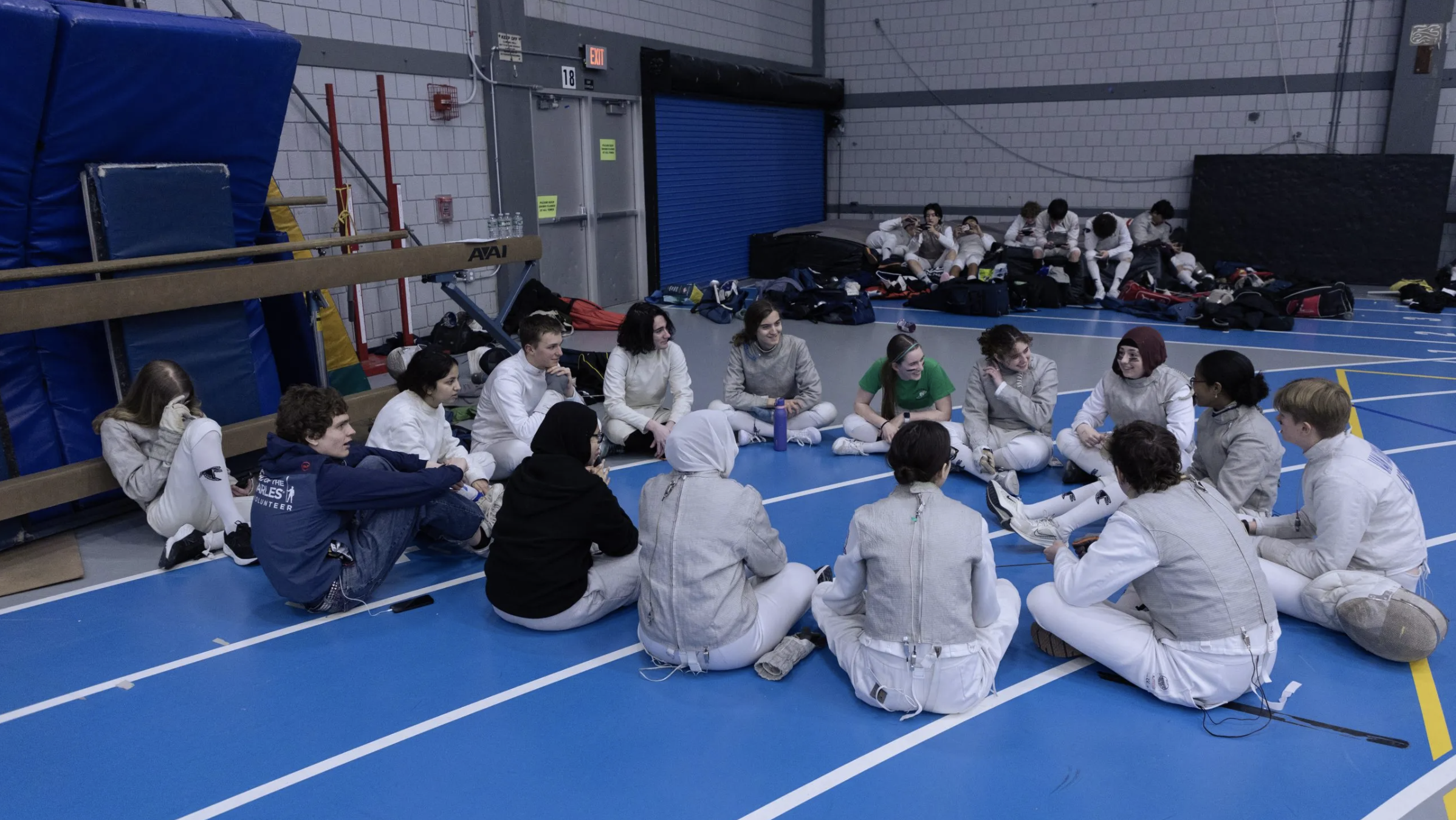
    As the Cambridge Rindge and Latin School fencing team’s season came to a close, its members had more to reflect on than just the state tournament.

    The Falcons started the season not expecting to make the state tournament. After six months of grueling practices and bouts on the strip – the area where fencing matches happen –  they proved to themselves and the fencing community that they belonged, even though the team didn’t lift the gold at the state championship tournament.

    CRLS had home strip advantage, hosting the tournament at the War Memorial Recreation Center. The men’s team placed fifth, while the women’s team placed sixth. (The co-ed Falcons split into men’s and women’s teams for the tournament.)

    Finn Graham, who has been foil captain for three years, said he was impressed with the team’s progress. “I saw so much growth from past years in our team, community, and culture, and that was really nice to see,” Graham said. “It feels like I’ve helped to contribute to that.”

    Gareth Flandro, a junior and captain of the épée team, said “I feel like I’ve gotten a lot better at fencing. I’ve improved and started to not just learn the techniques, but really start to apply them. It’s fulfilling in that way for me.”

    Fencing may seem like an individual sport, but it is more than that. The CRLS team is co-ed, with teams in all three blades. The team is composed of freshmen through seniors, and they all work together for a common goal, to have fun and get better.

    “I really like that it gives us an opportunity to be so close, because no one’s there to prove themselves,” Flandro said. “It’s just to improve, enjoy the sport and eventually compete and work our way towards that.”

    Sabre captain and senior Lee Van Voorhis in action. Credit: Bruno Muñoz-Oropeza

    For many, the collaboration and camaraderie are what has gotten the team to where it is.

    “When you’re just watching it, it can look like a more individual sport, but we really work hard together as a team,” Graham said. “It’s something that’s really great about the sport and about this team specifically, is the amount of collaboration that there is.”

    Fencing may not be a traditional high school sport, but to some of the players on the team, that’s what makes it unique. Some students may compete to get out of a physical education class, but for others it is the sport that they have found themselves in.

    Gregory Berger, the team’s head coach, has adopted a mantra for the team.

    “Fencing attracts the geeks,” Berger said. “Me and my coaching staff say, ‘We make athletes out of geeks,’ and the kids grow with it, and they like it.”

    The mantra has seemed to work out for the team, with the players excelling on and off the strip.

    “One of the things that I’m most proud of outside of fencing is that the combined grade point average is over 90 percent,” Berger said. “I am probably the luckiest coach of all – I don’t have to bench anyone for bad grades.”

    For some, the skills learned in fencing translate to both the classroom and into everyday life.

    “I have definitely come really far in learning how to best support people and how to direct people in a kind, but effective way,” Graham said. “I definitely will be using those leadership skills beyond this, and being on the team and being captain really helped me a lot.”

    Aside from the outcome on the strip, Berger and the program want the kids to have fun and enjoy competing. With the fencing season spanning through the bleak fall and winter months, it provides a great opportunity for kids to stay active.

    “If the kids can join and enjoy it, I think that is the only thing I can ask for,” Berger said. “Placing on top is important, but participating is also very important.”

    This story is part of a partnership between Cambridge Day and the Boston University Department of Journalism.

  • Cambridge Warriors set their sights on Special Olympics gold

    The Warriors congregate at a practice.Photo by Matthew Wuschke

    In the storied history of Cambridge basketball, there has never been a team like the Cambridge Warriors. Since 2017 it has gone 91-0 and is gearing up to represent Massachusetts at the Special Olympics in June.

    This opportunity means a lot to Santiago Pineda, one of the star players on the Warriors, a Division 1 basketball team run by the Cambridge Program for Individuals with Special Needs.

    “We earned it. We worked hard for it as a team,” said Pineda, 24, who has been with the program for six years. “It’s all about having a heart, a good mindset, and a good attitude when you’re on the court, so you gotta just keep pushing.”

    For Chris Owens, the team captain, the opportunity to compete June 20-26 at the Special Olympics in Minnesota carries a lot of weight.

    “It means everything because I’m an inner-city kid from Roxbury, and I didn’t really have the spotlight on me growing up,” said Owens, 24, who has been with the program for 10 years. “At 17, I came in the door at the Cambridge program and they treated me as family.”

    The city-run Cambridge Program for Individuals with Special Needs supports people with disabilities from age 13 to late 70s. The team consists of people with different disabilities, both high and low functioning.

    The Warriors compete in a league with teams from the Boston area composed of players with disabilities, with each team having a designated skill level. The Warriors are at the league’s highest skill level.

    The Warriors are coming off an emphatic 65-24 win against the Brookline Gators on Feb. 15. As the season heads to a close, the Warriors are eyeing their two final opponents – the Dorchester Blue Devils and the Ivy Street Hawks.

    Team captain Chris Owens shoots at a Cambridge Warriors basketball practice. Photo by Matthew Wuschke

    The Warriors have been a dominant force throughout the season, outscoring their opponents 315 to 196, with an average win margin of 24 points.

    The players credit hard work for their success. Owens said he has pushed himself in the gym and in the classroom to help get him to where he is.

    “I put in the hard work and countless hours growing up. I was in the gym by myself, with friends, with my mom,” Owens said. “Waking up at 6 o’clock in the morning for early morning workouts, just thinking how and when my time will come and, God willingly, it’s finally here.”

    David Tynes, head coach of the Warriors and program director, said the team is about more than basketball.

    “We’re preparing to represent not only ourselves as basketball players but our state and our city,” Tynes said. “We’re a class of active young men that can play basketball but also be respectful of everybody else’s differences at the same time.”

    He said he wants to support the players not just as athletes but as young men who will be prepared for the workforce and life.

    “We want this to propel them into, when it’s over, you can still come to me to help you with your resume,” Tynes said. “You can still come to me if you want that job pushing carts, or at Walmart, or something else.”

    Tynes said he cares about more than taking home the gold.

    “Success would be the gold medal, but I’m successful if one of my guys gets a job,” he said. “Sometimes a person with a disability is the best person for the job.”

    Owens credits the whole program – not just the team – for the Warriors’ success.

    “I just hope that me and my team get remembered, and everybody that’s on this journey,” Owens said. “I want the spotlight to shine on me and my team, not just me. I’m nothing without my teammates, from the staff, to the people that volunteer, and the people who donate.”

    The program is focused on a core message: “turning disabilities into capabilities.”

    “People with disabilities love, people with disabilities work, people with disabilities have families, and can play basketball well,” Tynes said.

    With this message, the program wants everyone to know that people with disabilities are capable of anything.

    “There’s people with disabilities, but at the end of the day we’re all humans,” Pineda said.

    This story is part of a partnership between Cambridge Day and the Boston University Department of Journalism.

  • CRLS Boy’s Basketball gears up for state championship tournament

    Camayah Visuals
    CRLS senior Jahari Toure Ortiz encouraging his teammates at a game in December, 2025.

    Sitting at a 14-6 record, the Cambridge Rindge and Latin boys’ basketball team is gearing up for some tournament action.

    The Falcons started the season 12-2 and then lost four of the last six games. The team is using these losses as fuel for the tournament.

    “We just need to play together and kill,” said senior forward Jahari Toure Ortiz. “A lot of the guys you see, any guy, any moment, any night, can have a good game. “Everyone is playing together and has that mentality to win and go as far as we can.”

    The Falcons have jumped 16 spots in the MIAA Division 1 Power Rankings since last year and now sit at No. 14. The team will find out Saturday who its first playoff opponent will be.

    To the eight seniors who lead the team, this tournament holds more weight than ever.

    “It’s my last year, so I want to go out hard,” said senior forward Aaron Abebe. “I just want to play as hard as I can this postseason–give it my all and uplift my teammates.  We’ve been kind of playing bad these last two weeks, but I think we can bring it up in the playoffs.”

    Even though the tournament brings pressure, it’s business as usual for the Falcons. The coaches are working on righting their wrongs from the rough stretch.

    “We’re sharpening our swords, just cleaning some things up,” said head coach Geo Rodriguez. “Maybe add an additional player to a couple situational practices, add more situationals, just in case anything happens in a late game stretch, end of the quarter, things of that nature.”

    The recent losses have resulted in a new mentality for the team, with its back against the wall, the team still has to show up when it matters.

    “The mentality is we still have a chance. We still got to fight,” said assistant coach Ta’Keame Gomes. “Guys still show up every day, ready to go. We can’t ask for much more.”

    Their recent struggles aside, the Falcons have strong talent and pose a threat to bring home a championship. A strong suit of the team is its depth, which Rodriguez refers to as a “seven-headed monster.”

    David Matthews Jr.
    Jaydaan Correia shoots over an Attleboro player in a game Dec. 30, 2025.

    The Falcons have beaten strong teams, and its losses have come to battle-tested teams like Boston Latin and Holland Tech, who recently met in the Boston City Championship.

    “It could be any one of them, any night,” Rodriguez said. “Other teams can’t prepare for one particular person. You have to prepare for six or seven.”

    The Falcons are very close off the court. When not in practice or at games, the players are either getting food, working out or simply hanging out. The team has taken on the identity of a family. 

    “These kids are a family, from top to bottom,” Gomes said. “As much as these guys give each other problems, like they’re always talking trash with each other, but it’s a brotherly feel. You know they love each other to death, and you can feel it.”

    Regardless of the outcome on the court, the coaches want to prepare the players to succeed both on and off the court. Two CRLS players, Jaydaan Correia and Itamar Fox, received full-tuition merit scholarships to Rutgers University through the Posse Foundation.

    “To be able to see those guys, since third grade, all grow up into amazing young men, speaks on their character,” Rodriguez said. “They’re just great individuals. All the seniors and kids have set goals for themselves – they know what they want to do with life and school. They all have their vision.”

    The MIAA Boy’s Divison 1 Playoff Bracket will be released on Saturday, February 21. The bracket and finalized standings will be available here.

    This story is part of a partnership between Cambridge Day and the Boston University Department of Journalism

  • CRLS squash program has varsity hopes

    Tien-Yi Lee. CRLS and Brookline teams huddling up before matches start.

    The loud thuds of rackets hitting balls and squeaking of shoes echo throughout Harvard’s Murr Center as Cambridge Rindge and Latin School students dart across the courts. A squash ball’s about the size of a walnut, so the students must hit with precision.

    The CRLS squash program, established last year as a club sport by its founder and team captain, sophomore Milo Miller, is in the middle of its second year and looking to take a step up to a varsity sport.

    Two years ago, Miller was playing in squash tournaments on his own and realized that nearly everyone participating went to a private school and played on a team. Miller, 16, wanted to stay in public school, but CRLS didn’t have a team, so he decided to start one.

    Miller was unsure of how to start the program, but when he learned Massachusetts Squash’s high school commissioner, Steve Lantos, was looking for new public school teams, Miller got in touch. Lantos, who is a chemistry teacher at Brookline High School and coaches its girls’ squash team, worked with Miller to create a plan to bring squash to CRLS.

    “He asked my son, and my son was like, ‘Yeah, nobody knows what squash is. Everybody’s like, “You play squash? What’s that?”’ So [my son] was like, ‘Yeah, I’m all in,’” said Tien-Yi Lee, Milo’s mother and parent liaison for the program.

    Tien-Yi Lee. CRLS and Brookline players facing off in pre-game player introductions.

    The program is co-ed and has 26 players, divided into two teams, a varsity squad and a developmental squad. The first team holds weekly practices and competes in matches against a mix of varsity and club teams from other schools; the team has a 4-6 record so far this year. The developmental team also practices weekly but is focused on internal matches along with some matches against other schools.

    For most of the team members, this is their first time playing squash. Some hadn’t even heard of the sport much before they joined.

    “Even though Harvard has one of the most beautiful facilities anywhere in the Northeast, there are people in Cambridge who probably just think squash is a vegetable,” said Andrew Frishman, one of the coaches.

    “So when we put up posters and started emailing it around to all kinds of parent lists, we had tons of kids come out and more kids than we could ever even possibly accommodate.”

    Ninth-grader Elijah Vanterpool, who joined the program this year, had never picked up a racquet before this season.

    “It’s hard at first and very confusing,” Vanterpol said, “but once you get a groove for it it’s pretty fun.”

    Frishman’s daughter, Jordan, didn’t have much experience before starting two years ago. Since then, squash has taught her a lot both on and off the court.

    “I think it’s a great way for people to learn how to work together, but also for themselves, since it’s more of an individual sport when you’re in a game,” said Jordan, a 16-year-old sophomore. “I’ve definitely learned how when you work for something, you can get better by pushing and putting dedication towards it.”

    Miller said he didn’t expect the squash program to go from idea to varsity team in just two years.

    “I’m really surprised with how fast everybody’s improving,” he said. “I honestly didn’t think that they would be at the level that they are now and I’m really happy with the improvement that they have made.”

    The CRLS coaches credit the Cambridge community for supporting the program. Squash has a reputation as a sport for the wealthy, but the CRLS program and Cambridge community are breaking down those barriers.

    The program received a $1,000 grant from the Cambridge Public Health Department to help cover some of the operational costs of renting equipment and courts.

    “One of the things that we are really committed to is making sure that this would be available to any kid, regardless of income,” Andrew Frishman said. “We want to make sure any kid who wants to, can walk on the court and play.”

    Aside from the efforts put in from the community, the coaches said they are committed to utilizing their resources the best they can. Since the CRLS program is technically still a club and working toward becoming a varsity sport, there have been some struggles along the way.

    “There are probably a million reasons that [a squash team] shouldn’t happen,” said Andrew Frishman. “We thought, ‘How are we gonna get equipment? How are you gonna cover insurance liability?’ And rather than thinking about, ‘what are all the things we don’t have,’ we tried to imagine, ‘What would this thing look like if it was successful?’ We don’t have to wait for all the conditions to be perfect. We said, ‘What do we have? We’ve got a bunch of people who care about it. We’ve got some kids who want to play squash.’”

    Regardless of the struggles, the CRLS team wants to make sure that their presence is felt in the squash community throughout Massachusetts.

    “We want to be a dominant force that not only gives any public school squash team a run for its money, but also beats up on the prep teams,” said Andrew Frishman.

    This story is part of a partnership between Cambridge Day and the Boston University Department of Journalism.