Author: Sana Muneer

  • Students at Dever Digitizing Day create a time capsule for a school that’s closing

    Students at Dever Digitizing Day create a time capsule for a school that’s closing

    Students, staff and community members gathered at the school last Thursday (March 26) for Dever Digitizing Day, an initiative to create a digital archive preserving the school’s nearly seven decades of history…

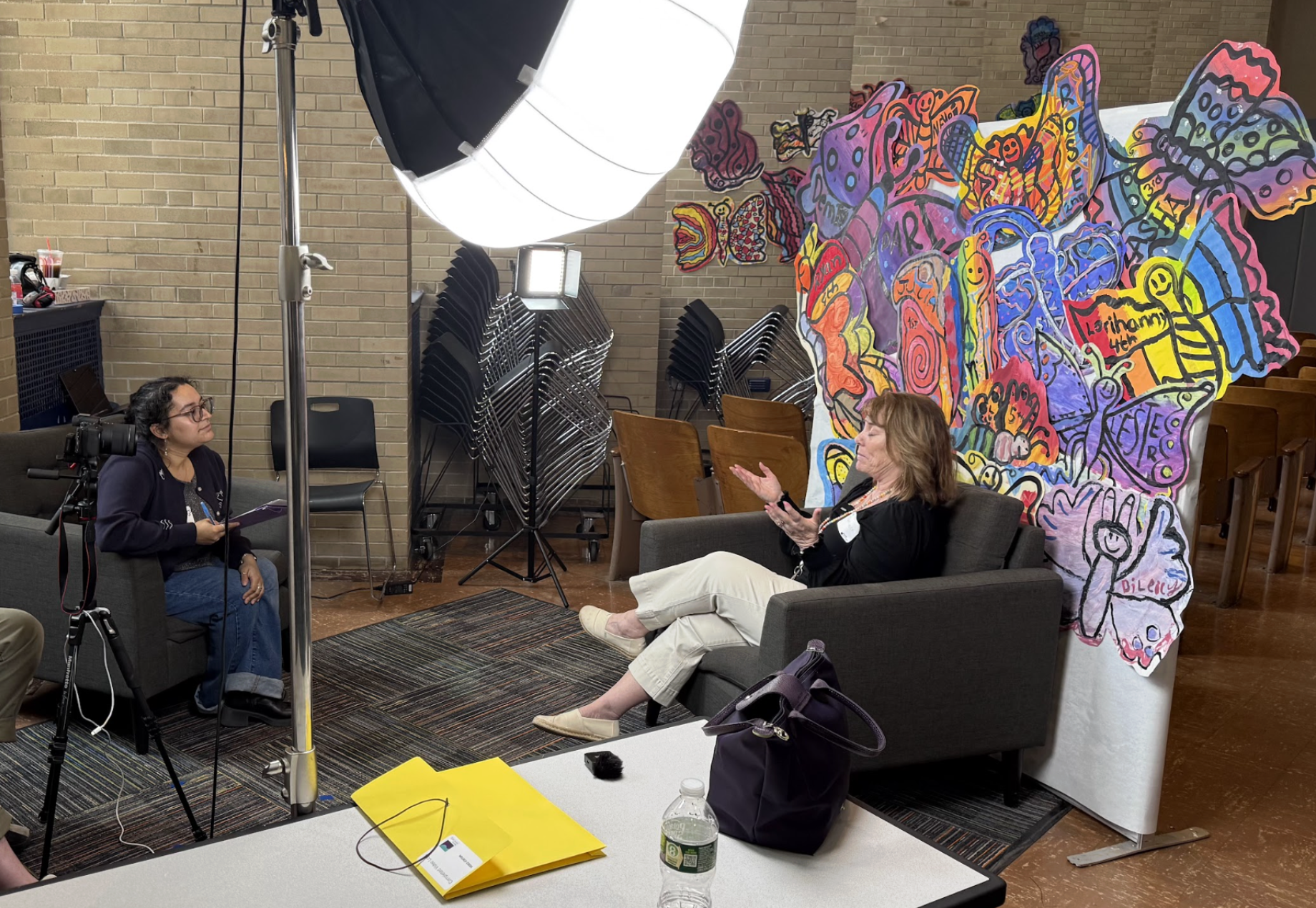
    Vibrantly colored butterflies filled large display boards at the Paul A. Dever School, each one marked with a student’s name and grade, and personal touches like doodles, hearts, and abstract designs. More than 200 butterflies, crafted by students, now form a growing archive at the elementary school on Columbia Point, which is set to close at the end of the school year. 

    Students, staff and community members gathered at the school last Thursday (March 26) for Dever Digitizing Day, an initiative to create a digital archive preserving the school’s nearly seven decades of history.

    “We started the year knowing that we’re leaving, but it hasn’t sunk in our hearts yet that we have three months then we’re not coming back,” said Ruth Hermann, the school’s art teacher. Her students each designed a butterfly for the archive, a display Hermann called the “Mariposas of Hope,” as the Dever’s students are also “full of hope.”

    She noted that “the butterfly represents that circle of life and community, and life changing,” she said, and it’s a way for students to process the school’s closure as well as leave their own mark. 

    The Boston School Committee voted in January 2025 to close or merge multiple Boston Public Schools, and one of them was the Dever, which opened in 1957 and will close its doors for good in June.  

    “I know it’s going to help our community have some closure, a representation of all the things, all the ways in which the Dever has touched their lives,” said Margaret Reardon, the school’s principal. 

    At the event, attendees posed for keepsake photos in front of the butterfly wall and shared memories, many with tears in their eyes.  

    Planning for the digitizing event began in October 2025 through a partnership with the Boston Teachers Union and Mass. Memories Road Show, an archiving program at UMass Boston that partners with institutions to document community stories.  

    “We’re hoping that people bring things that they love that remind them of the Dever, or of specific memories of the Dever… at the end of the day, people can also just bring their stories that they have in their head, and those can be recorded,” said Meghan Schroeder, senior project manager at BPS Capital Planning Department, in October. 

    “I’m really excited to see people present and past come back through the doors. I’m curious to see who shows up and what they bring, because there’s been a lot of memories here,” Reardon said. “I’ve been here for 11 years, and we’ve gone through huge transitions, and we’re leaving the school in a much better place than when we started.”

    The program values the contributors just as much as their contributions, said Nora Katz, associate director of participatory archiving programs. She said it’s meaningful for the university to be involved with the project, as UMass Boston and Dever School are close to each other. 

    “It almost is like a pause for people to be able to stop, take stock, be together, and reflect among all the like logistics that everyone is dealing with around the school closure,” Katz said.  

    At the event, there was a video station where participants could be recorded sitting in front of a butterfly backdrop and discussing their time at the Dever. 

    Pam Lueck, a third-grade teacher, spoke into the camera about what the school means to her. She added that she scanned three photos into the digital archive: a class photo from a school trip and photos of two of her students who had died. Lueck, who worked at the Dever for 12 years, will join Perkins Elementary School as a second-grade teacher next year. 

    Rui Gomes recalled his four years as assistant principal of operations and instruction at the Dever. “The work of the souls in this building that’s been done for students should be digitized, even though it’s closing,” he said as he shared photos of a unique role he also played at the school — cutting hair. 

    “You would see a lot of kids that couldn’t get a haircut for weeks and I’m like, ‘Hey Mom, if he behaves and does this well and he’s right there, do you mind if I cut his hair?’” he said with a smile. 

    The Paul A. Dever School

    For parents, the school’s closure has been difficult. 

    Edzna Vazquez, who has two children at Dever, said her children were devastated when they were told their school would be closing. She said that although she has several options for what school her kids will attend next year, she hasn’t decided yet. 

    “We all were doing these beautiful butterflies, and that is the summary of all the memories and moments that we all made together,” she said. 

    This story is the product of a partnership between the Dorchester Reporter and the Boston University Department of Journalism.

  • ‘Voices of Dorchester’ event will bring Revolutionary War stories to life for 250th anniversary 

    The “Voices of Dorchester” program on April 11 presented by Historic New England and the Dorchester Historical Society aims to amplify stories from the time period using diaries, letters and personal accounts…

    In Dorchester, history isn’t just confined to museums. It can be found in the old houses people pass on their way to work and in the stories passed down from historical figures to present-day residents. 

    The “Voices of Dorchester” program presented by Historic New England and the Dorchester Historical Society aims to celebrate the 250th anniversary of the American Revolution this year by bringing stories from the time period to life using diaries, letters and personal accounts. 

    The event, on April 11 at the Adams Street Branch of the Boston Public Library, will allow attendees to delve into the history of those who lived in Dorchester before them.

    “I want people to see these places differently,” said Carole Mooney, secretary of the Dorchester Historical Society.  

    “When you’re leaving Star Market and you notice that boarded-up house across the street, instead of thinking, ‘Oh, what an old, dilapidated building,’ maybe you say, ‘That’s where Lieutenant Colonel Badlam’s family lived,’” she added.

    p9 Pierce House REP 8-23.png

    The event will begin at the library with presentations from both historical groups, then will go into an optional tour of the nearby historic home (above) of Colonel Samuel Pierce, a Dorchester farmer and militia leader who participated in the fortification of Dorchester Heights — a key moment in the war. 

    Pierce’s correspondences and journals are the backbone of the program, said Kate Hooper, the school program manager at Pierce House.

    “Often when we hear about the Revolutionary War, we think about the famous names … but we often don’t remember that it was just these everyday farmers, shoemakers, blacksmiths, weavers that were really the ones putting a lot at risk,” Hooper said. 

    She noted that the primary source documents directly connect with what elementary grade students are learning about local history and about the American Revolution.

    The event will also show correspondences from prominent figures in the American Revolution, like George Washington and Alexander Hamilton. 

    Attendees are encouraged to bring any historical correspondences from Dorchester residents dating back to the American Revolution they may have as the groups work to document the community history. 

    “This is what you won’t get in your history books,” Mooney said. 

    “Voices of Dorchester” takes place April 11 at 10:30 a.m. at the Adams Street Branch of the Boston Public Library. Register here

    This story is part of a partnership between the Dorchester Reporter and the Boston University Department of Journalism.

  • At Neighborhood House Charter school, a preliminary OK on first union contract

    After more than two years at the bargaining table, Neighborhood House Charter School educators have reached a preliminary agreement with the administration on their first union contract. 

    The tentative three-year pact covers about 150 school workers and includes measures on wage increases, student-to-teacher ratios ,and opportunities for educators to be involved in decision making, the Boston Teachers Union announced last Tuesday.

    “First contracts are complex and often take a long time,” union president Erik Berg said in an interview. “We certainly would have liked it to happen more quickly, but we’re happy that it came together when it did.”

    Educators will vote on the agreement early this month. The staff at the public charter school, which was founded in 1995, elected to unionize in February 2024 and started bargaining that June.

    “What’s important about having a contract in place is that the ratios, class sizes, and other conditions are codified in such a way that they cannot be changed on a whim,” Berg said. “So, it’s really more about putting in place guidelines that everyone knows and adheres to.”

    The school’s executive director, Edverette Brewster, had a front-row seat to negotiations despite stepping into the role after the unionization process had started. 

    “There was some trepidation because we’re new, and so it was this balancing act of trying to come into a community, get to know and build trust, while also simultaneously going through this process that can be contentious at points,” Brewster said in an interview. 

    He said his approach to this hurdle was being consistent and collaborative.

    Who we are and were at the bargaining table were the same people we were when we left the room, when we entered the room, and we saw them on the next day,” he said. 

    “I would say,” he added, “that the impetus and rationale for unionization all happened prior to us starting… What was explained to me was that it was a desire to have more voice in decision making and more transparency from leadership in decisions.” 

    A contentious issue during negotiations was financials, he noted. “Charter schools’ budgets work very differently from traditional public schools… if the boiler breaks, we have to find a way to pay for it,” he said. 

    The contract calls for wage increases for employees in each year of the contract through a salary scale. Berg said wage increases differ for each staff member, and he could not offer a single percentage figure. Neither the school nor the union responded to questions about the details.

    The agreement includes language that states educators’ rights and responsibilities and safeguards against “retaliation” for speaking about workplace or student issues. 

    “There was a recognition that the students at Neighborhood House come first,” Berg said, “and that getting a stable agreement in place with strong working conditions for educators and transparency around working conditions is going to make a better learning experience for the students, which is what everyone is all about.” 

    If the contract is not ratified, school and union officials will return to the bargaining table.

    The Boston Teachers Union is also in the process of its first contract negotiation with Codman Academy Charter School.

    This story is a product of a partnership between the Dorchester Reporter and the Boston University Department of Journalism.

  • ‘Places of Resilience’— Five Dot park projects given Lee Fund grants

    Five beloved green spaces in Dorchester will get a fresh burst of life after receiving five of a ten-grant allotment from the Henry Lee Fund for Boston Parks, which supports community-driven projects that improve parks and gardens across Boston, according to the parks advocacy groups Friends of the Public Garden.

    The Dorchester sites, which will get grants ranging from $2,000 to $5,000, are: The 89 Radcliffe Street Food Forest, Ronan Park, Adams-King Playground, Rev. Loesch Family Park, and Thetford Evans Playground.

    “Everybody has a park somewhere close to them that can be really meaningful to them,” said Liza Meyer, president of Friends of the Public Garden. “This kind of grant program can help foster that connection between neighbors and park users to build a broader network of advocates.”

    The fund, which is in its second year, honors Henry Lee, the founder of the Friends organization. Lee, who died in 2024 at 99 years old, was a lifetime advocate for equity in urban parks, according to the group. 

    The Boston Food Forest Coalition is spearheading work on the Radcliffe Street Food Forest (below), an “edible park” that integrates fruit trees and berry-laden bushes to provide food access and a community gathering space, said Liz Luc Clowes, its director of engagement and construction.

    The coalition will put its $5,000 grant toward creating multilingual educational signage for plant identification, way-finding, and instructions for harvesting. 

    “These signs really are a bridge to bring people in, because there are people from many cultures that live in Dorchester, Mattapan, and the places that we serve,” Luc Clowes said. “In some communities, people speak Spanish, Haitian Creole, Cape Verdean Creole, Chinese, Vietnamese… this is a way to bridge people together.”

    The food forest is under construction and will open later this year, Luc Clowes said.

    The St. Marks Area Civic Association will use its $5,000 to create a “mini oasis of nature in a very urban place” at Adams-King Playground by upgrading a pollinator garden and planting native perennial floral, Secretary Jamie Bemis said. 

    “We obviously wanted to enhance our community with this beautiful garden open to everyone that’s a place for people to come and get a respite from the traffic and noise of the city, and just be in nature,” Bemis said. 

    The association also aims to make the garden a sanctuary for local wildlife, specifically pollinators, through its improvements. Bemis recalled the fulfillment of seeing and hearing swarms of bees as residents added perennial plants into the garden. 

    “We’re all in this together, sharing our love for gardening and amplifying the work of creating food for our neighbors, both human and non-human alike,” she said. 

    Just a few blocks away, the trees at Rev. Loesch Family Park will get a makeover with a $5,000 grant to the nonprofit Speak for the Trees. They will be professionally pruned, an initiative that will boost their long-term health, improve shade, and influence people’s mental and physical health, said advancement director Lisa Crist. 

    “The impact of low tree canopy coverage is really being felt by people,” Crist said. “That’s everything from air quality to heat, temperature, everything from mental health to physical health to property values.” 

    The Friends of Ronan Park, a volunteer-run organization dedicated to preserving the park, received $2,000 to upgrade the entrance at Mount Ida and Holmes Avenue, President Eleni Macrakis said. 

    The group will add plants near a Little Free Library, improve pathways and repaint seat walls, she added, noting that seeing people reading books from the library or watching the sunset while sitting on the seat wall is a common occurrence in the summer. 

    “We’re just excited that a park that’s not downtown is getting attention in terms of these grant funds and recognizing that people in some of the other neighborhoods also deserve a great park space and deserve the funds that can improve the space and activate the space,” Macrakis said.

    Redefining Our Community will put its $5,000 award toward beautification efforts at the Thetford Evans site. The playground, used by local families and day care centers, will undergo perimeter plantings and general improvements, according to a press release. The organization did not respond to requests for an interview. 

    With Dorchester’s parks making up half of the Lee Fund’s recipients, the funding speaks to the neighborhood’s dedication to urban biodiversity. 

    “People are learning from each other and meeting the moment, the moment for the climate, the moment for food access,” Luc Clowes said. “As there are increasing changes in the country, open spaces are really important for people to have a place to gather.”

    The grant also reflect the strength of Dorchester’s local groups in recognizing the neighborhood as a socioeconomically diverse place and providing for those individuals in the ways they know best. 

    “There’s a sense of community ownership that comes from being able to see an idea through,” Meyer said, “from an initial conversation or just a light bulb moment, into actually being built and being able to be enjoyed in person.”

    Above, a summertime yoga class at Ronan Park. Photo courtesy Eleni Macrakis

    The advocacy groups’ organizers acknowledged the park projects they are working on is part of a broader initiative to establish the parks and gardens as community havens and gathering spaces that define Dorchester as a neighborhood. 

    “These are places of joy, places of resilience,” Luc Clowes said. “When we work together as a community to build them, the community’s voice is captured in the landscape.”

    This story is the product of a partnership between The Dorchester Reporter and the Boston University Department of Journalism.

  • City plan calls for half-acre farm in Mattapan to combat food insecurity

    City officials Monday night unveiled a plan to create a half-acre farm in Mattapan to serve people experiencing food insecurity.

    The 22,000-square-foot farm, tentatively called “River Street Farm,” will be built on Boston Public Health Commission’s Mattapan Heights campus near the Lower Neponset River Trail, said Shani Fletcher, director of GrowBoston, the city’s Office of Urban Agriculture. She presented the plans at the Greater Mattapan Neighborhood Council’s virtual meeting.

    The health commission and the city signed a five-year memorandum of understanding to signify its partnership for the farm, Fletcher said. River Street Farm would provide a local source of fresh produce for food-insecure people with food harvested through Shirley’s Pantry, which provides emergency food assistance and is also located on site.

    “It’s got to be a 90-second drive from the farm,” Fletcher said. “It’s almost impossible to get more local than that.”

    Fletcher presented a tentative development timeline to the meeting’s 40 attendees, with work expected to begin in the spring.  The first phase — archaeology testing — is slated to begin in March or April, once snow has melted. Before any digging occurs, the city’s archeology team must apply for a permit to determine whether there are any artifacts there or if any parts of the site should be protected or avoided, Fletcher said. 

    “This is in an archeologically sensitive area … I learned recently that it’s between an important crossing of the river and a waterfall,” Fletcher said. “What we were told in our meeting with the archeology team is that it’s possible that this is a space that is very important and has a lot of artifacts.”

    Fletcher said nearby Indigenous groups, specifically the Wampanoag people, are being notified about the farm and archaeology testing as part of the process. She added that there will be a community engagement component to the archaeology testing, and volunteer opportunities for interested residents. 

    Thorough testing of the area’s soil contaminants and health, conducted by a team already under contract with the Mayor’s Office of Housing, will commence after archeological testing. 

    The archaeology and soil testing results will shape the farm’s design, Fletcher said. The draft design will undergo a “comprehensive farm review” with the Boston Planning Department, and there will be opportunities for community feedback.  

    After the design is finalized, the project will be put out to bid for construction contractors. 

    “The idea would be to launch the farm in 2027, hopefully by the spring, if the build-out has been completed,” she said, emphasizing the timeline is a draft and subject to delays. 

    Community response to the proposal was positive, with concerns centered around wildlife in the area.

    Resident Barbara Crichlow asked about the deer and coyotes that reportedly frequent near the farm’s location. Another resident brought up the issue of smaller animals invading the farm. 

    “There are raccoons, possums, the whole list,” the resident said. “I live, what, one block, two blocks over, and they’re in our yards, so I know that these critters will be having a feast.”

    Fletcher said the farm will be fenced to prevent animals from intruding.  “I’ve seen deer jump fences, so we can’t say that it’s 100 percent guarantee, but we will be setting it up so that it’s not as easy for them to get in and eat the food.” 

    Resident David Venter asked about educational efforts within the farm, specifically for children. 

    Because the farm is an “archeologically sensitive area,” there may be opportunities for educational interpretation, Fletcher said. She added that the farm will mainly be a production farm. 

    “This will primarily be a production farm, as opposed to, an educational farm or farm with a lot of volunteering,” Fletcher said. “So we’re not sure yet we’re going to explore those opportunities.”

    This story is a product of a partnership between the Dorchester Reporter and the Boston University Department of Journalism.