Author: Sara Creato

  • Still a mystery: Historical Society talk unearths Spy Pond Tusk revelations

    Found in Arlington more than 65 years ago, a tusk believed to be some 46,000 years old still prompts more questions than answers.

    The tusk, which is from a mammoth that roamed the North American tundra, is all that remains of this gargantuan Ice Age creature. The tusk, found in Arlington’s Spy Pond in 1960, was perhaps used as a tool for foraging plants and self-defense against predators. The Spy Pond Tusk was the subject of a presentation by the Arlington Historical Society on March 31.

    Local fisherman Arvid Carlson uncovered the tusk while fishing in Spy Pond with his then 10-year-old son, Steve. Carlson gave the tusk to the Boston Museum of Science, which donated it to the Arlington Historical Society in 1987.

    When the Museum of Science acquired the tusk, scientists extracted a sample for carbon-14 dating – a method used to determine the age of organic materials by analyzing the decay of their carbon-14 isotope. The results of this testing showed that the tusk was 43,000 years old. The researchers also assumed that the tusk belonged to a mastodon, because of the animal’s prevalence compared to mammoths in the New England area at the end of the Ice Age.

    George Parsons, Vice President of the Arlington Historical Society

    George Parsons, vice president of the Arlington Historical Society, said he is skeptical of the carbon-14 dating results. Previous corings of sediments taken from Arlington area ponds had shown that the oldest sediments were only 11,000 years old.

    “There was an ice age that started here about 26,000 years ago. Ice as much as a mile thick covered this area and it bulldozed everything into the Nantucket Sound,” Parsons said at the talk. “So how does a tusk that’s been dated to 43,000 years old show up on the bottom of the pond, not under anything?”

    Parsons contacted archaeologist Stuart Fiedel after reading an article he authored about carbon-14 dating a mastodon tusk found in South Egremont. Alongside Robert Feranec, curator of vertebrate paleontology and mammals at the New York State Museum, the team retested the tusk in 2022.

    Since the tusk’s discovery, carbon-14 dating methods have drastically evolved. Previously, the standard procedure involved extracting a fist-sized sample and measuring its radioactivity over long count times. Sixty years later, carbon-14 dating can be done with a smaller sample size using accelerator mass spectrometry – a multi-step process that isolates a fossil’s carbon. The carbon is then placed into a vacuum and exposed to calcium ions and magnetic fields to separate the carbon-14 from other isotopes.

    In July 2022, the new test results estimated the Spy Pond Tusk to be between 46,000 and 47,000 years old.

    “Let me put that in perspective: 47,000 years ago, the only humans in Europe were Neanderthals. There were no humans at all in North and South America,” Parsons said. “It would be 30,000 years before we invented agriculture and metal working. That’s how old this thing is.”

    After examining the tusk’s Hunter-Schreger bands – the growth lines found in mammal teeth — the team made another revelation: The Spy Pond Tusk belonged to a mammoth, not a mastodon.

    Although both mammals of the Ice Age, Parsons emphasized that mammoths and mastodons last shared a common ancestor 30 million years ago.

    “This is three times our separation from the gorilla,” Parsons said.

    The finding was further supported by the tusk’s nitrogen-15 levels, which were more consistent with the mammoth’s grass-based diet compared to the mastodon’s consumption of trees and shrubs. Despite the amount of evidence already gathered, Parsons wanted more and he submitted a sample for mitochondrial DNA testing.

    However, the DNA test results dropped the biggest bombshell: The mammoth was not from Arlington. Instead, its DNA matched with a group of mammoths from Alaska.

    How the mammoth’s tusk traveled from Alaska to the bottom of Spy Pond remains unknown.

    Parsons theorizes that the Fairbanks Exploration Company, a gold-mining enterprise, discovered the tusk while mining. Parsons said that records show that the Fairbanks Company had shipped the tusk and other discovered fossils to the American Museum of Natural History in New York between 1929 and 1951.

    Parsons believes that the museum had run out of storage space for the tusk and dumped it in the river.

    “Humans are entrepreneurial,” Parsons said. “Somebody saw the tusk being dumped and said, ‘Maybe I can take this tusk up to Boston or Cambridge or Worcester and I can make myself a tiny sum.’”

    Parsons also refuted the longstanding myth that Arvid Carlson had lured the 50-pound tusk to shore with his fishing rod after discovering it 75 feet from the shore. He credited Steve with providing him firsthand details about the tusk’s discovery.

    Junko Nagano, a former program manager, left the presentation pleasantly surprised.

    “It was more fascinating and informative than I had expected, especially the science aspects of it,” Nagano said. 

    The Arlington High School mammoth mascot. / PHOTO BY ELI CHOI

    Inspired by the Spy Pond Tusk, Arlington High School changed its mascot to a mammoth in 2024. Adam Lane, the mascot’s illustrator, said a mammoth mascot represents the school perfectly.

    “I’m just very happy with how it’s worked out, because it seems like for the most part, the students have embraced it,” Lane said. “[Mascots] are symbols for the whole community, but first and foremost they serve the kids.”


    This story, published on April 10, 2026, is part of a partnership between Your Arlington and the Boston University Department of Journalism.

  • Grief in community: The Children’s Room approaches 30th anniversary

    Grief in community: The Children’s Room approaches 30th anniversary

    Joy Fisher Williams remembers the welcoming atmosphere of her first peer support group meeting at The Children’s Room.

    “I was invited to make myself a cup of tea,” she said. “We had a singing bowl that we rung right at the beginning to signal, ‘whatever was on your mind: your commute to the children’s room, your busy day, your whatever, leave that and come together now to get the support that you need.’”

    In November 2017, Williams’ husband, Brent, died from an unexpected heart attack. She sought out grief support from the Room for herself and her two sons, Fisher and Ruben.

    “I was with a lot of people who were a little bit more experienced in their loss than I was,” said Fisher, who’s now on the Arlington nonprofit’s board. “I just remember this feeling that I want to be the person who has experience and time behind me, like a distance from the event so that I can feel like I had my life together. That did eventually happen.”

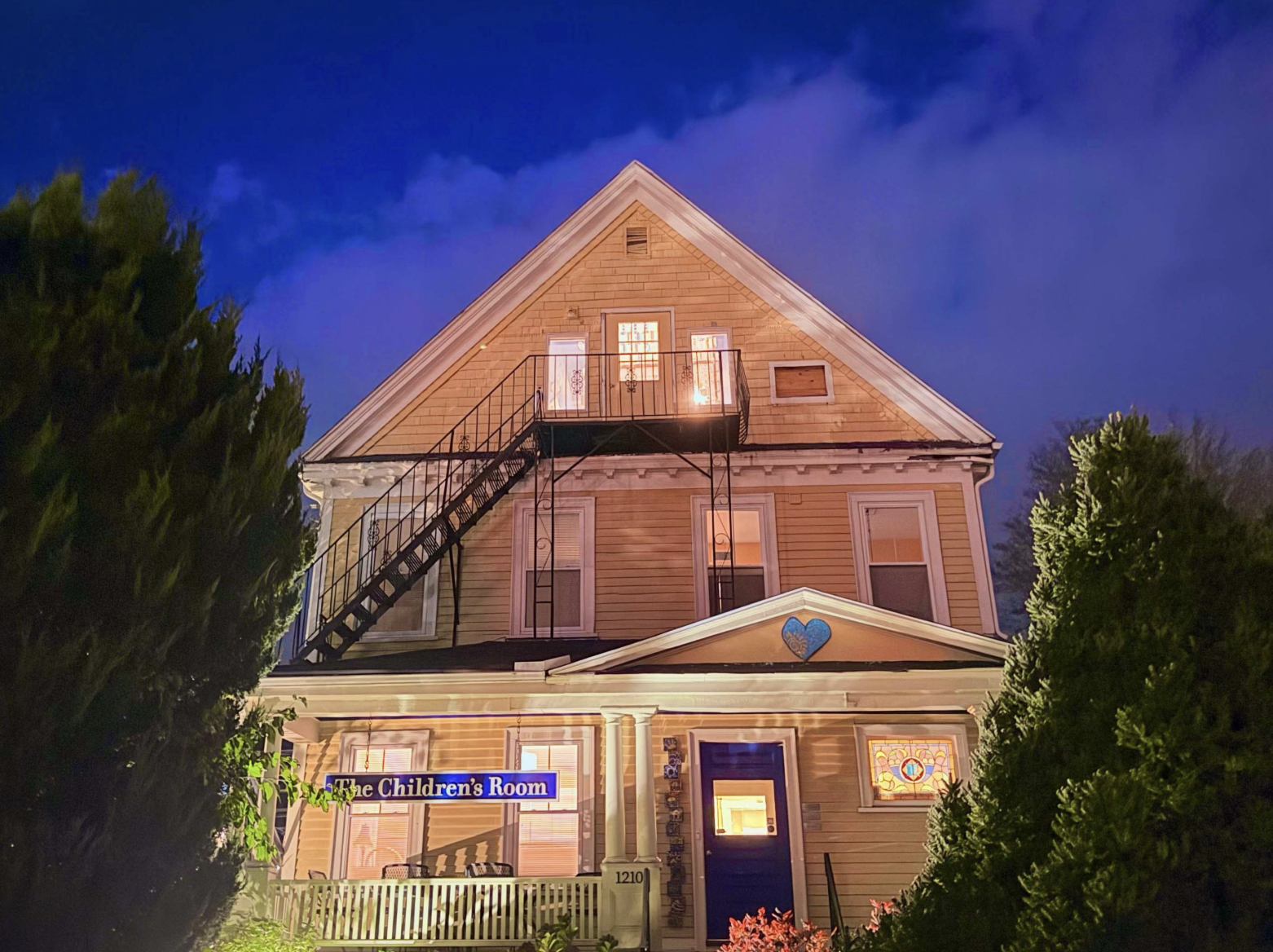
    Settled in a yellow Victorian house, The Children’s Room provides free grief support services to children and families in Massachusetts, along with programming in community centers and schools.

    A group of caregivers started the organization in 1993 at Hospice West in Waltham as a space for children to openly grieve. The Children’s Room gained nonprofit status in April 1996.

    Today The Children’s Room serves people from 80 communities. About 1 in 13 Massachusetts children experience the death of a parent or sibling by the age of 18, data from the Childhood Bereavement Estimation Model shows.

    Jon Gay, The Children’s Room’s executive director, reflected on the organization’s growth since its founding.

    “We were in the basement of a church, and we had five or six families coming to us,” Gay said. “You fast forward to today, and we’re working with about 500 children and teens and about 350 parents and caregivers. That’s kind of the exponential impact that we’ve been able to have.”

    A main component of its grief support services is the peer support model, which involves placing participants of similar ages and experiences into facilitated groups to address their grief. This approach makes people feel less isolated in their bereavement, Gay said.

    “What we hear oftentimes from the kids and teenagers is that they don’t feel alone,” he said. “They feel connected to others and like they’re part of a community.”

    Christine Lambright, the nonprofit’s director of school and community-based services, said the organization also emphasizes self-expression for children who are grieving. 

    “We also want to help them to be able to learn more about what grief is and how to express it,” Lambright said. “That could be learning words to match up to their emotions and learning ways to express their needs. It could also be through other means, like using art or using play or using movement or music.”   

    The Children’s Room uses grief-sensitive language in its approaches, such as avoiding the use of clinical terminology, Gay said.

    “We try not to medicalize grief, and we don’t treat grief because it’s a normal reaction,” Gay said. “We try not to use language like ‘loved ones’ because all relationships are complicated and different. We really are trying to change the narrative.”

    The center’s services extend into schools throughout the state. One of the focuses of in-school support is to teach students strategies to manage their expressions of grief, Gay said.

    “If they’re having a rough day, they’re going to know how to develop coping skills like taking a deep breath or stepping away from the material so that they can come back to it,” he said.

    Gay underscores the role of in-school grief support in mitigating negative effects, such as declines in attendance and test scores.

     “The actual intervention of providing grief support is a great way to counteract those adverse outcomes by getting kids the support they need in a place where they can benefit from it,” he said.

    One of these partner schools is Fenway High School. After attending a professional development presentation by The Children’s Room last February, school social worker Alejandra Castro worked with the organization to launch a peer support group this year.

    Castro said the group demonstrates the expansiveness of grief.

    “We had zoned in initially on students who would experience loss with parents and siblings, but what we’re seeing now is with friends and grandparents,” she said. “There were even kids talking about pets and neighbors.”

    School social worker Allyssa Pontes said the peer support group has affected the school community in a positive manner.

    “The impact for the Fenway community is just being able to give them that space, that students feel more comfortable, and there’s more awareness around getting help,” said Pontes.

    Lambright refutes the idea that children don’t grieve as much as adults do.

    “It’s interwoven into their story and who they are,” Lambright said. “It doesn’t define all of who they are, but it really helps shape how they see the world, especially as they grow up. Oftentimes in very empowering ways.”


    This story, published March 13, 2026, is part of a partnership between Your Arlington and the Boston University Department of Journalism.

  • Coyote mating season breeds curiosity and cautiousness

    Coyote mating season breeds curiosity and cautiousness

    With eastern coyote mating season under way, so too is the annual debate in Arlington over how well humans and coyotes can coexist.

    Arlington Animal Control Officer Michelle Parsons said she hasn’t received any reports of  coyote attacks on humans or pets so far this season. The last reported attacks in town occurred in 2021, when coyotes attacked two 2-year-olds in separate incidents.

    Coyotes are a minimal threat to human safety, Parsons said.

    “There are people that are more afraid, and I try to dissuade them from being super fearful,” she said. “[Coyotes] are really not out to attack us, and they’re more afraid of us than we are them.”

    During mating season, coyotes concentrate on courting mates and defending their territory. Their habitat includes all of Massachusetts, except Martha’s Vineyard and Nantucket. Although coyotes can adapt to urban, suburban, and rural environments, attacks on humans are extremely rare and usually caused by deliberate feedings.

    Pets face the most danger, Parsons said. She advises people to accompany animals during trips outside.

    “Especially during breeding season, a male is not going to let other males into the house,” she said. “They may not be discerning between your big male domestic dog against another male coyote that’s trying to come into their territory.”

    This winter’s heavy snowfall poses a challenge to coyotes’ and other wild animals’ ability to find food, Parsons said.

    “A lot of the smaller rodents and stuff that the coyotes are used to are underground and in hiding because of the cold weather,” she said. “I think they’re skinnier. They’re a little less robust.”

    With the coyotes increased hunger, Parsons encourages people to keep their garbage sealed to avoid attracting them.

    Capturing and relocating wildlife is prohibited in Massachusetts. Instead, people are advised to contact an animal control agent if they encounter issues with wildlife on their property. The law permits killing wildlife if they’re caught in the act of destroying someone’s property.

    Anne Short Gianotti, an associate earth and environment professor at Boston University who specializes in wildlife management, said people’s discomfort with coyotes persists despite state policy.

    “Being uncomfortable with coyotes in a particular place or wanting them to not be there can sometimes cause tensions between different neighbors,” she said. “People can have different ideas about what should happen with coyotes, but there’s actually not that much they can do except for manage their own property and their own behaviors.”

    Coexistence is the only option, Gianotti said.

    “We have to learn how to live with [coyotes] because even if we were allowed to remove them, they would just come back,” she said. “They’re very good at responding to openings in the environment.”

    Online groups create openings for communication and foster connections between humans and coyotes, Gianotti said.  

    One of these online groups is the Facebook group Coyotes of Arlington. Jang-Ho Cha founded the group in 2021 after seeing a lot of social media posts about coyotes on the Facebook forum The Arlington List. Coyotes of Arlington, which has roughly 2,700 members, is increasingly active during mating season.

    “We’re seeing all these incredible videos from people’s Ring cameras, and then occasionally there’s a sprinkling of [posts of], ‘My cat is missing,’ and then there’s a little discussion of ‘We should eliminate all the coyotes,’” Cha said.

    Most of the group’s posts are photos of coyotes, which receive mostly positive comments, Cha said.

    “Seeing a coyote is a really cool thing,” he said. “For some people, it’s scary. For me, it’s like if I saw a bald eagle.”

    Laura Kiesel, founder of Save Arlington Wildlife, a grassroots wildlife conservation organization, said the organization’s Facebook posts about coexistence with coyotes sometimes attract negative comments.

    Kiesel hopes to teach others about coyotes to reduce their stigma.

    “There’s been a lot of fear and I’ve seen more people saying we should cull them or we should relocate them, which is not even feasible or practical,” she said. Kiesel encourages people to maintain boundaries with coyotes.

    “At the same time that you shouldn’t be terrified of them, you also don’t want to feed them,” she said. “They’re not our dogs. They’re not pets, and it’s good to have some distance and keep them wild to the extent possible.”


  • Arlington launches new public meeting documents portal

    Arlington has launched an updated online portal on the town website to house all public meeting documents in an effort to improve accessibility.

    The new database includes all board, committee and commission meeting agendas and minutes from Jan. 26 onward. Users can filter through the portal based on categories such as board and commission, date and keywords. Older documents can be found under the website’s “Boards and Committees” tab.

    Arlington Public Information Officer Joan Roman said the portal was set up to better organize public documents on the town website and to comply with the Americans with Disabilities Act. 

    “It was something I always wanted to do because people were frustrated with things living in different places,” she said. “If things live in different places, it’s not very intuitive.”

    The creation of the portal began in 2024 when the town’s meeting management software platform, NovusAgenda, phased out of use. That April, the U.S. Department of Justice also released its final rule on ADA Title II regulations requiring state and local government-designed web content and mobile apps to meet a set of accessibility standards.

    To meet the ADA standards, the town’s communications team implemented new, screen-reader-friendly public document templates, and also trained staff and volunteer committee members on how to create them. 

    Many people with blindness or low vision use screen readers to access online content. The software uses speech synthesizers and braille displays to convey text and image descriptions embedded in the website’s code. Users navigate digital content with a keyboard or Braille display to tell the speech synthesizer which components to read aloud.

    Seemingly minor errors in the code can significantly impede screen reader users’ ability to navigate digital documents, Roman said.

     “If there’s a wrong piece of code, it can really stop people in their tracks,” she said. “We put a lot of thought to how things are set up, so we’re not putting up these barriers for folks.”

    Although many Arlington residents seemed unaware of the new portal, they expressed optimism about it once it was described to them.

    Educational consultant Bruce Johnson said he likes the portal’s convenient nature.

    “It’s a good idea that what the government is doing is available for us to read,” he said. “If I ever was really interested, I know I could go there.”

    Suzanne Kaminski, a first-grade teacher at Brackett Elementary School, said she likes that the portal centralizes the documents into one location instead of scattering them across the website.

    “Anytime things are consolidated in one place, it’s a good idea,” she said.

    Scott Mullen, the transportation management demand director at A Better City, a nonprofit for businesses and commerce in Greater Boston, said the new portal seems like an improvement that many residents will likely use leading up to the town’s override vote on March 28.

    “The old way it was done on the website, sometimes you have to click around a couple of times,” said Mullen, a Town Meeting member who serves on its Finance Committee. “It’s good to know that this is centralized, searchable. That really is key to keeping everybody informed.”

    The town is in the process of transferring its older public documents from NovusAgenda to its new platform, OneMeeting, before the DOJ’s April 2027 deadline. Roman estimates that 20,000 documents still need to be migrated into the portal.

    “I’m excited for the migration to be done and to have all these important documents in one place where people can easily search them, and can help residents of Arlington understand the business of the town,” Roman said.

    This story, published Feb. 18, 2026, is part of a partnership between Your Arlington and the Boston University Department of Journalism.

  • The many ports of call on Lynn Bishop’s cruise

    Lynn Bishop presents a pen. “I bought this pen, and it means a lot to me. Hold it until tomorrow,” she instructs. At a table in The Roasted Granola Cafe, she explains how to boost the self-worth of people with mental health conditions.

    “They would feel like they matter. They could look at the pen and think, ‘That’s important to her, and she thinks I’m going to come back tomorrow.’”

    These small acts of trust are impactful, she says.  

    “When we treat them like people who have value, they act like people who have value,” she said. 

    After 35 years of working at the Edinburg Center – a Bedford-based human services agency for adults and children with mental health conditions and developmental disabilities – Bishop, 62, retired as executive vice president. The Arlington resident’s tenure at the center was part of her lifelong love for advocacy.

    “My mother says I was born a feminist,” Bishop said. 

    As a child, her father’s work as a diplomat transported Bishop, her mother and two siblings to New Zealand, Lebanon and West Africa. Bishop said that her time spent abroad helped her to better empathize with the Edinburg Center’s immigrant staff, many of whom hailed from regions like Haiti and East Africa. 

    “I think staff found me to be unusual because I understood when they said that they lived in a village,” she said. “I knew they didn’t mean the village of Newton.”

    After graduating from Vassar College in 1985 with a bachelor’s degree in psychology and spending a year in Costa Rica with the Peace Corps, Bishop reunited with a college friend in Somerville. The friend – who taught two nonspeaking children on the autism spectrum at the Language and Cognitive Development Center in Jamaica Plain – struggled with retaining staff and encouraged Bishop to visit.

    That visit sparked her interest in special education.   

    “I fell in love with both of them,” she said. “They were as different as night and day, but to me they were such big puzzles.”

    Bishop remained at the school for three more years before working as a vocational developer at the League School for Autism in Newton. At a work training, she met Donna Mills, who was then associate director of the Edinburg Center. In 1991, Bishop joined the center as the qualified intellectual disability professional program director. 

    “There wasn’t [a patient] that I found too difficult or too challenging,” she said. “I got the reputation in the area as a person who would take the people that nobody else wanted.”

    After a center employee made a racist comment to another staff member, Bishop cofounded the center’s Diversity Committee in 1999. The committee’s programming centered around cultural competency and current issues, such as same-sex marriage.

    With many employees from countries that criminalize same-sex relations, Bishop, who now worked in management, felt confident that people would eventually overcome their prejudice. 

    “A lot of the staff came from countries where gay people were killed and we were telling them that they had to accept us to work at The Edinburg Center,” she said.  “I used my position of privilege to say, ‘They’ll get to know me and my wife, and maybe they’ll change their minds,’ and they did.”   

    In the wake of George Floyd’s murder by a Minneapolis police officer in May 2020, Bishop organized virtual town halls so people at the center could process their feelings together.

    Edinburg Center CEO Patti Maguire praised Bishop’s efforts.

    “There was just so much pain in our community and Lynn created a place for people to bring that,” she said.

    During the Covid-19 pandemic, Bishop also launched Meaningful Whole Life. The initiative allows patients to collaborate with staff – referred to as “Champions” – to create individualized day programming that caters to patients’ passions. The program supports roughly 300 activities ranging from fishing to crochet. Bishop says the program is “one of [her] proudest achievements.” 

    “We basically said, ‘We’re not sure that you’ll be able to achieve your wishes, because some of us never do, but we can help you towards the path,’” she said.

    Bishop taught patients how to write letters to their state representatives and produced short videos about individuals. She also co-created the center’s annual Legislative Breakfast to connect state lawmakers with the disability community. In 2023 she received the Ruth M. Batson Advocate of the Year Award for her dedication.  

    Bishop emphasized how individuals with developmental disabilities are infantilized or ignored in many scenarios, such as during interviews with media personnel and at doctor’s appointments. She said this treatment makes self-advocacy challenging.

    “People with developmental disabilities get treated like children,” she said. “Awareness about people with autism is relatively recent, and I think people dismiss them and some people are scared.”

    Bishop continued her activism outside of the center by working on political campaigns, including that of Arlington’s first openly gay selectperson, Dan Dunn, in 2009 and Gov. Maura Healey’s runs for attorney general and governor. 

    Outside of campaigning, Bishop maintains a close relationship with Healey and her sister, Dara. After being diagnosed with throat cancer in December 2024, Gov. Healey called to offer assistance.

    After undergoing a laryngectomy, Bishop couldn’t speak for roughly a year before receiving a voice prosthesis device a couple weeks ago. She said losing her voice was an eye-opening experience.

    “I’ve worked with people who couldn’t hear and who couldn’t speak because of developmental disabilities, but I never knew how discriminated against the voiceless were,” she said.    

    Bishop’s cancer diagnosis prompted an early retirement from the Edinburg Center. 

    Kathleen Doherty, the former executive vice president of the Edinburg Center takes Bishop to her doctor’s appointments and eats lunch with her every week. She said Bishop is perpetually positive.  

    “When I could be the black cloud of doom, she is that bright light.”

    In retirement, Lynn enjoys painting and spending time with her four dogs, Ms. Rita Bean, Gus, Jazz and Domino. She also frequently visits the center.

    Bishop calls her healing journey a boat cruise. During a dinner at Barcelona Wine Bar in Cambridge, she invited her loved ones to support her as members of “Lynn’s Village.”   

    “I was going to go on a cruise. If you were part of my cruise, you’re part of Lynn’s village,” she said. “Lynn’s Village was a huge success. Probably this spring, the cruise is coming into harbor parking.”


    This story is part of a partnership between Your Arlington and the Boston University Department of Journalism.