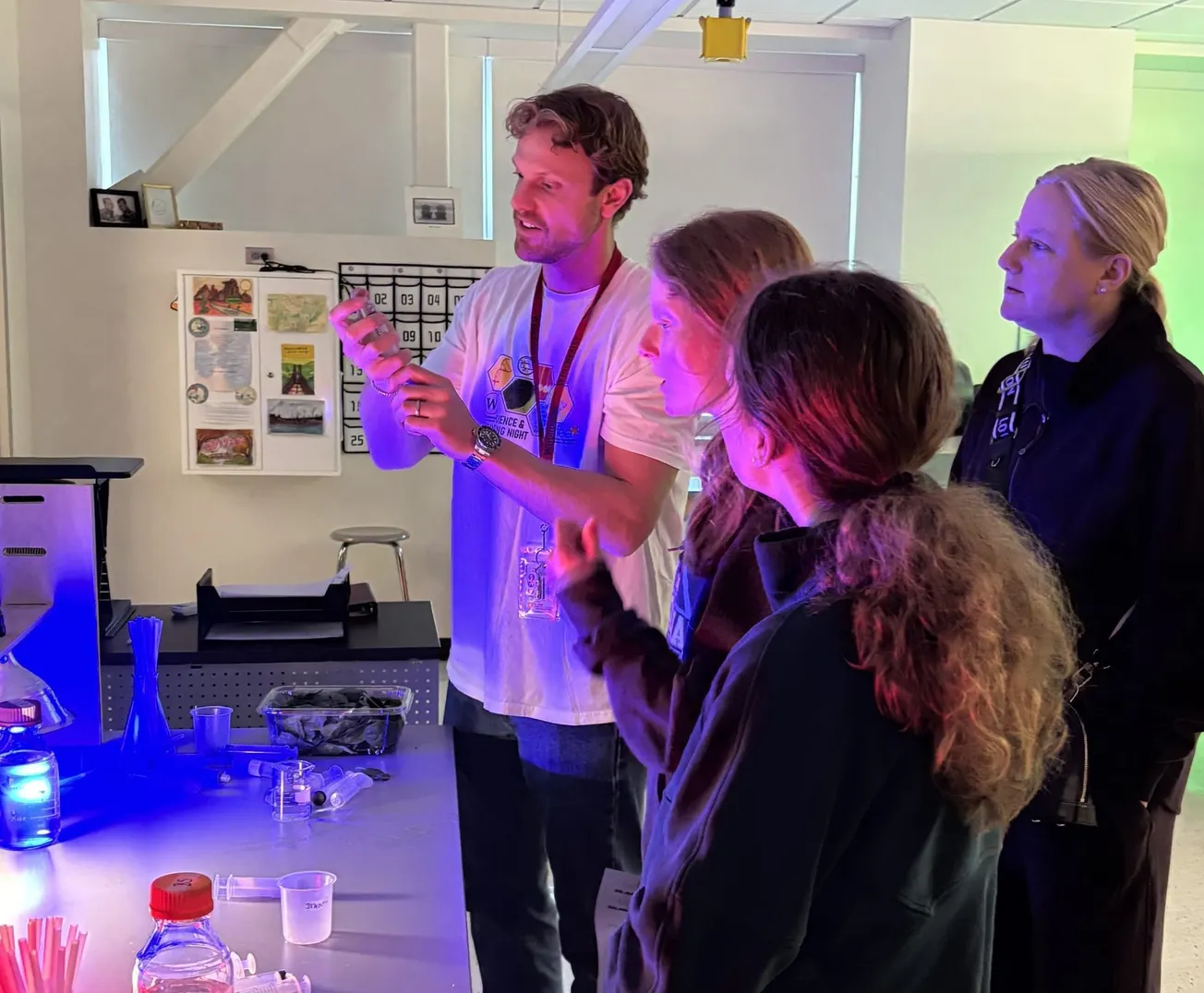
Science teacher Ben Lawhorn demonstrates a photosynthesis lab in the biology room during Winchester Science & Engineering Night on April 2. COURTESY PHOTO/ANN RITCHIE
Hundreds of families funneled into Winchester High School on April 2 to look at specimens through microscopes, toy with 3-D modeling on computers and try out pulse oximeters.
Science & Engineering Night invited parents and children in grades K-8 to visit the high school and watch 39 demonstrations of what students learn in the high school’s 13 science courses. The event, which drew 471 families, also showcased students’ projects and the school’s equipment.
“It’s great to show people in the town what science offerings they have here,” said Brendan Connors, a parent attending the night with his son, Ian.
Science Olympiad member Amelia Huang helps the Abbott family explore density in the chemistry room during Winchester Science & Engineering Night on April 2. COURTESY PHOTO/ANN RITCHIE
The equipment shown to families was paid for with grants from the Winchester Foundation for Educational Excellence, a nonprofit dedicated to raising money for Winchester’s public schools. The organization also funded the event.
The event was planned as a collaboration between the biology and engineering departments.
Ann Ritchie, director of science for grades K-12, said she hopes the night will encourage more collaboration among departments in the school.
High school students who were part of the National Honor Society and the school’s Science Olympiad team ran demonstrations.
“The way the big kids and little kids interact is so inspiring,” Ritchie said. “That’s what makes this night so unique.”
Students planned most of the activities. One student asked if they could bring in the Mystic River Association to do a demonstration about herring migration and how citizen scientists count the fish during their migration, Ritchie said.
“The [high school] kids are excited,” said Ipshita Chakladar, one of the teachers who organized the event. “We get our energy from them.”
Ethan and Wesley Bates test their hand-eye coordination outside the applied neuroscience room during Winchester Science & Engineering Night on April 2. COURTESY PHOTO/ANN RITCHIE
The first floor of the high school included 3D printing, a robotics demonstration, a construction and manufacturing booth, and a booth for the foundation.
An engineering section on the first floor showcased the engineering classes’ creations as well as the wood shop. The creations included a safe made out of wood, a xylophone and a garbage compactor.
On the second floor, families participated in activities that showed off the biology and anatomy courses. Activities included a brain speed test that asked kids to match the hand symbols pasted to a wall within 10 seconds and test their understanding of anatomy by naming parts of a model.
Within the high school’s library, families could test out button-making machines, music production, wood burning machines and 3D modeling computer program. There was a showcase of high school students’ projects, including a jacket that helped people with period cramps.
National Honor Society volunteer Talia Co invites the Parikh family to explore an optical illusion in the applied neuroscience room during Winchester Science & Engineering Night on April 2. COURTESY PHOTO/ANN RITCHIE
Anthony Zidell, a resident of Crescent Road, came with his daughter to check out what the high school had to offer.
“It’s really remarkable to see everything the high school has access to,” Zidell said, adding he couldn’t wait to send his daughter to the high school.
K-8 students who came said their favorite parts of the event were the wood shop, the heart monitors and the robotics.
Aurelia Gugliotta, a student at Lynch Elementary School, went with her mother because she loves science.
“I love it,” Gugiotta said when asked about her favorite part of the event. “All of it.”
Tavishi Chattopadhyay is a journalism student at Boston University.This story is part of a partnership between Winchester News and the Boston University Department of Journalism.
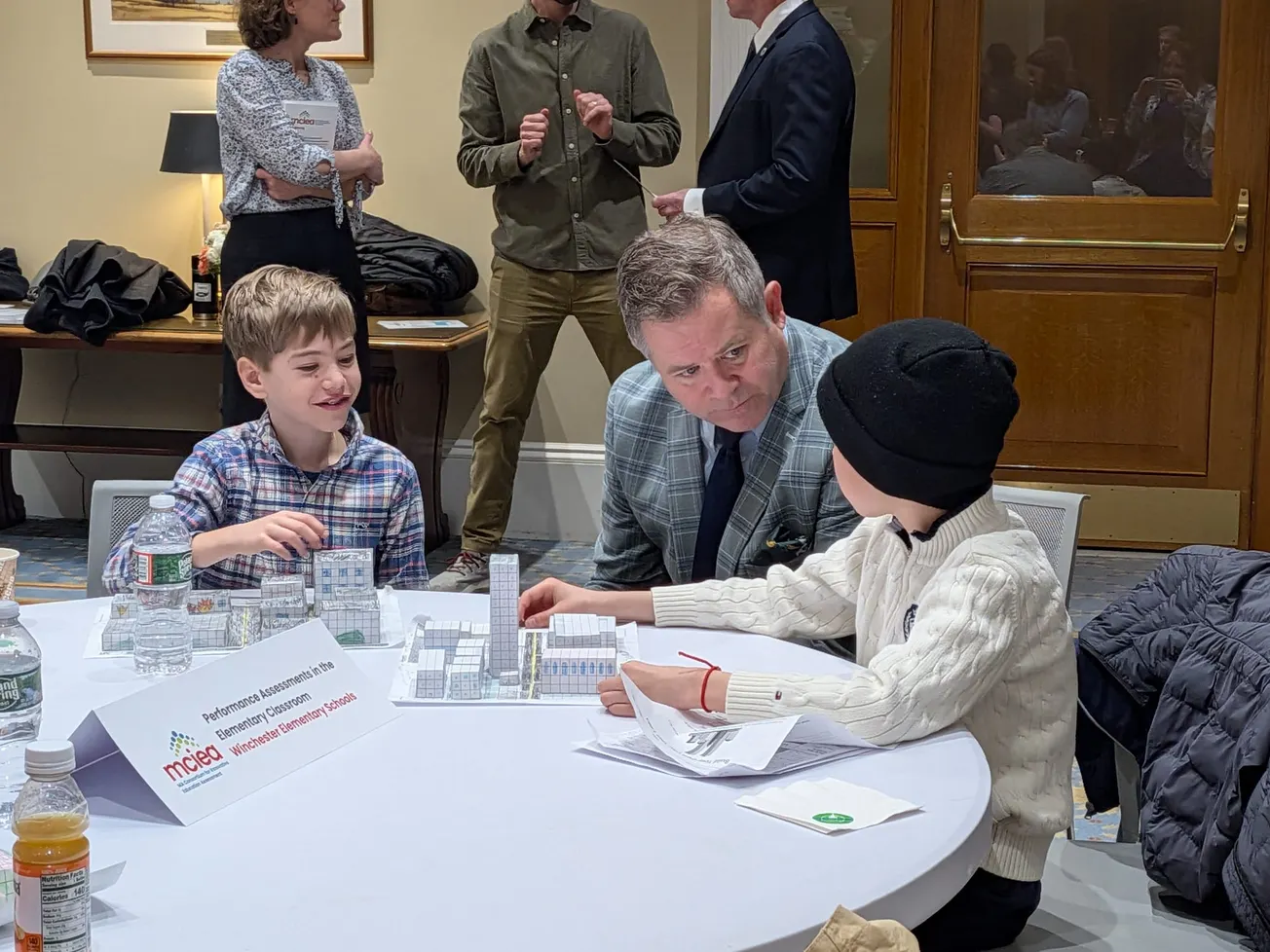
Rep. Michael Day sits and speaks with students about their experiences with the assessment tests. COURTESY PHOTO/JENNIFER ELINEEMA
Students from Winchester Public Schools accompanied their teachers to the State House this month to share their experiences with performance-based assessments.
Winchester school officials and teachers have attended briefings with legislators annually since 2016, but this was the first time students went with them. In these briefings, educators present their experiences with performance-based testing and how it influences learning.
Legislators and Winchester students and teachers gathered at the State House for a briefing on performance-based assessments. COURTESY PHOTO/JENNIFER ELINEEMA
Jennifer Elineema, assistant superintendent of the Winchester Public Schools, said the district will continue to bring students to briefings in the future.
“This should come to the people at impact, from the people it impacts the most – the students, “ Elineema said.
The effectiveness of standardized testing has long been debated. Opponents say the tests have implicit biases surrounding race, class and disabilities. They also argue the tests do not provide a proper measurement of students’ learning. Proponents argue the tests have improved Massachusetts’ quality of education.
In 2024, Massachusetts voted to repeal the requirement that high school students obtain a specific competency level on MCAS – the Massachusetts Comprehensive Assessment System – to graduate. Students are still required to take the test so that families see their child’s and the school’s academic progress.’
Josh Perez, a junior at Winchester High School, stands at a podium to speak to legislators while visiting the State House. COURTESY PHOTO/JENNIFER ELINEEMA
In Winchester, educators are using performance-based assessments to measure students’ academic learning and career-related skills. The district hopes these assessments will replace the MCAS as a measurement tool.
Each department has created different assessments for its students.
The high school’s English department ran its performance-based assessments from the summer of 2024 to the summer of 2025. The assessment had students create a portfolio of their English work.
Each department had different criteria for selecting which students would come to the State House.
Carolyn Plosky, the English director for grades 6-12, said the English department had teachers select students who had experience presenting in front of government officials from being part of the School Committee in December 2024.
Math teachers at Muraco Elementary School selected four students who persevered through the assessment and were able to explain the steps they took to get to their final results.
Stephanie Andella, a fifth-grade teacher, said one of the students was hesitant at first, but found their footing.
“I can’t tell you how proud they were of themselves and how proud we were of them,” Andella said. “It was probably one of the highlights of my academic career to see this.”
Winchester tudents showcase their article on neuroscience to legislators. COURTESY PHOTO/ANN RITCHIE
For students, the trip was one to remember. It offered them an opportunity to take control of their learning and feel heard by legislators.
“It was really transformative for me,” said WHS junior Josh Perez. “This should really become commonplace where students get a say in how their learning experiences are.”
Tavishi Chattopadhyay is a journalism student at Boston University. This story is part of a partnership between Winchester News and the Boston University Department of Journalism.
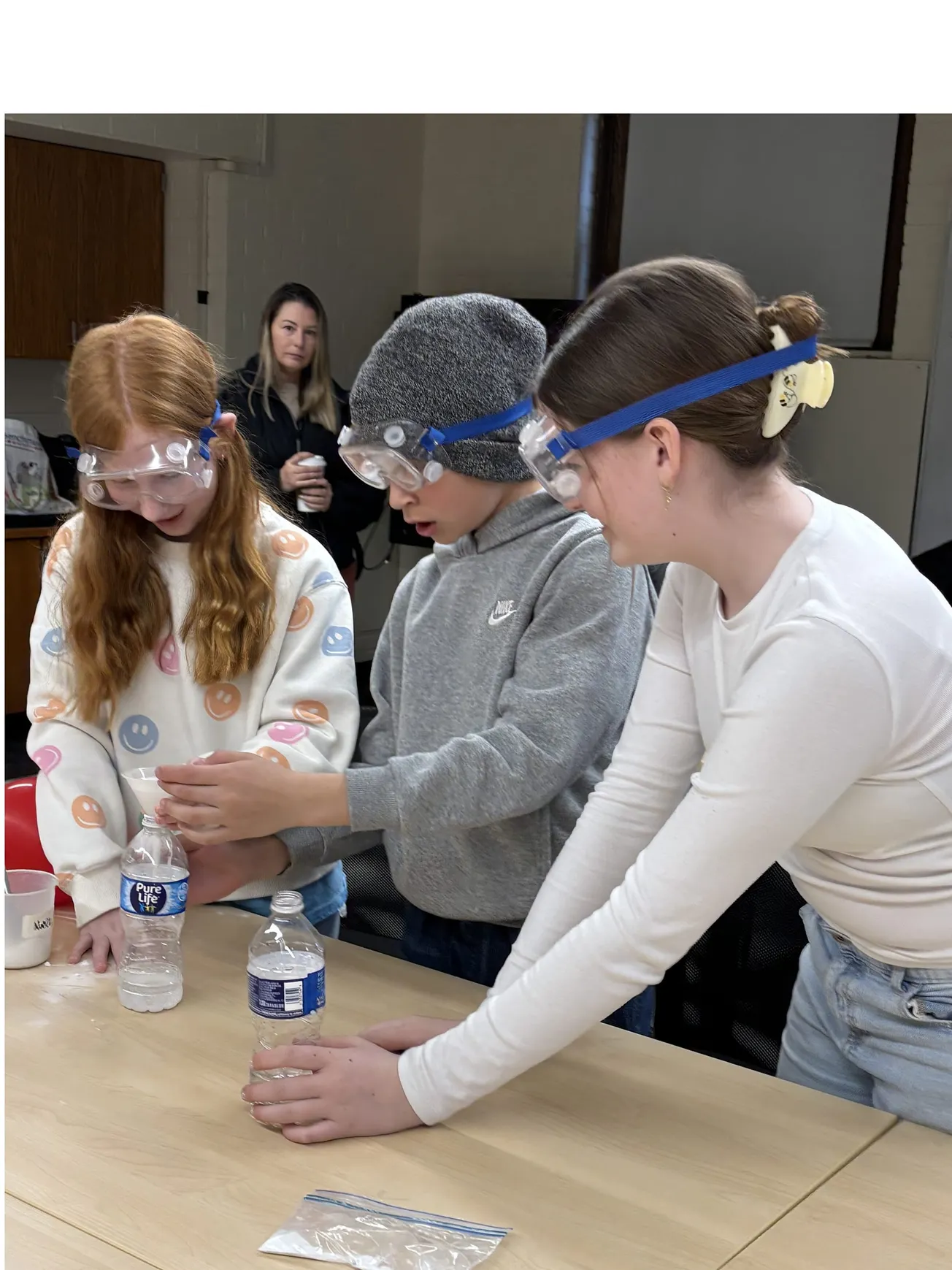
From left to right, Meara Daly, Liam Bradford and Hannah McGurry funnel baking soda into a plastic bottle of vinegar. COURTESY PHOTO/ANN RITCHIE
Bubbles sizzled in a plastic bottle as vinegar reacted with baking soda. The gas produced from the reaction filled a red balloon attached to the bottle’s top as five fifth graders looked on in awe.
“I liked watching the balloon grow,” Meara Daly, one of the fifth graders, said.
She and her classmates showed off one of the many demonstrations that will be presented April 2 for Science & Engineering Night. This is the first time the high school is hosting the event in six years.
Science & Engineering Night, running from 5 to 7 p.m., invites parents and K-8 students to the high school to witness demonstrations of various scientific fields. The event aims to showcase the opportunities available to high school students and generate community interest in science.
Organizers hope to draw 300 to 500 people.
“It’ll be a great opportunity to connect K through 12,” said Lia Stelljes, the elementary science, technology and engineering coordinator, who is helping plan the event.
All of the high school students in charge of the demonstrations are part of the Science Olympiad team, a collection of students who compete in STEM competitions.
The demonstrations will include fingerprinting and forensics, medicine and anatomy, applied neuroscience, chemistry, biology and environmental science, physics and engineering and robotics. There will also be a showcase of equipment in the community technology center and a tour of the tech engineering classroom.
In the community technology center, students will present laser machine technology and music technology using devices bought with grants from the Winchester Foundation for Educational Excellence, a nonprofit that raises funds for Winchester’s public schools.
There will also be a button-making station and computers where attendees can try out computer-aided design software that creates and modifies 2D and 3D models.
The event will also showcase the students’ accomplishments within their science courses and extracurriculars, including a paper on music’s influence on decision-making, which was published in April 2024 in the Journal for Emerging Investigators, which publishes original research done by high schoolers and middle schoolers.
The event was planned by a small group of faculty across the high school, middle school and elementary schools. They teamed up with students for suggestions on potential additions to the night.
One suggestion came from Summer Kim, a sophomore, who suggested that there be a preview of one of the demonstrations they’d be doing with fifth graders. Alice Chen, a junior, created the T-shirts that students and faculty will wear on the night of the event.
The two students acted as the instructors.
The fifth graders were shown how gas is created through the combination of baking soda and vinegar. After the experiment, they agreed their favorite part was pouring the baking soda into the balloon and watching it expand.
Fifth graders said they enjoyed the experiment and would be attending the Science & Engineering Night.
“I like it,” said Hannah McGurry, one of the fifth graders. “It’s fun.”
Tavishi Chattopadhyay is a journalism student at Boston University.This story is part of a partnership between Winchester News and the Boston University Department of Journalism.
Dozens of people gathered Saturday morning in Winchester for the third “No Kings” event to protest President Trump’s policies, reject authoritarianism and defend constitutional rights.
The number of people who participated nationwide was still being calculated on March 28, but there were over 3,200 organized events throughout the country, with more than 160 in Massachusetts alone. Protests also spread across the globe to major cities like London and Tokyo.
Winchester’s event, which drew residents of Medford and surrounding towns, began at 10:30 a.m. with a walk toward town called Neighbors Join In. Protesters gathered in three locations — the First Congregational Church, Bellino Park and Riverwalk Sculpture Park — before heading into town.
The walkers then met other protesters who had already gathered in downtown Winchester. Participants held signs with phrases like “Fight Fascism,” “Democracy Not Autocracy” and “We the People No Kings.”
At Bellino Park, Rebecca Slisz, executive director of the Network for Social Justice and a hub leader for the Neighbors Join In walk, went over safety reminders and encouraged protesters not to respond to negative comments.
For about two hours, protesters spread across the Winchester Unitarian Society’s lawn and on the sidewalks across from the building and in the surrounding area.
Residents from Winchester and surrounding communities came together to protest President Donald Trump and his policies at the No Kings Rally on March 28. WINCHESTER NEWS STAFF PHOTO/FRANK SITEMAN
IndivisibleWIN, the Winchester chapter of the national nonprofit founded in response to Trump administration policies, sponsored the event, which was aided by the Winchester Unitarian Society.
The Rev. Maeve Kieran Hammond, a 29-year-old associate pastor of the First Congregational Church, gave a blessing to the group gathered in front. She joined the rally to follow the same ideals that call her to her faith.
“We strongly believe in the call that Jesus gives us that we can’t serve two masters,” Hammond said. “Participating in this rally is a representation of our faith.”
The Network for Social Justice, a nonprofit dedicated to creating systemic change in Winchester, handed out information about immigration issues and rights. The League of Women Voters of Winchester table helped protesters register to vote, and IndivisibleWIN had a table informing people about the protest and directed people to voter registration packets that would be sent to Georgia voters.
Frank Siteman’s dog, Lyra, joined in the No Kings protest on March 28. WINCHESTER NEWS STAFF PHOTO/FRANK SITEMAN
Members of Mystic Mashup, a local chapter of the national Indivisible movement covering the Mystic Valley area, joined protesters at the Boston Common, where about 100,000 people were expected to show up. Leader Sue Edelman said she expected 3.5% of the population would participate in Saturday’s protests.
People said they joined for a variety of reasons, including standing up for future women and marginalized communities, being around like-minded individuals and making legislators aware of their frustration.
Other protesters said they showed up because they want to save democracy, they’re appalled at what is happening in the country and they had “no choice.”
Winchester protestors at the No Kings rally on March 28. WINCHESTER NEWS STAFF PHOTOS/CRYSTAL YORMICK & /TAVISHI CHATTOPADHYAY
Slisz said she protested because it is “foundational” not to diminish local action and because she is as concerned about the next generation as she is about her own.
“What happens here in our communities has such a big impact on our lives and the lives of people we care about,” Slisz said.
Two siblings, Eli and Ruby, accompanied their parents, who wanted their children to be identified only by their first names.
“America doesn’t have kings,” Eli said.
“The only reason America was invented was because they didn’t want kings,” Ruby said.
At the beginning of the rally, Sierra Scott, a junior at Winchester High School, read the preamble of the Constitution before handing the microphone to state Rep. Michael Day, the event’s emcee.
Winchester resident Frank Virnelli holds up signs he used at the protest. WINCHESTER NEWS STAFF PHOTO/CRYSTAL YORMICK
Speakers such as Maria Theresa Nagel, director of the Immigration Affairs office in Somerville, Rev. Seth Carrier-Ladd, a minister at Winchester Unitarian Society, and Mei Wu, a sophomore at Tufts University and an alumnus of Winchester High School, took to the stage to deliver speeches.
In between speakers, there were often chants. A speaker would say, “Show me what democracy looks like,” to which the crowd would respond, “This is what democracy looks like.”
Willie T performs one of his and Doctor X’s songs for the sound check before the rally begins. WINCHESTER NEWS STAFF PHOTO/TAVISHI CHATTOPADHYAY
Performers Willie T & Doctor X performed their original song “No Kings.” Later, Nick Lees performed Jesse Welles’ “Sometimes You Bomb Iran” and two other songs.
Amy Boss, a Winchester resident, protested with her young daughter. Boss — who is a teacher at Lexington Montessori School, where her daughter also attends — said the No Kings protest reinforces the same values the school teaches of accepting people and taking care of neighbors and the community. She wanted to show her daughter what a community looks like when it comes together.
Frank Virnelli, a Winchester resident, said he found it satisfying that there are millions of people who share his strong feelings about the “disaster going on in Washington [D.C.].”
Patricia Egan holds up a sign that reads, “No Kings, No Dictators.” WINCHESTER NEWS STAFF PHOTO/CRYSTAL YORMICK
Medford resident Patricia Egan said she protested because she wants to prevent people from being drafted into an “unjust war,” to support immigrants like her grandparents, and to see Trump impeached. She said she didn’t see as many children or families at this protest as the last one she went to in the fall.
Protesters said they felt positive about the turnout and the protest. Danielle Allen, who ran for governor in 2022, said the event had a “beautiful crowd,” and she hopes people understand that they need a government that’s “by the people” and “for the people.”
Protesters at the Winchester No Kings rally gathered outside of the Winchester Unitarian Society. WINCHESTER NEWS STAFF PHOTO/CRYSTAL YORMICK
“We’re starting to win,” said Allen, director of the Allen Lab for Democracy Renovation and James Bryant Conant University Professor at Harvard University. “We have the victory of getting [Secretary of Homeland Security] Kristi Noem fired. That’s a big deal. For people to recognize that their power matters, so they can make a difference, I think that’s making it an even stronger movement.”
Crystal Yormick and Tavishi Chattopadhyay are journalism students at Boston University. This story is part of a partnership between Winchester News and the Boston University Department of Journalism.
A look at the crowd gathered in front of the Winchester Unitarian Society on Main Street for the No Kings rally on Oct. 18, 2025. WINCHESTER NEWS STAFF PHOTO/FRANK SITEMAN
Winchester will hold its third No Kings rally this weekend and include a new addition to its program – a community walk toward town before the rally.
Organizers of Winchester’s third No Kings rally hope to draw in more than 1,000 people to the March 28 event. Other rallies were held in June and October 2025.
No Kings rallies have been organized across the country by activists to protest the Trump administration’s policies. Saturday’s rally will focus specifically on constitutional rights, democracy and the idea that “ no one is above the law,” said Eve Coffey, head of IndivisibleWIN.
“We’re coming up on the 250th anniversary of this country, and we’re seeing such backward movement,” Coffey said.
IndivisibleWIN, the Winchester chapter of the nationwide pro-democracy movement Indivisible, is organizing this rally. This weekend, it will add “The Neighbors Join In” and action tables.
The Neighbors Join In, organized by Bob Davidson, an assistant clergyman at the Parish of the Epiphany who is acting independently of the church, is a walk toward the center of town. Organizations will gather between 10:30 and 11 a.m. in three hubs: the First Congregational Church, Bellino Park and Riverside Sculpture Park.
Winchester residents were joined by others from nearby communities to protest the Trump administration during a No Kings rally on Oct. 18, 2025. WINCHESTER NEWS STAFF PHOTO/FRANK SITEMAN
The idea for the walk started after Davidson saw the success of “Winchester in Solidarity: Walking with Our Neighbors,” a walk in solidarity with immigrants, in early February. He wanted to echo those same feelings of community support that the walk had shown.
“Neighbors Join In is building on that solidarity walk,” Davidson said. “It’s really trying to focus on longer-term relationships between neighbors, creating that sense of support and momentum that we can take after the rally is over.”
At 11 a.m., those gathered in each area will walk toward the town center for the rally, which will begin at 11:30 a.m.
The rally will feature speeches from state Rep. Michael Day; Maria Teresa Nagel, director of Somerville’s Office of Immigration Affairs; the Rev. Seth Carrier-Ladd from the Winchester Unitarian Society; and more who have yet to be revealed.
Willie T & Doctor X, a Boston-based singer-songwriter duo, will perform an original No Kings song.
There will be “action tables” around the rally area, said Coffey. The tables will include postcard packets that can be purchased and sent to Georgia to encourage voter registration, along with a voter registration table run by the League of Women Voters.
Both of the past events have brought out residents from neighboring towns, including Medford, Stoneham and Woburn.
Medford resident Sue Edelman — a co-leader of Mystic Mashup, a local chapter of the national Indivisible movement that covers the Mystic Valley area, which includes Medford, Somerville, Malden and Everett — said most active members of the organization plan to attend the No Kings rally on Boston Common.
Mystic Mashup hasn’t hosted its own event because it wants to “add to the power of the larger events,” Edelman said. Leading up to the event, the organization has been creating flyers and cards with QR codes to its website to hand out at No Kings, preparing people to be marshals at the event and recruiting people to help with the medical tents.
Edelman expects Saturday’s event to include 3.5% of the population because “the last one was exponentially bigger than the first” and she thinks Saturday’s event will follow the same pattern.
Scott Drown, a Winchester resident who would be marching if he wasn’t out of the country on Saturday, said 3.5% of the population needs to be engaged in sustained efforts in order to “topple a regime.” Until the efforts are happening on a continuous level as opposed to massive get-togethers every three months, he doesn’t think the movement is going “to get anywhere,” he said.
About 5 million people attended the No Kings protest at about 2,100 locations across the country in June 2025, and 7 million showed up at 2,700 sites for No Kings rally in October 2025, Ezra Levin, co-founder and co-executive director of Indivisible, said at Indivisible’s What’s The Plan meeting on March 19. Over 3,000 events are registered for Saturday’s protest.
The first No Kings rally in Winchester drew around 500 people, while the second had between 800 and 1,000 people. Coffey hopes this rally will bring in even more people.
Davidson hopes the rally gets more people to start participating in social movements and find their voice. He also knows there is more to be done.
“The work is not over – it’s just really begun,” Davidson said. “We need to focus on resilience on one another, continuing to keep this vision of a just world in front of us, and continuing to find solidarity with our neighbors.”
Crystal Yormick and Tavishi Chattopadhyay are journalism students at Boston University. This story is part of a partnership between Winchester News, Gotta Know Medford and the Boston University Department of Journalism.
Winchester High School senior Lucas Yang receives a certificate for the U.S. Senate Youth Program. Courtesy Photo: Lucas Yang
Being called to the principal’s office usually means trouble. For Lucas Yang, sitting in his principal’s office was nerve-racking for a different reason.
Sitting there in early December, he learned he had been chosen as one of two Massachusetts students in the U.S. Senate Youth Program.
Two students from each state are chosen for the program, which sends students to the nation’s capital to learn about the inner workings of the government. It starts on Saturday, March 7, and goes until March 14. Each student delegate gets a $10,000 scholarship.
Yang, a 17-year-old senior, had been interested in this program for most of high school. He’s always had an interest in government and hopes to work in a public service position one day.
“I’m drawn towards [public office] because I would have a lot of interaction with community members,” Yang said. “I definitely want to serve in a position where I’m able to represent a constituency.”
Through every step of the application process, Yang had supporters in his corner, including his guidance counselor, Jack Burke, WHS Principal Paula Conis, student council adviser Rachelle Lane and his parents.
To Burke, Yang is a remarkable student with a variety of achievements under his belt.
Burke has worked closely with Yang, specifically during his junior year when Yang was part of the U.S. Senate Page Program, which required him to spend half of the school year in Washington, D.C., and the other half in Winchester. He has seen Yang’s dedication to his community.
“[His] sense of positivity has always fueled his interest in public policy and trying to make not only our schools a better and more positive place for everybody, but also his local community,” Burke said.
At school, Yang has taken on leadership roles. He’s president of the student council this year, and he’s helped start two clubs: the school’s debate team and a composting club. He’s co-captain of the debate team and director of the composting club.
Yang’s dedication to his community extends beyond school walls and into the town.
Last summer, Yang interned with the State of the Town, a body started by the Select Board to develop a fiscal plan. Michelle Prior, chair of the Select Board, and his internship coordinator, said his curiosity and eagerness to approach tasks were what made him stand out.
Prior remembers how he walked into rooms with 25 people who were decades older than him and was not intimidated. Instead, he was thoughtful and collaborative.
While interning with the town, Yang was asked to compare Winchester’s fees and revenues to those of other towns and to search for where improvements could be made.
The town manager and staff are using his findings to find areas where more revenue for the town can be made. One of the initiatives to increase building permit fees was borne from Yang’s research and will be underway in April.
“I expect him to do impressive things,” Prior said.
As Yang readied to go to D.C., he was excited to learn about the more human aspects behind legislation and bring back what he learns to Winchester.
“A lot of my passion for politics really comes from my education at Winchester,” Yang said. “Having grown up in Winchester all of my life, I’ve always felt really passionate about being involved.”
Tavishi Chattopadhyay is a journalism student at Boston University. This story is part of a partnership between Winchester News and the Boston University Department of Journalism.
Fernanda Stern and her 6-year-old daughter struggled to use the town’s sidewalks two days after last month’s blizzard to get to school from their home on Highland Avenue. Large mountains of snow had forced them to either walk on the street or in snow banks for weeks.
Snow build-up on sidewalks has become a hot topic of discussion since Stern posted on Facebook about her experience. Some people shared similar experiences.
The day after the Feb. 22-23 blizzard, Sarah Milt, who lives on Appalachian Road, set out to walk her dog on the sidewalk. Instead, she walked in the road after seeing a large snow pile that neither she nor her dog could climb.
In response to Stern’s post, some residents claimed it was the property owners’ job to shovel their sidewalks, while others said it was the Winchester Public Works Department’s job.
“There’s no accountability there because we think the neighbors will do it, the neighbors think DPW will do it, and at the end, nobody does it,” Stern said.
So who is actually responsible? It varies by community.
Some surrounding communities – Arlington, Medford and Stoneham – require residents to plow or shovel their own sidewalks.
Winchester is different.
The town’s bylaws state that commercial property owners are responsible for maintaining their sidewalks; failure to do so can result in a $10 fine. However, homeowners are exempt from this rule.
On its website, the Public Works Department has two maps showing the areas it is responsible for shoveling and plowing. Highland Avenue is included in its responsibilities. About 36 hours after the post, Stern said, the department cleared the sidewalk of snow.
The website warns residents that it may take between 24 and 48 hours for sidewalks to be cleared after a snowstorm.
DPW Director Robert LaBossiere said it can take longer for crews to clear sidewalks, depending on the storm’s severity.
Delays in snow removal can result from the breakdown of machines, including snow blowers, which often get clogged. The process is further delayed as the department waits for a mechanic and the repair parts to come for the broken-down machines.
Snow removal is also slowed by residents illegally pushing excess snow from their driveways into sidewalks or roads.
Town snow-removal workers often work for 30 or so hours, LaBossiere said.
“It’s not a glamorous position to be in for these guys, so it wears on them,” he said. “But they do the best they can.”
Workers stayed out from Sunday night, Feb. 22, until midnight on Monday, Feb. 23, to clear roads during and after the blizzard. Then they were out again Tuesday morning, Feb. 24, to clear the sidewalks, LaBossiere said.
Even with the town’s consistent work, LaBossiere said, it can take at least four days to fully clear all the snow from a major snowstorm, like the Feb. 22 blizzard that dropped 18 inches on Winchester.
However, residents are left unaware of the town’s plowing routes or its struggles with the storm. Milt said she learned about constraints on the department from a friend who works in a neighboring town’s public works department.
Town Manager Christopher Senior said Winchester needs to work on its communication. He said he hopes the town newsletter and social media accounts will help residents understand the snow removal process.
Shamus Brady, a Select Board candidate, said he plans to introduce a new bylaw that would require residents to shovel their own sidewalks. He also said he wants to start a high school volunteer team to shovel sidewalks for residents who are physically and financially unable to do so.
“I want the kids and those with mobility issues to be able to walk [around town],” Brady said.
The bylaws would require police to enforce sidewalk shoveling and residents to clear their sidewalks before school starts. This proposed bylaw must be submitted by March 13, along with 10 signatures in support, before it can be brought to the Spring Town Meeting for discussion.
Tavishi Chattopadhyay is a journalism student at Boston University.This story is part of a partnership between Winchester News and the Boston University Department of Journalism.