

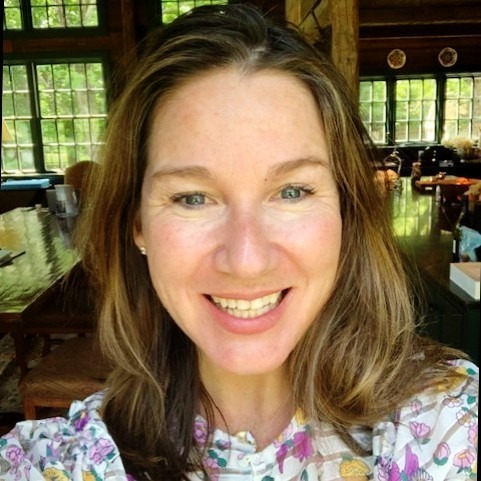
A Brookline resident and GBH producer has been honored for her work creating public media projects that foster civic engagement and media literacy for students.
Elizabeth Gardner, who oversees video production for the social studies, civics and history curriculum on PBS LearningMedia, has been named a 2026 Becton Fellow. Her work includes the youth-facing educational web series “Why It Matters” and the civic action program “Youth Stand Up.”
The Becton Fellowship is designed to support GBH producers in their professional development by providing them with grants to explore career opportunities, said Seeta Pai, GBH’s vice president of children’s media and education. Gardner is among eight GBH producers receiving Becton, Rey and Peter S. McGhee fellowships, all of which are awarded annually by GBH.
Pai called Gardner the star of GBH’s education department who “brought out the best of GBH.”
“There’s nobody else that does it quite like us,” Pai said. “We don’t just use media gratuitously. We use it for a purpose.”
Gardner, who joined GBH in 2016, frequently collaborates with educators and students to turn complex histories into accessible classroom tools.
“All of this is to equip students to be engaged citizens in this world and know how to do it and why it matters to them,” said Gardner.
At a rocky time for GBH and public media across the country, Pai said, Gardner has been essential in helping the department navigate funding cuts by creating content that performs well and addresses current civics and democracy headlines in a digestible way. In July, Congress pulled back funding for the Corporation for Public Broadcasting, costing GBH $18 million, about 8 percent of its budget.
“All the work she’s done is the example of what public media brings and what could be lost if it isn’t around,” Pai said.
“Youth Stand Up,” designed for middle schoolers, features short video profiles of young civic leaders, explainer videos and a skill-building toolkit to support student-run projects, such as worksheets and activities that teachers can use in the classroom.
“We really are looking for opportunities to bring in youth voices wherever we can,” she said, “so that we’re not just making media for young people. We’re also making it with young people.”
Gardner takes a social media-style approach to “Youth Stand Up” videos, drawing inspiration from TikToks and Instagram Reels to capture students’ attention.
“We knew [there] was an issue [of] young people that were learning civics in the classroom and really not connecting it to their own lived experience or understanding how this had to do with them,” Gardner said.
To find a solution, Gardner’s team went into middle school classrooms and found that students respond “overwhelmingly” well to videos that feature quick cuts, text on screen and a first-person perspective from a young person speaking to the camera.
One video centers on a Native American teen who organized a book drive on Native American reservations that featured Indigenous characters and authors. Another was a TikTok-style explainer on how to identify a credible source created and presented by a freshman at Cornell University.
As a Brookline resident, Gardner said she has seen student leaders in the community step up and take action.
In 2020, Gardner and her team produced a “Youth Stand Up” video on Adaeze Anyaosah, who at the time was a Brookline High School student who organized a rally for racial justice in Brookline.
The team turned her activism efforts into a short video and created accompanying materials for classroom learning.
“My experience of Brookline is that it is a community of people who care deeply about the place that they live and about their neighbors in the world, and that’s been very inspiring to me,” Gardner said.
Zaheer Ali, an educator in New Jersey, worked with Gardner on the documentary series “American Muslims: A History Revealed.”As executive producer, Ali said Gardner respected his goals and vision for what needed to come to fruition.
Ali said he felt comfortable rejecting ideas and pushing back on different decisions during the production.
“Elizabeth and I had long conversations where it was clear that she respected what I wanted to make sure came across in the materials,” Ali said.
Ali said being able to draw on public media is more important than ever, as the media spaces young people turn to may not always be credible.
“It’s really important for my students to be able to find that kind of media that we can critically engage with but depend on as having gone through some kind of process that has passed the test of scholarly rigor and academic integrity,” Ali said.
Gardner said her colleagues and their department’s mission inspire her to continue working in public media as the industry evolves.
“I found a home at GBH,” she said.
This story is part of a partnership between Brookline.News and the Boston University Department of Journalism.