Category: Belmont Voice

  • Belmont Electricity Rates Climb 6%; Residents Tighten Belts

    Belmont Electricity Rates Climb 6%; Residents Tighten Belts

    Belmont Light raised its residential electricity rate by 6% on March 1, and residents say the increase has compounded a year of climbing energy costs that are straining household budgets.

    Sue Choquette, 60, a Belmont renter since 2021, opened her January bill and found a $458.71 charge, up about $70 from the same month last year. She attributed the increase partly to colder weather but also to energy costs that crept higher throughout the year.

    “It really just kind of eats away at your savings,” Choquette said. “Your money doesn’t go as far, basically, because your pay is not increasing at the percentage that everything else is going up.”

    The mounting costs forced Choquette to trim her spending. Where she once went out to eat roughly three times a week, she now limits herself to about once a week. Electricity, she said, is just one piece of a larger financial strain.

    “Gas, electricity, it’s all been really high this year,” she said. “To some, $70 might seem small, but everything is going up, and it adds up.”

    Belmont Light, the town’s municipal utility, raised its residential electricity rate to about $0.246 per kilowatt-hour last month, citing higher transmission costs and adjusted conservation charges. The Municipal Light Board approved the increase at a Jan. 13 public hearing. Supporting documents, minutes, and other materials are available on the utility’s website.

    Belmont Light sets its rates locally, unlike investor-owned utilities such as National Grid or Eversource, where the state Department of Public Utilities plays a larger regulatory role. Even after the increase, Belmont Light’s rate remains below the statewide average. Massachusetts electricity costs rank among the highest in the nation. The utility does not impose seasonal rate hikes during the winter, unlike some investor-owned providers.

    Still, residents say the rate hike compounds costs that were already rising.

    Larry Berger, 76, a retired public health worker, moved to Belmont from Albuquerque, New Mexico, last September with his wife. He said he quickly adjusted his habits to control costs.

    “We’re already making sure we walk around the house to turn out lights and turn down the heat at night,” he said. “You try to be aware of the high cost of energy.”

    Belmont costs more than Albuquerque in almost every category, he said, from housing to food to transportation.

    Kathy Keohane, 67, said she invested in energy efficiency upgrades: solar panels, heat pumps and LED lighting. Even so, her bills continue to climb. Keohane said Belmont Light should expand its time-of-use programs, which allow customers to shift electricity consumption to off-peak hours when rates are lower.

    “We’re moving toward green energy,” Keohane said, “but it doesn’t fully shield us from rising costs.”

    Choquette said her concern extends beyond this year’s bill to what comes next.

    “Everyone wants clean, reliable energy,” she said, “but we need to understand the cost, the timing, and how it’s governed. Otherwise, it hits us—the people—hardest.”

  • Incumbent Moderator, Challenger Spar Over Town Meeting Reforms at Belmont Forum

    Incumbent Moderator, Challenger Spar Over Town Meeting Reforms at Belmont Forum

    Incumbent Moderator Michael Crowley and challenger Adam Dash clashed over concerns about Town Meeting management and the hybrid format at a League of Women Voters forum last week.

    The March 25 virtual forum began with pre-recorded videos from 37 of the 95 Town Meeting member candidates. Margaret Coppe then moderated a question-and answer session with nine of the 11 town-wide office seekers. The moderator’s race, the only contested seat, dominated the evening.

    Crowley framed his candidacy around continuity.

    “I’m running for re-election as town moderator because I believe Town Meeting works best when it’s accessible, well run, and focused on three things: giving people the chance to speak, be heard, and vote,” he said. “That’s democracy at its best.”

    Dash cast himself as a reform candidate responding to resident frustration.

    “I decided to run for moderator last fall after many Town Meeting members approached me, sharing concerns about how meetings were going, and asking me to step forward,” he said. “If elected, I will be ready on day one to carry out the core responsibilities of the moderator.”

    Asked about the Moderator Advisory Committee, Dash said “a great number” of its members reported having no “defined” responsibilities, set terms, or clear goals.

    “I don’t want to waste their time,” he said.

    Crowley disagreed, saying no committee member shares that view.

    “I know also that because of the sheer number of Town Meetings that we’ve had, it hasn’t been possible to do as much of the work that I would like to do with that committee, but I would like to continue [it],” he said. “I think my opponent has missed the fact that, effectively, there was a charter that spelled out how this committee was to operate and this went out to all Town Meeting members.”

    Audience member Susanne Croy said she received a postcard supporting Crowley paid for by the state educators’ union and asked whether either candidate had accepted endorsements. Crowley said the mailer “came as a surprise” to both him and the Belmont Education Association.

    “I will say that I gladly met with them as a Belmont public interest group as I would gladly meet with any resident or interest group in the community,” he said. “And frankly, I do esteem our educators. That doesn’t mean I have any influence over anything that the educators may care about.”

    Crowley added that the association endorsed him because Dash declined to answer its questions.

    “I wouldn’t take positions on articles that I don’t think is appropriate for the moderator, which is a unique position in town, because it is not political and needs to be above the fray and out of it,” Dash said. “Of course, I support the teachers, but it’s important for the moderator to be trustworthy and partial and fair.”

    Both candidates agreed hybrid Town Meetings should continue but acknowledged the format poses challenges. Dash said remote participants and in-person attendees experience the meetings differently.

    “The people at home can’t see the people in the room or can’t hear the points of order spoken from the chairs because, when you’re hybrid – which I tried out myself – all you can hear is the person at the microphone … and when you’re in the room in person, you can’t see who’s in line on Zoom,” he said. “That needs to be blended … I don’t think this is difficult to do.”

    Crowley cautioned that the proposed changes would require additional preparation and costs.

    “One of the things that we can do that’s not a technological fix is, anytime someone makes a point of order from now on, they have to come to a microphone,” he said. “That’s one way to ensure that everybody online can have the same experience.”

    Belmont voters head to the polls April 7. Polls open at 7 a.m. and close at 8 p.m. Voters can find sample ballots and the League’s voting guide on the town clerk’s page at belmont-ma.gov.

  • On the Road to Repair: Belmont’s Hidden History of Slavery

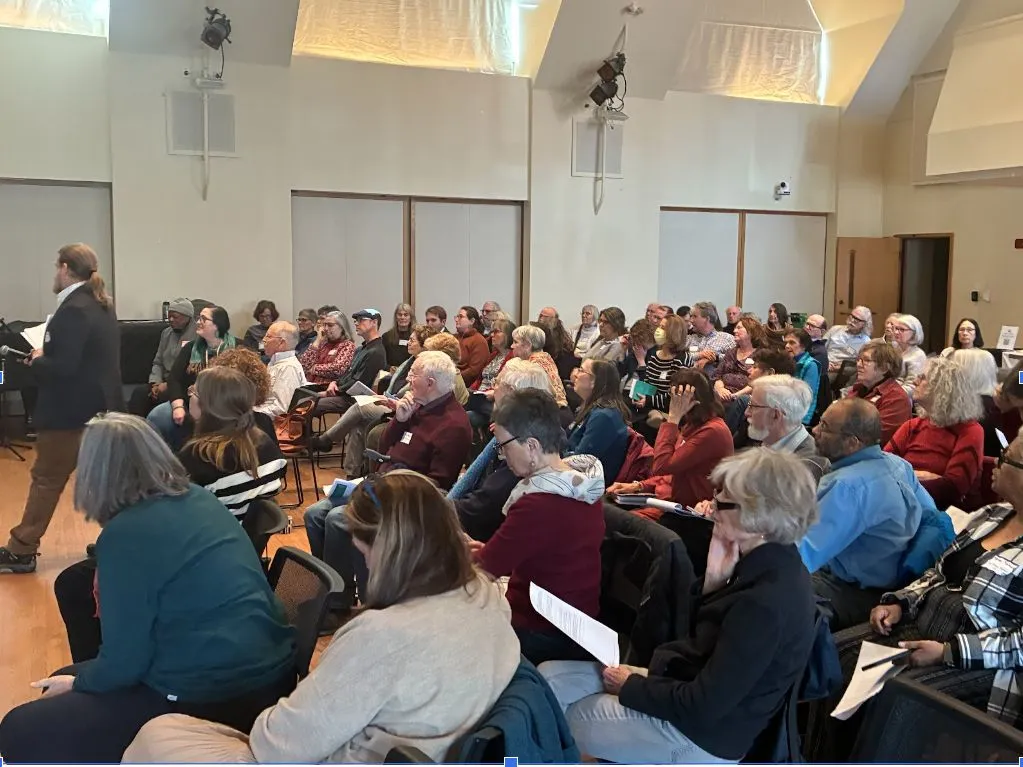
    The crowd at the First Church discussing the church’s historic ties to slavery. (Arianna Williams/Belmont Voice)

    Light streams through a multicolored stained-glass Tiffany window, filling the sanctuary of the First Church in Belmont with a warm, prismatic glow. The artwork depicts a man in a red robe reclining with a shepherd’s staff, an angel in green hovering above. Beneath the figures, an inscription reads: “1813 Elisha Atkins 1888.”

    The window has stood as the church’s artistic centerpiece for decades. But, like the building itself, it carries a lesser-known legacy: ties to slavery.

    Now, the congregation is reckoning with that history. In 2023, the church formed a task force that investigated the Atkins family’s fortune and its entanglement with slavery in Cuba. That work led to a reparations summit at which Unitarian Universalist congregations from across New England gathered in Belmont to share what they had uncovered about their own ties to slavery and to wrestle with a complex question: How do we repair?

    In Cuba, the small rural town of Pepito Tey lies about eight miles from Cienfuegos. The town was once called Soledad, a plantation owned by the Atkins family, where at least 177 people had been enslaved, according to the church’s website.

    Records show that Edwin F. Atkins, born Jan. 13, 1850, presided over the First Church in Belmont’s parish committee when he commissioned the radiant Tiffany window in memory of his father, Elisha Atkins. The window was dedicated in April 1890, along with the church building.

    The elder Atkins imported sugar from Cuba, especially from Cienfuegos, as early as 1838, according to the Massachusetts Historical Society. He operated E. Atkins and Company, and in the early 1880s, his son acquired Soledad and transformed it into a bustling sugar operation that yielded 4,000 tons by 1887.

    Slavery persisted in Cuba until 1886. Even after emancipation, many African and Chinese laborers worked on the plantation for paltry wages, according to historical accounts. In his 1926 book, “Sixty Years in Cuba,” Edwin F. Atkins wrote: “We had at Soledad Caribbees, Congos, Guinea negroes, and many others…among the older negroes was a little Congo, under five feet in height, who said he was the son of a prince in Africa and that he had been kidnapped and sent to Cuba as a slave.”

    Back in Belmont, the Atkins family became prominent benefactors over the years, donating land for Belmont Hill School and building several brick mansions, according to town records. The Belmont Historical Society notes that Atkins also contributed $5,000 to the First Church’s construction, a meaningful share of its $26,000 cost in those days.

    In the 19th century, Belmont thrived as a prosperous small town, as it does today. The same could not be said for Pepito Tey, which struggles with myriad ills.

    “They have an epidemiological crisis right now, in addition to their economic and political crisis,” said Gina Carloni, chair of the Legacy of Slavery Project. “There is a huge outbreak of mosquito-borne illnesses.”

    Cuba faces frequent power outages, chronic food shortages and widespread emigration, leaving behind an aging population, according to Human Rights Watch. The current U.S. administration has imposed an oil blockade restricting shipments from Venezuela and Mexico, the country’s main suppliers, according to human rights and policy reports.

    The church established the Legacy of Slavery Project in 2023. The group researches slavery and indentureship in Pepito Tey, informs the congregation and forges connections in Cuba for its next phase: reparations.

    On March 21, Unitarian Universalist churches from Arlington, Cambridge and beyond filled a room at The First Church in Belmont for a reparations summit. Five groups presented findings on their churches’ historical ties to slavery. The First Church in Cambridge recounted how minister William Brattle enslaved Cicely, a 15-year-old African girl, a fact engraved on her headstone in the Old Burying Ground, one of the oldest cemeteries in Cambridge.

    Researchers from the First Church of Arlington found documents showing that Revolutionary War hero Jason Russell enslaved Kate. The Arlington Historical Society records state that she was baptized on March 17, 1754, at 3 months old.

    “We have a responsibility to do something, and to bring this knowledge forward, and to move it from knowledge to action. And to work towards repairing those harms with communities that have been harmed,” Carloni said.

    The Belmont church works with Sophia Boyer, an educator and equity consultant with a background in sociology and history, to guide its reparations efforts. So far, church members have raised money to provide each home in Pepito Tey with a large mosquito net. Congregants are now seeking additional ways to advance reparative work, though strained U.S.-Cuba relations have made their efforts difficult.

    “As a person of color, it’s important to have these conversations in spaces with white people, and this is one of the venues that I will participate in that kind of conversation,” Boyer said.

    During the summit, Boyer outlined two types of repair: “material repair” and “symbolic repair.” Material repair involves tangible contributions such as money, land or other assets. Symbolic repair encompasses public apologies, memorials and historic acknowledgment. Her presentation invited congregants to reflect on how best to address past harms.

    “It has to come from them. What do they want? What do they need?” said Charles Hubbard, a member of the church’s Legacy of Slavery Project and an organizer of the summit. He said reparative work must prioritize the concerns of the people in their descendant community.

    “I think a lot of people hear the word reparations and they think, Oh, we’ve got to pay back money. We don’t have the money. We can’t do this, and therefore, we’re just gonna sort of look the other way,” said the Rev. John O’Connor, of the Arlington Street Church in Boston. “I think that is a very common response that you see in contemporary American culture.”

    In his closing remarks at the summit, the Rev. Chris Jablonski offered a note of hope: “We give thanks for the end of the beginning, for this lifelong and ongoing work.”

    This story was written by a journalism student in BU’s Newsroom program, a partnership between the university, The Belmont Voice and other news organizations in the Boston area.

  • She Once Relearned How to Walk; Now She’s Helping Others Do the Same

    She Once Relearned How to Walk; Now She’s Helping Others Do the Same

    Belmont resident Annie Veo completed her 14-week clinical rotation at Boston Children’s Hospital last year, treating children recovering from brain surgery, spinal fusion, hip injuries and broken bones. Some were in the intensive care unit; others were relearning how to walk.

    Fifteen years ago, Veo was one of them.

    For more than a decade, Annie battled a rare autoimmune disease that temporarily took her sight and mobility, forcing her to relearn how to walk.

    “I used to yell at my physical therapist because I didn’t want to get out of bed,” said Annie, 25. “It was too hard.”

    But those years in therapy shaped her career and inspired her to help people facing similar challenges.

    “After everything I went through, being a physical therapist was all I ever wanted because it helped to change my life,” she said.

    Annie took the licensing exam and waited.

    On Tuesday, Feb. 3, a few minutes before 5 p.m., her phone buzzed with a staccato text from an elated friend: “I passed.”

    Annie and her mother, Mora Veo, were in Miami, a post-exam vacation designed to decompress. She was shocked because the results of the physical therapy licensing exam were not supposed to be released until the following day.

    Annie and her mother sprinted up to their motel room. She opened the exam website, but the page would not load.

    With her mother looking over her shoulder, Annie clicked the page again. Nothing. Again, nothing. Then, at exactly 5:15 p.m., the word “Passed” appeared.

    “Me and my mom were screaming and jumping up and down, hugging each other,” she said. “It felt like everything I ever worked for finally came through.”

    Annie’s mother, Mora, said her daughter’s childhood symptoms were mysterious and frightening.

    “They really did not have much information on why she kept having episodes,” she said.

    This included recurring vision loss, severe headaches, neck and back pain, and weakness that sometimes left her unable to walk.

    “I would lose my peripheral vision one eye at a time, and it would switch back and forth,” Annie said.

    Doctors initially diagnosed her with meningitis, an inflammation of the membranes around the brain and spinal cord, because her symptoms closely mimicked the disease. But treatments did not resolve her condition, and over time, she lost her ability to walk. A decade later, at age 20, specialists determined she had myelin oligodendrocyte glycoprotein antibody disease, or MOG, a rare autoimmune disorder that affects the optic nerve and central nervous system.

    “I had to relearn how to walk again and just build up my strength to kind of live a normal life,” Annie said.

    Despite constant pain, multiple hospital admissions lasting weeks at a time, and uncertainty about her future, Annie kept up with her studies. Exhausted, with a body betraying her, she forced herself to attend classes, navigate hallways with limited vision, and complete assignments when she could barely keep her eyes open.

    “I don’t think I fully understood everything that was happening, but I just knew I had to keep going,” she said. “My family was always there, supporting me, and that gave me the push I needed to get through each day.”

    During her illness, the Belmont community rallied around the Veo family, and a 2012 fundraiser called “No Texting Day” raised more than $10,000 for Boston Children’s Hospital, where Annie was treated.

    Now, Annie is preparing to take on another challenge. This spring, she will run her first Boston Marathon to raise funds for children facing medical challenges.

    “There were moments I wasn’t sure I would ever get here,” she said. “Now I can run, walk, and help others, and it feels incredible to come to this full-circle moment.”

    It took years and countless hours of rehabilitation to get there. Ashlee Folkes, a physical therapist who supervised Annie during her clinical rotation, said she stood out early.

    “We never had to teach Annie how to work with kids. It came to her naturally,” Folkes said. “She could meet the kids where they were.”

    During her rotation, Annie worked with more than 100 patients, ranging from infants as young as 6 months old to young adults in their early 30s who were recovering from complex neurological and orthopedic procedures.

    “When more challenging cases came up, she never backed down,” Folkes said. “From the moment I met her, I knew she was going to be a great physical therapist.”

  • Belmont Residents Celebrate Public Library Opening

    Belmont Residents Celebrate Public Library Opening

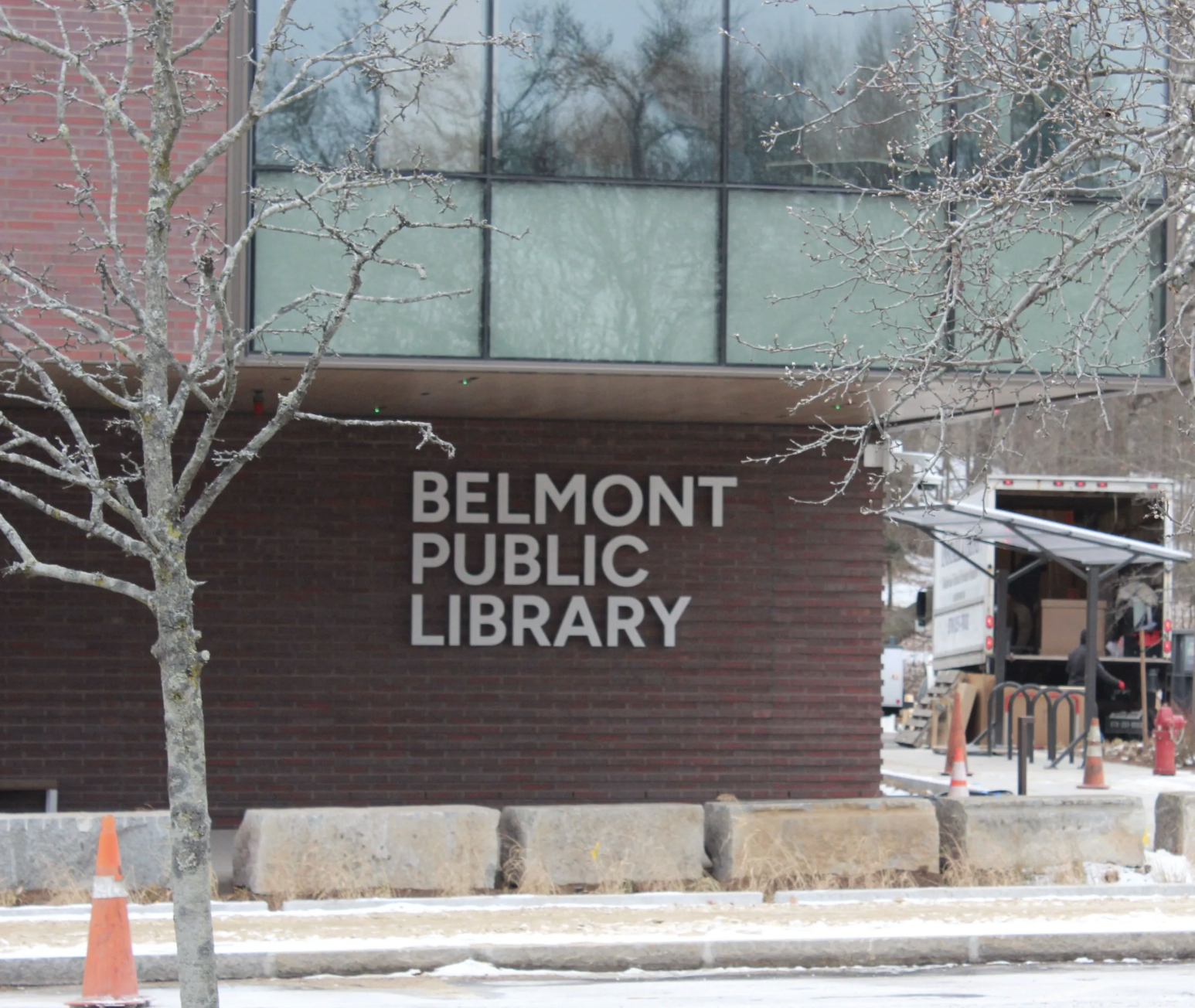
    The sign is up and workers are unloading the furniture as the library nears opening day. (Jesse A. Floyd/Belmont Voice)

    Ed Barker’s youngest daughter had respiratory problems that made the old, damp, and unreliable Belmont Public Library off-limits for his family. So, Barker ran for a seat on the Library Board of Trustees. On Jan. 17, his work paid off when the new library building opened after about two years of operating in temporary locations.

    On Feb. 6, Clair Colburn joined a panel discussion in the library’s Robert J. Morrissey Hall, and helped explain the building’s features to members of the public at an event hosted by the League of Women Voters of Belmont.

    “It was very impactful on the first day seeing all the kids who didn’t have anything like this for so long, one because the old building came down and we’ve never had anything quite like this in Belmont,” Colburn said.

    Colburn, an architect who served on the committee that oversaw the project, joined Board of Library Trustees member Barker and Children’s Services Coordinator Deborah Borsuk on the panel.

    Built in 1965, the old library building had developed structural issues. The foundation walls were failing and extensive studies showed it was more cost-effective to construct a new building rather than renovate, Colburn said. Borsuk said there were frequent issues with the elevator, water and plumbing. The Belmont Public Library is in the top 10 of busiest libraries in Massachusetts, according to the Belmont Library Foundation.

    “It became very clear that operating that building was inefficient and, to a certain extent, dangerous,” Barker said.

    It took more than 20 years of research and fundraising before construction began in 2024 with the demolition of the old building.

    “We couldn’t spend any time there,” Barker said.

    The new building has a reading room for quiet study, group study rooms for collaborative work, and a community classroom with access to 3D printing and sewing machines.

    “It’s an all-electric building, so there are no fossil fuels,” said Colburn.

    Environmental sustainability was one of the goals for the project.

    A green space along Wellington Brook is connected to the library for public use. The path is accessible and compliant with the Americans with Disabilities Act. The previous building failed to meet ADA guidelines in 1990, according to the library’s website.

    The Robert J. Morrissey Hall’s acoustics were designed to accommodate a piano for future musical events, Colburn said.

    “They literally went to the warehouse and sat on about 60 different chairs to figure out which ones are going to be comfortable, which ones are going to be durable, which ones are going to knock over when a teenager sits on them wrong,” Barker said, describing the design committee’s hands-on approach.

    “I think it’s absolutely beautiful,” said Maryann Scali, president of Belmont’s League of Women Voters, which donated to the project. She said the library gives organizations a place to gather in person after the COVID-19 pandemic shifted many meetings online.

    The Belmont Savings Bank Foundation donated $2 million toward the project. In honor of the gift, the room where the event was held was named after the foundation’s former chairman, Robert J. Morrissey.

    The project received $34.5 million in public funding but came in significantly under budget, aided by about $5 million in private funding. The exact figure is still being calculated, but Colburn estimates the project is half a million dollars under budget – money that will be returned to the town. A mural on the back wall of the first floor lists the names of people who donated.

    “It goes from the folks who made significant contributions to the kids who gave us fifteen bucks out of their piggy bank,” Barker said.

    Memories of the old library linger. The new children’s room displays stained glass windows recovered from the previous building, and granite from the curbs of the old building’s parking lot was repurposed into outdoor benches.

    “When we do have some nice spring weather, the ability to use this outdoor area for programming and individual library use will be just so valuable to us,” Borsuk said.

    Additional features are still in progress. Colburn said the building committee plans to install a green roof.

    “I do not have an exact number, but we have made, I would say, at least 300 library cards since we have been open,” Borsuk said.

    Most of the library’s programs are funded by the Friends of Belmont Public Library. Barker said the library’s budget is used to keep the building running, and he encouraged citizens to consider getting involved with the organization.

    “I appreciate that it was a community effort that brought us to this wonderful building,” said Borsuk.

    Arianna Williams is a journalism student in BU’s newsroom program, a partnership between the university, The Belmont Voice and other news organizations in the Boston area.

  • Using the Arts to Confront the Racism That’s Not Always Seen

    Inside Belmont High School’s Black Box Theater on Friday, Feb. 27, music and poetry will take on a subject some communities might believe they have already solved: racism.

    But for organizers and performers behind the upcoming Black History Month concert, the issue is not the loud, obvious version of racism most Americans picture. It’s the quieter kind. The kind marbled within misguided intentions and policies out of step with stated values.

    “This is not about yelling about racism at people,” musician Alastair Moock said. “But if nobody in the room feels challenged, we haven’t succeeded.”

    The Friday concert, featuring folk musicians Moock, Reggie Harris and Massachusetts Poet Laureate Regie Gibson, is part of Voices Rising, a new joint series by Passim’s Folk Collective and the Boston-based arts organization The Opening Doors Project. The series pairs curated music with candid conversations about race and identity across New England.

    In Belmont, the conversation carries weight.

    Belmont Against Racism, the local volunteer organization co-sponsoring the concert, was founded in 1992 after Los Angeles police officers were videotaped beating motorist Rodney King and the unrest that followed their acquittal. Residents formed the group out of concern that racial tensions seen nationally could surface locally.

    More than 30 years later, President Didier Moise says the work is far from finished.

    “I almost laugh when people say, ‘Well, racism is over,’” Moise said. “The effects of racism are still around us.”

    Moise, a Haitian American who has led the organization for more than two years, said Belmont’s efforts focus less on overt hostility and more on structural and institutional patterns that can be harder to see.

    “One of our missions is to encourage dialogue and awareness of institutional racism,” he said. “It’s very subtle.”

    That nuance is exactly what Moock says the concert aims to explore.

    “There are very different versions of racism,” said Moock. “There’s the loud, angry ‘I don’t like you because you don’t look like me’ version. But the version we are more focused on is what I would call liberal racism.”

    He describes it as “learning the vocabulary, saying the right things, and then being hypocritical about that with your actions.”

    An example, he said, is people who put Black Lives Matter signs in their yard and then fight affordable housing in their neighborhood.

    Moock, who co-founded The Opening Doors Project in 2021 with Stacey Babb, said the organization centers around “amplifying voices of color and advancing interracial conversations about race.” He believes those conversations are especially necessary in predominantly white suburban towns.

    “Black and brown communities are very aware of issues of racism and bias,” he said. “Conversations need to happen in white spaces more than they need to happen in any other spaces.”

    Black people make up 1.6% of Belmont’s population, according to the 2024 census. A reality Moock said can create both a challenge and an opportunity for change.

    “We get a pretty self-selecting crowd,” Moock said of past performances in communities with similar demographics. “Particularly in wealthy, predominantly white suburbs.”

    The goal is not to shame audiences, he added, but to invite reflection.

    “By virtue of showing up, they’re showing intention,” he said. “They want to learn. They’re meeting us halfway.”

    Still, he says comfort alone is not success, the organizers hope is to help the community reflect, and music makes that possible.

    “Using music as a way of digging into these conversations is an important piece of it,” Moock said. “Music brings people’s guard down and brings them together.”

    Gibson, who uses his African American lens to write poetry that often explores citizenship, democracy and public life, says the concert provides another avenue for civic engagement.

    “The rise of racism … it’s a social malaise that we have not solved,” Gibson said. “These things are just below the surface.”

    Gibson, who lived in Belmont from 2001 to 2006 and whose wife served on the board of Belmont Against Racism, said racial bias does not always present itself as open hostility. In some cases, he said, it surfaces in policy debates and in resistance to change.

    “When I was on the Human Rights Commission in Belmont,” he said, “there were folks who were expressly on the committee to make sure nothing changed.”

    He cited an incident years ago when flyers opposing interracial relationships circulated in town, an episode that prompted residents to launch a “Hate Has No Home Here” campaign in response.

    Gibson says art offers a way to ask difficult questions without closing doors.

    “My aim,” he said, “is to create a space that makes better citizenship possible.”

    That mission runs through the broader Voices Rising series, a program that includes an Indigenous Peoples’ Day concert, a Martin Luther King Jr. Day concert, two Black History Month concerts and other events. Each performance blends music with moderated dialogue, allowing artists to respond to one another and to audience questions.

    The Folk Collective at Passim, an artist-led initiative dedicated to expanding the narrative of folk music, partnered with The Opening Doors Project to bring the series to communities across New England throughout 2025 and 2026.

    Moock, who has spent three decades as a performer and teacher, said his own understanding of race has evolved through that work.

    “One of the privileges of whiteness in America is not having to think about your skin color,” he said. “White Americans often don’t think of themselves as having a race.”

    He said part of his role in interracial conversations with Harris is to acknowledge that privilege openly and honestly.

    “The single most important thing we’re doing in these spaces is modeling what healthy conversations and friendship can look like,” he said.

    Moise hopes the Belmont concert will build on that model locally. The organization has previously hosted film screenings, discussions and cultural events during Black History Month and Indigenous Peoples’ Day, often in response to students and families who felt certain histories were not fully acknowledged.

    “If you cannot even acknowledge a segment of society’s culture,” Moise said, “how could you say that you see these groups through a compassionate lens?”

    The concert, he said, is less about performance and more about presence.

    “We’re trying to build an inclusive and inviting community,” he said. “It has to be based on dignity and mutual respect.”

    Kallejhay Terrelong is a journalism student in Boston University’s Newsroom program, a partnership between the university, The Belmont Voice and other news organizations in the Boston area.

  • Food, Community Meet at Bellmont Caffe

    A few minutes after the bread vendor arrived at Bellmont Caffè, owner Rachid Smairi and his staff were discussing the merits of Greek versus Moroccan cuisine, their voices building with good-humored passion.

    “See, this is why I come here every day,” said customer Patrick Grasso, tilting his head toward the animated conversation.

    Even on the cafe’s quietest days, it hums with friendly chatter. Most of it comes from Smairi, who rotates between delivering food and welcoming customers. He jokes with a group of regulars about keeping a camel in the back of the restaurant. Recently, he surprised a new patron by bringing up the specialized bagels he imports from Montreal during a conversation – the same bagels the customer raved about to his family after a recent work trip.

    Customers say Smairi’s eight years of dedication to consistent, quality food and service have transformed Bellmont Caffè from a coffee shop into a community meeting place. Many regulars view the restaurant as a home away from home, and Smairi says it’s his life’s work to keep it that way.

    “I feel like I’m here for a purpose, not to just sell coffee,” he said. “If somebody is going through some difficulty, and there is something I can provide and do, I won’t even think twice. I will do it for them.”

    Smairi’s passion began during his childhood, as the youngest of 12 siblings in Casablanca, Morocco. He spent much of his youth working in the kitchen with his sisters, mixing handmade whipped cream and learning how to make cakes from scratch. He adored cooking and eating homemade food, knowing the effort and love his family put into each dish.

    “I grew up in that house loving these things,” he said. “That was the main source of me falling in love with the kitchen and forming a connection with cooking.”

    That passion inspired him to do more with food after he won his country’s lottery program, which allowed him to immigrate to the United States in March 2001 and eventually become a citizen in 2006. He began working in the food industry, but in 2003, he decided to pursue his new interest in restaurant operations.

    “I got to try something different … which is dealing with customers and day-to-day operation with employees, scheduling, food, ordering, and all of that,” he said. “I loved it.”

    Over 14 years, Smairi worked his way through Boston’s coffee scene, from a Huntington Avenue cafe to a Starbucks at the Sheraton Hotel in Boston to the Starbucks at the Prudential Center’s Barnes & Noble to a Dunkin’ Donuts in Belmont. After seven years there, one of his customers, Paula Carter, shared some insider information: The original owners were planning to sell the Bellmont Caffè. Soon after, he approached co-owners Minas Daldalian and Raffi Megdesyan, and they made a deal. Smairi became the cafe’s owner in March 2018.

    After picking up the keys, he shifted the cafe’s atmosphere in a Mediterranean direction, an homage to his homeland.Smairi’s love of homemade food animated his imagination and led to a curated menu featuring international cuisine. He gushed to a customer near the kitchen about the specialty waffles he imports from Belgium, then dipped behind a curtain and brought out two egg croissant sandwiches for a couple of regulars, and a crepe for another. Smairi says finding good food for his customers is something of an obsession. Even on vacation, he tries to bring food back to serve at the cafe.

    “We try to get a little bit of every place to make sure that the happiness of the customer is met,” he said.

    That goal extends to how he interacts with his patrons. If he can’t help someone, he tries to connect them to someone who can. He helped one customer who lost her job in the medical field get an interview by connecting her to another customer in the same profession. He introduced a couple to his mother in Casablanca so they could share a meal with her during their trip to Morocco. He offered to walk a 90-year-old woman to the cafe.

    “People can come here once every few months, and somehow he will remember, ‘How’s your kid doing in school?’” Grasso said. He started coming to the cafe four years ago and, after meeting a group of regulars, he has been coming consistently ever since. “He’ll have questions about them even though he hasn’t seen them for six, 10, 12 months … I find that amazing.”

    Over time, Smairi built a community of customers from all walks of life – construction workers, Harvard professors, doctors, professional athletes such as Boston Red Sox outfielder J.D. Martinez, and politicians such as Mitt Romney. The reason each person returns differs, but the community aspect is central to most people’s reasoning.

    “I feel like there’s a good vibe in this place that isn’t reflected in other places that are more corporate or chain in the town,” said William Valentine one recent afternoon. “My mother’s boss, (state) Sen. (William) Brownsberger, does a lot of meetings here outside because of the outdoor aspect and because of the community that’s been developed by the owner. A lot of places aren’t like that.”

    The cafe’s liveliness and warmth attract long-time regulars such as Linda Bragman and her group of friends back again and again.

    “I live by myself. I met these friends here for the last four years. We’re like family,” Bragman said, looking at the group. “But Rachid, he’s just a wonderful shopkeeper. It’s not like when you’re walking into Dunkin’ Donuts, you go and you leave. This is like home.”

    Customers have reflected his effort and positivity over the past eight years. During the coronavirus pandemic, neighbors stopped by to support the cafe financially, buying $300 to $400 gift certificates to use in the future. That support got the business and Smairi through the pandemic. Another time, an anonymous customer left a letter on the counter addressed to “Rachid, Bellmont Caffè,” thanking him for helping her through a hard time.

    “I was going through a very difficult time and you were there for me,” the note reads. “That’s not usually me, but at that period it was and I felt your positivity and love… It helped me a lot in that period.”

    Smairi said the woman left $100 in the envelope and signed the handwritten letter, “a customer.” He plans to keep both.

    “It just touched my heart a lot,” he said.

    The most recent form of support came in the mail in July 2025 – the Best Coffee Shop of Belmont Award. According to BusinessRate, which sponsored the award, the prize is “earned not by application or nomination, but by the authentic feedback of (its) own customers” who wrote Google reviews.

    “It’s nice to hear your effort has been noticed,” he said. “And, you know, it gives you a battery recharge of doing more and more and more, and it keeps that excitement going. It’s only going up and up.”

    Smairi hopes to eventually own the property and expand the cafe. Until then, most weekends will be filled with customers crowding into the small space, drinking warm beverages, dining on Smairi’s curated selection of food, and connecting with one another.

    He says he loves every second, and a recent gesture suggested he is sincere.

    After enjoying his first meal at the cafe, the bagel-loving customer placed his dishes at the main counter. Smairi asked him to wait a moment and disappeared into the kitchen. He emerged moments later with a bag of the man’s coveted Montreal bagels. Smiling, Smairi passed the gift to his customer.

    This story was written by a journalism student in BU’s Newsroom program, a partnership between the university, The Belmont Voice, and other news organizations in the Boston area.