Category: Boston Business Journal

  • Experts analyze consequences of Mass. tax cut ballot question

    A proposed 2026 ballot question to lower the Massachusetts income tax rate from 5% to 4% would cut household tax bills across the state but also blow a multibillion-dollar hole in state finances and force significant budget decisions on Beacon Hill, according to a recent Tufts University analysis.

    The report from the Center for State Policy Analysis estimates the measure would reduce the state income tax collections by 18.9% and total state tax revenue by about 10%, or roughly $5.1 billion a year by 2030. The report claims that revenue loss would more than offset gains surtax voters approved in 2022 on annual income above $1 million. 

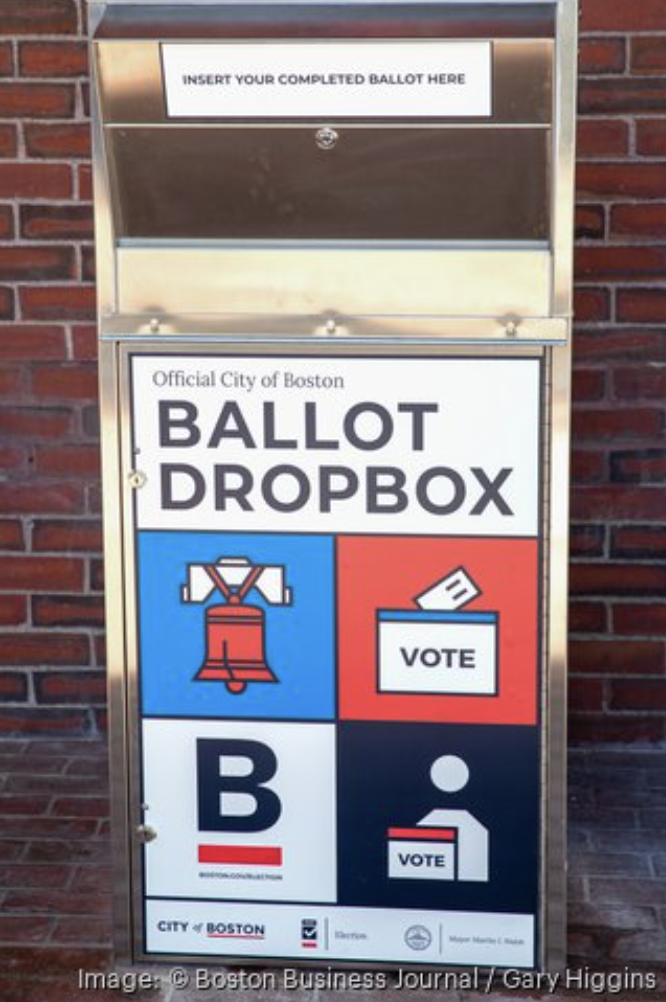
    A mail-in ballot drop box is one of three at at Boston City Hall.Early Voters came to Boston City Hall to place votes weeks ahead of the election.
    Gary Higgins / Boston Business Journal

     Phineas Baxandall, director of research and policy analysis at the Massachusetts Budget and Policy Center, said a revenue loss of that size would be unprecedented in Massachusetts and would likely force painful budget decisions across major areas of state spending.

     “We’ve never seen anything like this before,” he said.

     He compared the potential impact to the revenue collapse during the 2008-09 recession, when the state cut local aid, higher education and public health spending.

    For taxpayers, the proposal would mean smaller annual tax bill, but little change in household income. The report found the median households would save about $1,230 a year, with most keeping about 1% of their income. However, the value of those savings would favor top earners with the highest incomes, who would receive cuts roughly 30 times larger than the median household, the report found.

    The proposal would phase in the lower rate over three years, dropping to 4.67% on Jan. 1, 2027, 4.33% in 2028, to finally 4% in 2029. The rollout would create planning challenges for lawmakers already building future budgets without knowing whether voters will approve on such a major tax cut.

     Beacon Hill is already bracing for fallout if the proposal is approved, putting pressure on the state budget and potentially blocking other tax breaks for business to delay the shortfall.

    Baxandall said cuts to education-related spending could damage the state’s long-term economic position.

    “It would be strangling our competitive advantage as the most educated state in the U.S,” he said.

    He said surtax revenue has supported programs that residents rely on.

    “We have free school meals. We have free community college, turned around the deterioration of the MBTA … We became the only state in the nation to retain its subsidies for early childhood education care.” 

    Proponents of the ballot question argue that the cuts will strengthen economic competitiveness, but Baxandall said reducing the commonwealth’s ability to invest in education, commerce and infrastructure would ultimately hurt the state’s business climate. 

    “That’s not a good place to do business,” he said.

    However, supporters of the proposal argue that the tax cut will actually benefit taxpayers. Chris Keohan, the founder of CK Strategies and an organizer of the ballot question, said there is “no reason to believe that cuts will be necessary when this ballot question passes. Those threats are nothing more than fearmongering.”

    He said the numbers cited by opponents account for no economic growth and fail to understand that the money back in taxpayer’s pockets “will immediately go back out into the economy, creating jobs and increasing revenues from meals, hotels, gas and the other taxes that help to fund the state budget.”

    “Countless small businesses are saying that this tax cut will help them hire more employees, deal with rising costs and be the economic driver that moves our state forward,” Keohan added.

    Jim Stergios of the Pioneer Institute, who authored a report in support of the proposal, compared the pushback to backlash over the approved 2000 tax cut ballot which reduced the personal income tax rate from 5.95% to 5%. He stated that in the years the tax rate decreased, revenues were often flat or higher than the previous year.

     After Gov. Marua Healey publicly opposed the ballot measure, Stergios said in a statement that her claim “ignores more than a decade of runaway growth in state spending.”

     Further, he said the cut would help small and mid-sized businesses and increase employment. He argued the commonwealth can afford budget cuts by “reversing the recent surge in hiring and fixing widespread mismanagement in major benefits programs — mistaken payments, overpayments, and fraud.”

     Supporters also point to strong public support for approving the cut, with polls showing about 58% of respondents showing support as of February, according to The Bay State Poll, conducted by the University of New Hampshire Survey Center.

  • Massachusetts, Nova Scotia wind pact faces cost, permitting and transmission hurdles

    A memorandum of understanding between Massachusetts and Nova Scotia signed this month commits both governments to work together on offshore wind development and regional power sharing — but obstacles remain.

    The agreement — announced after Gov. Maura Healey unveiled her 2027 fiscal budget proposal — is an important first step to signal a coming stability to clean energy investors. However, experts say the deal, while important and symbolic, does little to change the state’s energy challenged outlook.

    The three-year MOU does not commit either government to purchase power and does not sanction the construction of any new transmission lines. Instead, it lays the foundation for collaboration as Nova Scotia builds its offshore wind industry and Massachusetts policymakers look to find solutions for long-term supply.

    Hannes Pfeifenberger of The Brattle Group, a consulting firm specialized in energy and finance, said one big obstacle is simply the cost. 

    “Part of the challenge is that with inflation and higher financing costs, the cost of offshore wind has increased significantly over the last five years,” he said.

    Another factor is time.

    Offshore-wind generation and transmission projects typically take a decade from planning to operation. Even under the best conditions, the benefits of the agreement would not be felt for years.

    “Building a large transmission, getting it planned, getting it permitted, finding people willing to pay for it, that’s probably closer to a 10-year process,” Pfeifenberger said.

    Supply-chain disruptions have added to the financial strain. Several U.S. offshore wind projects have been delayed or canceled because developers could not secure turbines within economically viable timelines.

    However, the ones that have been built — such as Vineyard Wind 1 — are running smoothly and proved their worth during cold snaps. The New England wind project only just resumed construction after a suspension issued from the U.S. Departments of the Interior’s Bureau of Ocean Energy Management was lifted by a federal judge in January. 

    At the same time, the state remains heavily reliant on natural gas for electricity generation, leaving ratepayers exposed to volatile fuel markets. Natural gas prices in New England can be significantly higher than in other regions due to pipeline constraints and seasonal demand spikes.

    Permitting uncertainty presents another major obstacle.

    Mark LeBel of the Regulatory Assistance Project said federal permitting instability has introduced risk into projects that already operate on small margins. “When the federal government plays games with permits, it ruins the certainty and financing model for all these things,” he said. 

    Questions surrounding who pays for transmission, how projects are approved, and how costs are allocated remain unresolved, he added.

    Meanwhile, electricity demand is expected to grow.

    ISO New England projects consumer demand for electricity will increase by roughly 11% over the next decade.

    Massachusetts needs additional energy resources to meet growing demand and long-term climate goals. Offshore wind is one pathway, but as of right now, the infrastructure, financing mechanisms and regulatory assurance required to carry out large-scale projects are not yet aligned with policy ambitions. 

    In that sense, the Nova Scotia agreement serves as a positive signal, but intent is not the same as delivering power.

    Until there is action in stabilizing permitting and financing costs moderate and transmission plans advance, the state’s energy system will remain largely dependent on existing resources.

  • Mass. hospitals have added 10K jobs since 2020. But that growth has a cost.

    Massachusetts hospitals have added 10,000 jobs to the healthcare workforce since 2020, primarily in caregiving positions, according to recently released data from the Massachusetts Health and Hospital Association. They have also reduced industry-wide vacancies by 28%.

    But one healthcare watchdog says that growth comes at the cost of other sectors and public priorities, since everyone, from businesses to individuals to taxpayers, covers these expenses.

    “We have to look at healthcare as part of the overall economy,” McAnneny said.

    The healthcare industry contributes heavily to the Massachusetts economy, which leads the United States in health care affordability and access. Total state health care expenditures in 2023 totaled $78.1 billion.

    Vacancies in essential hospital jobs decreased from 19,000 open positions in 2022 to 13,600 openings in 2024, according to the MHHA report. It says that has helped drive the state economy while also addressing the healthcare worker shortage for the past five years.

    However, the added expense of those hires can increase healthcare costs. Eileen McAnneny, president and CEO of the Employer Coalition on Health, said that businesses with a small profit margin, like small retailers, and restaurants, are particularly vulnerable to increased healthcare costs, which affects their ability to hire and operate. While she is not surprised that the healthcare workforce is growing, she says it’s one of the only few sectors that is expanding.

    “(The healthcare workforce growth) speaks to the overall affordability challenges in Massachusetts. Healthcare costs are a primary affordability concern,” she said.

    Valerie Fleishman, executive vice president and chief innovation officer of MHHA, argued that filling vacancies reduces healthcare costs rather than increasing them.

    “Reducing staffing vacancies strengthens patient care and access while delivering major economic benefits,” Fleishman said in a statement. “It cuts hospitals’ need for expensive temporary labor, helps prevent care delays that can drive up healthcare costs, and boosts local economies as workers spend and invest in their communities.”

    The healthcare industry contributes heavily to the local economy, with total state health care expenditures in 2023 totaling $78.1 billion.

    Healthcare vacancies

    The median vacancy rate for 56 different healthcare positions totaled 14.2% in 2024, according to the report. The number of jobs being filled increased for the majority of these positions, but workforce gaps expanded for a few roles, including endoscopy, cardiac catheter, and radiologic positions.

    When caregiver roles aren’t filled this causes a “ripple effect” in the entire health care system, said Fleishman of MHHA.

    “There are fewer beds online, fewer beds available for patients,” she said. “There are wait times that increase, and there are additional strains on caregivers.”

    Areas for progress listed included nursing vacancy rates, temporary labor, transitions of care and behavioral health. While “significant strides” have been made in hiring to assist in the patient transition process and free up beds in hospitals, as many as 2,000 patients are “stuck” in hospitals waiting to be discharged, according to the report.

    Vacancy rates for nursing roles also decreased by 5%, going from 15% in 2022 to 10% currently. So for every 10 nursing roles available, there is now one vacant role. Five out of the top 10 vacancy rate reductions consisted of nursing related positions.

    “There’s still progress to make, but our members, our hospitals, our health systems, are really leaning into solutions to fill those vacancies,” said Fleishman, referring to nursing and caregiver positions.

    Earlier this year, 78% of Massachusetts nurses said in a survey that hospital care has declined over the past two years due to understaffing, according to the Massachusetts Nursing Association, which several nurses attributed to workplace violence, being overworked, poor nurse to patient ratios and inadequate pay.

    “It’s encouraging, but there’s a lot more work that needs to be done,” said Aaron Winston, a registered nurse and MNA committee co-chair, referring to the new data. 

    Critical gaps still remain for sitters, community health workers and technician positions whose vacancy rates all exceed 20%, which is above the median vacancy rate, according to the report, which also noted behavioral health and advanced practice as roles facing high turnover rates and shortages in staffing.

    MHA listed career ladder programs, partnerships with higher education for training programs, higher salaries, housing and childcare support programs by hospitals, their partners and the state government as contributors to workforce improvements.

    To continue the positive momentum moving forward, the report recommended passing legislation to support the workforce, filling care gaps for key roles and focusing on patient-facing roles. 

    McAnneny said as the population ages, healthcare will need to become more efficient and affordable, since more people will use it. She added that healthcare is only one determinant of health, and access to food and housing and public safety are other areas to focus on.

    “The growth demand for [healthcare] service won’t abate anytime soon,” she said.

  • There’s been a decline in SNAP sales at Mass. farmers markets since Nov. 1

    Massachusetts farmers are beginning to feel the effects of reduced federal SNAP benefits, with some businesses reporting their SNAP are down by half at farmers markets around Boston.

    Nov. 1 was the one-month mark for the federal government shutdown that began Oct. 1. Patrick Penn, deputy under secretary of food nutrition and consumer services for the U.S. Department of Agriculture, said last week in a court filing that SNAP recipients will receive 65% of their benefits for the month. The decision follows an order by a federal judge for the Trump administration to use emergency funding for the program Oct. 31.

    David Wadleigh, owner of Kimball Fruit Farm in Pepperell, said last week that he’s been to a market every single day Nov. 1. At all of them, he said foot traffic was slower than usual and at the Copley Square Farmers Market on Friday, SNAP sales were down by about 50%from before Nov. 1.

    SNAP purchases typically make up about 20% of his profits at markets, which worked out to about a 10% decrease in profits overall, he said.

    “We’ve been paying to upkeep these plants already. We’ve already put the money out,” Wadleigh said. “Now the risk is the money might not come in like we’re expecting it to.”

    Chath pierSath, a farm worker at Nicewicz Family Family Farm in Bolton, drew attention to agriculture’s effect on the larger state and city economy. Enabling people to eat sustains this part of the economy, he said.

    “By making sure that access to food and water (is available), you create a larger picture of our protective economy,” he said. “When people are alive, well and healthy, then the economy is alive and healthy.”

    Some farmers said they hadn’t yet seen a decline, but said it was too early in the day to determine if sales would be affected or not.

    “Farmers are in many ways notoriously optimistic,” said Edith Murnane, executive director of Massachusetts Farmers Markets. “There’s a sense of ‘we’ll wait and see.’”

    Farmers said help is available to help from the state’s Healthy Incentives Program as well as community donations and assistance programs as avenues for affected customers to continue shopping at markets.

    Markets in areas like Somerville and Cambridge have programs that allow people to obtain additional SNAP benefits. For the Davis Square Farmers Market in Somerville, users typically need to have a remaining SNAP balance to match their account balances for the month by up to $15. In light of the shutdown, customers have been able to receive benefits regardless of the amount on their cards, said Murnane.

    Vendors who don’t take SNAP benefits at their formers market stands said that while they haven’t been directly affected yet, they worry that’s possible if the shutdown continues, since consumers may choose to use money they would use for other uses on food instead.

    Most farmers with leftover produce said they plan to donate their crops to local food banks. While concerned about their own sales, many said they’re also worried for the consumers themselves.

    “We at least have places that we can donate (food) to so hopefully (people) will still have access to the food,” Wadleigh said. “We want everyone to be able to have access to our food.”

    As the federal government shutdown continues, farmer’s markets, neighborhood stores and supermarkets along with the retailing, agriculture and fishing sectors are all expected to feel continued impacts.

  • Mass. needs thousands more clean energy workers. Here’s how it plans to train them

    Massachusetts needs to train about 29,000 additional clean energy workers by 2030 to reach its climate goal of net zero greenhouse gas emissions by 2050, according to the Massachusetts Clean Energy Center’s 2024 Industry Report. 

    Jennifer Applebaum, MassCEC’s managing director of workforce development, said in reaching that estimate the agency looked at both its goals and what the market is saying at the moment.

    “What drives hiring is absolutely still local industry and business demand,” Applebaum said. “The programs and workforce efforts that we set up and support have to be tied to that local and real time demand.”

    The Healey Administration, in partnership with Social Finance — a national nonprofit and registered investment advisor — recently implemented the Massachusetts Climate Careers Fund to fill climate employment gaps, grow economic mobility and prop up a diverse workforce.

    The CCF offers 0% interest loans to low-income Massachusetts residents for climate career training. Once a worker is certified in a “good-paying role that supports the climate transition,” and earns at least $47,000 annually, they begin repaying their loan. Repayments will help fund future participants, according to the Social Finance website.

    “We get to spend that same dollar over and over again,” Massachusetts Climate Chief Melissa Hoffer said at a climate workforce forum of about 50 people hosted by the Boston Foundation and Social Finance Oct. 8. 

    Programs include electrical and plumbing apprenticeships, HVAC certification and solar tech training. 

    The original goal for the fund was $10 million, comprising both public and private philanthropic investment. MassCEC has not formally announced what the state’s specific contribution amount towards the fund will be yet, Applebaum said. 

    Kirstin Hill, president and chief operating officer of Social Finance, said there has been a “meaningful focus” on higher education nationwide but less investment in the workforce compared to other developed countries globally. 

    “One of the critical levers that’s missing, not only in Massachusetts, but across the country, is the workforce, and is the skilled labor workforce, in particular,” she said.

    Applebaum said historically the workforce was a limiting factor for clean energy, but with properly-skilled employees, these companies could be growing faster. 

    “Solutions are reaching places where there’s scale and need for much larger numbers of folks that are going to do the installation and the maintenance to make these changes really happen across the commonwealth,” Applebaum said. 

    Barriers that can prevent both training and employment include transportation, child-care and rent payments. The opportunity cost for training can sometimes derail workers from completing the needed steps, and other times, the jobs trained workers hold can be unsustainable for personal or external reasons.

    The International Renewable Energy Agency reported in July that 91% of renewable energy projects in 2024 were less expensive than their fossil fuel alternatives while renewables outpaced coal generation globally for the first half of 2025, according to a Global Electricity Mid-Year Insights report by Ember, a global energy think tank. 

    So the “horse is out the barn” — or a done deal — Hoffer said at the forum, referring to the globalized clean energy transition. 

    “[Massachusetts] is in line with that forward thinking, and the market is supporting these transitions,” said Mary Wagner, clean energy training manager at Holyoke Community College. 

    Jobs in the clean energy sector include electricians, energy auditors, electric vehicle mechanics and HVAC technicians as well as solar, offshore wind, EV repairs and geothermal technology related careers.

    The clean energy industry makes up 3% of the Massachusetts workforce, according to MassCEC’s 2024 Executive Summary, and the industry has experienced 100% job growth since 2010. As it expands, the supply of workers and the training and resources needed must increase to keep up with demand. 

    “Filling those jobs is a tremendous economic impact. We need the workers, and [these are] good high paying jobs.” said Rep. Jeffrey Roy, D-Franklin, who is currently sponsoring a bill to establish green energy tracks in vocational schools.

    Andrew Baker, workforce training manager at HCC, expects there to be job growth in the trades during a time when other jobs are threatened by artificial intelligence. 

    “You can’t AI your way out of a broken furnace,” Baker said.

  • Fed’s Collins presents benign economic outlook, emphasizes inflation and wage growth focus

    Federal Reserve Bank of Boston President Susan M. Collins presented a “benign” outlook on the economy with inflation and wage growth remaining main focuses as markets begin experiencing long-term effects of continued inflation, tariffs and heightened market uncertainty.

     Collins said Wednesday that the Federal Reserve must maintain its federal independence to ensure it can make long term monetary policy decisions to reach and sustain its goals, including a 2% target for inflation it currently exceeds.  

    “That’s an environment that really supports maximum employment,” Collins said to a gathering of about 200 people, consisting of business leaders across sectors from outsourcing to financing. “Vibrancy enables people to be able to thrive.” 

    She reported solid economic growth and a resilient consumer consumption, which she attributed to the healthy spending positions of households and firms, and reduced employment growth that reflects a slow growth in both labor supply and labor demand and uncertainty in the current economic environment. 

    “As the uncertainty fades and firms adjust to the new tariff environment, I would expect the pace of hiring to increase,” Collins said. 

    While the broader economy has remained “relatively robust,” Collins said she expects the effects from tariffs to become more pronounced as firms pass costs onto consumers in the form of higher prices, which in turn would limit purchasing power and household spending. 

    Consumers have responded with resilience so far, she said, but added that this could evolve, so it should be watched carefully.

    Current market challenges include heightened uncertainty, housing supply and affordability, scarcity of childcare and increased difficulties for maintaining technology, science and healthcare ecosystems, according to Collins.

    Collins, who usually roots economic decisions in data, said considering the federal government shutdown – where certain data might now be unavailable until it reopens – the Federal Reserve will use a range of other valuable indicators to make decisions.

    “We get creative and look at the range of information out there,” she said in an interview with the Boston Business Journal.

    Most Boston business leaders were unsurprised by the findings and presented a range of reactions following the presentations from “cautiously pessimistic” to neutral to optimistic.

    Joelle Moroney, vice president of brand partnerships for Captiv8, said she appreciated Collins’ “audacious” goals of financial stability and employment. 

    “It gave me a good perspective to lean in on these small business owners and bring our part to support those areas wherever we can,” Moroney said.

    DJ Dantas, founder and CEO of Solvane Strategies, said he was unsurprised by Collins’ findings and echoed her use of the word benign to describe the economic outlook.

    “A lot of it are things that I’ve observed and heard before,” Dantas said. “I was more so expecting some new information, something I haven’t heard before.

    Topics not addressed during the hour-long presentation that business leaders said they would have liked to see included growing wage gaps, a greater focus on healthcare and education and tariffs’ effects outside the United States, including China, which Rob Natale, founder of North Square Capital, described as the “elephant in the room.”

  • Food truck owners push for bill establishing state-wide health regulations

    As the summer winds to an end, and with it, the prime season for mobile food establishments, lawmakers are considering a bill to create statewide health regulations for food truck businesses.

    Current regulations require trucks to obtain separate permits from the local board of health for every vehicle they use in each municipality the establishments conduct business in. While the businesses are required to meet certain provisions under the Retail Food Code, the local boards “may require additional information or plans.”

    “To just not have any uniform standards in place is really a barrier for food trucks to be able to get to more communities,” said the bill’s sponsor Sen. Patrick O’Connor, R-Weymouth.

    Compared to their brick and mortar counterparts, mobile food establishments must deal with several permitting processes based on how many municipalities — of which there are 351 statewide — they choose to conduct business in.

    “We would love businesses to have less hurdles,” said Jessica Moore, director of government affairs for the Massachusetts Restaurant Association, in support of the bill. “If it’s someone who has both [a food truck and a brick-and-mortar restaurant], they know what they’re doing. We want to make business as safe, easy and clean as possible.”

    Food truck owners have described the health regulation process as tedious, confusing, disorganized, costly and redundant. 

    And the format of permits vary across municipalities, according to owners. Towns decide how long the permits are valid for and can require separate permits for individual events if they wish. 

    Ryan Margulis, chief executive officer of Bees And Thank You, a mobile food establishment, testified at a Sept. 10 hearing of the Legislature’s Public Health Committee that he has spent more than $17,000 and 472 hours — the equivalent to about 59 full work days — on health permits over the last five years.

    “We end up spending thousands and thousands of dollars per year,” said Mari Kilmain, treasurer of the SSFTA and events coordinator for Sarcastic Swine BBQ & Restaurant.  

    Some owners said the permitting process prevents them from conducting business in certain towns. Inspections typically take about 10 minutes, according to Kilmain, but the traveling time and costs add up.

    O’Connor and several owners said support for the bill has been unanimous amongst mobile food establishments. The only concern he’s heard, O’Connor said, involves the money communities would lose from permitting fees. 

    “There’s other ways in which communities can recoup the money that they could potentially lose,” O’Connor said. “But again, we’re talking [about] not that much money, a couple thousand for each one of the communities. Growing the industry will see more benefit.” 

    “It just really comes down to common sense,” said Clint Smith, an original member of the SSFTA, referring to the bill. 

    Smith, owner of South Shore Taco Guy, services 24 towns across Massachusetts and pays about $3,500-$3,800 a year in permitting fees—but it isn’t the cost that bothers him.

    “It’s the redundancy and time it takes to get these inspections [that’s the problem] for me personally,” Smith said.

    One goal O’Connor has with passing this bill is for mobile food businesses to build themselves up and invest in brick-and-mortar restaurants, which will increase meal availability, taxes and employment.

    Katie Keefe, president of the SSFTA and owner of Ellie’s Treats, said the current permitting process has affected opportunities for businesses and deterred people from entering the industry. 

    “There are people that genuinely just do not get started in the industry because they’re so overwhelmed by it,” Keefe said. “If the permitting process was simplified in Massachusetts, I definitely think you would see more food trucks.”