Category: GottaKnowMedford

  • Medford’s urban forest needs some TLC and some funding, according to a new report

    Medford’s urban forest needs some TLC and some funding, according to a new report

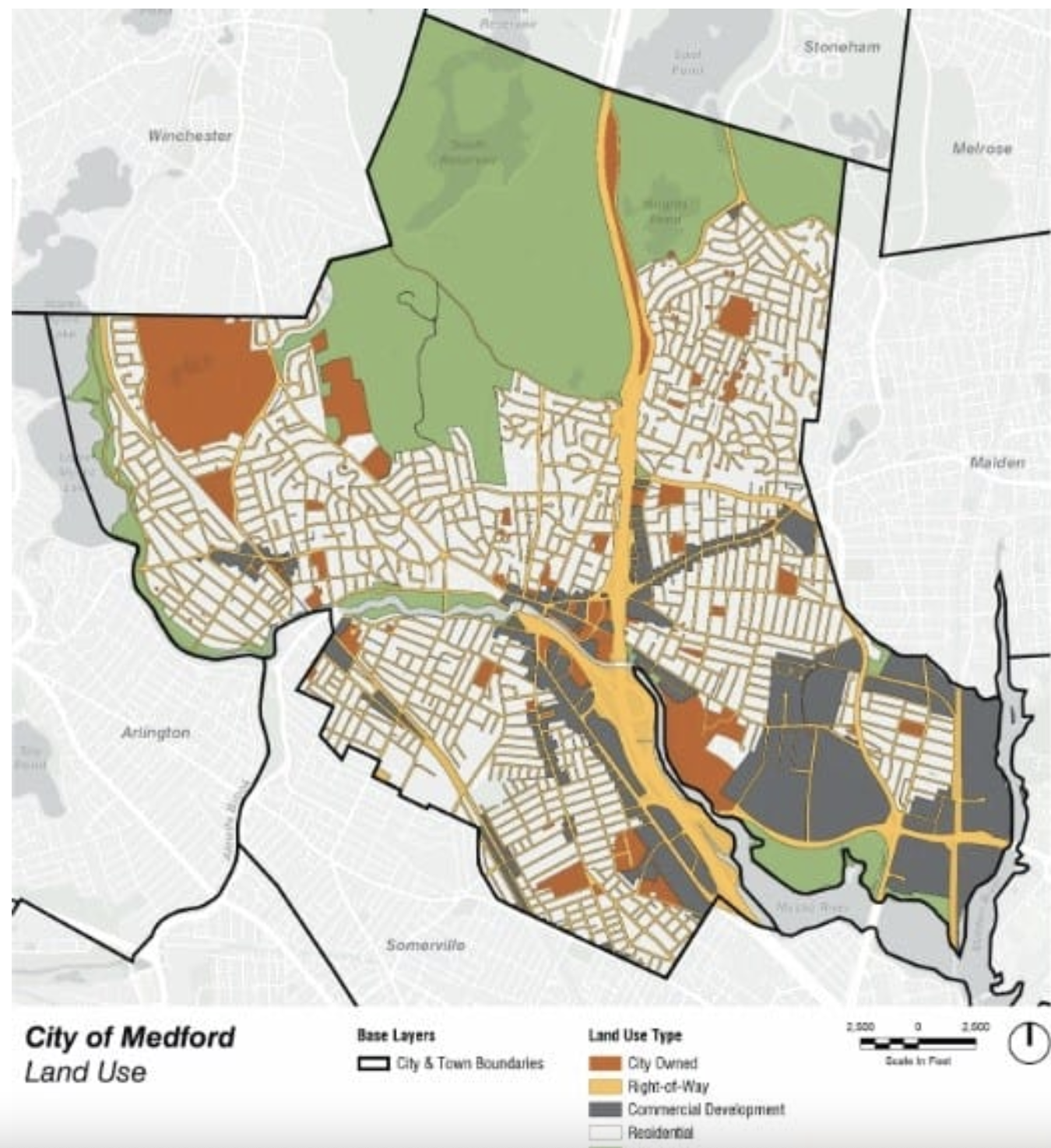
    Graphic created by Weston & Sampson for Medford’s Urban Forest Management Plan shows current land use in the city. COURTESY/City of Medford and Weston & Sampson

    Medford should focus on growing, protecting and maintaining trees as key strategies for creating a “healthy, resilient and equitable urban forest,” according to a new report.

    The Urban Forest Management Plan recommends strengthening tree ordinances and standards, maximizing tree canopy in limited spaces, and increasing staffing, tree diversity, and annual tree plantings. Doing so would help the city address issues of canopy loss and a lack of canopy coverage.

    The City Council unanimously passed a motion on March 10 urging the city to implement the plan and set a goal of having canopy coverage of 35% in residential areas within the next 10 years. It requests that the city allocate resources in upcoming budgets to carry out these goals.

    Medford’s tree canopy — the layer of leaves and branches visible from above — declined citywide by about 1.2% from 2015 to 2021, according to the report. While any loss is unwanted, 1.2% is “actually not bad” when compared to other communities that have lost canopy faster, said Matthew Soule, a team leader at Weston & Sampson, the engineering and environmental consulting firm hired to do the report.

    The plan, which was funded by the state, recommends that efforts to create this urban forest should be prioritized in environmental justice areas, which are places disproportionately affected by environmental hazards, often in marginalized communities. Vacant sites and sites with dead trees should be inspected for planting, and the city should look into replacing species in poor condition.

    The report recommends that by 2030, the city double the number of trees planted every year. Soule, who explained the report’s findings during a March 30 presentation at the Medford Public Library, said doubling the current number of trees planted annually from 200 to 400 would reverse projected tree losses over time.

    “If we stuck with 200 trees a year, it becomes much harder to get that to make up those losses,” Soule said.

    The presentation also called for the city to increase its forestry budget by $400,000 a year in order to reach these 2030 goals and to add three positions–an additional forester and two laborers. These increases would allow the forestry department to plant and manage more trees, Soule said.

    Amanda Bowen, who is co-chair of TreesMedford, a volunteer nonprofit that supports tree planting and stewardship, said the goals to increase the budget and staff are realistic but might require grant funding. Some cities charge developers for removing trees and pointed towards that as another way to build funding, she said.

    Residents at the March 30 presentation expressed concerns and excitement at the report’s findings. Concerns included the survival likeliness of trees, why more money is not spent on watering, pruning and maintaining the trees once they are planted, and the city’s role in trees on private land. Medford Public Works Commissioner Tim McGivern said the city has no obligation to spend public money on private resources but tries to help out where it can.

    McGivern said the inventory of public trees is the most powerful finding from the report. Medford’s private roads are absent from the inventory, he said, but the city can still plant on private property if it has the permission to do so.

    Residents can request that the city plant trees in their neighborhood, said Medford Tree Warden Aggie Tuden. If multiple residents on a street request trees, they’re more likely to get them, Tuden said.

    There are about 10,000 public trees in Medford. About 10% of them are in poor condition, and 1% are dead.

    There are challenges to planting trees in Medford, Soule said. Some sidewalks are too small, and there is limited space in some areas. To address this, he said trees can be planted more densely and between trees that are expected to die soon.

    City Councilor Justin Tseng said there are ways to find funding to plant more trees, such as grants. Plans often die in filing cabinets, he said, and he wants to make sure that that doesn’t happen here. 

    “You need a spark like this meeting to galvanize people together,” Tseng said. 

    This story is part of a partnership between Gotta Know Medford and the Boston University Department of Journalism.

  • Medford High School Best Buddies Program fosters inclusivity, leadership

    The school’s Best Buddies club, which is celebrating its first anniversary, is dedicated to bridging social, physical and economic gaps for people with intellectual and developmental disabilities.

    Medford High School’s Best Buddies club celebrates its first anniversary this month. Pictured, from left, are Co-Advisor Kasey Goldberg, Student Leadership Team members Savannah Brazell and Kelly Dao, Communication Coordinator Katherine Beagan, Vice President Norah Berson, and President Violet Freimark. GOTTA KNOW MEDFORD PHOTO/Crystal Yormick

    The school’s Best Buddies club, which is celebrating its first anniversary, is dedicated to bridging social, physical and economic gaps for people with intellectual and developmental disabilities.

    In the halls of Medford High School, about 30 students who might otherwise not have met have found a place to connect. Twice a month, they spend time with one another through activities like baking, crafting and celebrating holidays.

    This club is the school’s chapter of Best Buddies, an international organization dedicated to bridging social, physical and economic gaps for people with intellectual and developmental disabilities. The program, implemented here in March 2025, hosts group events and provides one-to-one matches between students with and without disabilities. It will celebrate its first anniversary this month. 

    “There’s just never been an entry point for some of these kids to meet, and that’s where [the] Best Buddies program comes into,” said John Skerry, a co-adviser of the program and a teacher at Medford High. 

    Student leaders in the club said they’ve gone outside their comfort zones, met people they wouldn’t have met otherwise, and presented in front of the Medford School Committee and at the club fair. They’ve raised money, taken on leadership responsibilities, and made new friends since joining Best Buddies. 

    “I get shy a little bit because I don’t socialize. I have social anxiety,” said sophomore Savannah Brazell. “Now that I’m a Best Buddies director, I feel like I’m coming out of my shell and talking to people.”

    The club began with group activities last year, said Kasey Goldberg, Medford’s other Best Buddies co-adviser. Goldberg, who is a teacher for Medford High’s Access Program — a life skills, special education program — said this school year the club implemented one-to-one matches between students. Now when the group hosts big activities, students with a match can also hang out with their buddies during that time. There are currently 10 pairs of students with buddies, but a one-to-one match is not a club requirement.

    “So [there are] 20 students total who have a match,” Goldberg said. “Then the other 13 either weren’t interested in having a match or couldn’t make the time commitment, but they still wanted to be in Best Buddies and a part of the group.”

    The students who do have buddies are paired based on interests and personality or through the organic connections they make. Goldberg said having a buddy helps students who are shy to communicate with someone rather than sitting alone. 

    “You’re still friends and connect with everyone in the club, but it’s like that person is kind of your person to sit down next to them first at the club,” said junior Norah Berson, the club’s vice president. 

    President Violet Freimark said the club has helped people connect like she has with her buddy, who she said usually keeps to herself. 

    “I’ve been able to make a good connection with her when she usually wouldn’t reach out to people, which is always very nice,” Freimark said.

    Some of the student leaders said since they’ve been introduced to their buddies through the club, they notice each other much more across campus than before. 

    “Ever since we’ve become buddies, I see them at least three times a day,” Berson said. “We always say hi to each other.” 

    Berson said she’s formed an “out-of-school and in-school connection” through the program. She said she joined because she wanted to be a part of a supportive environment and now sees her buddy three times a day. 

    “This feels great to kind of be a leader and connect with people that I don’t know as well and also just share Best Buddies to other people,” Berson said.

    Because the program is so new, an important aspect is educating people about it and what it means to its members, said sophomore Katherine Beagan, the club’s communication coordinator. Beagan and her buddy Kelly Dao are on the student leadership team together.

    “I wanted to make sure that everybody was in a place where they could feel safe and where they could be themselves because it can sometimes be hard to foster that environment in high schools,” Freimark said. 

    Skerry said he started the program last year because he wanted to foster inclusively at the school. Goldberg said she saw a notice last year about Best Buddies coming to Medford High. It’s the “perfect opportunity” for her students to become involved with an after-school club setting, she said. 

    “It’s been a great time so far, and it’s great to see my students so involved,” Goldberg said. “The inclusion aspect is just amazing to see.” 

    Skerry and Goldberg said the Medford community has been receptive to the program. Local businesses have sponsored some of the club’s events, like pumpkin decorating, and donated snacks for meetings. The school’s culinary program donated a sheet cake for one of its events, Skerry said.

    While the program has stayed within the high school so far, Skerry said he hopes to expand to the middle school and to participate in events with Best Buddies programs at other schools. 

    Organizers said they always welcome more people to join the club, but they have a good group right now, too. 

    “It’s so heartwarming every time that I leave there,” Goldberg said. “It just feels so good to see the inclusion and how happy my students get having a buddy.”

    This story is part of a partnership between Gotta Know Medford and the Boston University Department of Journalism.

  • Medford Polar Plunge benefits Special Olympics

    Medford Polar Plunge benefits Special Olympics

    These brave souls took the Medford Polar Plunge just before the Blizzard of ’26 hit. The event was co-hosted by Medford Police and the Medford Chamber of Commerce.

    About 50 people took turns immersing themselves in a truck-size basin of frigid water outside Hormel Stadium Sunday, Feb. 22, to raise money for Special Olympics Massachusetts.

    The second Medford Mobile Polar Plunge, which was hosted by Medford Police and the Medford Chamber of Commerce, raised about $8,000 of its $15,000 goal. Participants could sign up individually or as teams, and fundraising sources included sponsorships and donations. The event included free food, free car wash vouchers, and an after-party at Ford Tavern.

    Carly Ciarletta (center) celebrates post-plunge with her sister and another co-worker. The sisters wore matching Raising Cane’s shirts for the event. GOTTA KNOW MEDFORD PHOTO/Crystal Yormick

    Participants included members of the Medford Police Department, Tufts University students, and other community members. The crowd gathered beforehand in the parking lot outside the stadium, where people could sign up at the last minute and some sponsors had tables to promote their businesses. 

    Medford Chamber of Commerce Executive Director Laura O’Neill said the event was a way for the Medford business community and Police Department to come together and make a positive impact. 

    “It’s our way of helping the police raise money for Special Olympics,” O’Neill said. “The police do a lot of business in Medford, and it’s a coordinated effort for a great cause.” 

    Medford Police Public Information Officer Jessica Walsh said the organizers first met at Medford National Night Out, and the idea blossomed from there. The plunge, run by the Law Enforcement Torch Run of Special Olympics, was a collaboration between the Medford Police Department and the Medford Chamber of Commerce. A professional diver was on hand to assist participants.

    “It’s just such a community endeavor,” O’Neill said. “We love that the businesses and that the police all get together.” 

    People had different reasons for participating. Some said they have family or friends with special needs, while others said they wanted to give back to the community and bring people together. 

    “It’s just a great way for people to come out to do something outside of their comfort zone,” said Kylie Cronin, fundraising coordinator for Special Olympics Massachusetts. “Our big thing is to jump for inclusion.” 

    There are 31 other plunges happening around Massachusetts, according to the Special Olympics website. Participants chose different ways to jump in, ranging from cannonballs to belly-flops to jackknives. 

    GOTTA KNOW MEDFORD PHOTO/Crystal Yormick

    Medford Mayor Breanna Lungo-Koehn said she plunged because Medford has several inclusionary programs across the city she wants to support, along with the police department and Special Olympics. 

    The event was originally planned for Feb. 8 but changed because of cold temperatures.

    Anthony Petrelis and Jon Sencabaugh, who plunged for the Beyond Podcast team, said they saw the event after it was delayed, so they were able to sign up. 

    “[This is] allowing kids the opportunity of all walks of life [and] giving them the opportunity to do what everyone else can do,” said Sencabaugh, whose 6-year-old daughter has special needs. 

    The team, which raised $420, the second highest amount, credited their podcast audience. 

    It took about 20 minutes for all plungers to go, and many met the water with yelps and gasps. One man outstretched his arms and asked the crowd, “Are you not entertained?” They cheered, and he jumped in.

    Some wore bathing suits while others wore clothes or costumes. Two sisters wore matching Raising Cane’s T-shirts. There were awards for “Most Spirited Plungers,” which went to the brothers of Theta Chi, which is a fraternity at Tufts University, “Most Spirited,” which went to Petrelis, and “Top Fundraiser” and “Top Fundraising Team,” which went, respectively, to Walsh and the Medford Police Department. Walsh raised just over $2,000, individually, and the MPD team as a whole raised over $3,000. 

    “It’s just such a good reset,” said Carly Ciarletta, area leader of marketing at Raising Cane’s, sporting a red Raising Cane’s T-shirt. 

    Those plunging expressed a mix of excitement and apprehension before entering the water. 

    “I’m freezing just thinking about it,” Lungo-Koehn said.

    Walsh said the event will hopefully continue each year and continue to get more people involved. 

    To learn more and to make a donation, visit https://fundraise.specialolympicsma.org/events/946.

  • Tufts Medicine Behavioral Health Hospital opens next month

    Tufts Medicine Behavioral Health Hospital opens next month

    A new behavioral health hospital will open in Malden in March on the site of the former Malden Hospital.

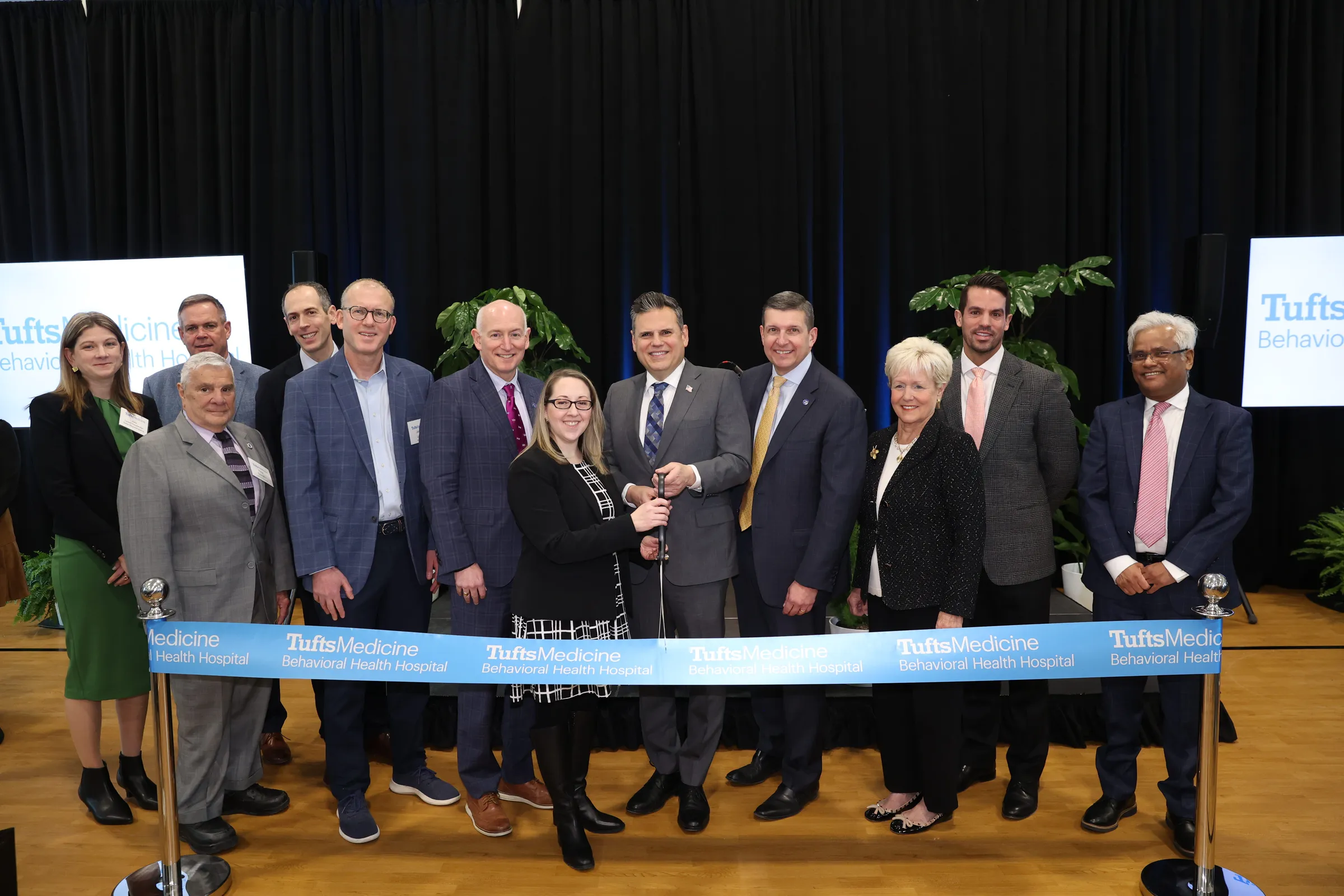
    The 144-bed Tufts Medicine Behavioral Health Hospital, which is a collaboration between Tufts University and Acadia Healthcare, will train Tufts medical students and consolidate inpatient services in a facility designed specifically for psychiatric care.

    Malden Mayor Gary Christenson said the city has been trying to find a use for the building at 100 Hospital Road for over two decades. 

    “To finally see a project like this one involving behavioral health is a great feeling for our city,” Christenson said. 

    Dr. Brent Forester, director of behavioral health at Tufts Medicine, wrote in an emailed statement that community stakeholders had expressed they wanted to see the property return to health care use.

    About two-thirds of the beds at the hospital will be new, while the others will be transferred from MelroseWakefield Hospital and Lawrence Memorial Hospital in Medford. The behavioral health hospital is where patients facing mental health issues will be directed if they first go to other medical facilities in the area. 

    “We expect that the additional bed capacity will help relieve pressure across the broader Massachusetts behavioral health system,” Forester wrote.

    Other considerations for the space included housing, senior living, city services and a park, Christenson said.

    Ward 3 City Councilor Amanda Linehan said she has not heard any concerns about the space being used as a hospital instead of housing. In the past, when the area was considered for multi-family housing, she said, there was so much backlash that the developer withdrew the project. 

    Linehan said she has been impressed by how much the community has supported the project. While she thinks concerns could come up once the hospital opens, she said, “We will address them as they do, like you would with any new development.” 

    Linehan and Christenson both said the pandemic is part of the reason the community has supported the plan for the behavioral hospital. 

    “[Mental health was] something that made sense to people in a new way,” Linehan said. “The pandemic re-framed how people think about mental health and mental health needs because so many people had suffered isolation and loss and grief.” 

    The city plans to buy back a few acres of land on the site next to the hospital and install benches and trails there for the public to enjoy, according to Christenson.

    The hospital, which will serve adults and children, will provide behavioral health treatment like therapies, psychiatric evaluations, outpatient programs, medication management, hospitalization, and treatment for mental health and substance use disorders.

    The staff will include psychiatrists, psychiatric nurses, therapists, social workers, and other behavioral health professionals. It will also serve as a teaching site in collaboration with the Tufts University School of Medicine.

    Expanding training capacity at a time when the state and nation are facing a shortage of behavioral health professionals is essential, Forester wrote. 

    He wrote there is a “critical need” for increased behavioral health capacity in the state. Because of the insufficient amount of psychiatric inpatient beds, patients can sometimes be stuck in emergency departments for days, he wrote, and he cited a recent study that found that about 12% of pediatric visits to the ER for mental health concerns last for about three or more days before an inpatient bed is available. 

    Christenson said he is thrilled to have a Tufts hospital in the community because of its strong reputation. And because it is a for-profit hospital, it will add property tax revenue to the city.

    The hospital has begun onboarding clinical staff and will start accepting patients by the end of March.

  • Medford third-grader’s idea becomes school newspaper at Roberts Elementary School

    Medford third-grader’s idea becomes school newspaper at Roberts Elementary School

    The student newspaper at the Roberts Elementary School began not with a curriculum change, but with a third grader who decided the school should have one.

    Owen Jette Walsh, 10, proposed the idea during the final week of third grade last year, asking to start what is now the Roberts Ram-Page, a newspaper produced by elementary school students.

    “I thought it would be nice to have a school newspaper,” said Owen, who serves as the publication’s editor-in-chief. “I would describe it as a school newspaper that is made to make people laugh and know about the community.”

    What will you find inside the Roberts Elementary School’s student run and produced newspaper? Here’s just one sample. COURTESY PHOTO/ROBERTS-RAM PAGE NEWS

    Though the students have grown up with Chromebooks and smartphones, the Roberts Ram-Page is a traditional print newspaper.

    Jennifer Devlin, who was Owen’s second- and third-grade teacher, said she was surprised when he approached her in the final days of the last school year with the idea. During the summer break, the two began working on turning it into a reality.

    “Owen asked if he could hang a sign-up form in the classroom, saying he wanted to start a school newspaper,” Devlin said. “I thought it was a great idea, so we got together and wrote a proposal to ask permission to have the paper.”

    Owen and Devlin created a prototype issue so they could present the idea to the school, and other students soon joined the team. The Roberts Ram-Page published its first full issue in December and is preparing its second for March.

    “I wanted to be in the Roberts Ram-Page because I thought it’d be fun,” said fifth-grade reporter Martha Jacob, 11. “I like writing a lot, and I thought it would be a fun way to get to know my community.”

    The group now meets after school on Wednesdays to report, write and design the publication. Sixteen students brainstorm topics they believe their readers will find interesting, assign stories and submit drafts.

    The December issue featured a mix of reporting, reviews, opinion and entertainment. One story examined why desserts are rarely served at lunch, while another recapped the Student Council’s annual food drive. The issue also included jokes, a comic strip, a review of the new “Dog Man” book and a feature in which students debated whether they would drive a flying car.

    “We make a list of things kids will like, because we’re kids ourselves,” said fourth-grade reporter Mary Massa, 9. “Then we choose one, whether it’s an opinion topic or just something happening, and decide what to write about.”

    Students submit their drafts through Google Classroom, where Devlin reviews and edits the work before moving it into Canva for layout and design. Once finalized, the paper is printed, folded, stapled and distributed to classrooms.

    “I guide them in their writing a little bit, but mostly I go over it and help put it all together,” Devlin said. “After the submissions, we print it and help with the folding and stapling. It’s several hundred copies, which is a lot.”

    Beyond writing stories, the project has also required students to communicate with teachers and staff while managing responsibilities.

    “They have to reach out to adults and write emails,” Devlin said. “They have to interact with people they’re not used to interacting with, so they’re definitely learning communication skills.”

    The staff of the Roberts Ram-Page includes editors, reporters, designers and features specialists. COURTESY PHOTO/ROBERTS-RAM PAGE NEWS

    Students said the process has also taught them how to work together and stay on schedule so each part of the paper comes together on time.

    “You have to get it out by a certain point so the design team can place it,” Mary said. “In class you might have more time, but here we have to meet the deadline.”

    The paper has begun to generate conversation across the school, with students offering feedback and suggesting ideas for future issues.

    “Some people have said, ‘This is a great idea for the paper,’ and they’re sharing ideas for future editions,” Devlin said. “The kids are enjoying it, and they’re looking forward to the next issue.”

    The group was recognized during December’s School Committee meeting, drawing attention beyond the school’s walls.

    Looking ahead, Owen said he hopes the paper continues after he moves on from Roberts.

    “I just hope it keeps going, and I hope other schools follow this idea,” Owen said.

    Fifth-grade reporter Guthrie Hansen, 10, said she also hopes the paper continues while maintaining high standards.

    “I want it to keep going, but I want it to be good,” Guthrie said. “I don’t want to just push out random stuff. I want to make people happy and have more people read it, because I think it’s very impressive for us kids.”

    Sangmin Song is a senior journalism student. This story is part of a partnership between Gotta Know Medford and the Boston University Department of Journalism.

  • Medford’s Edify Church drive provides clothing for community, exposure for church

    Sweaters, coats, dresses, shoes and bags line the walls, shelves and tables of the basement of a building on High Street. Although the selection features gently used items as well as clothing with the tags still attached, it is not like other secondhand shopping opportunities — it is entirely free.

    The items, donated by church and community members, are part of Edify Church’s fifth clothing drive, which began in November and ended last weekend.

    Pastor Britnee Youman said the idea came about when she would offer to have church members look through her closet or give away a piece of clothing she no longer used. It turned into a broader project.

    “Me and my husband are givers,” she said. “We give clothing away. We give shoes away. We just give things away to help people. So I think it’s just in our heart to give and to sow into people’s lives.”

    Saturday’s event received a rush of about 10 to 15 people that slowed shortly before noon, Britnee said.

    Edify Church has been operating from a building on High Street for three years. GOTTA KNOW MEDFORD STAFF PHOTO/CRYSTAL YORMICK

    The clothing drives have been a way for the 7-year-old nondenominational church to give back to the community and expose it to more people, church members said.

    “We wanted to do something that was going to support and bless the community,” said Pastor Eric Youman, Britnee’s husband.

    Eric said Edify Church has gained a lot of traction with the community since starting the drives. Volunteers stand outside the drives with signs during the events, but this was not possible Saturday because of the cold weather, he said.

    Church member Caterin Hodjikj-Valiente said her experiences at the clothing drives have been uplifting. It differs from shopping at thrift stores like Goodwill or Salvation Army, because the items are all free, she said.

    Hodjikj-Valiente and Britnee said people in Medford don’t always need the clothes, but are happy to donate.

    “You just hold onto [this stuff], but in these times that I’ve volunteered I’ve seen people that really need it,” Hodjikj-Valiente said. “They walk out of here so happy.”

    Maciel Beato, another church member, said a lot of people don’t know where Edify Church is because it’s in a basement. When people come to the drives, she said, they get free items and “they’re also getting some Jesus.”

    The church’s operations and services will continue until the end of February, when it plans to leave its High Street location, Britnee said.

    People have brought bags of clothes to donate and also have left the drive with bags full of clothes, Britnee said. She recalled one person with six children who found the drive particularly helpful. Another time, a man who had an interview the next week left with a suit.

    “We were able to be a blessing to him when it came to that,” Britnee said. “So that warmed my heart.”

    Clothing donated by the community for the fifth Edify Church drive. GOTTA KNOW MEDFORD STAFF PHOTO/CRYSTAL YORMICK

    The Youmans launched Edify Church in their living room in 2019. They started operating out of Envision Hotel in Everett in 2020 for in-person services for a few weeks before conducting virtual operations during the COVID-19 pandemic.

    After the pandemic, it moved to an office space in Everett before finding its current space on High Street, where it has been for just over three years, Britnee said. The congregation is made up of about 30 people.

    Edify Church has not yet identified plans for a new location, and there are no plans to move into a new space yet, Britnee said. She said it is not feasible right now to have physical space for the church but plans to continue doing ministry.

    Crystal Yormick is a journalism student at Boston University. This story is part of a partnership between Gotta Know Medford and the Boston University Department of Journalism.

  • Medford firefighters say they are fed up with mice and mold in station

    Medford firefighters are fed up with their station.

    Citing rodents, bugs, and mold in the Main Street headquarters — where they eat, sleep, and live almost as much as their own homes — they’re asking for help from city officials, a year after voters shot down a $30 million proposal to build a new station.

    In late August, the Medford firefighters’ union, Local 1032 took to Facebook with their complaints. They posted photos and videos taken inside the Fire Department headquarters, along with a letter to the health director describing the problems and asking the city for help to “mitigate the filth.”

    Firefighters have been complaining about the station for years, but they lobbied against November’s ballot question, saying the plans were inadequate.

    City officials would not speak with Gotta Know Medford about the firehouse and referred a reporter to a communications director, who emailed a statement saying the issues have been largely resolved.

    Gotta Know Medford attempted to speak with firefighters about the conditions, but none would talk on the record. One firefighter did speak at length with a reporter but later asked to have his name withheld for fear of retaliation.

    “We just want a fire station that doesn’t have mice and rats crawling around,” he said. “I don’t think that’s that much to ask.”

    He said city officials have ignored the firehouse conditions since firefighters lobbied against last year’s ballot question. The firefighter stopped speaking with Gotta Know Medford in early October, though, saying city officials were starting to pay attention to the problems and he didn’t want to jeopardize that progress.

    In a written timeline shared with Gotta Know Medford, the firefighter cited two incidents in late July and early August. One involved a firefighter finding a mouse eating through the tinfoil on his food container. A week later, another found droppings beside the coffee pot in the morning.

    The firefighters’ union then posted on its Facebook page photos and videos of mice crawling out of food pantries, bite marks torn through insulation, and corners of the station covered in droppings.

    “We want a mayor that works with us collaboratively and stands up for civil service employees and protects her employees from an infestation of mice,” one firefighter wrote on Facebook, “which our current living conditions entail.”

    The union also shared a letter from Local 1032 President Danielle Marcellino to Medford Health Department Director MaryAnn O’Connor.

    “We have been trying to work with the Chief and the City Administration to mitigate numerous issues, specifically: rodents, insects/mites, and feces that are found in every corner, cabinet, and under every piece of furniture or appliance,” Marcellino wrote in her letter, dated Aug. 25. “The Union officials have been more than patient with our chain of command, but at this point the lack of action is far beyond acceptable.”

    Mayor Breanna Lungo-Koehn and Fire Chief Todd Evans both refused to speak with Gotta Know Medford and referred a reporter to communications director Steve Smirti. Smirti would not speak with a reporter but provided a written statement.

    Once city officials received the union’s letter, they contacted pest control, sealed access points, and conducted a deep clean of the kitchen, Smirti wrote.

    “To give some context, there were no rats on the premises, it was mice. And mice are attracted to food waste that is not properly disposed of,” Smirti wrote in an email. “We learned that personnel were leaving food unattended and that’s going to attract mice and insects, just like if you or I didn’t clean up after ourselves at home.”

    He said the station hasn’t had a mouse problem since, “probably due to the staff doing a better job disposing of food and cleaning up after meals.”

    But the firefighter who spoke with Gotta Know Medford said mice were still in the station as of late September. Terminix was coming weekly, advising firefighters not to use the oven or the stove, forcing firefighters to spend excess money on takeout. Pest control experts raised health concerns over discolored droppings that may suggest the mice have ingested poison, “a hazard to our health,” the firefighter said.

    Asked why firefighters lobbied against the $30 million ballot initiative that would have funded a new fire station, the firefighter said fire personnel were not consulted after one initial meeting. The mayor did set up a committee, he said, but that committee never met.

    City Council President Isaac “Zac” Bears said Medford clearly needs a fire station.

    “It’s been clear for a long time that we need a new fire headquarters,” Bears said. “Our firefighters deserve a much better facility than what we have now.”

    He said that although he was disappointed that the ballot question was shot down — and the current facility is “disgusting” — he was even more frustrated by the reason behind it.

    “I understand that they are not happy with each other, and haven’t been for a long time,” he said. “[But] I really would like to see leadership from the mayor to come together with the fire union and to let us know what the plan is. Just because that question didn’t pass, doesn’t mean we don’t need to get this done.”

    Lungo-Koehn has not communicated any plans regarding the firehouse to anyone on the City Council, Bears said.

    Daisy Levine is a journalism student at Boston University. This story is part of a partnership between Gotta Know Medford and the Boston University Department of Journalism.