Category: The Swellesley Report

  • Wellesley eats up library’s Edible Book Festival

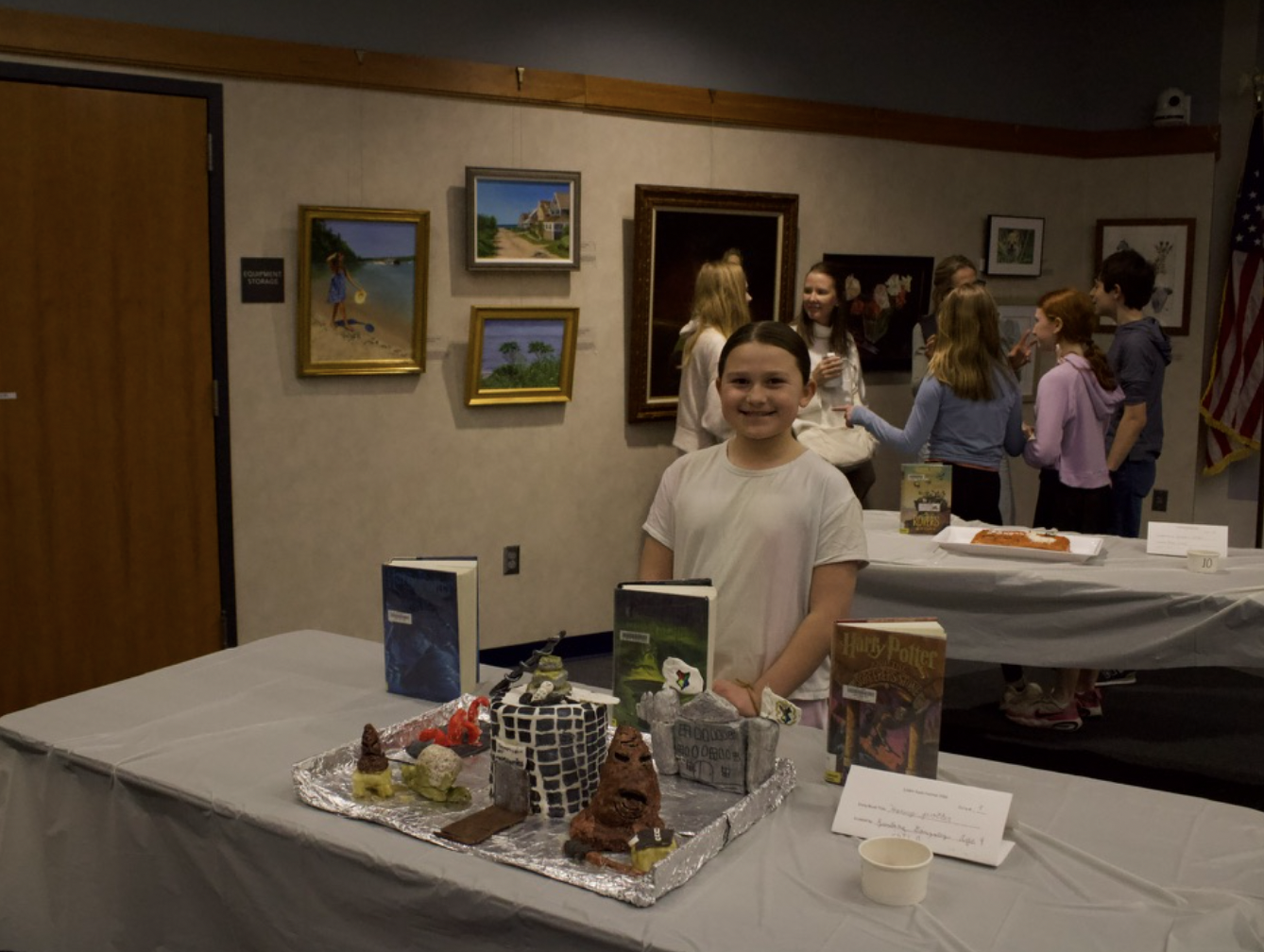
    Luciana Gonzalez next to her Harry Potter-themed edible creation (photos by Emma Mullay)

    When asked why she picked Harry Potter as the theme for her edible creation, 9-year-old Luciana Gonzalez, standing proudly at her station—which showcased an intricate scene depicting characters and places like the Sorting Hat, Hogwarts Castle and Hedwig the owl made from cake, Rice Krispy treats, fondant and more—said it was simple. 

     “I like magic!”

    The Wellesley Free Library hosted its second annual Edible Book Festival on March 29, with colorful and delicious creations depicting different scenes from over a dozen children’s novels. 

    Emma Weiler, children’s supervisor at Wellesley Free Library

    Emma Weiler, the children’s supervisor at the Wellesley Free Library, said she heard about it online and wanted to take part.

    “People organize these globally, it’s always around April 1, and I’ve always wanted to do one,” she said. “I like that, as a librarian, I can take my interests and turn them into programs.”

    This is the second year Wellesley has held festivities for International Edible Book Day since librarians Judith A. Hoffberg and Béatrice Coron founded the holiday April 1, 2000.

    Weiler said the library event was open to everybody, regardless of age. It awarded six different prizes for both youth and adult submissions. Two awards, Best Kid Creation and Funniest/Punniest Entry, went to 8-year-old Avery Lee who created “Make Way for Booklings,” a play on Robert McCloskey’s iconic “Make Way for Ducklings” book. 

    8-year-old Avery Lee, who won Best Kid Creation and Funniest/Punniest Entry for her “Make Way for Booklings” design

    Isabella Conway, 10, based her creation off of Jasmine Warga’s “A Rover’s Story,” which she chose because she “wanted to have something that represented a lot of life lessons” and was “inspiring” to her and her peers. 

    Conway said she chose to frost a rectangle cake because she knew it would be easier to design and wanted it to resemble the cover of a book. She said she heard about the event through the bulletin board at the library and is planning on taking part in it again in the future. 

    Isabella Conway next to her “A Rover’s Story” edible creation

    Gonzalez decided to recreate a variety of scenes from the Harry Potter series by JK Rowling, which are both her favorite books and movies, with the castle Hogwarts, the Sorting Hat and Harry’s pet owl, Hedwig, among those showcased in her design.

    Her friends and family also all love the books, so she said it was an easy decision. Gonzalez said she had “so much fun” with the hopes to do it again next year. 

    Weiler said she aims to continue the event next year, hoping for increased turnout and more engagement from the community. 

    “I feel like every year, you tweak things and try and make it a little better,” she said “This is only our second year, but I’ve certainly been billing it as our second annual, and we’re going to do it again next year.”

    This story is part of a partnership between the Swellesley Report and the Boston University Department of Journalism.

  • Reflecting on the Wellesley Inn’s demolition 20 years ago

    The first room to the left in the Wellesley Inn housed a large, ornate fireplace, a central part of the living room where residents would meet up to chat or solve jigsaw puzzles over tea and corn muffins. The room was adorned with dark and moody wooden accents, and community members would gather in one of the Inn’s three unique dining rooms, or by the rocking chairs on the front porch looking out over Washington Street. It was a place to eat, a place to meet, and a place to simply get together with friends and family. 

    But that was 20 years ago. 

    Now, in its stead, stands a luxury condo development with over 20 housing units above the businesses on the lower level. Gone are the days of the historic community gathering hub that held that lot for over a century, now home to a modern monolith, and to some, a shadow over the town. 

    Long-time Wellesley residents, like Beth Hinchliffe, mourn the loss of the Inn and what it stood for. Originally the Wellesley Tea Room, it was established in 1897 and remained the focal point of the town until it was sold to developers and demolished in 2006. 

    “It was really important in the life of the town, because it had grown up with the town,” Hinchliffe said. “It had a graciousness about it, and an awareness of history, of where we came from. It was a connection with all the generations that have come before.”

    Hinchliffe said she attended all sorts of events at the Inn throughout the years, from baby showers to wedding receptions to graduation and birthday parties. But above all, she said, it was a place for the community to come together, and one that hasn’t been replicated since. With three different restaurants — a tavern, a ballroom, and the original tea room — there was something for every occasion. 

    “It led to losing the sense of a town center, a community center, because it really was our community gathering place,” Hinchliffe said. “It was so much a part of all your life.” 

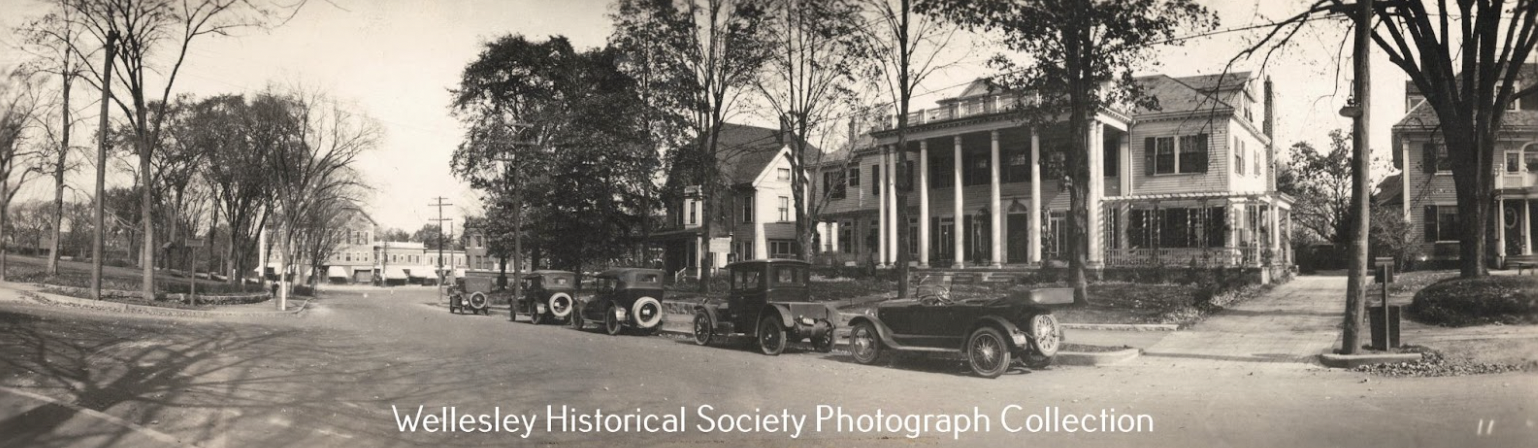
    Wellesley Inn (Wellesley Historical Society Photograph Collection)
    Inside the Wellesley Inn (Wellesley Historical Society Photograph Collection)

    She recalled going there after graduation to celebrate and how her parents went out to dinner there every year for Mothers’ Day. There was caroling in the winter, Easter egg hunts in the spring, and it was where everyone gathered after the annual Wellesley Veterans Parade. Her favorite memories, however, were sitting by the fireplace in the living room with friends and family, drinking tea and solving puzzles in the warmth of the flame.  

    “That room was like a big embrace,” she said. “I remember times I’d been out shopping with friends and we would just go in to get our tea in front of the fireplace.”

    Katherine “Gig” Babson has lived in the same house in Wellesley for almost 79 years and remembers the Inn as “a glorious structure,” with the columns and stairs providing an intense visual impact in the heart of town. In her 50 years of involvement in local politics, she served as a Select Board member for nine years and was on the committee when the building was torn down. 

    Babson said she has “very strong feelings” about the Inn being demolished instead of purchased by Wellesley College. 

    “My unfiltered view is that Wellesley College had a great opportunity to purchase it and make it into a boutique hotel for the benefit of Wellesley College students,” she said. “I think it’s a missed opportunity.” 

    At the time, there were movements from local residents to see if there was any way to preserve some part of the original building, but most people understood that it was incredibly expensive and would have been far too large of an undertaking to be feasible. 

    Wellesley Inn (Wellesley Historical Society Photograph Collection)
    Wellesley Inn (Wellesley Historical Society Photograph Collection)

    Tory DeFazio, a resident of almost 89 years and a Town Meeting member for over 50, said that the Inn originated as a family home and eventually expanded to serve the parents of the students at Wellesley College looking for somewhere to stay. Since then, those families and anyone else visiting Wellesley have had to stay in nearby towns like Needham or Newton, he said. 

    “When we had family weddings, the guests would stay there at the Wellesley Inn, and you could sit out on the front porch in a rocker and look at the traffic going by,” he said. “It was just a lovely environment, and they were always very gracious.” 

    It has been 20 years since the demolition itself, which fell exactly on Wellesley’s 125th birthday on April 6, 2006. That decision, though likely unintentional, was a blow to many who were already devastated by the loss of the historic building, with Babson referring to the choice as “a huge booboo.” 

    “If you’re going to take down something that a lot of people have strong feelings about, maybe you shouldn’t take it down on the town’s birthday,” she said. “They could have been more sensitive.”

    Hinchliffe remembered the day itself, noting that while people knew the demolition was imminent, nobody expected them to pick that day to tear it down. Friends called to her to avoid the “heartache” of the demolition, and “the town really got riled up when they tore it down on exactly the 125th birthday.” 

    “It was shocking to a lot of people,” DeFazio said. “It was gone before you knew it.” 

    While there are some visual similarities between the Wellesley Inn and The Belclare, the new development that took its place, they serve vastly different functions.

    “The columns are the only thing that remind me of the old Inn,” DeFazio said. “But there’s no porch, no rockers.” 

    The Belclare
    The Belclare (photo by Emma Mullay)

    On the ground level of the development, there are a number of shops that are rented out, although there has been a significant amount of turnover with them, DeFazio said. Above them are the luxury condos, selling for up to $3 million. 

    Lois Lee and Young Jo Kim, Wellesley residents of 22 years, didn’t live in town during the Inn’s prime and don’t remember it when “it was really being used.” 

    “It’s nice for having the option of a luxury condo right in the center of town,” Lee said. “They did a beautiful job with the building, and it is nice to have the retail on the first floor.”

    But while these condos provide a new life for the lot, others, like Hinchliffe, still deeply mourn that place it used to be. 

    “I just loved it, and I miss it,” she said. “I think everybody misses it.” 

    This story is part of a partnership between the Swellesley Report and the Boston University Department of Journalism.

  • Race for Norfolk DA opens after Morrissey steps down amid controversy surrounding Read, Birchmore cases

    After years of controversy surrounding the Norfolk County district attorney’s office, voters will choose a new top prosecutor this fall as a crowded field of candidates begins to take shape.

    District attorneys serve as the chief law enforcement officials in their counties, overseeing criminal prosecutions, working with police on investigations, and deciding what charges to bring or whether to bring them at all.

    The race comes after longtime Norfolk District Attorney Michael W. Morrissey announced in January that he would not seek reelection, having served since 2010. Morrissey’s tenure has drawn increasing scrutiny in recent years over how his office handled several high-profile cases.

    The Sept. 1 Democratic primary is likely to decide the race, as voters in 28 cities and towns including in Wellesley choose from a field of six candidates. 

    High-profile cases fuel scrutiny of DA’s office

    The most high-profile case in recent Norfolk County history was that of Karen Read, who was charged with killing her boyfriend, Boston police officer John O’Keefe, in 2022. Prosecutors alleged Read struck O’Keefe with her SUV and left him in the snow, while her defense argued she was framed and that O’Keefe was injured elsewhere.

    The case drew national attention, fueled protests outside the courthouse, and raised questions about evidence handling and potential conflicts of interest. After a mistrial in 2024, Read was acquitted of the most serious charges in 2025, though she was convicted of driving under the influence.

    Another case that intensified criticism of the office is the death of Sandra Birchmore, a 23-year-old woman found dead in her Canton apartment in 2021. Her death was initially ruled a suicide, and the district attorney’s office said it found no evidence of foul play. 

    Federal prosecutors later alleged that Birchmore was killed by a former Stoughton police officer, who staged the scene to appear as a suicide, raising questions about why the case was not pursued more aggressively at the local level.

    Together, the cases have prompted broader concerns about investigative practices, prosecutorial decision-making, and the relationship between law enforcement agencies in Norfolk County. Those issues are now at the center of the race to replace Morrissey.

    A crowded candidate field

    Several candidates have centered their campaigns on reform aimed at restoring public trust, though they differ in how deeply they believe the office’s problems run.

    Djuna Perkins, a former prosecutor and civil attorney, has been among the most forceful critics of the office’s recent performance. She pointed to what she described as “bad and unethical decisions” in the handling of high-profile cases and called the failure to pursue charges in the Sandra Birchmore case a “complete failure of our government” which inspired her to run for DA. 

    Perkins said she would begin her tenure with a top-to-bottom audit of the office and emphasized the need to return to “the highest standards of professionalism, integrity and transparency.”

    Adam Deitch, a former federal prosecutor who worked on public corruption cases, has also emphasized restoring public trust, focusing on transparency and access to the office. 

    “Folks feel like the DA’s office is closed to them, and that should not be the case,” he said.

    He said he would pursue that transparency through structural changes, including regular public meetings, expanded access to information and the creation of a dedicated anti-corruption unit. He also supports the creation of dedicated task forces for elder fraud and hate crimes.

    Greg Connor, who spent 25 years as a prosecutor in the Norfolk DA’s office, has taken a different approach, emphasizing experience and continuity while acknowledging the need for change. 

    Connor acknowledged concerns about recent cases, saying the Karen Read prosecution was “overcharged,” but pointed to what he described as the office’s broader track record.

    He highlighted the expansion of overdose prevention efforts and diversion programs such as drug court and veterans court and said he would build on those initiatives while more strictly enforcing conflict-of-interest rules requiring prosecutors or officers with personal connections to a case to step aside and introducing new units focused on cold cases and animal cruelty.

    “I think that anyone who wins is going to rebuild that office in what they want to do,” he said, framing his candidacy as an effort to build on the office’s existing strengths rather than overhaul it.

    Craig MacLellan, who has worked as both a prosecutor and a defense attorney, has positioned himself as another middle-ground candidate, arguing that reform is needed without dismissing the work of career prosecutors. 

    “The vast majority of cases … are handled in a professional manner,” he said of the current DA’s office.

    He acknowledged that recent controversies have “caused the public to lose a great deal of confidence in the office,” criticizing “certain elements” of the Karen Read case as “very poorly” handled and saying the Birchmore investigation “left a lot to be desired.”

    To regain public trust, MacLellan said the office is “in need of reform” in three core areas: community engagement and outreach, the office’s internal structure, and the way deaths are investigated, all of which need to be “reinvented and reimagined.”

    Macy Lee, who currently serves as director of the state’s Office of Medicaid Board of Hearings and previously led a narcotics unit in the Suffolk County district attorney’s office, has emphasized her experience managing large systems and pointed to hate crimes and constitutional protections as key priorities, drawing on her own experiences with discrimination.

    Lee, who is Asian American, said she “experienced hate at a very young age,” adding that those experiences have shaped her commitment to ensuring protections for “all residents, not just citizens,” and to taking a zero-tolerance approach to civil rights violations, including by federal immigration enforcement.

    Jim Barakat, a defense attorney, has framed his campaign around a broader critique of the criminal justice system and the role of prosecutors within it. 

    “I’ve spent my career representing people against the full weight of the system, and that changes how you see justice,” he said.

    Barakat argued that the office should move away from prioritizing conviction rates and instead focus on rehabilitation and reducing recidivism. 

    “We should be asking: are we reducing harm, are we treating people fairly, and are we building trust?” he said.

  • Wellesley’s new ice rink: ‘nothing more special than skating outside’

    Wellesley’s new ice rink: ‘nothing more special than skating outside’

    A free outdoor ice rink is open in Wellesley for the first time in years, drawing families outside and creating a welcoming space for community and connection for the winter months. 

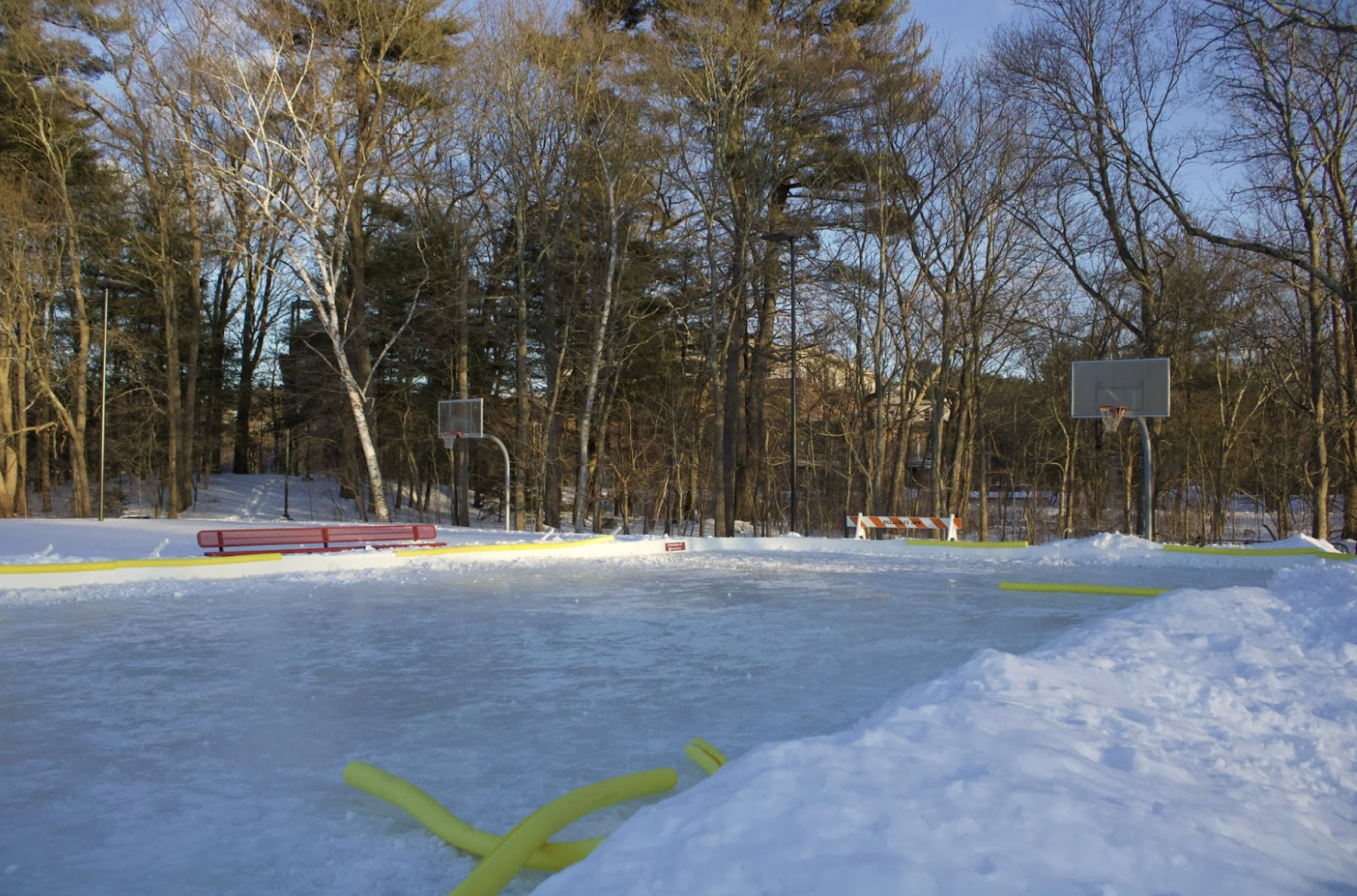
    The rink, located on one of the basketball courts at the Hunnewell Field Complex off Rice Street, opened for the first time last week. Community members can sign up to receive information about the rink in a newsletter from the Wellesley Recreation Department. It’s open seven days a week from 8 a.m. until 9:30 p.m. while the weather allows (obviously, this week’s blizzard will be an issue…).

    Matt Chin, the town’s Recreation Director, said the rink first opened about 10 years ago and lasted for a handful of years before shutting down. This year’s launch was organized in collaboration with Wellesley Parks, Water, and Fire Departments, as well as DPW. 

    outdoor skating rink
    Photo by Emma Mullay

    He also noted that “a group of dedicated volunteers have been clearing the last snowstorms for the rink to open,” which had pushed the opening date back. 

    Vishal Kuchaculla, a local parent, got together with other residents to clear the snow off the ice, noting that the snowfall had pushed the opening back a week or so. He said maintenance is “the only thing that the township asked” of the community. 

    There was also an issue with vandalism, which caused the opening to be delayed another few weeks. Kuchaculla said that someone threw a parking cone and tree branches onto the ice, where it then got lodged, and people were “walking and stomping on the ice” before it was fully frozen. In the future, Chin wants to make sure that they secure the site better while waiting for the rink to freeze. 

    Chin said he thinks the rink is important because it “provides a safe place for ice skating,” as the town “does not check local ponds” to see if they’re safe. 

    Kolea Zimmerman, another resident, said he heard about the rink through an email from the Recreation Department. He was there skating with his two young kids, but was otherwise alone. He said that the parking was confusing and inaccessible, with the lot near the rink being gated off (parking is available at the high school). 

    “It’s a little rough, but, you know, fun,” he said. 

    Zimmerman also said that he thinks that it would be beneficial to have some sort of skate rental system “to get more people out here.” 

    outdoor ice rink skating
    Photo courtesy of Ken Downey
    outdoor ice rink skating
    Photo courtesy of Ken Downey

    Kuchaculla said it’s important for kids to have spaces where they can get outside, create memories and skate with friends. He said that the rink provides a place that will allow for that for the community. 

    “There is nothing more special than skating outside,” he said. “I’d like this to be an annual thing, and it’s something that can be organic.” 

    This story was produced in partnership with the Boston University Department of Journalism.

  • Tracking Wellesley Select Board’s plan to split town, school budgets

    The Wellesley Select Board recently came to consensus about splitting the school budget from the town’s overall spending plan, ending a decades-long practice of consolidating Wellesley’s municipal finances into a single budget. 

    Town Meeting member Michael Tobin proposed the separation at this past spring’s Annual Town Meeting. “This motion is a necessary step,” he said, “toward responsible governance and fiscal transparency.”  

    While some Town Meeting members look forward to more accessible and digestible information about Wellesley’s budgets when Annual Town Meeting begins on March 3, others in town are wary of possible repercussions. 

    The FY26 school budget is $94,035,026, just over 44% of the town’s overall spending plan.

    Town Meeting members for years have been forced to wait until after all town department and School Committee presentations to debate and vote on the entire budget, a process that can take more than one session.

    The school budget is often presented last. If a department item is an issue, a Town Meeting member would need to recall it and refresh the group’s memory.

    Tobin said a dedicated motion for school finances would help members stay organized and lead to better debates. “I expect and hope we’re gonna have better conversations and debates in Town Meetings,” he said, “It’ll be richer conversation … and I think it’s gonna lead to a better outcome.” 

    Katherine Babson proposed the omnibus budget at Town Meeting in 1986. She initially opposed splitting the budget, but describes herself as “agnostic” about the change. She said she would fight any effort to break down the budget further.

    Before 1986,Town Meeting members reviewed as many as 80 separate articles for individual departments. “It went on forever,” Babson said, and in the end, when the voting body got to the last few articles, no one was listening.  

    School Committee Chair Niki Ofenloch and former chair Linda Chow attempted to safeguard the omnibus budget’s original intent. 

    They argued that the omnibus budget has continued to provide a clear representation of school costs. Chow said the School Committee worked hard to sift through and vet the school system’s 426-page budget.

    “We talk a lot about … ‘One Wellesley’ and wanting to approach things with a whole community focus,” said Ofenloch, “and I think that dividing the motions … siloes the schools from the rest of the town.”

    Chow said splitting the budgets may have severe, unintended consequences when uncertainty around school funding continues to swirl. “What message is the Select Board sending by creating this separation?” she asked. 

    During a Sept. 30 meeting about preparation for the 2027 fiscal year, the board confirmed it would be moving forward with the split. Select Board Chair Marjorie Freiman said Town Meeting members wanted “more clarity on how the [school’s] numbers are derived” and to “fully and fairly reflect the cost of schools.” 

    The change may create logistical problems, Chow said. What would happen, for example, if one budget passes and the other doesn’t?

    “If there’s cuts, for some reason, there’s dates … built into the contract by which we need to notify staff members,” she said. “And if we don’t have a balanced budget by any of those dates … in theory, then we don’t have any money past June 30 by which to pay our staff.” 

    Select Board members presented four options for handling unbalanced budgets: requiring the School Committee to prepare a list of potential cuts, drawing on free cash reserves, voting down the town budget, or overriding it.

    Vice Chair Tom Ulfelder told the board the School Committee needs to actively participate in developing the budget from the beginning.

    Many people don’t understand the “extraordinary complexity of educating children in the public school system in Massachusetts today,” Ulfelder said, so they cannot comprehend why the costs are increasing while enrollment is decreasing. 

    Some members of the community still view school as simply reading, writing, and arithmetic, he said. “It’s not just the requirements under special education,” he said, “but it’s the impact of COVID, it’s the social emotional learning, it’s the impact of so many factors that are affecting these children in their safe and healthy development.”

    Wellesley’s foray into splitting the budgets has attracted attention from other regional elected officials. Natick Select Board Chair Bruce Evans said he’ll be monitoring the change. Most Massachusetts municipalities use combined budgets. 

    Evans said there’s a fine line between information overload and the concise information that people are looking for, and Natick is still finding the balance. “I’ll be curious to see how it plays out,” he said.

    Babson, the architect of the combined budget in Wellesley, suggested the revised approach to finances may make it easier for new Town Meeting members.“Older Town Meeting members have been through it a million times,” she said, “while new Town Meeting members might not know … when to say or how to express their questions.”  

    Transparency in the budgeting process, she said, is a reasonable desire. “Maybe we need to do a better job of educating everybody.”

  • Everything came up green for Wellesley Middle School teachers at Spelling Bee

    Three Wellesley Middle School teachers won their first victory after 20 years of competing in the Wellesley Education Fund’s annual spelling bee Wednesday night, correctly spelling “ailurophile” to defeat 38 other teams.

    The Spell-tics – two middle school teachers and one retiree – studied for hours at Starbucks to prepare for the 36th annual competition, according to Kari Sciera, a member of the winning team.

    “We’ve come 20 years in a row,” she said, “and this is the first time we’ve won.” The winning word, “ailurophile,” is a noun used to identify a cat lover. 

    The champions entered the competition with extra motivation: Their own students beat them last year. The Spell-tics eliminated the reigning champions, eighth graders, in Round 4.

    Dozens of grinning and giggling Wellesley residents packed the Wellesley High School cafeteria for the good-natured fundraiser, which attracted participants ranging from middle school students to firefighters and tennis coaches. In all, 39 teams competed.

    Beyond spelling prowess, teams competed for costume awards. The WPS Secretaries won first place for best costume, Wellesley Cotillion took second and the Spell-tics placed third in Boston Celtics uniforms. Other contestants wore Dunkin onesies,  tutus and a blow-up bumblebee costume. 

    “It’s our biggest event of the year and we love how it brings the whole community together,” said Tizzy Chamberlain, co-president of the Wellesley Education Fund.

    Gregg Myles Levin, Treasurer for WEF, said the group typically funds around $250,000 in annual grants for Wellesley educators, including projects such as an Anatomage Table, guitars for Wellesley High School, cell phone pouches for Wellesley Middle School, and library furnishings. 

    The spelling bee’s sponsors included Needham Bank, Babson College, Wellesley College, and Schumacher Companies Landscape Artisans. 

  • Wellesley Hills Church Pumpkin Patch: A colorful tradition of volunteers and community spirit

    The Wellesley Hills Congregational Church has hosted a New England-styled pumpkin harvest for more than two decades, a tradition featuring pimpled gourds in marbled green and sunshine gold, alongside cozy bunches of ribbed orange orbs – some tall, others stout, all plump and ready for purchase.

    The tradition continued last week in Wellesley, as more than 40 good-natured volunteers gathered to unload a truckload of future jack-o-lanterns, porch decorations and pumpkin pies.

    Afterward, Nancy Simons and Paul Bruchez stood on the church lawn, surveying the sea of dimpled orange.

    “It’s a multi-generational event,” said Bruchez, who has volunteered at the pumpkin patch since 2003. “I don’t think there’s anything else like this in Wellesley.” 

    “It’s a community event…that connects new people that come into the community whether they moved from Texas or they moved from China or they moved from Ghana,” said former Wellesley Selectman Jack Morgan, a veteran pumpkin patch volunteer and former deacon and moderator at the church.  

    He estimated that more than half of the church volunteers at the pumpkin patch during their 3 week-run.

    Several of the high school volunteers were originally just looking to complete required community service, but they fell in love with the festivities and kept coming back.

    Ally Shi was one of them. She’s been volunteering for three years. “I totally think that a bunch of high schoolers, when they first started …volunteering…thought ‘Oh I’m just gonna do this for school,’” Shi said. “But, like, as I kept doing it more and more and like giving back to the community, it actually felt really amazing, and made me really happy.” 

    For 22 years, the pumpkin patch has been a scenic backdrop for family photos and wedding shoots, a field day for excited toddlers, a time capsule for returning buyers, and a reliable source of charitable community bonding. 

    Pumpkin Patch backstory

    It all began with a youth pastors’ crazy idea, one that eventually gave rise to the moniker, “pumpkin church.” Today, the Wellesley Hills Congregational Church’s fundraiser is one of the most highly anticipated and loved events in town. 

    Laurie Otten was the first chairwoman. She visited the patch that inspired it all, the Carter Memorial Church in Needham, which gave her some idea of dos and don’ts. 

    She said unloading is the trickiest part. 

    The pumpkins used to be delivered loose in the belly of an 18-wheeler. No boxes, just hay and pumpkins stacked to the roof. 

    The adults couldn’t maneuver themselves to the top of the pile inside the trucks, so organizers deployed 12-year-old “pile monkeys” to send pumpkins down while offering an occasional avalanche warning. 

    The Hills Church used a good old-fashioned assembly line, running from inside the truck onto the lawn. Efficient, for sure, but the old way isn’t easy on today’s average body, particularly for those catching pumpkins from a 13-foot drop.

    Volunteers say the last person on the truck and the first person on the ground have the worst jobs. “I managed to catch one in a way that tore a little bit in my shoulder one year,” said Otten. “So, I don’t do that anymore.” 

    At one point, the team cleared an enormous pile, only to reveal a carton with about 100 more small pumpkins. “It was like so depressing,” Bruchez sighed. 

    Soon after, a little blonde girl lifted their spirits. “‘I’ll get in,’” Bruchez remembered her calling out. She was lowered into the carton and happily went to work, giving the group enough rest to finish the job with gusto.

    Bruchez also went to the Needham church to gather intel. “They had a huge group of 20-something men who were briskly unloading,” Bruchez said. “We did not have a large group of 20-something men.”

    But they did have a group of geeky engineers who used their brains instead of their backs. They developed a ramp system that allowed loose pumpkins to roll from the truck to the ground. 

    Today, most pumpkins arrive on pallets. The church rents a forklift and hires a driver to transfer the pallets to the loading areas. 

    For the event’s first 10-15 years, Otten said late delivery trucks and primitive cellphones led to frayed nerves. One year, a lost driver arrived after dark, forcing volunteers to buy lights at Home Depot so they could unload pumpkins. In possibly the worst case, a driver enroute to Wellesley completely abandoned his truck load of pumpkins. 

    “We had no way of communicating with the driver and they had no way of communicating with us,” Otten said. “It broke down somewhere. They found it sometime later … abandoned on the side of the road. I can imagine that must’ve been a very smelly truck.”

    Soon after, a new load of pumpkins arrived at the church.

    This year’s delivery arrived a day early, on Monday. Volunteers arrived in the late afternoon the next day and calmly unloaded the pumpkins with practiced hands. Cardboard boxes flanked the lawn until workers pushing wheel barrels rolled the pumpkins into their final position. 

    “You look out here today, you see very young people and people who are not so young, but young at heart, and everybody is out here working together,” said Kristen Toffer, co-chair of the event. “Somebody told me in the church, (the event is) … like having a barn raising, everybody in the community is coming out to raise a barn.” 

    Volunteers described the process as “organized chaos,” but it looked like a well-oiled machine to observers.

    A serious fundraiser

    These pumpkins’ stories began before they were harvested in New Mexico, before they were passed hand-to-hand along a chain of volunteers in Wellesley, and long before they were purchased for decorations, or other artisanal projects. The pumpkin patch story began with a handshake sealed by trust in 1974. 

    The first pumpkin fundraiser was a deal between Richard and Janice Hamby who ran a three-acre pumpkin patch and a local church. The Hamby’s would supply goods for the church’s fundraiser, and they would share the proceeds. A simple deal turned into a family-run business as the Hamby’s acquired more partners. Today, they partner with more than 1,000 organizations nationwide, delivering pumpkins on consignment.

    After Hurricane Hugo, the Hamby’s moved their operations to a Navajo reservation in New Mexico. In collaboration with the Navajo Nation, Pumpkin Patch Fundraisers grows 1,200 acres of pumpkins and employs over 700 Native Americans to run the operation and coordinate the harvest.

    Sixty percent of the funds raised by each organization is returned to Pumpkin Patch Fundraisers and dispersed to the Indigenous community. 

    The Hills Church pumpkin patch fundraiser is a shared experience that reaches beyond the Wellesley community. Each pumpkin connects a farmer to a family, and the money raised connects Wellesley to the world. 

    Though it is not widely known, the Hills Church pumpkin patch fundraiser supports various community service operations such as disaster relief groups and Family Promise Metrowest, a non-profit that provides education, shelter, and other types of support to families in need. 

    This year, proceeds will support the Wellesley Food Pantry and the Hills Church Youth Service Trip.  

    Pastor Zach Kerzee became the director of youth ministry and congregational engagement at the Hills Church in January. He said he was excited to participate in this quintessential Hills community event and organize the youth service trip. One of his responsibilities is to rebuild the youth service trip post-Covid.  

    He said the service trip and the community service opportunities allow young people to be a part of the world outside of their screens. “So much of kids’ lives are through their phones,” Kerzee said. “It’s important for kids to think outside of themselves. It’s important for kids to broaden their world view.” 

    Next spring, a group of 6-12 graders will visit Puerto Rico. Kerzee said the goal is not to indoctrinate or impose themselves on a community, but to learn, share life experiences, and do some good along the way. 

    No phones are allowed on the trip, a prohibition Kerzee described as “detox.” Participating in community events gets the kids to connect with real people, he said, preparing them to meaningfully engage in their cultural exchange. 

    The goal of the fundraiser is not oriented around the money raised, it’s just to sell out. And they usually do. Last year, the Hills Church raised $32,000 and donated $6,600 to the youth service trip and the food pantry. 

    “I believe we need positive things that we can do concretely,” said Morgan. “And working at the pumpkin patch is a concrete thing you can do.”