


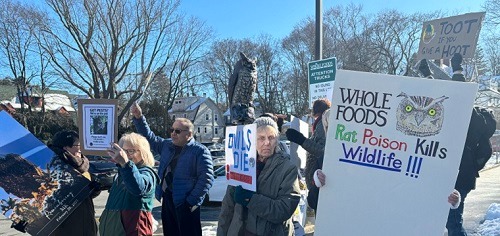
Dozens of people crowded the sidewalk next to the Whole Foods Market in Arlington on Saturday, Feb. 22, to protest what they say is the company’s continued use of rodenticides at the store and parking lot, despite the discovery of two dead hawks there in the past several weeks.
Protesters, bundled in warm layers, hoisted signs for passing motorists and visiting shoppers to see. Customers engaged with the protesters, expressing curiosity about the movement. Drivers added noise to the chatter among protesters and patrons as they beeped while driving along Mass. Ave.
Laura Kiesel, the founder of Save Arlington Wildlife, said that while other businesses in Arlington also use harmful rodenticides, the contrast between Whole Foods’ proclaimed dedication to environmental causes and its actions is what raises concern.
‘Hypocrisy’ cited
“The problem with Whole Foods is that their whole mission is about environmental sustainability and humane treatment of animals,” Kiesel said. “So I think it’s the hypocrisy that really gets people.”
A Whole Foods manager declined to discuss the protest or rodenticide use with YourArlington.
The call to action, which took place on National Wildlife Day, started almost two years ago after Arlington lost a family of great horned owls to second-generation anticoagulant rodenticides, or SGARs, Kiesel said. The owls’ deaths – discovered at nearby Menotomy Rocks Park – likely occurred after the owls ate rats that had ingested SGARs.
Second-generation anticoagulant rodenticides are a class of rat poison that stops the blood from clotting by blocking Vitamin K from curdling blood. When ingested, it causes the animal to bleed from its mouth, feathers and rear.
Finds rat bait
After discovering that Whole Foods hides rat bait in gray, rock-shaped boxes around its property, Kiesel said she asked the company, which is owned by Amazon, for a discussion. Calls to Whole Foods’ national headquarters went unanswered, and local management didn’t have answers, she said, so Save Arlington Wildlife, among other wildlife advocacy groups, turned to protests.
On Jan. 4, a hawk was found dead in the Whole Foods parking lot, reigniting the discussion.
The juvenile Cooper’s hawk was found with a bloody mouth and nostrils, a sign indicating rodenticide poisoning. The necropsy on the bird’s liver revealed SGARs exposure, the same poison used on Whole Foods property.
A second dead hawk was found this month across the street from the Whole Foods, next to a house and church.
“They don’t use poisons,” Kiesel said, referring to the buildings across the street from Whole Foods. “It could be someone else. I’m not saying it’s Whole Foods alone. They’re getting poison from other sources, too.”
Race against clock
Marci Cemenska, the organizer of Saturday’s protest and founder of Save Lexington Wildlife, said it’s a race against the clock when animals ingest SGARs.
“If [the animal] gets to rehab fast enough, they go through around-the-clock care for a day or weeks to heal them,” she said.
Patricia Sears-Joyce, a founder of Operation Woburn Wildlife, said she protested on Feb. 22 because of her experience rescuing animals.
“We rescue and transport owls and hawks so when I see what I see, it’s awful,” she said. “They’re bleeding from the inside out.”
These images don’t haunt the general public, however, so Jim Joyce, a member of the Woburn Conservation Commission, said that most people are unaware of the consequences of rodenticides.
“I don’t think there is anywhere near enough public outreach,” he said. “I don’t think that overall people really understand the way to actually get rid of [rats] the right way.”
Rodenticide research
After a rodent infestation during Covid, Arlington resident Lynne Eisenburg panicked and turned to pest control instead of relying solely on her snap traps. She started researching rodenticides after hearing about their dangers. Even though she had signed a contract with the pest company, she demanded they stop using the product.
“I researched what the guy from the company told me, and he was lying,” she said. “He said ‘Oh, I’m a wildlife lover, too. The poison is so little, it doesn’t even bother the coyotes.’ He lied.”
The protesters stayed outside Whole Foods for almost two hours Saturday. Joyce said he believes that the fight will be hard-fought.
“We’re fighting against one of the largest corporations in the world,” he said. “You’re going to find [rodenticides] in every Whole Foods across the country.”
Communication noted
Kiesel said Whole Foods’ lack of clear communication has given her mixed information.
“I called the national headquarters – the woman kept putting me on pause – she said that it’s decided at the local level,” Kiesel said. “But first they said it’s a national thing, so their story keeps changing.”
Asked how the store is responding to the protest, Arlington’s Whole Foods manager, who would not give his name, said “no comment.”
Some communities have begun to ban the use of SGARs. On Feb. 8, the Lowell City Council voted unanimously to prohibit their use on city-owned property.
Andrew Joslin, a tree climber who rescues wild animals, summed up the wildlife organization’s motive for holding Saturday’s protest.
“This is all about awareness raising. We’re not here to block anyone,” he said. “The idea is to get people to think, ‘What was that about?’”
This story, published Sunday, Feb. 23, 2025, is part of a partnership between YourArlington and the Boston University Department of Journalism.