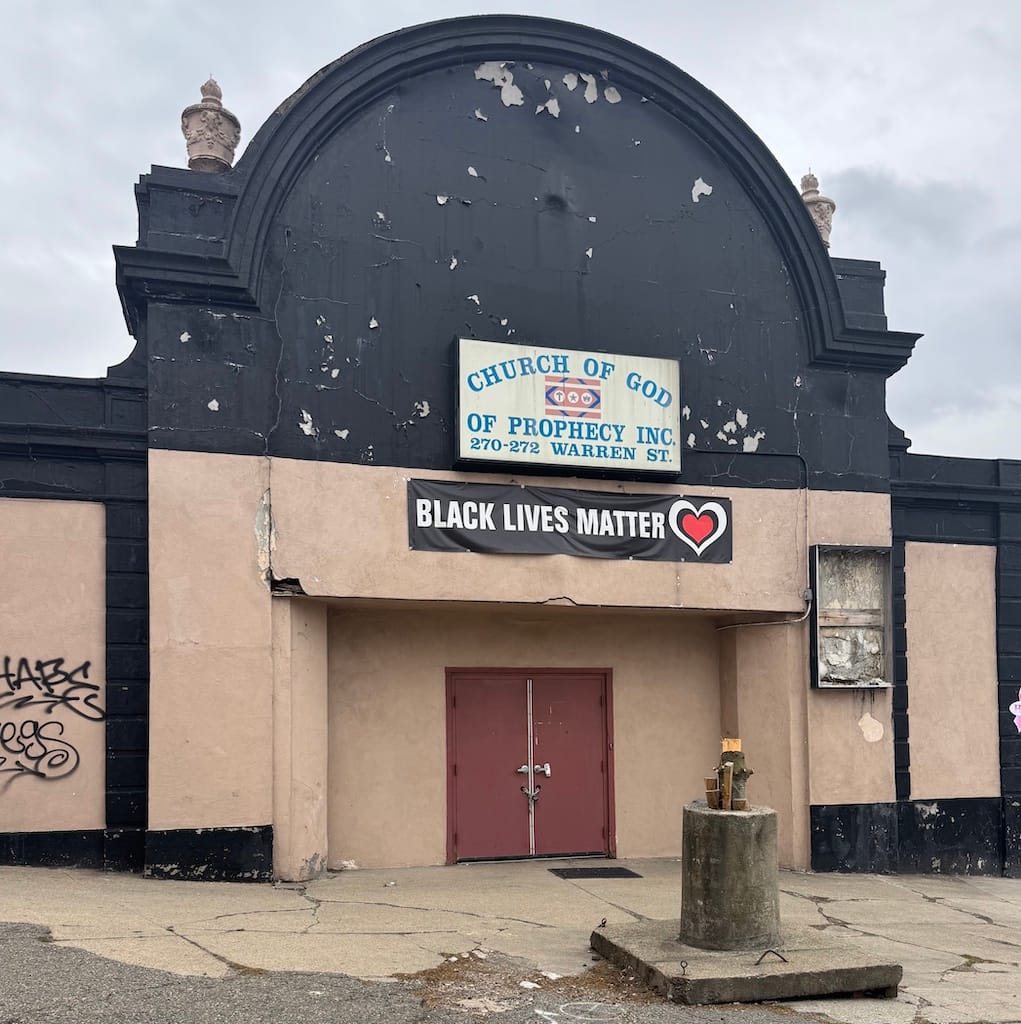
With walls sprayed with graffiti and trash lining the street nearby, a dilapidated structure sits on 1 Waverly St. in Roxbury. What had once been a movie theater from the 1940s through the 1970s was converted into a Church of God of Prophecy Inc. site and utilized as a place of worship for more than 20 years.
Five years ago, the church sold the building due to increasing maintenance costs, and it sat in a state of significant disrepair with parts of the roof collapsing and water leaking.
Since then, Cruz Development Corporation bought the site, seeing an opportunity to transform it into affordable housing for Roxbury.
Now, the One Waverly project is moving one step closer to completion after the company received about $2 million each in state tax credits and additional subsidies through the federal Low-Income Housing Tax Credits program, according to Cruz Companies.
The funding is in addition to $5.2 million the project received in September from the City of Boston Mayor’s Office of Housing, according to officials.
“It’s been a blighted building for a very long time,” said Daniel Cruz Jr., the company’s senior vice president. “[Residents] want to see something happen on the site since it’s been … an eyesore. They’re looking forward to us putting up a brand new building.”
The proposed project would include 52 units of affordable housing dedicated to households earning less than 60 percent average median income and over 3,800 square feet of commercial space.
Funding for affordable housing is very competitive, and the process can be arduous, said Stephen Donovan, the city’s housing development project manager of One Waverly.
“This project has a lot of momentum right now,” said Donovan. “There’s a critical need for restricted affordable housing in Boston.”
Cruz said the neighborhood’s demographics suggest the same.
“A lot has to do with what the neighborhood is looking for,” Cruz said, “We try to come up with something that we believe will be strongly supported by the neighborhood that we choose to do a development in.”
Construction is projected to start in early 2027, according to Cruz, with an approximate 20-month building time.
Cruz Companies is a third-generation, family-run and 100 percent Black-owned enterprise that works on multiple types of projects, including affordable and mixed-income transactions and rentals.
Cruz said the company had multiple meetings with neighborhood groups and have received support for the complex.
The current site of 1 Waverly, the former Church of God of Prophecy Inc. (Stephanie Ahn photos).
Lorraine Payne Wheeler, the chair of the Roxbury Path Forward Neighborhood Association, said she supports the project but explained that not all affordable housing endeavors have had positive impacts in Roxbury.
If rentals are 100 percent affordable for mostly low-income residents, then, she said, that does not leave much for people in the middle. Those residents struggle to choose between extremely expensive and restricted low-income housing, said Wheeler in an interview.
“Many groups of people need assistance with housing because it’s so expensive. But I think you reach a saturation point. We’ve been pushing for more affordable home ownership rather than rentals,” Wheeler said.
Wheeler and other neighbors said they are optimistic about the Waverly project due to the location and income flexibility for residents. Wheeler cited the sliding fee, housing opportunities to different people and the project’s attractiveness to neighbors.
“We’re hopeful that this building will serve everybody in the neighborhood,” said Wheeler.
Cruz Development has said the project will include other appealing amenities and green space.
The current run-down courtyard in the middle of the buildings will be transformed into an open space with picnic tables and chairs for residents to enjoy.
The company is projecting the building to be open to rent to residents in early 2029.
Domingos DaRosa stands on the corner of Dudley and Burrell streets, and it seems as if everybody in Roxbury knows him. Friends, family, and strangers yell to him on the sidewalk, across the street and even from their cars. “They love you, Domingos,” said a passerby standing outside Ideal Sub Shop.
DaRosa is hoping to convert that goodwill into votes for his first bid for mayor of Boston.
A near-lifelong Boston resident, the 47-year-old DaRosa moved from Cape Verde to Boston with his family when he was 10 months old and grew up with part of his home in Dorchester and the other in Roxbury.
“Growing up here, we had nothing,” he said, “so we built a community with the community. Being Cape Verdean in a community, we were so diverse. Spanish, Black, Cape Verdeans, you name it…all the kids in the neighborhood, we all hung out together.”
DaRosa, the father of four, owns a landscaping business and volunteers as a coach with the Boston Bengals Pop Warner football program. He launched his campaign on Feb. 2 of this year with a simple post to his Facebook account: “I’ll be running for the mayor seat in Boston.”
This is not his first city campaign. He ran unsuccessfully for City Council at-large seats in 2017, 2019 and 2021.
His campaign manager, Sharon Hinton, said she was surprised with DaRosa’s decision to run for mayor.
“I’m not going to lie. When I first thought about it, I was like, ‘Seriously, mayor?’” said Hinton, who campaigned for DaRosa during his 2021 venture. “I was thinking about who he was coming up against.”
DaRosa is one of three challengers who made the ballot to challenge Mayor Wu, with Josh Kraft, son of Patriots owner Robert Kraft, and East Boston resident Robert Capucci being the other two. The four will face off in the preliminary municipal election Sept. 9 to determine which two candidates appear on the Nov. 4 ballot.
Hinton was initially deterred by the lack of funding for DaRosa’s campaign, noting his disadvantage in that respect compared to some of the other candidates. But, that helped to inspire his campaign slogan, “For the people — not the money.”
Said DaRosa: “I have no money, and I don’t want it, I don’t need it, I don’t care for it, and I don’t think I need it to be able to achieve my goal.”
While he is raising small dollar donations, he mainly depends on volunteer labor. Hinton isn’t paid for her efforts; one of the students he coaches in the Pop Warner program designed his campaign website; and friends and family members helped to gather the 3,000 signatures necessary to get his name on on the ballot.
Natalya Bethel, a DaRosa supporter, used to pick up needles with DaRosa at Massachusetts Avenue and Melnea Cass Boulevard, an area with a history of rampant substance abuse.
“You have to get a mayor that really cares about the city for the city to improve,” Bethel said, “to clean up that mess, to clean up the violence.”
For DaRosa, substance abuse in the Mass. and Cass area has long been a problem for him and his Pop Warner program. “I had 300 kids on my football program, and the last season I had, I was barely able to get 30 kids on the field,” he said, citing parents’ concerns with substance abuse on the Clifford Park field in Roxbury.
He noted that a 9-year-old player from the Pop Warner program was pricked by a hypodermic needle while running laps in 2022.
For 15 years, DaRosa has tried in his own way to alleviate the issue by picking up needles throughout Clifford Park and in and around Mass. and Cass.
In 2020, he moved to raise awareness about the issue by dumping used hypodermic needles outside former Gov. Charlie Baker’s home in Swampscott, which resulted in a court order forbidding him to be within 100 yards of Baker’s residence thereafter.
As mayor, DaRosa says he’d reopen Long Island, a city-owned facility that housed homeless people and offered addiction treatments until 2014, when the bridge to the harbor island was deemed unsafe. A prolonged and ongoing legal battle between Quincy and Boston has been one major reason that the island — which is owned by Boston— has not been re-used.
DaRosa says he doesn’t want to rebuild the bridge. He wants to use boats to ferry people and supplies to the island. “Once someone is on the island,” he said, “there’s no way for them to go get the drugs or the paraphernalia they need.”
He is also against consumption sites in Boston — except for those on Long Island.
Some of his other priorities, DaRosa says, include affordable housing, after-school programs and resources for students, public safety initiatives that address illegal substance distribution and gun violence, and direct communication with Immigration Customs and Enforcement.
“Wu has no input on how ICE comes into the city,” he said. “They just do what they want to do, and who suffers? Everybody.”
DaRosa said he wants a more humane detention process for undocumented immigrants. At the same time, he said he believes in prioritizing legal residents and undocumented individuals who are making an effort to obtain legal status.
“For those who come illegally, we will aid you in finding a way of becoming legal,” he said, “but we’re not going to harbor you, to say, ‘We’re going to hide you among the rest of the people,’ while the rest of the people are the ones taking the collateral damage. That’s not fair to the greater good.”
He also offered another point: “I’m the only one on stage that’s an immigrant, remember that. I’m the only one that’s a survivor of BPS. I’m the only one that’s a survivor of gun violence, I’m the only one that has been fighting Mass. and Cass without a political view, just to help the human who’s struggling.”
Part of the at-large panel (l-r): Erin Murphy, Henry Santana, Ruthzee Louijeune, Marvin Mathelier and Alexandra Valdez at a Hibernian Hall forum on May 22, 2025. Photo by Georgia Epiphaniou
Seventeen candidates for City Council seats fielded questions about affordable housing, immigration enforcement, and other topics last Thursday evening (May 22) at a forum at Roxbury’s Hibernian Hall.
Nine candidates for the District 7 seat and eight for the four at-large seats participated in the nearly three-hour forum, which drew more than 100 people and was moderated by Yawu Miller, editor in chief of The Flipside, and WGBH reporter Saraya Wintersmith.
The at-large field All four incumbent at-large councillors running for re-election attended the event: Ruthzee Louijeune, Julia Mejia, Henry Santana, and Erin Murphy. City election officials have also certified nomination signatures for five challengers, so far: Will Onuoha, Marvin Mathelier, Alexandra Valdez, Yves Mary Jean, and Frank Baker. All but Mary Jean were in attendance.
Baker previously served as the District 3 councillor for 12 years. Valdez is the director of Boston’s Office of Cultural Affairs, and Onuoha worked as the executive director of the Mayor’s Office of Fair Housing & Equity, among other posts in over two decades in city government.
Marvin Mathelier, a Marine Corps Reserve veteran, said his goal is to bring to the City Council the values instilled in him by military service.
At-Large City Council panel: (from l to r) Will Onouha, Julia Mejia, Erin Murphy, Henry Santana, Ruthzee Louijeune, Marvin Mathelier, Alexandra Valdez and Frank Baker. Photo by Wen Qi
Asked how they would make Boston more affordable, Mathelier, Valdez, Santana, and Louijeune give similar answers about supporting rent control, community involvement, budgeting, zoning, mixed-income social housing, and reusing old buildings.
Onuoha introduced a new idea on workforce housing, targeted to families that earn too much to qualify for affordable housing but can’t afford market rate housing. He says no one should pay over 30 percent of their income for housing.
“Affordable housing is not affordable,” he said. “That’s a myth that we tell people.”
Mejia said she supports a displacement tax, a fee that she says would mitigate the loss of residents and businesses due to rising property values, typically caused by gentrification.
“I’ve been questioning this whole idea, because we’re getting displaced in high numbers” she said.
Murphy talked about education and workforce development.
The candidates gave varying answers about how they would support communities targeted by ICE. Baker and Onuoha recommend that immigrants stay off social media. “Do not say anything bad about the government,” Onuoha said.
Baker thinks Boston police should have a relationship with ICE to create transparency. “There should be some sort of liaison with ICE to see where they’re going, what they’re doing,” he said.
At-Large City Council panel included (from left to right): Marvin Mathelier, Alexandra Valdez and Frank Baker. Photo by Wen Qi
Most of the candidates said the city should do more to educate immigrants about their rights. Mejia, who was born in the Dominican Republic, said she survived Trump’s first term and can do it again.
“I’m prepared to stand up to Trump,” she said, while reinforcing the need to educate immigrants about their rights. There was some support among the candidates for bike and bus lanes.
“I don’t want to walk by no more ghost bikes,” Louijeune said. “I don’t want that. I don’t want that for our children, to say that someone died here because we didn’t do our job to build a safer, better city.”
Baker said the city should explore expanding water transportation and Valdez and Mejia emphasized that each neighborhood needs its own plan for bike and bus lanes so it makes sense to businesses and residents. “People can’t do one size fits all,” Mejia said.
Murphy blamed increased traffic congestion on bike lanes and speed bumps. “I think it’s important that we don’t just wake up one day and find out that our streets look different and we didn’t have to say anything,” she said.
In a “speed round,” everyone except Onuoha, Baker, and Murphy said they support statewide rent control legislation. Everyone except Baker said “yes” when asked whether they support inclusionary zoning requiring 20 percent of housing in market-rate developments to be income restricted.
Onuoha, Valdez, and Baker went on record opposing an elected school committee and against abolishing the Boston police gang database. Everyone else voted yes on those questions.
There was unanimous support for approving a $4 million increase in the city’s rent subsidy program to provide permanent housing for 130 homeless families.
Baker was the only candidate who didn’t answer a question about whether universities should increase their payments in lieu of taxes, known as PILOT funds. Baker held his paddle sideways, refraining to answer and drawing an eruption of laughter from the crowd.
District 7
District 7 City Council panel: (from l to r) Wawa Bell, Samuel Hurtado, Said Abdikarim, Said Ahmed, Mavrick Afonso, Miniard Culpepper, Roy Owens, Natalie Juba Sutherland and Jerome King. Photo by Georgia Epiphaniou
The first part of the forum focused on the District 7 seat now held by Tania Fernandes Anderson, who recently pleaded guilty to two of six federal corruption charges after allegedly arranging a kickback scheme that netted her $7,000. Fernandes Anderson, who has said she intends to resign from the seat before her term expires at the end of the year, is not running for re-election.
Nine candidates have qualified for the ballot for the preliminary election to be held on Sept. 9, with early voting starting on Aug. 30: WaWa Bell, Samuel Hurtado, Said Abdikarim, Said Ahmed, Mavrick Afonso, Rev. Miniard Culpepper, Roy Owens, Natalie Juba-Sutherland, and Jerome King.
The candidates began by explaining what makes them qualified for the job.
“I think that our community has been ill-represented for a long time,” said Bell, who went on to say he wants to continue the “positive work” of Fernandes Anderson, who was in attendance at the event.
Miller asked the candidates how they would work to make District 7 more affordable. Bell expressed support for rent control and a cap on how much landlords can earn.
The candidates all agreed to advocate for the statewide “Homes for All Massachusetts” rent control legislation that would limit rent increases and ban no-fault evictions. The response came during rapid-fire questions for which candidates had to respond with a paddle with “yes” on one side and “no” on the other.
Bell and Culpepper emphasized a push for more homeownership, while Juba-Sutherland mentioned a need for more financial literacy among homeowners.
“What financial literacy does [is] it teaches us how to manage our money,” Juba-Sutherland said. “Because we can actually say, ‘Yes, we can own our homes,’ but can we keep our homes?”
Afonso, who is the director of external affairs at the state’s Executive Office of Housing and Livable Communities, called for the development of “surplus land” and accessory dwelling units for affordable housing.
Candidates answered questions about how they would support communities targeted by US Immigration and Customs Enforcement. King called himself a “fighter” and questioned who ICE agents are.
“All I see is a bunch of people running around with shiesties on,” King said. “They don’t show their face.”
Nearly all candidates expressed some form of support for community members targeted by ICE, except Owens, who did not answer the question and went on to talk about congestion pricing.
Both Hurtado and Abdikarim emphasized educating immigrants about their constitutional rights. Afonso said he supports more funding for legal resources for immigrants.
From left: Said Ahmed, Mavrick Afonso (standing), Miniard Culpepper: and Roy Owens. Photo by Wen Qi
“This is a sanctuary state,” Afonso said, ”so let’s provide these people the counsel that they need if ICE comes to try to take them away.”
During rapid-fire questioning, all candidates backed Boston’s inclusionary zoning policy requiring 20 percent of units in market-rate developments to be income restricted and indicated support for amendments that would increase participatory budgeting funds.
Bell, Hurtado, Owens, Juba-Sutherland, and King said they oppose the Wu administration’s decision to lease White Stadium to a professional women’s soccer team. Abdikarim, Ahmed, Afonso and Culpepper all said they support the plan.
All except for Juba-Sutherland and Owens voted to abolish the Boston Police Department’s gang database. Juba-Sutherland voted “no,” and Owens abstained from the question.
Hurtado was the only one of the nine candidates to vote against a fully elected school committee.
A strong turnout at the Boston City Council Forum, Hibernian Hall, Thursday, May 22, 2025. Photo by Georgia Epiphaniou