Tag: ballot question

  • Ballot proposal for income tax cut sparks debate

    Ballot proposal for income tax cut sparks debate

    This November, Massachusetts voters may be asked to approve a state income tax cut from 5% to 4%. Supporters say the tax cut would give the state a competitive edge, boost the economy and improve affordability. But opponents, including four New Bedford lawmakers, argue it could put public programs at risk and threaten an already strained state budget.

    The question has put business leaders at odds with union leaders and the state Legislature. 

    House Speaker Ron Mariano has said that raising other taxes is a possibility if voters approve the ballot question in November, but he recently indicated that he’s open to negotiating a compromise with the committee that organized the ballot question. The committee said it’s open to the idea. 

    Credit: Unsplash

    Proponents point to outmigration, affordability challenges 

    According to ballot measure supporters, someone moves out of Massachusetts every 11 minutes and 38 seconds. They claim that lowering tax rates is an important step in curbing outmigration and making Massachusetts a more attractive place to live. 

    “Yes, we’re No. 1 in education. Yes, we’re a safe state,” said Chris Keohan, the spokesperson and consultant for the Taxpayers for an Affordable Massachusetts ballot committee. “But what does it tell you if we’re losing people to states that are less safe, that have less level of education? It tells you that we’re at a breaking point and something absolutely has to be done.”

    In making the case for the tax cut, the executive director of the Pioneer Institute, Jim Stergios, points to North Carolina. 

    According to a Pioneer report, North Carolina reduced its individual and corporate tax rates from 2014 to 2025. In recent years, the number of new residents and jobs in the state has spiked. Between 2020 and 2025, North Carolina added 448,900 private-sector jobs, while Massachusetts lost 18,000.  

    Stergios told The Light that migration to North Carolina is not solely due to lower taxes — the state has long had lower energy and housing costs — but that taxes are a significant factor. 

    Several business groups support the tax cut. The ballot question is backed by Mass Opportunity Alliance, a group formed by the Massachusetts High Technology Council, Pioneer Institute and the Massachusetts Competitive Partnership. The question is funded by Mass Opportunity Alliance, the Massachusetts High Technology Council and the Pioneer Institute.

    According to Keohan, the Retailers Association of Massachusetts, the Massachusetts Fiscal Alliance and the National Federation of Independent Businesses also support the question.

    Proponents argue that the income tax cut would also benefit businesses. 

    A staircase in the Massachusetts State House. Credit: Jamie Perkins / The New Bedford Light

    According to Keohan, over 140,000 businesses in Massachusetts, mostly small businesses, are treated as pass-through entities for tax purposes, meaning their income is taxed as personal income. The proponents’ analysis found that reducing these businesses’ taxes will create between 43,000 and 48,000 new jobs.

    The tax cut proposal attracted 58% support in a February poll of 670 Massachusetts voters conducted by the University of New Hampshire Survey Center. It found 21% opposed and 21% neutral or not sure.   

    Critics warn of dire consequences  

    Four New Bedford lawmakers told The Light that they don’t support the ballot measure.

    Rep. Mark Sylvia, D-Fairhaven, acknowledged that the cost of living is an issue in the state, but he said that cutting the income tax would have “a catastrophic impact” on the budget, especially amid cuts from the federal government

    Rep. Steven Ouellette, D-Westport, said he’s concerned that current expenditures in his district could be cut, noting that the state supplements school budgets. 

    “The funds not only help the communities as a whole, it adds to the economic engine that we are trying to expand,” Ouellette wrote in a statement to The Light. 

    Like his counterparts, Rep. Christopher Markey, D-Dartmouth, said he’s “not a fan” of the proposed tax cut because it could put public services in jeopardy. 

    “We don’t know what’s going to happen with federal reimbursements to programs that have always been in existence,” Markey said. “To keep our environment clean, keep our schools number one in the country — all of those things matter. Maybe we’ve taken some of the stuff for granted, and we don’t realize that there’s a cost to all of these things, but I do think that we have a pretty good balance right now.”

    Rep. Christopher Hendricks, D-New Bedford, said that reducing the income tax would be “disastrous,” as the state is already operating on a small budget. 

    Rep. Antonio F.D. Cabral, D-New Bedford, did not take a stance on the measure, noting that it is still before the Joint Committee on Initiative Petitions. 

    “Until the committee acts, we’re not sure if it will be on the ballot,” Cabral said. “So we have to see how that process moves forward.” 

    Sen. Mark Montigny, D-New Bedford, declined to comment on the ballot measure.

    Several grassroots organizations and union leaders also oppose the ballot measure. 

    The Coalition for Social Justice, an activist organization with ties to New Bedford, argues that it will result in cuts to public services. 

    “It jeopardizes our safety net for working families and people on fixed incomes,” said Executive Strategist Deb Fastino. “If people rely on things like MassHealth coverage, food assistance, fuel assistance, childcare vouchers, it makes it harder for working families in our area to make ends meet.” 

    Fastino identified several programs in the Greater New Bedford area that could be “harmed” by state tax cuts, including PACE and Citizens for Citizens, both of which have Head Start programs and offer fuel assistance. She also pointed to HealthFirst Family Care Center and New Bedford Community Health Center. 

    According to Andrew Farnitano, the spokesperson for the union-backed organization Raise Up Massachusetts, the tax cut would lead to shuttered hospitals, schools and libraries, and layoffs of teachers, firefighters and police officers. 

    Raise Up has pushed several companies to resign from the Massachusetts High Tech Council and the Massachusetts Competitive Partnership due to the groups’ support of the tax cut ballot proposal. Farnitano said these calls to action are working, citing recent reporting that some business leaders are now opposing or concerned about the question. 

    Tax cut by the numbers

    Opponents of the ballot measure argue that the tax cut would overwhelmingly benefit the richest residents. Farnitano claimed that the bottom 80% of taxpayers would see an average tax cut of $534 per year, or around $10 per week. 

    “If your roads are filled with potholes because they haven’t been maintained, and you have to replace a tire, $10 a week is not much,” Farnitano said. “If your health care is taken away and you have to pay out of pocket for the surgery you need, it’s not much.” 

    In a statement to The Light, SEIU Local 509 President Dave Foley said that the CEOs and corporate investors backing the question would not be the ones to face its consequences.

    “Those consequences will fall squarely on working people: the anxious parent being pushed out of the workforce because their access to childcare is limited, or the direct care worker who has to look a client in the eye and tell them the program they depend on is closing,” Foley said.

    Evan Horowitz, executive director of the Center for State Policy Analysis at Tufts University, analyzed how much residents would save if the ballot measure passes. His data shows a $37,352 gap between the savings of the richest and poorest residents.

    Click to expand ↑ According to data from Evan Horowitz, executive director of the Center for State Policy Analysis at Tufts University, the state’s wealthiest residents would save $37,421 while the poorest residents would save $69. Credit: Jamie Perkins / The New Bedford Light

    Proponents, on the other hand, said the tax cut is meant to help the middle class. Rebekah Paxton, a consultant for Mass Opportunity Alliance, said the average resident would save $1,300, and the median household would save $1,100. 

    Between 2020 and 2024, the median income in New Bedford was $56,981. According to Taxpayers for an Affordable Massachusetts’ calculator, median earners in New Bedford would save $570 a year if the measure passes. 

    Opponents and supporters of the measure also disagree on how the tax cut would affect the state’s revenue, citing vastly different figures. 

    Though the exact figures vary, policy analysts have found that once fully implemented, the tax cut would cost the state about $5 billion per year, a number that opponents such as Farnitano cite in their arguments. The state income tax raised $26.7 billion in fiscal year 2025. The state’s total budget this year is about $61 billion.

    The Massachusetts Taxpayers Foundation estimates that the tax cut would result in a $5.4 billion annual revenue loss for the state. Doug Howgate, president of the foundation, told The Light that this is a static analysis, meaning the calculation does not account for changes in economic activity. 

    Using a dynamic analysis, Horowitz at Tufts concluded that the ballot question will cost the state $5.1 billion per year beginning in fiscal 2030. The center’s report states that this would more than offset the revenue gains from the millionaires tax, which raised $3 billion in fiscal year 2025. 

    Proponents claim that these numbers are incorrect because the cut could boost the overall economy. Mass Opportunity Alliance estimates that the state would lose around $2.2 billion over three years, but by fiscal 2030, they predict the state will see an increase of $500 million. 

    Horowitz said that the proponents’ $2.2 billion figure is “interested advocacy” rather than a “modeling or statistical disagreement,” but added that the tax cut is an important question for voters. 

    “This is exactly the kind of question that belongs on the ballot,” Horowitz said. “The debate has to happen honestly, and we need to be clear and honest about the implications of going from 5% to 4%. But once we are, it’s totally reasonable to say to voters, ‘What do you think?’”

  • Experts analyze consequences of Mass. tax cut ballot question

    A proposed 2026 ballot question to lower the Massachusetts income tax rate from 5% to 4% would cut household tax bills across the state but also blow a multibillion-dollar hole in state finances and force significant budget decisions on Beacon Hill, according to a recent Tufts University analysis.

    The report from the Center for State Policy Analysis estimates the measure would reduce the state income tax collections by 18.9% and total state tax revenue by about 10%, or roughly $5.1 billion a year by 2030. The report claims that revenue loss would more than offset gains surtax voters approved in 2022 on annual income above $1 million. 

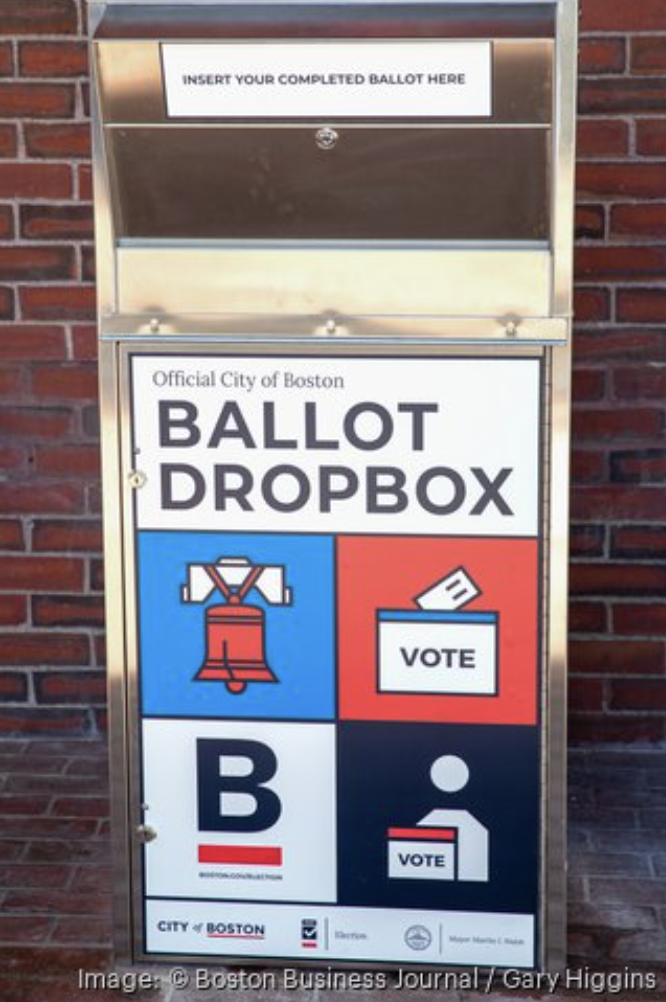
    A mail-in ballot drop box is one of three at at Boston City Hall.Early Voters came to Boston City Hall to place votes weeks ahead of the election.
    Gary Higgins / Boston Business Journal

     Phineas Baxandall, director of research and policy analysis at the Massachusetts Budget and Policy Center, said a revenue loss of that size would be unprecedented in Massachusetts and would likely force painful budget decisions across major areas of state spending.

     “We’ve never seen anything like this before,” he said.

     He compared the potential impact to the revenue collapse during the 2008-09 recession, when the state cut local aid, higher education and public health spending.

    For taxpayers, the proposal would mean smaller annual tax bill, but little change in household income. The report found the median households would save about $1,230 a year, with most keeping about 1% of their income. However, the value of those savings would favor top earners with the highest incomes, who would receive cuts roughly 30 times larger than the median household, the report found.

    The proposal would phase in the lower rate over three years, dropping to 4.67% on Jan. 1, 2027, 4.33% in 2028, to finally 4% in 2029. The rollout would create planning challenges for lawmakers already building future budgets without knowing whether voters will approve on such a major tax cut.

     Beacon Hill is already bracing for fallout if the proposal is approved, putting pressure on the state budget and potentially blocking other tax breaks for business to delay the shortfall.

    Baxandall said cuts to education-related spending could damage the state’s long-term economic position.

    “It would be strangling our competitive advantage as the most educated state in the U.S,” he said.

    He said surtax revenue has supported programs that residents rely on.

    “We have free school meals. We have free community college, turned around the deterioration of the MBTA … We became the only state in the nation to retain its subsidies for early childhood education care.” 

    Proponents of the ballot question argue that the cuts will strengthen economic competitiveness, but Baxandall said reducing the commonwealth’s ability to invest in education, commerce and infrastructure would ultimately hurt the state’s business climate. 

    “That’s not a good place to do business,” he said.

    However, supporters of the proposal argue that the tax cut will actually benefit taxpayers. Chris Keohan, the founder of CK Strategies and an organizer of the ballot question, said there is “no reason to believe that cuts will be necessary when this ballot question passes. Those threats are nothing more than fearmongering.”

    He said the numbers cited by opponents account for no economic growth and fail to understand that the money back in taxpayer’s pockets “will immediately go back out into the economy, creating jobs and increasing revenues from meals, hotels, gas and the other taxes that help to fund the state budget.”

    “Countless small businesses are saying that this tax cut will help them hire more employees, deal with rising costs and be the economic driver that moves our state forward,” Keohan added.

    Jim Stergios of the Pioneer Institute, who authored a report in support of the proposal, compared the pushback to backlash over the approved 2000 tax cut ballot which reduced the personal income tax rate from 5.95% to 5%. He stated that in the years the tax rate decreased, revenues were often flat or higher than the previous year.

     After Gov. Marua Healey publicly opposed the ballot measure, Stergios said in a statement that her claim “ignores more than a decade of runaway growth in state spending.”

     Further, he said the cut would help small and mid-sized businesses and increase employment. He argued the commonwealth can afford budget cuts by “reversing the recent surge in hiring and fixing widespread mismanagement in major benefits programs — mistaken payments, overpayments, and fraud.”

     Supporters also point to strong public support for approving the cut, with polls showing about 58% of respondents showing support as of February, according to The Bay State Poll, conducted by the University of New Hampshire Survey Center.

  • Advocates and lawmakers at odds over transparency ballot questions

    Asking the Legislature to support changes to its procedures has proven an uphill battle, leading to tense hearings and prickly exchanges this month.

    BOSTON — Advocates for increased transparency in the state Legislature are turning to voters in November with two potential ballot measures — to rework how legislators are paid and to apply public records laws to the Legislature and the governor’s office. 

    Asking the Legislature to support changes to its procedures has proven an uphill battle, leading to tense hearings and prickly exchanges this month. 

    Multiple New Bedford lawmakers told The Light they support reforming the public records law but disagreed with adjusting legislators’ leadership pay — a sentiment echoed by legislators across the state. 

    Legislative stipend regulation 

    Being a legislative leader comes with rewards: anywhere from $7,776 to $119,000 in addition to lawmakers’ base pay of $82,046. And leadership positions are easy to come by on Beacon Hill. Out of 200 state senators and representatives, 150 receive leadership stipends. 

    Leadership roles range from Senate president to vice chairs of little-known committees, some of which rarely hold hearings. 

    Critics claim this system places too much power in the hands of the House speaker and Senate president, who expect loyalty in return. A ballot campaign led by several transparency advocates and former legislators is seeking to rework the system. 

    The ballot measure would reduce the stipends of high-ranking lawmakers, capping leadership pay based on position. Additional rules would reduce stipends for legislators who are leaders on multiple committees. 

    To increase transparency in the Legislature, the measure would guarantee only half of eligible committee chairs’ stipends. The other half would be contingent on two conditions: their committees would have to hold both a public hearing and a public markup session on every bill by a certain date, and any committee recommendation must result from a majority vote in a public session with a quorum present. 

    Many committee chairs would receive stipends only if their committee is deemed “eligible” — meaning it is a joint committee, and the House and Senate refer at least 50 bills to it by March 1 of the first year of the two-year term. 

    The House speaker, Senate president, and several other leaders would also forfeit part of their stipends for every panel that fails to meet the transparency requirements. 

    Transparency advocates push for change

    At a contentious hearing on Tuesday, advocates, including several former legislators, urged the Legislature’s Special Committee on Initiative Petitions to advance the measure. 

    Former Rep. Denise Provost said that at the beginning of her 15 years on Beacon Hill, leaders polled representatives on how they would vote on an upcoming bill. If members had concerns, votes might be postponed, bills might be redrafted, or there might be floor debates — “a real legislative process.” 

    Then, in 2017, the Legislature passed a law expanding legislative stipends and giving them to all committee vice chairs. That year, Provost said, the then-speaker’s margin of votes became “so comfortable” that polling stopped. Those who voted against the speaker saw demotions, less desirable committee assignments and downgrades in office space. 

    “With more members in leadership positions, the House became more hierarchical and less collegial. Dissent lessened, dissidents became more conspicuous and marginalized,” Provost said. 

    “I do not imply that members of the Legislature are venal or unprincipled,” she added. “It’s demoralizing, though, to have to work in such a frankly manipulative system, and embarrassing to have to explain it to constituents who want to know how and why particular decisions are made.” 

    Jonathan Hecht, who served as a representative for 12 years, stressed the importance of the transparency conditions written into the ballot measure. He said committees no longer hold open meetings to discuss, amend and vote on bills, and now meet only for hearings to take public testimony.

    “This is not normal, and it’s not healthy,” Hecht said. “The inability of the public to observe and understand how bills are being shaped in committee, and to see committee members debating and voting in public, feeds cynicism and distrust in the legislation.” 

    Lawmakers defend the system 

    Attempting to persuade lawmakers to cut their own salaries proved difficult. Provost’s claim that stipends affect votes did not sit well with the committee. 

    “I think Representative Provost said she wasn’t intending to demean the public service of our colleagues here, but our votes are being bought?” Rep. Michael Day, D-Stoneham, said. “I’d be curious to see how we would be more demeaned.”

    House Committee Chair Alice Peisch, D-Wellesley, said she “resent[s] the implications that every chair here does not think for themselves.”

    Day grilled Hecht on the ballot campaign’s funding and spending, including about $300,000 used to pay signature gatherers, a common practice. He suggested that the campaign paid people to sign the petition, which Hecht rebutted. 

    Hecht later told The Light that he found Day’s “attitude” to be “troubling.” 

    “I think [the suggestion] shows a lot of contempt, frankly, for the people who signed,” Hecht said. “It sort of suggests that they’re stupid, or they’re easily fooled by somebody who’s asking them to sign.” 

    Three New Bedford-area representatives told The Light they also disapprove of the ballot measure on legislative pay.

    Rep. Steven Ouellette, D-Westport, and Rep. Christopher Markey, D-Dartmouth, do not receive leadership pay, but both defended the system. 

    Ouellette said it’s “not necessarily true” that leadership pay is based on loyalty. He added that committee chairs “keep very busy.” 

    Markey called the ballot measure “inappropriate.” He chaired the House Committee on Ethics from 2015 to 2020 and said he was not “unduly influenced” by receiving extra pay. 

    Markey added that he doesn’t believe the Legislature has a transparency issue. 

    “I think that having elections every two years is a very important aspect of accountability. And as far as transparency, I think we’re pretty transparent in relation to how laws are written,” Markey said. “It would be nice to have a little bit more time to see a final bill and vote on it, but that would really be the only thing that I would want to change.”

    Rep. Antonio F.D. Cabral, D-New Bedford, co-chairs the Joint Committee on State Administration and Regulatory Oversight, earning $44,861.93 in extra pay. Cabral said his committee has heard over 360 bills and held over 14 public hearings this session. 

    “Chairing a committee adds additional responsibility, and, of course, additional work. I’m not complaining about that. I enjoy very much what I do,” Cabral said, noting this includes engaging with the public and political subdivisions outside of the Legislature. “That’s what the stipend, I believe, is for.” 

    The claim that leadership pay buys loyalty “undermines” the work that committee chairs do, Cabral added. 

    Sen. Mark Montigny, D-New Bedford, and Rep. Mark Sylvia, D-Fairhaven, did not grant interviews with The Light. Rep. Christopher Hendricks, D-New Bedford, did not respond to repeated requests for comment. Hendricks and Montigny both receive legislative stipends. 

    Montigny receives $75,068.96 in stipends as chairman for two committees and vice chairman of one. Yet the Light reported in August and January that the committees Montigny leads rarely consider bills. Neither committee he chairs — the Senate Committee on Intergovernmental Affairs and the Senate Committee on Post Audit and Oversight — held hearings this fall. 

    The post audit panel did hold a hearing on Feb. 3, and the intergovernmental affairs committee held a hearing on Feb. 4. They were the first hearings since a joint hearing of the two committees on July 30. That hearing took place a month after The Light began asking Montigny’s aides about his committee hearings. 

    The Legislature’s website did not have a record of the last time before 2025 that a committee Montigny chaired held a hearing. A Montigny aide told the Light last summer that he’d held several high-profile hearings in his previous stint as chair of Post Audit and Oversight in 2011 and 2012.

    Montigny is not the only lawmaker who earns extra pay for chairing committees that rarely meet. Over 20% of the Legislature’s committees did not hold a single hearing or consider a single bill during the 2023-2024 session. 

    Public records reform 

    Massachusetts is the only state where the Legislature, the judiciary and the governor’s office are all exempt from the law guaranteeing access to public records, and one of only two states where both the Legislature and the governor are exempt. 

    A November ballot initiative started by the Coalition for Healthy Democracy 2026 seeks to address this gap. Under the proposal, the Legislature’s committee votes, final bill drafts and amendments, legislative expenditures, attendance records, public meeting minutes and public testimony submitted to committees would become public records. 

    Several supporters of the ballot measure testified earlier this month before the Special Committee on Initiative Petitions. 

    “Transparency is not a partisan issue; it is a democratic one,” said Coalition for Healthy Democracy campaign manager Jesse Littlewood. “It is one of the ways public institutions earn and sustain trust, and we are in a moment where public trust is strained.” 

    Scotia Hille, executive director of Act on Mass, told committee members that the ballot question “is not about punishing the Legislature or the governor’s office or making a mockery of elected officials.” 

    “It’s about affirming the public’s fundamental right to know what’s being done on our behalf … It’s also about safeguarding our democracy for future generations,” Hille said. “Governments are made of humans, after all, and although you may trust yourselves and your colleagues to do your jobs faithfully, I would ask, can you confidently say the same for every person that will hold your job in the future? For every future employee of the executive branch?” 

    A panel of transparency advocates and former lawmakers testifies before the Special Committee on Initiative Petitions in support of a ballot measure to rework the leadership stipend system. Credit: Jamie Perkins / The New Bedford Light

    Multiple New Bedford lawmakers said they support expanding the public records law to include the Legislature. 

    Cabral said he has been attempting to improve the public records law for many years, most recently by filing legislation that would create a division within the Secretary of State to oversee and regulate public records access. 

    Ouellette said the ballot measure makes sense “on the surface,” adding during his eight terms on the Westport Select Board, “everything executive was available unless it was a legal matter.” 

    Markey said he doesn’t support the measure as written because it lacks sufficient exemptions, but said the principle behind it is important.

    poll of 642 Massachusetts residents commissioned by the Pioneer Institute this month found that 86% of respondents believe legislators should be subject to state public records laws, while 84% believe the law should extend to the governor’s office and management of the judicial branch.

    The poll also found that only 28% of respondents had a very or somewhat favorable opinion of the state Legislature, down from 49% who approved of the Legislature’s job performance in a November 2025 Suffolk poll.

    Just over 87% of respondents said government transparency is extremely important to “achieve the ideals of a democracy.”

    Committee raises concerns 

    Some lawmakers, including Senate President Karen Spilka, have spoken out against expanding the public records law, citing privacy concerns. Committee members echoed these concerns at the hearing.

    In addition to the existing public records law exemptions, the measure would exempt communications and documents related to “developing policy positions” of legislators and the governor. Littlewood said that the exemption would apply to draft legislation, communications among legislators, and policy development discussions. Another exemption would apply to communications related to individual constituent services.

    Sen. Barry Finegold, D-Andover, asked proponents whether the ballot measure could allow the Trump administration to access conversations between local lawmakers and universities about funding cuts. Sen. Paul Feeney, D-Foxborough, questioned whether an individual who calls their state lawmaker to lobby a bill would be protected.

    Are these questions constitutional?

    Critics question whether the two ballot measures violate the state constitution. 

    Boston University law professor Sean Kealey told the committee on Tuesday that the legislative stipend reform proposal is an “end run around the Constitution.” He argued that the measure dictates legislative rules by requiring public votes and markup sessions. 

    The committee went in circles with Hecht on whether the measure infringes on the Legislature’s right to create its own rules. Hecht insisted that it only relates to extra money. 

    “The Legislature can choose to do its business any way it likes, but the people don’t have to pay extra if the Legislature chooses to do it in a way that doesn’t meet what the people are looking for,” he said. 

    Political scientist Jerold Duquette testified against the public records ballot measure at the hearing in early March. Duquette co-founded the Massachusetts Law and Politics Project, which he described as bringing academic expertise to “efforts to misuse the Commonwealth’s initiative and referendum process.” Duquette, who teaches at Central Connecticut State University, argued the ballot question would require an amendment to the state constitution. 

    “[The petition] violates the separation of powers as well as the Legislature’s exclusive constitutional authority to ensure faithful execution of the law,” he said. 

    Last week, the Senate voted to seek advisory opinions from the state Supreme Judicial Court on whether the two ballot questions are constitutional. The last time the legislative or executive branch sought such an opinion was in 2016. 

    The attorney general has already determined the initiative petitions meet the constitutional requirements to appear on the ballot. 

    What comes next?

    If lawmakers do not pass the measures as filed, the ballot campaigns must collect an additional 12,429 signatures for the question to be placed on the November ballot. 

    Hecht told The Light he’s “very confident” that the stipend question is widely supported by the public and will make it onto the ballot. He doesn’t expect the Legislature to pass it. 

    “The makeup of that committee itself was kind of indicative of the problem. There were no rank-and-file members of that committee,” Hecht said. “Those are all people who are chairs and leaders, and sometimes both. So they have a vested interest, both personally and professionally, in the system as it stands. It’s not surprising that they weren’t very happy to hear it criticized.”

    Jamie Perkins is a graduate student in journalism covering state government for The Light as part of the Boston University Statehouse Program. Email them at jperkins@newbedfordlight.org.