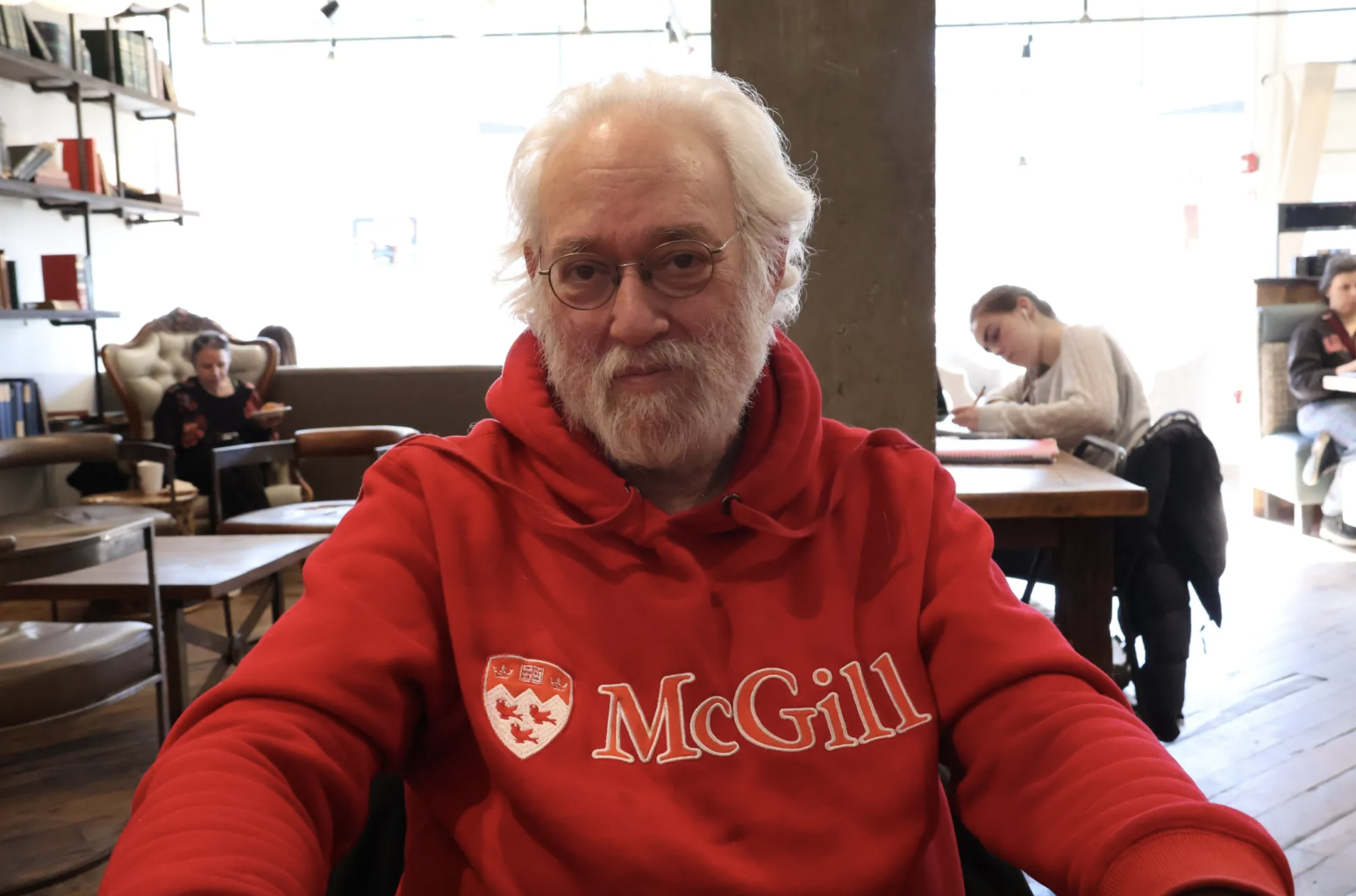
Harold Hubschman’s humble attire – sneakers, blue jeans, and a red McGill hoodie projects an air of understatement as he strides into the Caffe Nero minutes away from his Brookline Village condo.
Few would guess that the 69-year-old with a crop of unkempt white hair is a highly skilled political operator, let alone the linchpin behind the vast majority of paid signature drives that have put ballot questions before Massachusetts voters over the past two decades.

Ballot questions allow voters to directly weigh in on proposed laws, bypassing the state Legislature. In Massachusetts, qualifying a question requires collecting tens of thousands of valid voter signatures within a tight timeframe, a process that has given rise to a small, highly specialized industry.
Hubschman, along with two partners, owns SignatureDrive.com, a firm that has become the dominant signature-gathering business in Massachusetts and an important national player. The firm has completed more than 100 statewide signature drives for ballot initiatives and candidates in 26 states, all successfully.
Since 2009, the company has run collection drives for 26 of the 29 ballot initiatives in Massachusetts that hired paid firms. Of the 11 ballot questions currently advancing through the certification process for potential inclusion on this November’s ballot – the most in state history if all qualify – SignatureDrive collected signatures for eight.
But the petition process is more than just a business to Hubschman, who has called Brookline home since 1984, after immigrating to the United States from his native Montreal.
“It’s the purest form of democracy…This country was built on petitioning the government,” he said before whipping out his business card, emblazoned across the top with a quote from the U.S. Constitution: “Congress shall make no law … abridging … the right of the people … to petition the Government.”
Hubschman’s circuitous journey into the world of signature-drive organizing began in 1994, when he got involved in his friend Doug Barth’s ballot campaign to eliminate tolls on the Massachusetts Turnpike.
“I wanted to work on a campaign, and so I helped him with that,” Hubschman said. “I’d literally never been involved in politics before then. And so we had to go out and collect, I think that year it was like 60,000 valid signatures.”
The effort quickly became a crash course in the mechanics of direct democracy. With no established infrastructure, Hubschman and his collaborators had to build a signature-gathering operation from scratch.
“We’d never done this before. We were building an organization on the fly,” he said. “And I realized at the end of that experience that I hate collecting signatures, and I never want to do it again.”
While he came to dislike being grimaced while standing outside supermarkets for eight hours, Hubschman discovered that he had a knack for the logistical side of organizing the drives.
“I told Doug, I will run the entire statewide signature drive if I don’t have to collect signatures,” Hubschman said. “And Doug said, ‘Sold.’”
What began as an impromptu operation has since grown into a Massachusetts industry leader. SignatureDrive’s work sits within a niche corner of politics that few voters ever consider.
In a state with more than five million voters, “There are probably fewer than 100 people who know how to do what we know how to do,” Hubschman said. “It’s a very niche field. There are very few people who are good at it. It’s extremely lucrative, quite honestly, and it’s fun for us.”
The initial defeat does still sting, however,
“Tolls on the pike are a really dumb idea, and one of these days I’m gonna actually get that question on the ballot to get rid of them,” he said.
Behind the scenes, Hubschman describes running a signature drive as a herculean feat of organization.
During peak campaign season in Massachusetts, typically the eight-week window in the fall when campaigns race to collect enough signatures to qualify for the ballot, Hubschman said he works roughly 100-hour weeks. His days often begin around 9 a.m. and stretch until 2 a.m., spent almost entirely on the phone coordinating crews, managing logistics, and tracking progress across the state.
Much of that work involves coordinating a small army of experienced signature gatherers who travel from campaign to campaign across the country.
“They’re like migrant political workers,” Hubschman said. “They travel around the country, and they collect signatures. They’re people who do this year-round.”
Managers often rent Airbnbs as workspaces where petitioners can turn in signatures, while individual workers stay in nearby motels or short-term housing, moving as needed to where demand is highest.
The work itself is repetitive and often thankless.
“We tell them you’re going to stand in front of a supermarket. A thousand people are going to walk by over the course of eight to 10 hours, 900 of them are going to blow you off,” Hubschman said. “A good day is when you get 50 people to sign. A great day is 100.”
Signature drives are expensive undertakings. Hubschman said a full campaign to qualify a question for the ballot typically costs between $800,000 and $1 million, most of which he said is paid to signature collectors.
When asked whether that price tag creates a barrier for everyday people trying to get issues on the ballot, Hubschman pointed to the recent success of one of the few questions slated to appear before Massachusetts voters this November that his company didn’t collect signatures for.
“Rent control did their initiative entirely with volunteers,” he said, before conceding the limits of that approach. “I mean, the answer is yes, it’s definitely easier if we do it.”
Campaign filings first reported on by the State House News Service, however, show that even the rent control campaign — which proudly touted not hiring a paid signature-gathering firm — relied in part on paid nonprofit staff to collect signatures, blurring the line between a volunteer effort and one supported by compensated labor, and underscoring the rarity of truly all volunteer drives.
Despite the scale of his operation, Hubschman describes his role as largely procedural, noting that SignatureDrive.com works with a wide range of clients across the political spectrum.
“I’m running a business, and it’s not my role to decide who gets to be in the debate,” he said. “If you want to raise taxes, we’ll help you do that. If somebody else wants to lower that tax down the road, we’ll help them do that too.”
Hubschman said he and his partners do not discuss their personal opinions about initiatives with clients, nor do their clients ask for them. Still, that neutrality has limits.
“We each have red lines. If the ick factor is too high, we won’t touch them under any circumstances,” Hubschman said. “I’m pro-choice, I’m pro-equal marriage, pro-union. I am pro-immigrant. I won’t work on initiatives that I consider to be on the wrong side of those issues.”
Even so, Hubschman denies that his firm’s dominance over the signature-gathering business in Massachusetts makes him a gatekeeper to the process.
“I tell my clients, we’re the only people who can get you on the ballot in Massachusetts,” he said wryly. “But other people can do it.”
Instead, Hubschman insists that he and his colleagues are simply neutral facilitators.
“We definitely do not have an outsized influence. We’re just the technicians who collect the signatures,” he said. “If we weren’t doing it, eventually other people would figure out how to do it too, but not as well as us.”
With a record number of questions slated to appear on Massachusetts voters’ ballots this year, Hubschman said the trend reflects growing frustration with the state Legislature, which was the least efficient in the country in 2025 based on the ratio of bills proposed to bills passed, according to policy analysis firm Fiscal Note .
“Political groups don’t do it unless they have been trying for years to get it done through the Legislature and not succeeding,” he said. “The process wouldn’t exist if people were able to get things easier through the Legislature.”
From his vantage point, having attended hearings on several of this year’s ballot questions in recent weeks, Hubschman said lawmakers’ frustration is evident, even if it is not always explicit.
“They’re polite in their annoyance,” he said.
That frustration, he said, is most focused on proposals that would directly affect lawmakers’ own power or independence. Among the most hated this year, by his estimation, are the questions pertaining to legislative stipends and public records laws.
While he couldn’t point to specific proposals, Hubschman said he has recently heard rumblings from reporters around the Statehouse that during the next legislative session, lawmakers may move to make it more difficult to get questions on the ballot in response to the unprecedented number advancing toward November.
Hubschman, for one, is unsurprised, “They’re perennially trying to reform the ballot process,” he said. “They’re always trying to make it harder.”
He is, however, not particularly bothered by efforts to further complicate the already idiosyncratic process. To sum up his perspective on the matter, Hubschman recalled a meeting some years back with a former head of the Legislature’s Election Laws Committee at the Statehouse, whom he declined to name.
“The first thing he said was, ‘I want to increase the number of signatures,’” Hubschman said. “And I said, ‘I love that idea.’ He was surprised and said, ‘Why?’ I said, ‘Because we make more money.’ He was shocked.”