

Tag: Belmont

  • On the Road to Repair: Belmont’s Hidden History of Slavery

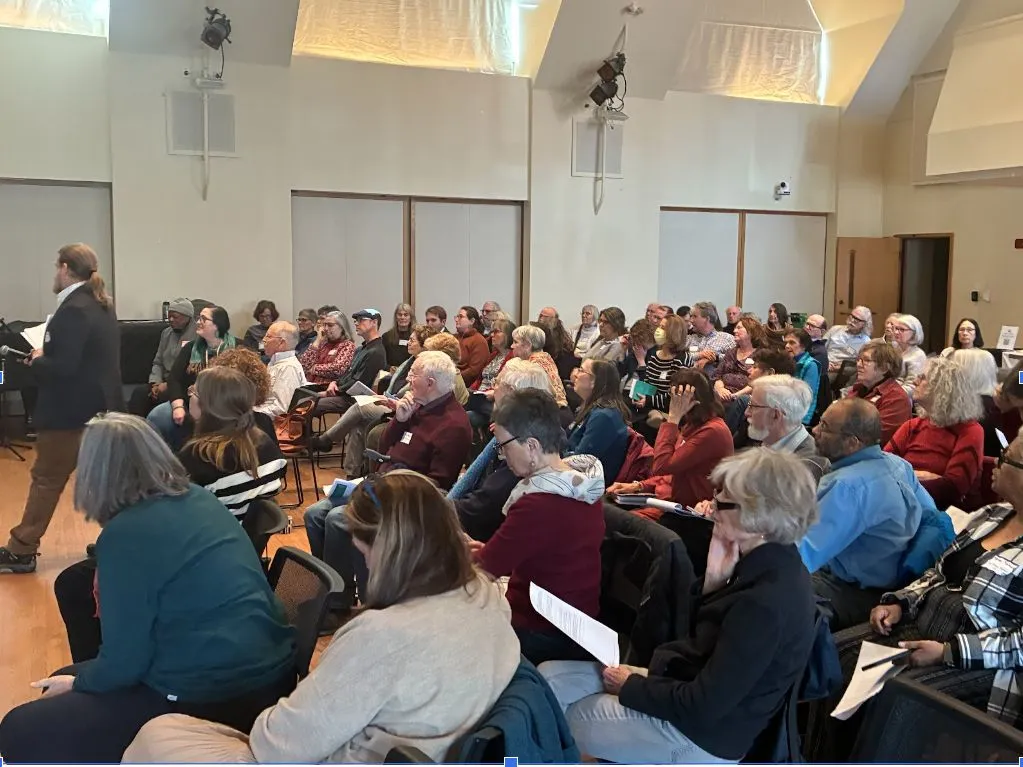
    The crowd at the First Church discussing the church’s historic ties to slavery. (Arianna Williams/Belmont Voice)

    Light streams through a multicolored stained-glass Tiffany window, filling the sanctuary of the First Church in Belmont with a warm, prismatic glow. The artwork depicts a man in a red robe reclining with a shepherd’s staff, an angel in green hovering above. Beneath the figures, an inscription reads: “1813 Elisha Atkins 1888.”

    The window has stood as the church’s artistic centerpiece for decades. But, like the building itself, it carries a lesser-known legacy: ties to slavery.

    Now, the congregation is reckoning with that history. In 2023, the church formed a task force that investigated the Atkins family’s fortune and its entanglement with slavery in Cuba. That work led to a reparations summit at which Unitarian Universalist congregations from across New England gathered in Belmont to share what they had uncovered about their own ties to slavery and to wrestle with a complex question: How do we repair?

    In Cuba, the small rural town of Pepito Tey lies about eight miles from Cienfuegos. The town was once called Soledad, a plantation owned by the Atkins family, where at least 177 people had been enslaved, according to the church’s website.

    Records show that Edwin F. Atkins, born Jan. 13, 1850, presided over the First Church in Belmont’s parish committee when he commissioned the radiant Tiffany window in memory of his father, Elisha Atkins. The window was dedicated in April 1890, along with the church building.

    The elder Atkins imported sugar from Cuba, especially from Cienfuegos, as early as 1838, according to the Massachusetts Historical Society. He operated E. Atkins and Company, and in the early 1880s, his son acquired Soledad and transformed it into a bustling sugar operation that yielded 4,000 tons by 1887.

    Slavery persisted in Cuba until 1886. Even after emancipation, many African and Chinese laborers worked on the plantation for paltry wages, according to historical accounts. In his 1926 book, “Sixty Years in Cuba,” Edwin F. Atkins wrote: “We had at Soledad Caribbees, Congos, Guinea negroes, and many others…among the older negroes was a little Congo, under five feet in height, who said he was the son of a prince in Africa and that he had been kidnapped and sent to Cuba as a slave.”

    Back in Belmont, the Atkins family became prominent benefactors over the years, donating land for Belmont Hill School and building several brick mansions, according to town records. The Belmont Historical Society notes that Atkins also contributed $5,000 to the First Church’s construction, a meaningful share of its $26,000 cost in those days.

    In the 19th century, Belmont thrived as a prosperous small town, as it does today. The same could not be said for Pepito Tey, which struggles with myriad ills.

    “They have an epidemiological crisis right now, in addition to their economic and political crisis,” said Gina Carloni, chair of the Legacy of Slavery Project. “There is a huge outbreak of mosquito-borne illnesses.”

    Cuba faces frequent power outages, chronic food shortages and widespread emigration, leaving behind an aging population, according to Human Rights Watch. The current U.S. administration has imposed an oil blockade restricting shipments from Venezuela and Mexico, the country’s main suppliers, according to human rights and policy reports.

    The church established the Legacy of Slavery Project in 2023. The group researches slavery and indentureship in Pepito Tey, informs the congregation and forges connections in Cuba for its next phase: reparations.

    On March 21, Unitarian Universalist churches from Arlington, Cambridge and beyond filled a room at The First Church in Belmont for a reparations summit. Five groups presented findings on their churches’ historical ties to slavery. The First Church in Cambridge recounted how minister William Brattle enslaved Cicely, a 15-year-old African girl, a fact engraved on her headstone in the Old Burying Ground, one of the oldest cemeteries in Cambridge.

    Researchers from the First Church of Arlington found documents showing that Revolutionary War hero Jason Russell enslaved Kate. The Arlington Historical Society records state that she was baptized on March 17, 1754, at 3 months old.

    “We have a responsibility to do something, and to bring this knowledge forward, and to move it from knowledge to action. And to work towards repairing those harms with communities that have been harmed,” Carloni said.

    The Belmont church works with Sophia Boyer, an educator and equity consultant with a background in sociology and history, to guide its reparations efforts. So far, church members have raised money to provide each home in Pepito Tey with a large mosquito net. Congregants are now seeking additional ways to advance reparative work, though strained U.S.-Cuba relations have made their efforts difficult.

    “As a person of color, it’s important to have these conversations in spaces with white people, and this is one of the venues that I will participate in that kind of conversation,” Boyer said.

    During the summit, Boyer outlined two types of repair: “material repair” and “symbolic repair.” Material repair involves tangible contributions such as money, land or other assets. Symbolic repair encompasses public apologies, memorials and historic acknowledgment. Her presentation invited congregants to reflect on how best to address past harms.

    “It has to come from them. What do they want? What do they need?” said Charles Hubbard, a member of the church’s Legacy of Slavery Project and an organizer of the summit. He said reparative work must prioritize the concerns of the people in their descendant community.

    “I think a lot of people hear the word reparations and they think, Oh, we’ve got to pay back money. We don’t have the money. We can’t do this, and therefore, we’re just gonna sort of look the other way,” said the Rev. John O’Connor, of the Arlington Street Church in Boston. “I think that is a very common response that you see in contemporary American culture.”

    In his closing remarks at the summit, the Rev. Chris Jablonski offered a note of hope: “We give thanks for the end of the beginning, for this lifelong and ongoing work.”

    This story was written by a journalism student in BU’s Newsroom program, a partnership between the university, The Belmont Voice and other news organizations in the Boston area.

  • Using the Arts to Confront the Racism That’s Not Always Seen

    Inside Belmont High School’s Black Box Theater on Friday, Feb. 27, music and poetry will take on a subject some communities might believe they have already solved: racism.

    But for organizers and performers behind the upcoming Black History Month concert, the issue is not the loud, obvious version of racism most Americans picture. It’s the quieter kind. The kind marbled within misguided intentions and policies out of step with stated values.

    “This is not about yelling about racism at people,” musician Alastair Moock said. “But if nobody in the room feels challenged, we haven’t succeeded.”

    The Friday concert, featuring folk musicians Moock, Reggie Harris and Massachusetts Poet Laureate Regie Gibson, is part of Voices Rising, a new joint series by Passim’s Folk Collective and the Boston-based arts organization The Opening Doors Project. The series pairs curated music with candid conversations about race and identity across New England.

    In Belmont, the conversation carries weight.

    Belmont Against Racism, the local volunteer organization co-sponsoring the concert, was founded in 1992 after Los Angeles police officers were videotaped beating motorist Rodney King and the unrest that followed their acquittal. Residents formed the group out of concern that racial tensions seen nationally could surface locally.

    More than 30 years later, President Didier Moise says the work is far from finished.

    “I almost laugh when people say, ‘Well, racism is over,’” Moise said. “The effects of racism are still around us.”

    Moise, a Haitian American who has led the organization for more than two years, said Belmont’s efforts focus less on overt hostility and more on structural and institutional patterns that can be harder to see.

    “One of our missions is to encourage dialogue and awareness of institutional racism,” he said. “It’s very subtle.”

    That nuance is exactly what Moock says the concert aims to explore.

    “There are very different versions of racism,” said Moock. “There’s the loud, angry ‘I don’t like you because you don’t look like me’ version. But the version we are more focused on is what I would call liberal racism.”

    He describes it as “learning the vocabulary, saying the right things, and then being hypocritical about that with your actions.”

    An example, he said, is people who put Black Lives Matter signs in their yard and then fight affordable housing in their neighborhood.

    Moock, who co-founded The Opening Doors Project in 2021 with Stacey Babb, said the organization centers around “amplifying voices of color and advancing interracial conversations about race.” He believes those conversations are especially necessary in predominantly white suburban towns.

    “Black and brown communities are very aware of issues of racism and bias,” he said. “Conversations need to happen in white spaces more than they need to happen in any other spaces.”

    Black people make up 1.6% of Belmont’s population, according to the 2024 census. A reality Moock said can create both a challenge and an opportunity for change.

    “We get a pretty self-selecting crowd,” Moock said of past performances in communities with similar demographics. “Particularly in wealthy, predominantly white suburbs.”

    The goal is not to shame audiences, he added, but to invite reflection.

    “By virtue of showing up, they’re showing intention,” he said. “They want to learn. They’re meeting us halfway.”

    Still, he says comfort alone is not success, the organizers hope is to help the community reflect, and music makes that possible.

    “Using music as a way of digging into these conversations is an important piece of it,” Moock said. “Music brings people’s guard down and brings them together.”

    Gibson, who uses his African American lens to write poetry that often explores citizenship, democracy and public life, says the concert provides another avenue for civic engagement.

    “The rise of racism … it’s a social malaise that we have not solved,” Gibson said. “These things are just below the surface.”

    Gibson, who lived in Belmont from 2001 to 2006 and whose wife served on the board of Belmont Against Racism, said racial bias does not always present itself as open hostility. In some cases, he said, it surfaces in policy debates and in resistance to change.

    “When I was on the Human Rights Commission in Belmont,” he said, “there were folks who were expressly on the committee to make sure nothing changed.”

    He cited an incident years ago when flyers opposing interracial relationships circulated in town, an episode that prompted residents to launch a “Hate Has No Home Here” campaign in response.

    Gibson says art offers a way to ask difficult questions without closing doors.

    “My aim,” he said, “is to create a space that makes better citizenship possible.”

    That mission runs through the broader Voices Rising series, a program that includes an Indigenous Peoples’ Day concert, a Martin Luther King Jr. Day concert, two Black History Month concerts and other events. Each performance blends music with moderated dialogue, allowing artists to respond to one another and to audience questions.

    The Folk Collective at Passim, an artist-led initiative dedicated to expanding the narrative of folk music, partnered with The Opening Doors Project to bring the series to communities across New England throughout 2025 and 2026.

    Moock, who has spent three decades as a performer and teacher, said his own understanding of race has evolved through that work.

    “One of the privileges of whiteness in America is not having to think about your skin color,” he said. “White Americans often don’t think of themselves as having a race.”

    He said part of his role in interracial conversations with Harris is to acknowledge that privilege openly and honestly.

    “The single most important thing we’re doing in these spaces is modeling what healthy conversations and friendship can look like,” he said.

    Moise hopes the Belmont concert will build on that model locally. The organization has previously hosted film screenings, discussions and cultural events during Black History Month and Indigenous Peoples’ Day, often in response to students and families who felt certain histories were not fully acknowledged.

    “If you cannot even acknowledge a segment of society’s culture,” Moise said, “how could you say that you see these groups through a compassionate lens?”

    The concert, he said, is less about performance and more about presence.

    “We’re trying to build an inclusive and inviting community,” he said. “It has to be based on dignity and mutual respect.”

    Kallejhay Terrelong is a journalism student in Boston University’s Newsroom program, a partnership between the university, The Belmont Voice and other news organizations in the Boston area.

  • Belmont and Transylvanian Churches Celebrate 35-Year Bond

    Members of The First Church in Belmont Unitarian Universalist traveled to Romania this summer to celebrate the congregation’s 35-year partnership with its sister church in Transylvania, a relationship that began in the 1990s and has grown into decades of fellowship — meals, music and faith shared between two communities an ocean apart.

    Désfalva is a small village in the Transylvanian region of Romania, known for its deep Hungarian roots and centuries-old traditions. The Belmont church’s relationship with the Central European congregation began in 1990 through the denomination’s church partnership program, which connected churches after the fall of Communism.

    Every January, the congregations hold a joint worship service via livestream. Belmont projects Désfalva’s sanctuary onto a large screen so members can see one another in real time as they worship.

    “We’ll do a piece of music, and then they’ll do a piece of music, and then he’ll preach, and I’ll preach, live at the same time,” said the Rev. Chris Jablonski, senior minister at The First Church in Belmont.

    Among the most meaningful symbols of their relationship is the Kopjafa, a traditional, hand-carved wooden commemorative pillar that stands outside both churches. In Désfalva, villagers carve the columns to commemorate a community that was flooded during Romania’s Communist era, destroying the homes of Unitarian, Greek, and Jewish families. Artisans in Désfalva crafted a kopjafa and shipped it to Belmont in 2013 to honor Hans de Muinck Keizer, the first Belmont member to visit the village in 1990. This year, the Romanian congregation continued the tradition with a brass plaque honoring Sherry Jones, a Belmont community leader and founding supporter of the partnership, who died Nov. 15, 2024.

    “One of the really inspiring things that I’ve learned from them is the importance in trying times to keep people connected, grounded, hopeful, and remembering that they’re part of something larger,” said Jablonski.

    That sense of connection has deepened through decades of visits, projects, and friendships. Jeanne Mooney, a retired communications director at the Belmont church, first met visitors from Désfalva in 1997 when the church hosted the Transylvanian minister and his wife. In the intervening years, she said, cooking meals together, eating around tables, and going out to people’s homes has evolved into lasting friendships and connections.

    Jablonski joined members of his congregation on the visit to Désfalva this summer to dedicate a refurbished church organ, meet students who receive scholarships funded by the Belmont congregation, and enjoy traditional gatherings, including a horse-drawn wagon ride through the countryside.

    The 19th-century organ had been left in disrepair for decades after Romania’s Communist regime, when many church properties were seized and damaged.

    “Their organ basically looked like it was destroyed on purpose,” said Livia Racz, chair of the denomination’s partner church committee. “This person who rebuilt it really just wanted to right this wrong that had been done.”

    Racz said a craftsman charged the church 10,000 euros (about $11,600), which for a year of work and all new parts, was considered a bargain. The restoration typically would have cost 10 times more.

    The Belmont congregation helps fund scholarships for 12 to 15 students each year from Désfalva and the nearby village of Haranglab, according to Racz. The money allows students to attend Hungarian-language high schools, since local Romanian schools prohibit speaking Hungarian in class.

    “They could go to a Romanian school, but they’re not allowed to speak Hungarian,” Racz said. “If they want to keep their heritage, they have to travel really far. So, we have a scholarship fund that supports those who want to go to a Hungarian high school.”

    Jablonski said meeting the students was one of the most moving parts of his trip.

    “We heard from all of the current scholarship kids,” he said. “It’s been a very inspiring experience. Getting to know our friends in the village, hearing their stories of what they went through, and seeing the community still so connected.”

    Meals with host families were another highlight.

    “They had chickens and pigs and goats, and so I would milk the goats, and then we had that goat milk for breakfast,” Jablonski said. “Everything was there. The jam from berries and plums, bacon from their pigs, eggs from their chicken.”

    Mooney described the visit as an “intergenerational connection” between the two congregations, with families on both sides staying in touch for decades. Over the last quarter century, she said she has watched her Transylvanian friends’ children grow up and their church welcome a new generation of ministers.

    “It’s really a fun time to meet people after you’ve been [separated by] such a long, long distance,” Mooney said.

  • Weston’s Knox: The K-9 whose game of fetch keeps community safer

    On a dark night in Belmont, police officers were convinced a man had tossed a handgun near a playground where two people had been shot. Officer Mike Rizzitello of the Weston police department unclipped Knox, his German shepherd K-9, and watched for the “proximity alert” – when the dog’s head snaps up, indicating he’s located the prize.

    “That night he just stops, lies down and stares. I shine my light and there’s the firearm underneath him,” Rizzitello said.

    To Knox, finding guns, shell casings, explosives, or missing people is a game with strict rules.

    “He’s toy-driven. Everything to him is play,” said Rizzitello. “Finding a missing person – he’s been trained that you follow human odor, (and) at the end, you’re going to get your toy.”

    Knox joined the Weston Police Department in 2018 as a 9-month-old puppy brought over from Slovakia. He looks every inch a sharp working shepherd – shiny black coat, ears standing at attention, dark, curious eyes, a strong wedge of a head positioned over a smoothly muscled body, ready for the miles he may be called to cover.

    Knox is named after Henry Knox, the Revolutionary War general who hauled artillery through Weston on the route to Boston, on what became known as the Knox Trail. Almost two and a half centuries later, a different kind of mover goes to work here, hauling answers out of the woods and out from under playground leaves.

    He was trained at the Boston Police K-9 Academy, where he spent 12 weeks learning human-odor tracking, and then 14 more weeks focused on finding explosives. Knox is trained monthly and certified annually, including a certification through the Bureau of Alcohol, Tobacco, Firearms and Explosives.

    Now seven years into their partnership, Rizzitello and Knox operate as Weston’s K-9 team and as members of the Northeast Metropolitan Law Enforcement Council (NEMLEC) regional K-9 unit, which consists of roughly 30 dogs across the region trained to assist in missing-person searches, SWAT operations and other police work. By deploying multiple K-9s from across the region, police are able to surge into an area, cover more ground, and rotate crews to avoid fatigue.

    In 2025, Knox assisted during SWAT-executed warrant cases, missing persons searches and mutual-aid calls. He also works locally responding to bomb threats at schools, venue sweeps for VIPs and large public gatherings including the Boston Marathon and Bentley University’s commencement.

    Startup costs for Weston’s K-9 program came from the Stanton Foundation, which funded the costs for the dog, handler, and training fees before the town took over routine care.

    “Roughly, he costs us about $2,000 a year,” Police Chief Denis Linehan said, most of which is food and veterinary care.

    During a short demonstration at the Weston Police Department, Rizzitello hid a small odor-aid pouch, a fabric pad sprayed with explosive scent for the dog to locate. Caring little for strangers, Knox put his nose-down and swept every corner along the floor until his head snapped back, mouth closed to pull air across his olfactory system. Suddenly, there was a beat of stillness and a quick head-lift as scent lifted off the surface – the proximity alert. Knox glanced at Rizzitello and waited while his partner marked the find. Then the reward toy appears, and the tension transitions into play.

    “When the odor is so strong in the air, he doesn’t have to look at the ground anymore,” Rizzitello explained. “When I see his head come up and he starts sniffing the air, that tells me we’re near someone.”

    Why does quiet, affluent Weston need a K-9 team?

    Rizzitello, who’s been a police officer for 17 years, said Knox can track down people with his nose in ways officers’ eyes and ears cannot.

    “We’ve seen a large increase in residential housebreaks, stolen cars, and yesterday there was a scam for money,” he said. “Rather than calling other towns trying to get a K-9 we have one that’s here.”

    Public perception of police dogs is slowly shifting, Rizzitello said. “People see pointy-eared shepherds and think aggression,” he said. “But 90% of what these dogs do is passive locating.”

    Knox’s mere presence can also cool a potentially volatile event. “He’s never bitten anyone,” Rizzitello said. “A couple of times we brought him out and he de-escalated a situation. People decide they don’t want to fight a dog.”

    Off duty, Knox lives with the Rizzitello family.

    “My wife always says, ‘I can’t believe he’s a police dog,’” Rizzitello said, laughing.

    Linehan says Knox is “like having another officer out there that provides our residents with a level of safety, ” and credits the handler’s devotion. “A big part of the success of a K-9 program is the handler,” the chief said. “You can see the bond in how the dog works for him.”

    When called upon, Rizzitello says Knox is all business. But even hardcore cops need time off. For Knox, the perfect shift ends like it began —with a game. “He finds it and gets his ball,” Rizzitello said. “That’s the whole point – find the thing, get the toy.”