The Boston Parks Department has an answer to the city’s summer heat problem — plant more trees.
Boston experiences the urban heat island effect — increased temperatures in places covered in asphalt and concrete — across its more developed neighborhoods like South Boston, where the artificial surfaces absorb and retain heat and make conditions environmentally hostile in the summer.
Because those neighborhoods have limited space, it is more difficult to plant trees there, but it’s worthwhile, said Todd Mistor, the director of the city’s Urban Forestry Division. “We can’t keep avoiding the difficult tasks because they’re just difficult and more expensive.”
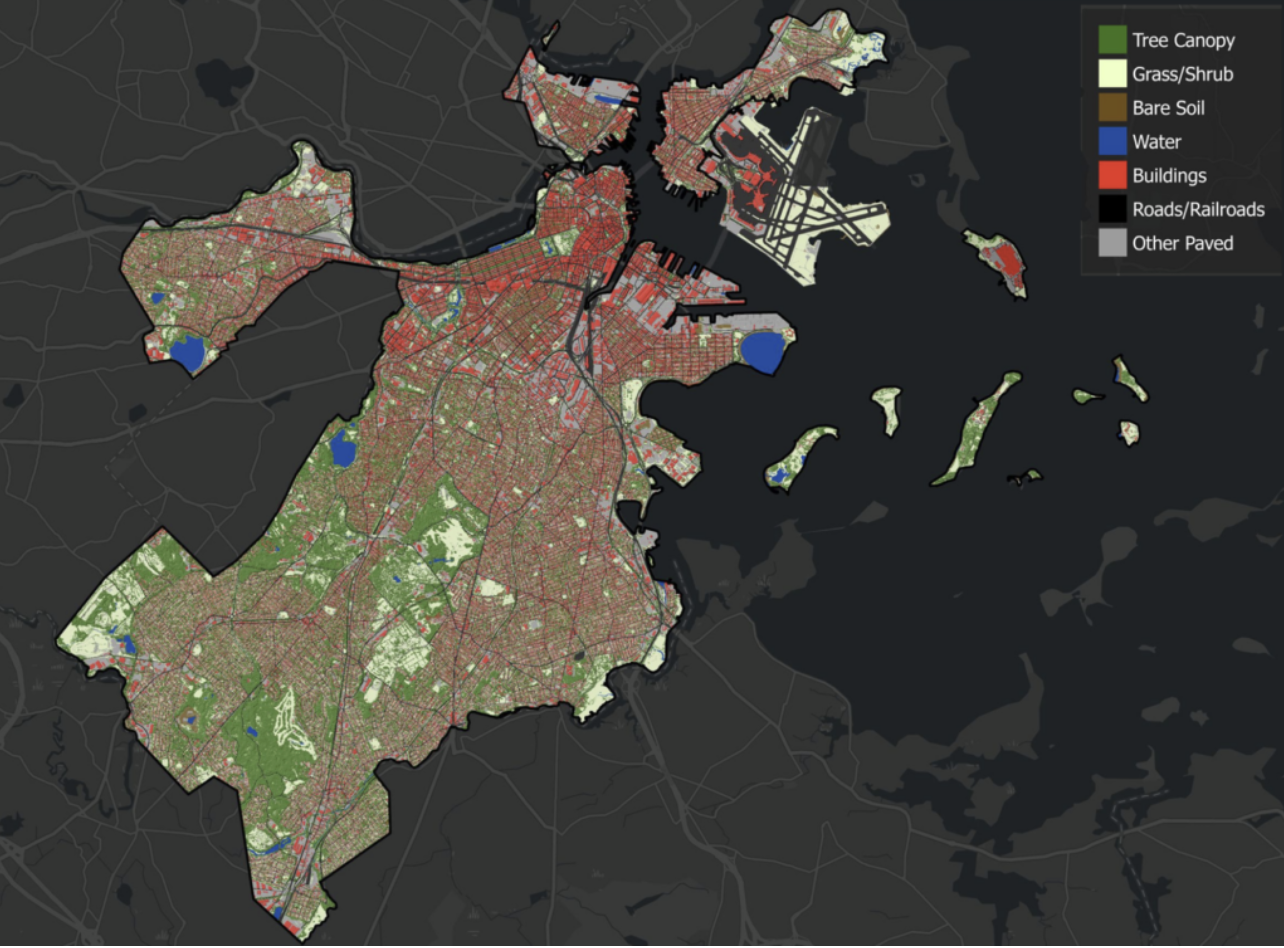
The phrase “tree canopy” describes the coverage provided by a tree’s branches and leaves that cover the ground when viewed from above. A Tree Canopy Assessment Report, put out earlier this month by the Parks Department and the Mayor’s Office, used data collected via Light Detection and Ranging, a remote sensing technology known as LiDAR, to create a precise map of tree canopy coverage in Boston.

The assessment, which was provided by the University of Vermont Spatial Analysis Lab, showed a net increase of 151 acres of canopy, resulting in Boston’s coverage increasing by an absolute 0.5 percent to 28.5 percent (excluding the airport) during the five-year period, driven by gains on public land such as parks and rights-of-way.
This was called “meaningful progress” over the previous five-year period, which showed no net change in canopy coverage.

Shade provided by trees helps cool the air outside and reduces indoor cooling costs, Mistor said, and mature trees also block northern winds, uptake stormwater, and, as a corollary matter, have been shown to benefit mental health.
“We need to be proactive about caring for our trees,” he said. “They are absolutely an asset for the community.”
Although the Urban Forestry Division is responsible for the maintenance of newly planted street trees, his office encourages residents to be stewards of nearby trees by watering them and looking out for issues like invasive pests or dying trees.
Research shows that tree cover in US cities average about 40 percent, but only 27 percent of Boston’s 31,000 acres is covered by tree canopy, according to the assessment.
Dorchester’s canopy saw almost no change between 2019 and 2024, according to the report. More-leafy Mattapan and Hyde Park saw decreases in coverage, but because these neighborhoods already had a high percentage of canopy coverage — roughly 36 percent and 41 percent in 2019 — the small decreases there are less concerning than a small decrease in an area like East Boston, where canopy coverage is scarce, Mistor said.
Dave Queeley, interim executive director of Speak for the Trees, Boston, a nonprofit that plants, preserves, and advocates for trees, said in an email that younger trees don’t offer the same benefits as mature trees, “but continuing to plant as many trees as possible is important.”
His group partners with the Parks Department to plant trees in public parks, cemeteries, and areas where trees are dying. The group has planted more than 529 trees since 2018 and projects it will plant 200 this year. An added positive factor: more than $1.3 million in city grants to fund tree-planting initiatives.
Slowing the development of areas that house clusters of mature trees would also aid climate resilience efforts, Queeley wrote.
Development is not the only factor to consider; harsh weather can take a toll on the city’s trees, especially during punishing storms like the few Boston saw this winter. And invasive pests like the emerald ash borer beetle kill ash trees when its larvae burrow under the bark and feed on the nutrients inside the tree.
The largest share of Boston’s tree canopy, 35 percent, is on residential land. Dorchester is no exception to this. Mistor said he wants residents to know that trees on private property matter just as much as street and park trees and that residents can request that a tree be planted on a street near their land.
Rather than focusing on a quantitative goal, Mistor said, the Parks Department is committed to creating equity among neighborhoods.
“Hopefully in a place like Dorchester,” he said, “we can move that needle a little bit more than just breaking even.”
This story is the product of a partnership between the Dorchester Reporter and the Boston University Department of Journalism.