
Some patients want more control over their health data. Cambridge Health Alliance’s Hannah Galvin is working to help.
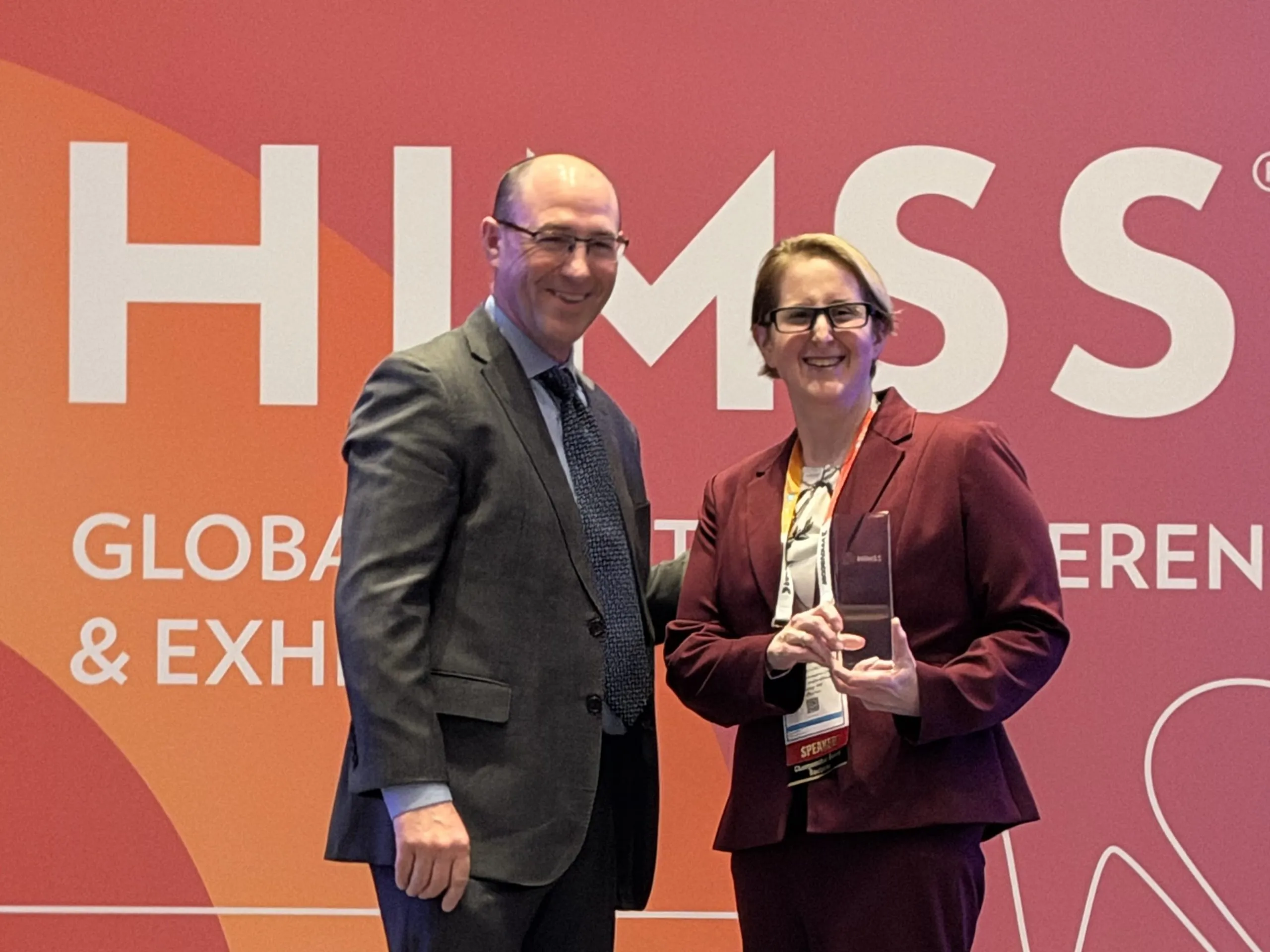
Hannah Galvin (right) at the 2026 Healthcare Information and Management Systems Society Global Health Conference with Tom Leary (left), senior vice president and head of government affairs at HIMSS. Credit: Courtesy of Cambridge Health Alliance
The push to make patient data easier to share across health systems has exposed a gap, as most systems still lack a way for patients to control how their information is used.
When a patient walks into an emergency room, their medical history can arrive before they do. For some, that means faster, better care. For others, it can mean being judged before they are treated.
That tension is at the center of the work of Hannah Galvin, chief health information officer at Cambridge Health Alliance, a community-based health system serving Boston’s metro-north area. She recently received a national Changemaker Award from the Healthcare Information and Management Systems Society for her work on patient data sharing.
“My work is about balancing access to information with patient privacy,” Galvin said. “Right now, we’ve built systems that move information easily, but they don’t always account for how that information affects patients.”
For health systems, sharing data is now a core part of care. Doctors rely on it to see medications, allergies and past diagnoses without having to start from scratch.
“When a patient comes in, we already have a baseline understanding of who they are,” said Jeannette Currie, the alliance’s senior vice president and chief information and digital officer. “That builds confidence in the care they receive, because they don’t have to repeat everything from the beginning.”
Worrying about health TMI
That lack of control can have consequences for patients, particularly those with sensitive health histories. Galvin said she saw that firsthand while working with homeless and at-risk youth through Bridge Over Troubled Waters in Boston, where some hesitated to seek care because of how their information might be viewed.
“They were worried about what was already in their record and how it would be interpreted,” she said. “Some would tell me they didn’t want to go to the emergency room because they thought providers would see their history and make assumptions about them.”
In some cases, that hesitation appeared when patients needed urgent care. Galvin said patients especially with a history of substance use worried their records would lead providers to dismiss their symptoms.
“They would tell me, ‘They’re going to see that and assume I’m just drug-seeking,’” she said. “Even when something else was going on, that history shaped how they expected to be treated.”
Part of the issue is how systems handle data sharing. In most cases, patients can either allow their information to be shared or block it entirely, with little room in between. That leaves those concerned about privacy with a difficult choice: share everything or risk providers missing important details.
Standard setting for data sharing
To address that gap, Galvin co-founded Shift Collaborative, a group working to develop standards that give patients a greater say in how their health data is shared. The aim is to allow people to choose which information is shared and with whom, without limiting access to care, reflecting a broader shift in how the industry is approaching data use.
“If the system is all or nothing, then it’s not working for everyone,” said Amit Trivedi, director of communications and partnerships at Shift Collaborative. “The people who may need that data sharing the most are often the least likely to use it.”
Adoption is in its early stages. Much of the work remains behind the scenes, as health IT vendors and policymakers decide how to incorporate these changes into existing systems.
“We’re getting to a point where this can start showing up in real-world settings,” Galvin said. “This has been something the industry has avoided for a long time because it’s hard to do, but that doesn’t mean it shouldn’t be done.”
Working to get adoption
Unlike many efforts in the health tech space, Shift is not developing a product or selling a service. The nonprofit has relied largely on volunteers so far, with plans to grow through grants, partnerships and training.
That structure means its impact depends on whether others choose to use it.
“The goal is to make sure the benefits of data sharing actually reach everyone, not just the people who are already comfortable with the system,” Trivedi said. “We can build the framework and show that it works, but it only matters if it’s adopted across the system.”
The challenge now is turning that framework into something widely used, as health systems continue to expand data sharing faster than they build in ways for patients to control it.
“We’ve spent years building systems to move data,” Galvin said. “The next step is making sure patients have a real say in how that information is used.”
This story is part of a partnership between Cambridge Day and the Boston University Department of Journalism.