
Tag: clean energy

  • Newton Energy Commission launches survey to understand barriers to home electrification

    Newton Energy Commission launches survey to understand barriers to home electrification

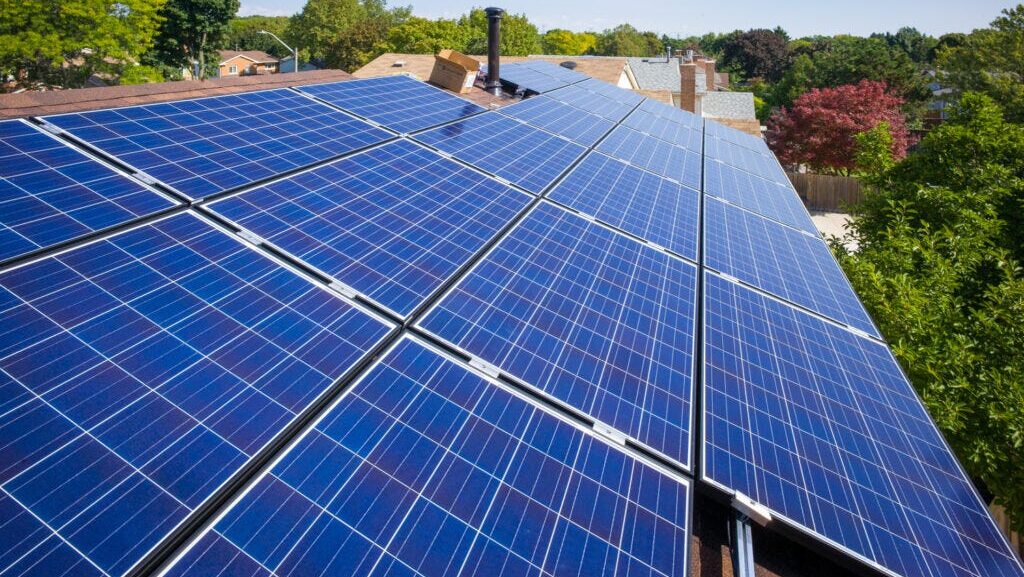
    Solar panels. Public domain photo

    The city of Newton aims to become carbon neutral by 2050, but reaching that goal will require transforming nearly 25,000 homes into fully electric households. And environmental advocates say it starts with something basic: knowing what’s actually inside people’s homes.

    To gain a better understanding of what’s being used in Newton homes, the Newton Energy Commission—in partnership with Green Newton, 350 Mass Newton, and Mother’s Out Front Newton—launched a survey aimed at single-family homeowners. 

    “There’s a lot of conversation at the policy level—both for the city and the state—about this subject, and a lot of it is quite honestly uninformed by what’s the current state,” said Jon Slote, a volunteer member of the Newton Energy Commission and a retired solar engineer. “We wanted to take an objective view and find that out.”

    Slote said the survey is designed to answer two fundamental questions: What heating sources and appliances are Newton residents using, and what is stopping them from switching to electric alternatives.

    Massachusetts has been working toward this kind of transformation for years. In 2008 the state passed the Global Warming Solutions Act and in 2021 updated the act to set a goal of cutting greenhouse gas emissions at least 57% below their 1990 levels by 2030. According to Massachusetts Clean Energy and Climate Metrics, residential fuel combustion remains one of the key factors the state must address in order to complete its climate goal.

    Judy Jacobs, executive director of Green Newton, said the survey is as much about fixing poor-quality data as it is about gathering new data. “Right now, the decisions are being made with incomplete or overly conservative data,” she said, “And in some cases those costs are being estimated much higher than the real cost.”

    For Jacobs, better data means better outcomes for residents. “We really want to get the data we need about costs and barriers and help that inform decisions so that it ultimately benefits Newton residents,” she said.

    That data could ultimately shape how residents heat, power and cook in their homes in the years ahead.

    “One of the things that’s pretty clear, when we think about carbon neutrality, is you need to reduce the emissions of greenhouse gases that are being produced by everything we do on a day-to-day basis,” Slote said. “All of us who live in homes in Newton, over time, we need to think about replacing gas and oil and propane uses with electricity.”

    The survey, which went live March 16, asks homeowners about their heating systems, hot water, cooking appliances, dryers and other energy uses. The survey is funded by a $3,000 microgrant from the Village Bank, which will help cover costs to mail surveys to Newton residents. 

    Additionally — to encourage participation — three respondents will be randomly selected to win free gift cards ranging from $50 to $250. Residents who complete the survey can also request a free consultation with one of the city’s volunteer energy consultants.

    For some Newton residents, the survey won’t be necessary. They’ve already decided to switch to all-electric products. 

    Rachel White has fully electrified her home after years of gradual changes. She began with her stove, then tackled heating and hot water in 2023 when her central air conditioning system was failing.

    “The motivation for doing that was that I really wanted to reduce exposure to the emissions associated with gas while cooking,” she said.

    White said one unexpected benefit was the quiet. “The air blows so smoothly and slowly from heat pump systems that they’re barely noticeable when they’re operational,” she said.

    She also acknowledges cost as a legitimate concern but says she breaks it into two categories—upfront costs and operating costs—and says the investment has been worth it. White said solar panels, which she installed alongside the heat pump system, have helped offset rising electricity costs. 

    “For folks who do have good solar exposure, the solar panels pair really, really nicely with an all-electric house,” she said.

    Debra Kriensky had a similar experience. Eight years ago, she and her family moved to a Newton home that ran mostly on oil —something she described as both expensive and frustratingly loud.

    “Even within our first year we were like, ‘We would love to do something about this and get off oil,’” she said. “Not just because of the environmental concerns, but also it was expensive and the prices kept changing.”

    Like White, Kriensky replaced appliances gradually throughout her time living in her home rather than doing it all at once. 

    Kriensky said she discovered heat pumps through a Green Newton webinar. “I’m grateful for organizations like Green Newton, for example, because if I hadn’t randomly come across one of their webinars on heat pumps, I don’t know that I would’ve even known about it as an option.”

    Her family has since gone fully electric and recently added solar panels to manage expensive electric bills.

    “Our home has been much more comfortable—everything’s been quieter,” Kriensky said. “I definitely think it was worth it.”

    Slote said he hopes the survey will help to inform further conversations about electrifying homes in Newton. “We’re very excited about the notion of trying to find some neighborhoods where people would like to collectively electrify and get off the gas system,” he said. “And we want to be a big support for that.”

    If you’re a single-family homeowner and are interested in filling out the survey, click here

    ****

    This story is part of a partnership between the Newton Beacon and the Boston University Department of Journalism.

  • Amid federal cuts, legislators push for transition to clean energy

    State legislators and Newton officials are encouraging residents to participate in sustainability programs to reach the commonwealth’s goal of net-zero emissions by 2050, following recent federal funding cuts to clean energy projects.

    On Oct. 2, the Trump administration terminated federal funding for 223 energy projects nationwide, totaling $7.5 billion nationally and approximately $446 million in Massachusetts. In a press release, Gov. Maura Healey said that the cuts target private companies, universities and nonprofits working on research and product development, and undermine efforts to lower energy prices.

    “These misguided actions will make it significantly harder to achieve net-zero emissions by 2050 in Massachusetts,” Sen. Cynthia Creem said in an interview. “We cannot completely fill the gaps from the lost federal funding, but we are not powerless.”

    The Newton Democrat advised that the best way forward is to continue pursuing climate policies and installing clean energy at the state and local level. She noted the state will continue to offer programs that fund clean energy investments, including Mass Save for energy efficiency and electrification, MOR-EV for electric vehicle incentives, and initiatives supporting solar and battery storage systems.

    Creem said she has personally filed bills to ensure that scarce climate resources are used as effectively as possible. These include establishing a process for low-cost transition from gas to clean heat, transforming Mass Save’s energy assessments into decarbonization assessments, and aligning transportation infrastructure with climate obligations.

    “Massachusetts law requires us to reach net-zero emissions by 2050 and that hasn’t changed. If we’re going to comply with that law, then we don’t have time to despair. We have to get to work,” said Creem.

    Ann Berwick, co-director of the Newton Sustainability Department, said that Newton is moving ahead with programs that aren’t federally funded.

    One example is the Building Emissions Reduction and Disclosure Ordinance (BERDO), which targets reducing the carbon footprint of large buildings in Newton, which account for 27% of the city’s greenhouse gas emissions. Berwick also highlighted Newton Power Choice—which is funded by electricity customers and utility bills—as a resource for residents to increase their investment in clean energy.

    Green Newton, a nonprofit organization dedicated to improving sustainability and educating residents on their resource use, hosted a Green Expo on Sunday to highlight environmentally friendly products, companies and information.

    “We are killing our planet with greenhouse gas emissions from burning fossil fuels. We have to stop doing that,” said Craig Forman, a member of Green Newton’s board of directors.

    Forman said that while federal tax credits are being lost, there are still other easy ways for Newton residents to make a difference locally. Eating less beef and taking public transportation, walking or biking can help lessen greenhouse gas emissions.

    “These can have a very big effect, even though it’s not putting equipment in your house or any big change of lifestyle,” said Forman.

    *****

    This story is part of a partnership between the Newton Beacon and the Boston University Department of Journalism.

  • Mass. needs thousands more clean energy workers. Here’s how it plans to train them

    Massachusetts needs to train about 29,000 additional clean energy workers by 2030 to reach its climate goal of net zero greenhouse gas emissions by 2050, according to the Massachusetts Clean Energy Center’s 2024 Industry Report. 

    Jennifer Applebaum, MassCEC’s managing director of workforce development, said in reaching that estimate the agency looked at both its goals and what the market is saying at the moment.

    “What drives hiring is absolutely still local industry and business demand,” Applebaum said. “The programs and workforce efforts that we set up and support have to be tied to that local and real time demand.”

    The Healey Administration, in partnership with Social Finance — a national nonprofit and registered investment advisor — recently implemented the Massachusetts Climate Careers Fund to fill climate employment gaps, grow economic mobility and prop up a diverse workforce.

    The CCF offers 0% interest loans to low-income Massachusetts residents for climate career training. Once a worker is certified in a “good-paying role that supports the climate transition,” and earns at least $47,000 annually, they begin repaying their loan. Repayments will help fund future participants, according to the Social Finance website.

    “We get to spend that same dollar over and over again,” Massachusetts Climate Chief Melissa Hoffer said at a climate workforce forum of about 50 people hosted by the Boston Foundation and Social Finance Oct. 8. 

    Programs include electrical and plumbing apprenticeships, HVAC certification and solar tech training. 

    The original goal for the fund was $10 million, comprising both public and private philanthropic investment. MassCEC has not formally announced what the state’s specific contribution amount towards the fund will be yet, Applebaum said. 

    Kirstin Hill, president and chief operating officer of Social Finance, said there has been a “meaningful focus” on higher education nationwide but less investment in the workforce compared to other developed countries globally. 

    “One of the critical levers that’s missing, not only in Massachusetts, but across the country, is the workforce, and is the skilled labor workforce, in particular,” she said.

    Applebaum said historically the workforce was a limiting factor for clean energy, but with properly-skilled employees, these companies could be growing faster. 

    “Solutions are reaching places where there’s scale and need for much larger numbers of folks that are going to do the installation and the maintenance to make these changes really happen across the commonwealth,” Applebaum said. 

    Barriers that can prevent both training and employment include transportation, child-care and rent payments. The opportunity cost for training can sometimes derail workers from completing the needed steps, and other times, the jobs trained workers hold can be unsustainable for personal or external reasons.

    The International Renewable Energy Agency reported in July that 91% of renewable energy projects in 2024 were less expensive than their fossil fuel alternatives while renewables outpaced coal generation globally for the first half of 2025, according to a Global Electricity Mid-Year Insights report by Ember, a global energy think tank. 

    So the “horse is out the barn” — or a done deal — Hoffer said at the forum, referring to the globalized clean energy transition. 

    “[Massachusetts] is in line with that forward thinking, and the market is supporting these transitions,” said Mary Wagner, clean energy training manager at Holyoke Community College. 

    Jobs in the clean energy sector include electricians, energy auditors, electric vehicle mechanics and HVAC technicians as well as solar, offshore wind, EV repairs and geothermal technology related careers.

    The clean energy industry makes up 3% of the Massachusetts workforce, according to MassCEC’s 2024 Executive Summary, and the industry has experienced 100% job growth since 2010. As it expands, the supply of workers and the training and resources needed must increase to keep up with demand. 

    “Filling those jobs is a tremendous economic impact. We need the workers, and [these are] good high paying jobs.” said Rep. Jeffrey Roy, D-Franklin, who is currently sponsoring a bill to establish green energy tracks in vocational schools.

    Andrew Baker, workforce training manager at HCC, expects there to be job growth in the trades during a time when other jobs are threatened by artificial intelligence. 

    “You can’t AI your way out of a broken furnace,” Baker said.

  • SunDay protest held in Wellesley went beyond environmental justice issues

    Anti-Trump protestors co-mingled with demonstrators promoting environmental justice on Sept. 21 in front of Wellesley Town Hall, resulting in a shared event among residents with similar social and political sensibilities.

    SunDay, a national event promoting clean energy and sustainable technologies, attracted approximately 100 people on a Sunday afternoon, representing activists opposed to recent presidential policies and climate advocates. The group occupied the lawn in front of Town Hall and spilled across a public sidewalk.

    Many activists held homemade signs, some of which read, “It’s Science, Stupid,” “There’s No Planet B,” “Defend Democracy,” and “So Many Things, So Little Cardboard.”

    Quentin Prideaux, a board member of Sustainable Wellesley, spoke to the crowd. He said Earth’s health gets worse every day, but hope for the future is embodied in citizen activists like those assembled in Wellesley. “The majority of the population of this country wants renewable energy,” he said. “You are the majority … you can help it happen a little bit faster.”

    At one point, the crowd took up the tune of “Bella Ciao,” an anthem of Italian anti-fascists. 

    “We need to rise up,” protesters sang. “We need to open our eyes and do it now, now, now!”

    Behind the demonstration, two tables offered direct and indirect ways to fight the Trump administration. One table provided postage-paid postcards for participants to write directly to voters in Virginia, encouraging them to vote for progressive initiatives. Another table dispensed multi-colored paper clips in response to journalist E. Jean Carroll’s call for the revival of the paper clip protest, a World War II-era silent dissent against the Nazis. Carroll accused President Trump of sexual assault, and later won an $83.3-million defamation lawsuit against him.

    “We’re losing ground with our ecology, with our freedom…we need to stand up and be counted,” said Wendyl Ross. She sat at the edge of the protest. When asked what it meant to be “counted” she said, “Hopefully that our votes will be counted…that our voices will be recognized.” 

    Ross said she feels grateful to live in Wellesley, where the town government takes care of its citizens and houses a “world-class” recycling area. 

    Sam Hunt had a “No Stupid Kings” sign hung around his neck while holding a cane and an American flag. He said he attended SunDay specifically to protest Trump, and plans on writing a letter to The Boston Globe questioning what he called the newspaper’s unbalanced political coverage of the Trump administration. 

    “Let’s see if they put this on the front page,” he said. 

    Looking into the street, he said it was disappointing not to see more young faces. 

    Wellesley High School junior Jonathan Luu appeared as the second guest speaker. Taking AP Environmental Science, he said, taught him about human impacts on natural ecosystems.

    “Buy less stuff,” he said, accusing many manufacturers of polluting the Earth. Luu suggested people shop at Wellesley Give-and-Take and thrift shops. Hand-me-downs, he said, make ecological and financial sense.   

    Near the end of the day, Raina McManus, a member of Sustainable Wellesley, said the cacophony of voices and opinions added to the impact of the event.

    “If we don’t have a healthy, sustainable planet,” she said, “What’s the point of having a democracy?” 

  • Ain’t No Sunshine: Trump’s tariffs on steel, aluminum stall Newton’s solar plan

    Construction of a solar canopy in the Memorial Spaulding Elementary School parking lot has been halted after Trump’s tariffs caused steel prices to soar.

    The city has made a consistent effort to stay at the forefront of the Commonwealth’s sustainability efforts, with initiatives like the Climate Action Plan, a five-year timeline to introduce sustainable practices into the city, and Newton Power Choice, a city-funded program that enables citizens to easily invest in clean energy.

    As of 2022, the city had 18 solar projects online, which generate 5 million kW/hr a year, equal to 25% of the city’s total electricity use. Now, it has one additional project completed, two more under construction and six planned.

    Since 2022, Newton has also planned to install solar canopies at the Education Center, the Wheeler and Meadowbrook Road corner parking lot, and Memorial Spaulding Elementary School. However, the construction at Memorial Spaulding suddenly shut down when the developer was looking to do the last round of purchasing, specifically for steel.

    As of June 4, Trump raised the tariffs on steel and aluminum from 25% to 50%, causing steel prices to climb from $700 to $900 per ton.

    “With recent uncertainty around tariffs and the tariffs that were already in place on steel coming in,” said Sam Nighman, Newton’s co-director of sustainability. “The project was no longer financially viable for them.”

    Construction had not started, but the project was in the final planning stages.

    “With canopies, those end up involving a lot more steel compared to, like, your overall roof system or a ground mount system,” Nighman said.

    There is still hope that the project will resume at Memorial Spaulding. There are no barriers besides tariffs preventing construction.

    “I think everyone agrees it would be a good location for a solar canopy,” Nighman said. “If we can, in the future, find a way for that to work financially. We’ll pick that up and try to make that happen then.”

    The remaining canopies are larger and are predicted to produce more energy, which makes them more financially viable. As of now, construction for these areas is still planned for the summer, but Newton is not certain of the exact outcome for the other canopy projects.

    “Ones where we are looking at canopies, this could be impacted,” Nighman said.

    The solar projects are conducted under power purchase agreements with Ameresco, a New England-based solar developer, which means the company owns and maintains the projects and the city leases the space to them, Nighman said. Ameresco pays for the panels, the installation and all the upfront costs. The city buys the electricity produced by these panels.

    The solar projects allow Newton to mitigate some effects of climate change and save money on energy because solar is less expensive than other energy sources.

    “So I think if we look at our overall portfolio, the amount annually that we save is somewhere around $1 million in electricity costs from all of our solar projects,” Nighman said.

    The plan includes solar installation on municipal property as a big part of their plan to mitigate climate change.

    The issue is seen not only in Newton but in construction projects across the country. Even the talk about tariffs before they were implemented was enough to disrupt the supply chain that was still reeling from the pandemic.

    “There’s been a lot of disruptions,” said Gilbert Michaud, an assistant professor at the School of Environmental Sustainability at Loyola University Chicago and the policy division chair at the American Solar Energy Society. “It’s definitely not just in Massachusetts or New England or a regional thing, like it’s all across the country.”

    A report published in 2021 by the Newton Citizens Commission on Energy, a citizen-run group that creates renewable energy policy, found that residential homes and cars were responsible for 61% of the greenhouse gas emissions created in Newton. Commercial properties accounted for 37% and municipal uses 2%.

    Philip Hanser, the commission’s chair, said the group will set its sights on finding ways to encourage more solar adoption in residential areas.  

    “I think our next sector to tackle is residential homes and buildings, particularly less than 20,000 square feet, because they represent over a third of the emissions in the city,” Hanser said. “That’s the kind of next big frontier, and that’s where things need to be concentrated.”

    The biggest hurdle is motivating more of Newton’s 31,730 households to participate.

    “There are state and national mandates to help do that, but a lot of it is getting the word out and convincing people it’s a good idea,” said Michael Gevelber, a member of Newton’s Energy Commission since 2012 and an associate engineering research professor at Boston University.

    “How do you get more of them to put solar panels up, buy electric cars, put in heat pumps to provide heat during the winter?” Gevelber said. “That’s the question we’re contemplating, and that’s what goes into the climate action plan.”

    The same 2021 report revealed that Newton was not on track to reach any of its 2025 goals regarding EV ownership, residential heating emissions, commercial heating emissions, and heat pump installation.

    “Five years later, you measure, ‘Where are we?’” Gevelber said. “We barely scratched the surface, unfortunately.”

    To combat this issue, the commission urges the government to educate residents about their energy consumption.

    “The commission right now is putting forward that the city needs to think about putting into place an ordinance for homes to know what their energy use intensity is, and to use that data in the long run to develop decarbonization plans for everybody’s homes,” Hanser said. “And part of the decarbonization plans could be to supplement the energy sources with solar panels.”

  • Five state legislators outline strategy to counter Trump administration at Brookline forum

    From left to right: Moderator Tom Hallock, State Senator Cindy Creem, State Representative Tommy Vitolo, State Representative Bill MacGregor, State Representative Greg Schwartz and State Representative Kevin Honan. Photo by Jacqueline Manetta

    Five Democratic state lawmakers advised Brookline residents Monday how to navigate the Trump administration and push back against its policies.

    About 70 people attended the forum, which featured state Sen. Cynthia Stone Creem and state Reps. Kevin Honan, William MacGregor, Greg Schwartz and Tommy Vitolo. It was hosted by the Brookline Democratic Town Committee and Activist Evenings, a progressive group based in Brookline.

    Tom Hallock, treasurer of the Brookline Democrats, asked the legislators questions about essential services, the environment and immigration. The group responded to three audience questions at the end and stayed afterwards to answer one-on-one questions.

    Creem cited the state Senate’s new committee, Response 2025, as a potential solution to the Trump administration’s cuts. The initiative has tasked the bipartisan Committee on Steering, Policy and Scheduling with finding policy solutions to combat misinformation and protect residents’ rights.

    Keeping political allies in office is one of the most effective ways to fight the executive branch’s polarizing policies, Vitolo said.

    “I think it’s really important in all of the things we talk about tonight to consider the reality that if Governor Healey doesn’t win reelection — or Attorney General Campbell doesn’t win reelection — we are in much worse shape,” he said.

    Schwartz, the only medical doctor in the Massachusetts legislature, said health care programs — and consequently state revenue — will be affected if defunding continues. If the U.S. Senate approves President Trump’s “Big Beautiful Bill,” Massachusetts can expect its $14 billion of Medicaid reimbursement to be reduced, he said.

    “That could affect 200,000 to 300,000 patients losing Medicaid and, of course, it will affect the emergency rooms, the primary care physicians and the hospitals, which are already not in great shape,” Schwartz said.

    All five lawmakers emphasized the need for Massachusetts to remain at the forefront of responsible environmental efforts as federal environmental protections roll back. The legislators plan to concentrate on statewide initiatives such as expanding clean energy, increasing accessibility to electric vehicles and strengthening existing policies.

    The lawmakers also discussed immigration, which they identified as a core American principle that must be protected. Honan cited several bills that work to protect the rights of immigrants, including the federal Safe Communities Act, which prevents local law enforcement from asking about immigration status.

    “We say the best Americans represent hard work, taking chances, building a business, finding success, improving yourself and being part of a community,” Vitolo said. “These are all the things we say we value as a country, and the folks who do it best are the immigrants.”

    Before taking questions from the audience, Creem discussed the Massachusetts Data Privacy and Protection Act and its aim to support women’s reproductive health care rights.

    Under the bill, selling location data and other information collected on cellphones and devices would be prohibited. In recent court cases, consumers’ data from apps has been used  to prosecute health care providers and women receiving out-of-state abortions.

    “My hope is that we can protect that data and minimize the use of that data outside of what you intended it to be,” Creem said.

    The audience at a community forum on safeguarding democracy on Monday, Jun 9, 2025. Photo by Jacqueline Manetta

    Asked if the public has a role to play in resisting the Trump administration’s policies, the lawmakers urged residents to engage with opposing viewpoints and point out injustices.

    “Every second Saturday, from 11 to 1 p.m. in Coolidge Corner, we’re out there doing the very public work of reminding folks that this is not normal, and it’s perfectly reasonable to say it out loud,” Vitolo said.

    The audience erupted with applause as the panel of representatives was asked about increasing transparency in the state’s government.

    MacGregor said representatives are candid about financial statements and regularly audited.

    Creem said she posts her votes on social media to communicate with her constituents. The accusation of insufficient transparency has been brought to her attention before, but she said she doesn’t understand what voters mean or where their concerns come from.

    Schwartz, who was elected to his position in 2024, framed problems with transparency as a potential shortcoming of the media.

    The legislators’ answers to the transparency question were met with eye rolling and groans.

    The event closed with a discussion about reforming the Democratic party. Although Honan said he thinks Republicans will cause their own demise, MacGregor and Creem said Democrats must regain popularity with the working class.

    Vitolo and Schwartz agreed their party must find a message that speaks to a larger segment of the population.

    “We on the left like to play demographic bingo with our voters,” Vitolo said. “What they see is a Democratic party picking off little bits and pieces of certain people and saying, ‘That’s what’s important’ instead of saying everybody’s important.”