Tag: Coolidge Corner

  • Brookline’s ‘Age-Friendly Businesses’ campaign makes older residents’ needs a priority

    Brookline’s ‘Age-Friendly Businesses’ campaign makes older residents’ needs a priority

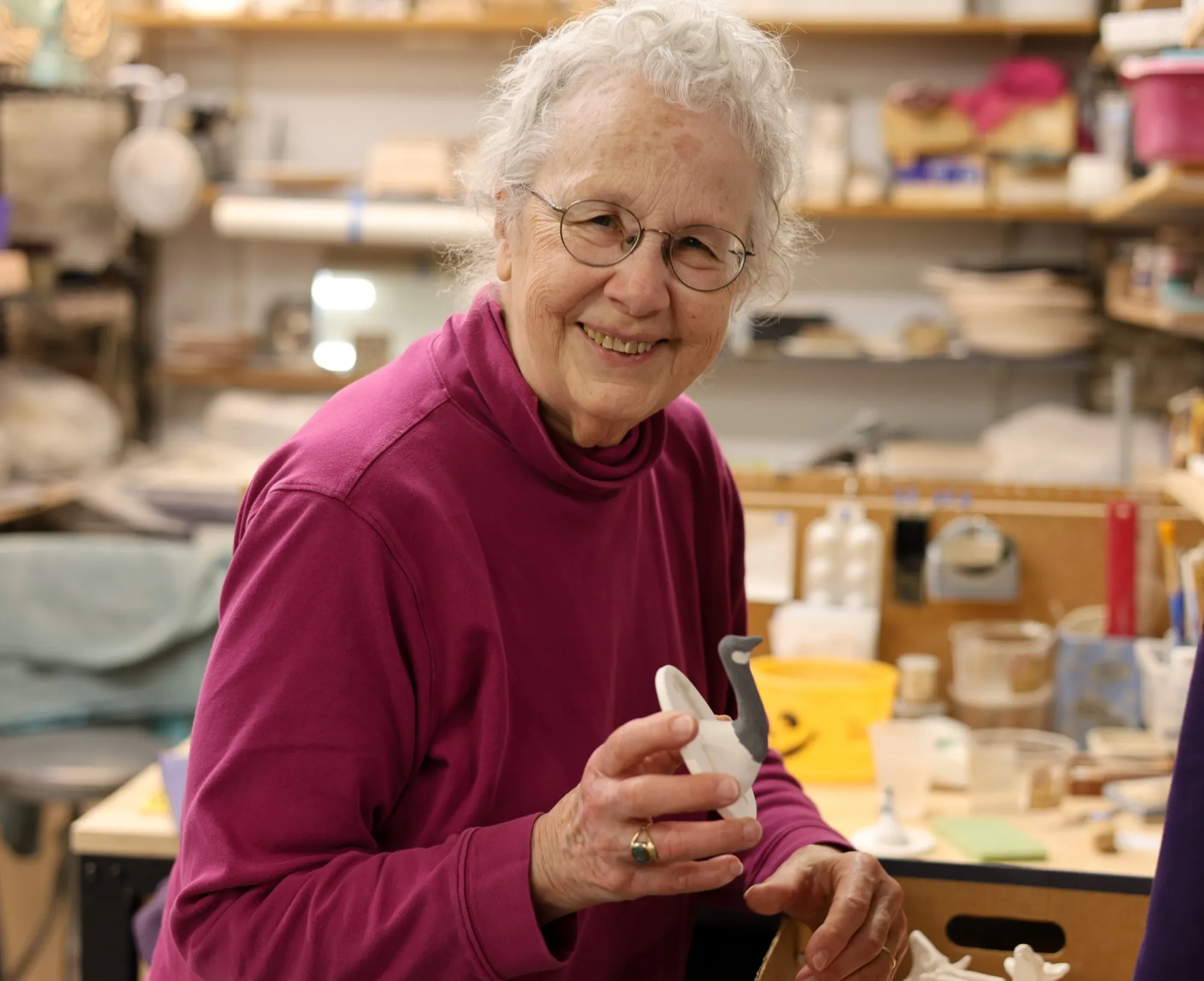
    Bohn Whitaker holds up a goose shaped coat-hook in her studio at Feet of Clay Pottery on February 19, 2026. Photo by Milena Fernsler

    At Michael’s Deli, a Coolidge Corner staple serving overstuffed bagels and hot knishes, owner Steven Peljovich treats his customers the way his parents taught him.

    “You always respect the people who came before you,” he said.

    Designated an “Age-Friendly Business” as part of a campaign led by the Brookline Community Aging Network, Peljovich says he takes special care to meet the needs of his older clients. He offers curbside service, helps sight-impaired customers with self-serve items and even paid for a new walker for one regular customer when she mentioned her insurance wouldn’t cover it. 

    After all, who if not grandparents can keep up the deli’s tradition?

    “They’re the ones that really hold my feet to the fire,” he said. “They know what it’s supposed to look like, what it’s supposed to taste like.”

    To be designated as “age-friendly,” store owners submit an application, after which BrooklineCAN volunteers visit and check for wheelchair accessibility, seating, large-font menus, and general “friendliness” and willingness of staff to accommodate older people’s needs. 

    About 100 age-friendly stores, restaurants and services are compiled on the group’s website , along with other resources like a map of publicly accessible restrooms.

    After the campaign’s founder, Frank Caro, died suddenly in 2020, his wife, Carol Caro, took up where he left off, reaching out to the over 200 new businesses that have appeared in Brookline since the project’s launch.

    Carol Caro, 85, said the purpose is twofold: to serve as a resource for older residents and to help participating businesses expand their customer base.

    “It’s really important for the senior population, and for the population as a whole,” she said. 

    The effort in Brookline is part of a global movement through the World Health Organization’s network of age-friendly cities, which encourages business owners to rethink sidewalks, storefronts and services as the world’s senior population grows rapidly. 

    Over 20% of Brookline residents are older than 60, up from 18% in 2010. That’s about 13,000 seniors, a number that is expected to keep rising. 

    Emily Williams, director of the Brookline Senior Center and co-chair of BrooklineCAN, said the town must keep up with the demands of this growing clientele. 

    “Seniors really need to be heard,” Williams said. “We see so much ageism all over the place. It’s everywhere.”

    Ageism, she said, isn’t always overt. It can show up as a lack of accommodation not only for physical impairments but for cognitive changes as well.

    “Sometimes seniors with memory loss or dementia repeat questions, and some people may not have patience for that type of a situation,” she said. 

    Too often, Williams said she sees older people avoid situations that would make them feel like a “burden.”

    “If there’s a decal in the window of the business, seniors feel much more at ease,” she said. 

    One of the first businesses to earn such a decal was Feet of Clay Pottery, where founder Frank Caro discovered his artistic calling after retirement. 

    The studio’s owner, Jenn Wyman, remembers him riding his bike to Feet of Clay almost every day until his death.

    “He was so funny. So funny. He would just make us roll and laugh,” Wyman said. She said Caro’s advocacy made her more aware of older people’s needs in the studio. She began thinking about even flooring to prevent tripping hazards and bathroom accessibility. After a 78-year-old artist collapsed in the studio, she installed a defibrillator.

    “We treasure the people that have been at Feet of Clay for so long, and we watch them get older,” she said. 

    The artist who’s been there longest of all is Bohn Whitaker, 75, who has been working at the studio for almost half a century.

    “As an older person, it’s easy to become isolated,” she said. Whether she’s chatting with veteran potters or passing on techniques to younger artists, Whitaker said she enjoys being around other people. 

    She said the Age-Friendly Businesses campaign is a good idea, but she’s found Brookline so accommodating that she hardly sees a need for improvement. 

    “I can’t imagine a store where I would not feel welcomed,” she said. This story is part of a partnership between Brookline.News and the Boston University Department of Journalism.

  • How is Brookline handling this harsh winter? Snow far, snow good

    Ian Martz clears off his top deck on February 24, 2026. Photo by Milena Fernsler

    James Danforth spent an hour trying to dig his car out of ice and snow on Corey Hill before finally giving up.

    “Quite a storm we had,” Danforth said, leaning on a shovel. “The side streets are terrible.”

    Danforth, 60, lent a hand to a neighbor whose snowblower broke. “Paul’s too old for shoveling,” he said. Danforth, a roofer, said he loves the work and had been helping neighbors shovel their driveways since before sunrise Tuesday.

    “It’s good exercise,” he said.

    Monday’s blizzard piled another 17 inches of snow on Brookline less than a month after a late January storm dropped nearly 2 feet. If the winter of 2025-26 feels particularly brutal, Brookline residents are taking it in stride – maybe even enjoying it.

    “It’s been a while since we’ve had a real winter,” said Elliot Shimer, a health care strategist who was waiting for the T in Coolidge Corner. “It’s actually kind of fun to have, like, a real snowfall.”

    Daniela Santos and Daniel Lounsbury walked out of Trader Joe’s in Coolidge Corner Tuesday, groceries in hand and snow boots on, and headed to Lounsbury’s apartment in Brighton. They wanted to be prepared for the trek.

    “[We] learned our lesson,” Lounsbury said, smiling. “[Santos] wore Uggs last time.”’

    “It wasn’t fun,” said Santos, a Boston University student. “My Uggs are ruined.”

    Lounsbury, a BU alum, said he and Santos had plans to sled in the “impressive” snowfall. He was also impressed by how well Brookline cleared the roads.

    “The last storm, they didn’t do as well clearing up afterwards,” he said.

    A few doors down, Stephen Chen and his wife, Christina, shoveled snow outside Flake Bakery, their Portuguese pastry shop, as well as neighboring storefronts.

    Stephen Chen takes a break from shoveling outside his pastry shop Flake Bakery. Photo by Eli Pekelny

    “I’m just helping the neighbors shovel,” said Chen, wearing a Donald Duck apron and a short-sleeved shirt.

    Chen called Monday’s blizzard “just another snow day.”

    “I used to see this type of snow, I feel, almost every winter. Now you rarely see it,” Chen said. “It’s probably a shocker to most, but I’m just kind of just used to it. It’s nice to see.”

    Susan Silveira moved from Brookline to Portland, Oregon, in late 2025. She flew back here for a doctor’s appointment Monday. With the blizzard, her appointment was rescheduled for Tuesday and then canceled altogether. She didn’t even mind.

    “It wasn’t terrible, because I have friends here, and I really enjoyed seeing them,” Silveira said.

    Even with her flights back to Portland delayed, Silveira said she holds no vendetta against the snow.

    “In Portland, there’s no snow, so it’s actually kind of a pleasure for me to see the snow, because I’m accustomed [to it,]” Silveira said. “It’s been a pleasurable several days, even with this appointment cancellation.”

    ‘It is beautiful’

    Corey Hill might not be the Tatra Mountains of his childhood in Poland, but Andrei Prey took his skis to the slopes there Tuesday.

    “It is beautiful, eh?” he said, gesturing to the snow-laden trees around him. “Normally there’s no chance to ski because there’s no snow.”

    He pulled down his sunglasses to return to his laps around Corey Hill Playground, where he was the sole visitor. “Profiter de la vie!” he said, as he skied away, French for “make the most of life.”

    Across the street, kids were doing just that with their day off from school. One child tasted fistful after fistful of snow, while another amassed a pile of the stuff with a miniature red shovel. Others flew down Corey Hill on sleds, shrieking when they wiped out, and ran back up to repeat the experience.

    Dillion Tharp (far left) takes it easy, while Lauren Tharp gives Jordan Tharp a push and Nora, Dillon’s classmate, works on a snow pile. Photo by Milena Fernsler

    High school math teacher Lauren Tharp gave her son’s sled a kick to send him down the hill, while her other son, 3-year-old Dillon, sat motionless on a reclining park chair, staring into space.

    “Dillon doesn’t like the snow,” she said. 

    He’s not the only one, of course. Not everybody is a fan of this relentless winter.

    Bill Cook, a retiree and part-time Brookline resident, lives on the South Shore most of the time, which is where he was headed after his trip to Trader Joe’s. He said the snow situation here is a lot better than what he’s dealing with on the shore.

    “We’re buried down there,” Cook said.

    However, he did have a comment about the snow management in Brookline.

    “The streets are pretty sloppy in a lot of places,” Cook said. “I don’t want to seem cranky, but for the taxes you pay, they probably should do a better job clearing the streets.”

    In an email to Town Meeting members and other Brookline officials, public works commissioner Erin Chute asked for patience as crews work to clear roads.

    “While conditions are improving, recovery from a storm of this magnitude is a multi-day effort,” Chute wrote. “Operations will continue for several days as we work toward restoring normal conditions across the community.”

    David Hill, a Brookline Police Department spokesperson, said there were no major incidents related to the blizzard as of Tuesday.

    “A few vehicles stuck in the snow, some wires down calls, some road hazard calls, seven traffic crashes … and a bunch of cars in violation of the parking ban,” he wrote in an email to Brookline.News.

    The snow-related delays on the MBTA have also been wearying for some.

    Ian Lebovitz, who has worked at J.P. Licks in Coolidge Corner, said his commute from Somerville has become increasingly difficult.

    “Now, it’s like an hour on the T,” Lebovitz said. “I get on the green line, ride it till Government Center, switch over to a different train, and then ride it another 30, 40 minutes… The worst part is just waiting for the train to show.”

    Some people, of course, are simply tired of all the shoveling.

    Ian Martz shoveled the snow from the top deck of his house Tuesday, showering the sidewalk below, after excavating his driveway and walkways.

    “Fun times,” he said sarcastically.

    This story is part of a partnership between Brookline.News and the Boston University Department of Journalism.

  • In new exhibit, local artist Michael Berger captures Brookline’s character

    By Hazel Nystrom

    Michael Berger remembers the moment well. It was 10 degrees in Coolidge Corner. A few stragglers stood shivering, waiting for the T. It hardly seemed like a good photo opportunity. 

    But as his eyelashes frosted over, the scene looked different to Berger. The light refracted, creating a blurry, impressionistic version of the moment. 

    Looking through his icy lashes, he snapped the photo as he envisioned the final piece. “That’s the image,” said Berger, an artist  and professor emeritus of chemistry at Simmons University. 

    Tucked into a small gallery in the Brookline Bank in Coolidge Corner, Berger’s latest work showcases sights dear to Brookline residents. Along the walls, the 13 pieces that make up “Visions of Brookline” capture glimpses of everyday scenes, somewhat obfuscated through fractals and haze.

    The exhibit is open through October as part of ArtsBrookline’s initiative to showcase local artists. ArtsBrookline is a nonprofit organization established in 2017, aiming to support artists and develop Brookline into a cultural district.

    As a Brookline resident of nearly 50 years, Berger, 81, takes inspiration from the places around him. Coolidge Corner, Village Square and Dane Park are among the familiar sights found in his work. Berger said his art serves not just to document a place but to capture a feeling.

    For Sasha Liang, 39, longtime Brookline resident and manager of Brookline Bank’s Coolidge Corner branch, Berger’s exhibit did just that. 

    Liang said the exhibit showed “how the various landscapes have changed in the 30, 40 years [he’s] been in the community.” 

    “It’s nice to see what [Brookline] used to look like,” Liang said. 

    Of the locations he photographs, Berger finds Brookline Village to be “the most evocative of another time,” Berger said. Many of his works open a window to Brookline’s past. 

    Berger uses photography and digital painting software in place of a traditional artist’s sketchbook, in an effort to evoke a “sense of place.” He then prints a giclée, a high-quality art print, on canvas and augments his piece with classical mediums — oils, watercolors, chalk pastels or acrylics. 

    The intersection of art, science and photography has always been at the epicenter of Berger’s work. During his 25-year career at Polaroid, he sought to capture both the sharp detail of traditional photography and the feeling of the moment. 

    To do so, he said, “you have to go off track. You kind of have to look at it squinting and look at it over your shoulder.” 

    Berger said he captured that feeling in his work, developing new types of film for Polaroid. This intersection of science and art has influenced his work since, including during his 19 years as a chemistry professor at Simmons. 

    “Science is very dynamic, and art is like that too,” Berger said. “I find that art and science kind of stimulate one another if they’re allowed to blend.” 

    Amy Browning Emmert, vice president of ArtsBrookline, wanted to feature the locally well-known artist. Throughout the installation of his exhibit, passersby stopped to observe the work and chat with Berger, she said. Everyone seemed to know him. 

    Browning Emmert said Berger’s work evokes the memories of the viewer, providing a sense of place and community. 

    “It’s sort of a way of distilling memories in a contemporary way,” she said. The images “make you think about your life, when you went through that place, or how you stood waiting for the T.”

    What many see as mundane, Berger can transform. Dynamism, connectivity, and movement drive his work, even in the most unsuspecting of places.

    “I love the T,” Berger said. “It connects. It flows, just like art and science. It has that dynamic.”

    As a founder of the Brookline GreenSpace Alliance, a nonprofit intended to support Brookline’s open spaces and greenery, Berger’s passion for environmentalism seeps into his art. He’s currently working on another series of images taken at the Arnold Arboretum. 

    Berger’s first exhibit was at the Arnold Arboretum in 1992. And he’s still going. When rain starts falling in sheets, or snow drifts slowly down, he’ll grab his camera and get to it. 

    “The rain, the darkness, the fog, cuts out a lot of the extra stuff,” he said. The image “becomes more like a poem, a visual poem, than a documentation.”

    This story is part of a partnership between Brookline.News and the Boston University Department of Journalism.

    This article was originally published on September 18, 2025.

  • ‘We’re everywhere’: At Brookline’s No Kings rally, crowd fills Coolidge Corner to protest Trump

    By Lauren Albano

    About three miles from the Boston Common, where over 100,000 people gathered  for the second “No Kings” protest, over 100 Brookliners of all ages filled Coolidge Corner on Saturday to do the same. 

    Organized by local activist groups Speak Out, Seniors! and Brookline PAX, the demonstration represented a microcosm of a nationwide movement which brought out nearly 7 million people to streets across the country this weekend to protest the “authoritarian” policies of President Donald Trump’s administration. 

    “We’re here to bear witness and to tell people who feel the same way we do that there are others, so they can feel some sense of solidarity,” said Deborah Finn, a Speak Out, Seniors! organizer who spearheads the group’s weekly 2 p.m. Saturday standout.

    The Brookline rally was accessible for seniors who may not feel comfortable commuting downtown or standing in large crowds, Finn said. Senior demonstrators had space to sit or use walkers as they raised signs and waved to passing cars, whose drivers honked frequently in support of their cause.

    John Bassett, 86, stood at one corner of the square playing old protest songs, such as “When Johnny Comes Marching Home,” with his trumpet. Several of his family members, including his grandson, accompanied the senior standout regular to the No Kings rally. 

    “I’ve had a good life, and I would like my grandchildren to have maybe even a better life, or at least just as good,” he said.

    Bassett participated in protests against Vietnam and nuclear weapons in the 1960s and 70s. He said he appreciated the Coolidge Corner rally being organized in tandem with both the Boston Common protest and the thousands of No Kings demonstrations nationwide.

    “It’s arguable that a lot of smaller demonstrations in a lot of different places is as good as, or maybe even better, than everybody being in one place,” he said. “This way, you can’t get away from us. We’re everywhere.”

    Finn said as an older, white woman, she is “least likely to be suspected of being a troublemaker.” Given recent federal immigration crackdowns in Boston, Finn said it’s important for people of lower-risk demographics to speak out.

    “This is a town full of immigrants,” she said. “There are people here who are vulnerable, and the people who are theoretically less vulnerable have to stand up in front.”

    Lea Hachigian, a 35 year old who works in biotech, came to Coolidge Corner with her husband and two kids for the rally. Hachigian said her kids are old enough to pay attention to the news and have begun asking questions.

    “We’ve been trying to talk about it at home a little bit, and we felt like these democracy rallies are a very positive way to get involved and focus on the good aspects of what it means to be an American,” she said.

    Lea Hachigan, right, came to the No Kings rally in Brookline with her husband and two children. Photo by Lauren Albano

    Hachigian said she has been “dismayed” by the Trump administration’s actions, but this moment serves as a reminder to appreciate the government citizens have had. 

    “Hopefully, we can do something before we destroy more and more parts of this incredible system that’s lasted hundreds of years,” she said.

    Holding a sign that read “No kings since 1776” was 87-year-old Gail Flackett , who attends the senior standout nearly every week and brought her two grandchildren to the No Kings rally. 

    She comes from a long line of activism, noting that her grandmother helped people get abortions before they were legalized. Flackett recalled traveling to Washington, D.C. in the 1990s to advocate for Planned Parenthood. 

    “My parents would be very shocked if they knew that Trump was president,” she said.

    Flackett encouraged people to think about their values and question whether they are truly being represented in the government.

    Mica, a public health researcher who wished to withhold her last name, held a sign reading, “No kings. No fascists. No hate.” She noted the impact of federal research cuts on her work.

    “We’ve lost a ton of public health federal funding for research,” she said. “Our research saves lives, and all of the cuts at the federal level are going to impact science research for decades.”

    Jeff Rudolph, 51, said he dislikes Trump’s practice of seeking “retribution” against those who challenge him politically. He said the ongoing government shutdown is a prime example of this.

    “Not being able to do any negotiation across the aisle [is] because no one trusts him,” he said. “And now we’re seeing programming cut, all kinds of people that need help aren’t able to get resources they need, and it all comes down to him.”

    Elisabeth Pendery, 70, a retired Public Schools of Brookline teacher, attended the Boston Common rally before coming to the Brookline demonstration. She said the country is in a “very dangerous, precarious time right now,” so it’s crucial for people to stand up and make their voices heard because “democracy is an action.”

    Former Public Schools of Brookline teacher Elisabeth Pendery, right, attended both the Boston Common No Kings rally and Brookline’s local event. Photo by Lauren Albano.

    “To say you’re not political is to say you don’t care about your community, and I think people have to take a little more personal responsibility about trying little things to make a difference,” she said.

    Bassett emphasized that protests are important for displaying the ideology and values of a community. He said while holding demonstrations can seem trivial, they make a difference. 

    “Each action is a drop,” he said. “Eventually, the drops spill the bucket, and those things that we did eventually help change our policies.”

  • Bar Lunette serves up colorful cocktails in Coolidge Corner

    Romy Meehan prepares a cocktail at Bar Lunette. Photo by Hannah Roderick.

    Bar Lunette is quickly making a splash in Coolidge Corner.

    The new cocktail bar, in a space that had been an optician’s office, has an undeniably retro vibe. The floor is a black-and-white checkered pattern, and vintage paintings hang on the yellow walls. Patrons can doodle or write quotes on one wall covered in brown paper.

    “It’s so cute here,” said Jenny Seminack, a 21-year-old Boston University student who was there for the first time on a recent Friday, drinking a strawberry spritz with gin. “I can’t wait to come back.”

    Bartenders Mikaela Estes, right, and Romy Meehan at Bar Lunette. Photo by Hannah Roderick.

    While there is no shortage of bars in Coolidge Corner, owner Nick Mallia said he wanted to create a unique experience.

    “There are lots of options on the table but not a cocktail bar,” said Mallia, who has worked for the neighboring Paris Creperie for over 20 years. “A cocktail bar to go to before a movie. A cocktail bar to go to after the movie. A cocktail bar to go to after the sit-down fancy restaurant.”

    Bar Lunette’s menu features French spirits, “Frenchified” classic cocktails and clever pop culture references. Drinks include “Lunette’s French Martini,” which contains vodka, pineapple, mint and blackberry liqueur, and the “Guillo-tini,” a cosmopolitan with a rose and basil foam. The spicy and smoky margarita “Paris Is Burning” references Jennie Livingston’s 1990 documentary. Most cocktails cost $13 to $16.

    A bartender serves up “Lost in Translation,” a Midori sour, at Bar Lunette. Photo by Hannah Roderick.

    “The drinks are really good and unique for a reasonable price,” said Nicolle Alvarez, 24, a research lab technician at Massachusetts Eye and Ear.

    Malia said he hopes by mid-summer to offer a food menu that includes baguette sandwiches, French onion soup, cheeses and more.

    Open since mid-May, Bar Lunette already has regulars.

    Lauren Smith, 21, a manager at CorePower Yoga who lives in Brookline, said Bar Lunette is a good addition to the community.

    “The vibe is great,” Smith said. “We need more fun little bars.”

    A “Guillo-tini, left, and “Stardust” at Bar Lunette. Photo by Hannah Roderick.

  • Why matcha mania is taking over Brookline’s cafés

    Deborah Obeng enjoys her matcha at the Maruichi Tea House in Brookline. Photo by Miu Tung Rong.

    Walking through Coolidge Corner on a weekend morning, it’s hard not to notice the matching cups. Dozens of people pass by holding the same clear plastic cup — each one filled with a layered, vividly green drink. Some swirl it as they walk. Others pause to take photos before taking a sip.

    Matcha – the finely ground powder of specially grown and processed green tea leaves, known for its earthy, slightly bitter taste and vibrant green hue – has become a highly visible part of Brookline’s food and drink culture. What was once a niche product in health food stores and Japanese grocers is now a common order at cafés and tea houses, especially among younger consumers.

    “I personally have whisked easily over 10,000 matchas,” said Akira Kato, the shift lead at Maruichi Select, a Japanese tea house and market in Brookline. “I actually have a callus from it.”

    The rise of matcha – whose global market is valued at over $2 billion and growing – reflects broader shifts in how people consume food and drink, prioritizing aesthetic appeal, health benefits and cultural variety. Over time, it has steadily integrated into everyday routines, reflecting changing tastes and a growing interest in Japanese tea culture.

    Matcha originated in China during the Tang Dynasty and was brought to Japan by Zen Buddhist monk Eisai in the 12th century, where it became deeply rooted in meditative rituals and the tea ceremony tradition, according to Matcha.com. Eventually, regions like Uji in Kyoto refined the cultivation and stone-grinding techniques, turning matcha into a symbol of Japanese culture and craftsmanship, according to Tenzo Teas.

    Maruichi  Select, part of the Fuji Mart Corp. family of Japanese grocers and markets, launched its Brookline “Select” boutique in 2021. The store combines a curated selection of private‑brand and imported goods — ranging from pantry staples to gift items — with a café offering handcrafted beverages and food. Its prominent matcha line offers insight into how global trends gain local traction and how social media visibility can shape real-world behavior.

    Two cups of matcha at Maruichi in Brookline. Photo by Anny Zheng Wu.

    Other Brookline spots serving matcha — like Kyo Matcha, Caffè Nero and Japonaise Bakery — point to the drink’s broader popularity in cafés, bakeries and specialty shops.

    This summer Junbi Matcha & Tea will open its first Massachusetts location in Brookline. The brand has 11 locations across the United States and is opening eight more, including the shop at 190 Washington St. in Brookline Village. With drinks like yuzu dragon fruit and strawberry matcha, Junbi adds even more variety to Brookline’s booming café scene.

    Kato has observed the tea house’s rising matcha demand firsthand. On a busy Saturday, staff prepare anywhere between 700 to 800 matcha drinks, often with customers ordering in groups or picking up multiple drinks for friends or family. Prices typically range from $8 to nearly $20, especially when drinks are paired with food items or include seasonal ingredients.

    Unlike most cafés, where matcha is pre-mixed and poured, each drink at Maruichi is hand-whisked to order — a time-consuming process that some customers view as part of the appeal.

    “It’s never pre-batched in a big container or in squeezy bottles,” Kato said. It’s all just right, directly from the bag into the tins, and then we just whisk it.”

    That attention to detail is part of what drew in Deborah Obeng, who typically makes her own matcha at home.

    “I don’t typically go to places just because I don’t like their quality,” she said. “So I usually make it at home. But this one was worth trying.”

    “I saw her whisking it just like I make it at home, so that makes me feel good about it,” she added. “It’s not super sweet. You can still get the green earthiness from the matcha.”

    Maruichi’s growing visibility has been boosted by limited-edition seasonal menus and pop-up events. One of the most high-profile was a 2024 collaboration with Japanese tea brand Yamamotoyama, featuring Eitaro, a tea expert who traveled from Japan to participate.

    “I think the pop-ups we’ve been having, where we’ve had the strawberry matcha with the guy coming in — that really, especially on TikTok and Instagram, that really propelled us forward.”

    The influence of those online posts has translated into in-person traffic. Kaylie Chapa, a 2025 Boston University graduate, said she was drawn in by a seasonal special.

    “The strawberry one last year was amazing,” she said. “Now I got the seasonal mango one. It’s my favorite matcha.”

    According to Kato, drinks like the mango or strawberry matcha outsell the house menu items during seasonal periods. “For every tonic drink we sell, we probably sell maybe three to four mango matchas,” he said.

    Nikhill Deo & Dani Murdoch enjoy their matcha at Maruichi Select. Photo by Miu Tung Rong.

    With increased attention has come the challenge of maintaining quality at high volumes. Kato said that during crowded events, consistency can be difficult to manage.

    “I heard some complaints saying the matcha was too strong or too weak,” Kato said. “It was so hectic that we couldn’t measure it out,” he said. “Outside of pop-up, we measure everything, you know, by weight just to make sure… we really need that consistency.”

    Flavor preference also plays a role in feedback.

    “Our matcha is pretty strong compared to a lot of other places,” Kato said. “So a lot of people are like, ‘This is too matcha-forward,’ you know. So they either ask for more milk or more syrup.”

    Oat milk is the most popular add-on, though Kato said he personally prefers soy milk for matcha. Syrup additions, like vanilla, are common among first-time customers or those seeking a sweeter option.

    He recommends hojicha, roasted green tea, for those looking for a milder option. “If you had to compare matcha to grass, right – I would say hojicha is more like wood,” he said.

    Though matcha is the main draw, Maruichi also offers a wide range of Japanese grocery items — from onigiri and bento boxes to imported sake and snacks.

    “A lot of people come in here and they’re like, ‘Wow. It’s like I took a plane to Japan,’” Kato said.