Tag: Crystal Yormick

  • Medford mini-forest aims to reduce heat, increase biodiversity

    A volunteer-run nonprofit is planting a mini-forest at Tufts Park to increase Medford’s tree canopy and biodiversity.

    The mini-forest will cover about 1,100 square feet at Tufts Park, a popular off-leash dog park site. Work is under way, and planting will begin in September.

    By increasing canopy coverage, TreesMedford aims to reduce heat, strengthen air quality, manage storm water and make the area healthier and more livable, according to the advocacy group’s website.

    The nonprofit is focused specifically on heat island neighborhoods, said Jared Ingersoll, chair of the TreesMedford mini-forest subcommittee.

    Heat islands are urban areas with lots of structures and little greenery. They often have higher temperatures than surrounding areas with more natural landscapes and tend to be in environmental justice areas, which are places disproportionately affected by environmental hazards, often in marginalized communities. Glenwood, South Medford and Wellington are focus areas with heat islands listed on the organization’s website.

    TreesMedford sought public input to determine where to plant the forest, Ingersoll said. The group selected Tufts Park because of its “large, open, unutilized space,” he said.

    When vetting sites, TreesMedford considered whether they had invasive species nearby, proximity to water, exposure to sunlight, and trees already there, Ingersoll said.

    Map showing location of Tufts Park in Medford, where TreesMedford will install a mini-forest. COURTESY/Google Maps

    Dan Bender, a volunteer with TreesMedford and owner of Wilderscaping, a landscape designer, said one of the goals is to bring in a diverse group of trees, so the entire forest is not vulnerable to diseases that might sweep through the area.

    The budget for the project is $11,000 to $12,000, Ingersoll said. TreesMedford received a $10,000 grant from the Medford Community Fund Committee to cover some of the costs.

    The mini-forest follows the Miyawaki method, a dense-planting style developed with native trees and plants. This differs from typical street-tree planting because plants and trees are placed close together so they compete for light and close canopy faster, which helps limit weeds, create habitat faster, and reduce maintenance over time, according to the TreesMedford website.

    “The idea is you can sort of supercharge tree growth by simulating the conditions of a really healthy forest environment,” Bender said.

    In the mini-forest’s first few years, there is significant growth, Ingersoll said. By reintroducing these natural communities, certain wildlife in the city can be restored.

    “The mission is to find as close to what we find in the woods down the street,” Bender said.

    TreesMedford hopes to bring in about 50 volunteers to help plant the mini-forest, Ingersoll said. The organization has begun working with Curtis-Tufts High School and hopes to involve other nearby schools. He said he wants the community to think about tree coverage, but he also wants to provide a community event.

    Soil prep is set to begin at the end of May. There will be two opportunities for community involvement: Site Preparation Day May 23 and Community Planting Day Sept. 19.

    The forest will take around 10 years to grow, Ingersoll said, and for the first three years it will need to be regularly maintained before nature can take over.

    Mayor Breanna Lungo-Koehn said if this mini-forest works, she could see the city potentially planting another one and would love to see more ways to increase tree coverage across different avenues, including mini-forests and tree plantings.

    Once the canopy is established, the next step is introducing forest-floor species and flowers, Ingersoll said, and to add flower beds on the perimeter of the forest. Ingersoll said one of the project’s goals is to educate people on different ways to use their own space.

    Once the forest is finished, Bender said, the park will be a space he looks forward to using and enjoying.

    “We need healthy, intact forests,” Bender said “We need biodiversity. We need genetic diversity in those forests so that, as we sort of progress as a species and a society, we can preserve a little bit of what matters out there.”

    This story is part of a partnership between Gotta Know Medford and the Boston University Department of Journalism.

  • Medford’s urban forest needs some TLC and some funding, according to a new report

    Medford’s urban forest needs some TLC and some funding, according to a new report

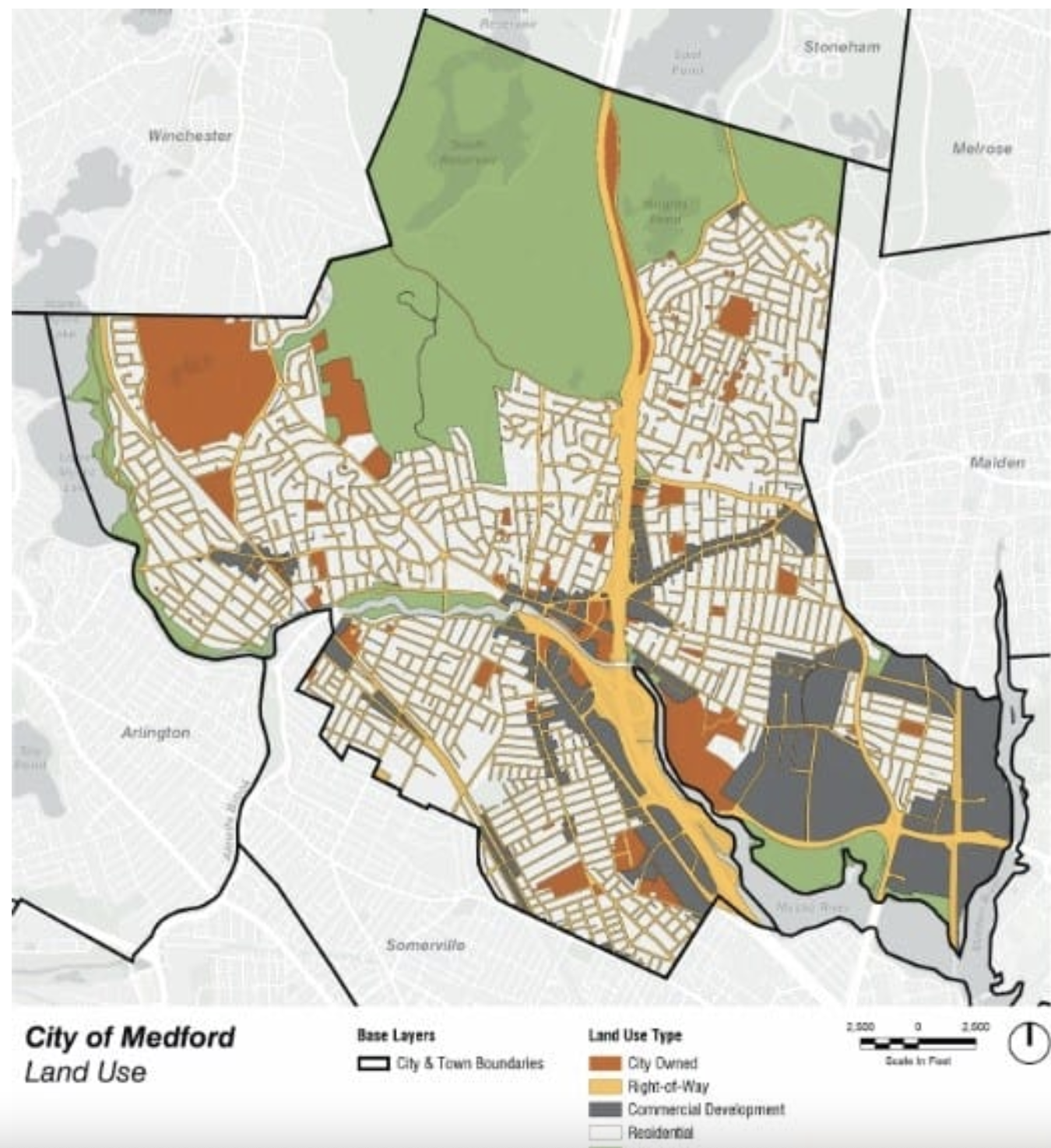
    Graphic created by Weston & Sampson for Medford’s Urban Forest Management Plan shows current land use in the city. COURTESY/City of Medford and Weston & Sampson

    Medford should focus on growing, protecting and maintaining trees as key strategies for creating a “healthy, resilient and equitable urban forest,” according to a new report.

    The Urban Forest Management Plan recommends strengthening tree ordinances and standards, maximizing tree canopy in limited spaces, and increasing staffing, tree diversity, and annual tree plantings. Doing so would help the city address issues of canopy loss and a lack of canopy coverage.

    The City Council unanimously passed a motion on March 10 urging the city to implement the plan and set a goal of having canopy coverage of 35% in residential areas within the next 10 years. It requests that the city allocate resources in upcoming budgets to carry out these goals.

    Medford’s tree canopy — the layer of leaves and branches visible from above — declined citywide by about 1.2% from 2015 to 2021, according to the report. While any loss is unwanted, 1.2% is “actually not bad” when compared to other communities that have lost canopy faster, said Matthew Soule, a team leader at Weston & Sampson, the engineering and environmental consulting firm hired to do the report.

    The plan, which was funded by the state, recommends that efforts to create this urban forest should be prioritized in environmental justice areas, which are places disproportionately affected by environmental hazards, often in marginalized communities. Vacant sites and sites with dead trees should be inspected for planting, and the city should look into replacing species in poor condition.

    The report recommends that by 2030, the city double the number of trees planted every year. Soule, who explained the report’s findings during a March 30 presentation at the Medford Public Library, said doubling the current number of trees planted annually from 200 to 400 would reverse projected tree losses over time.

    “If we stuck with 200 trees a year, it becomes much harder to get that to make up those losses,” Soule said.

    The presentation also called for the city to increase its forestry budget by $400,000 a year in order to reach these 2030 goals and to add three positions–an additional forester and two laborers. These increases would allow the forestry department to plant and manage more trees, Soule said.

    Amanda Bowen, who is co-chair of TreesMedford, a volunteer nonprofit that supports tree planting and stewardship, said the goals to increase the budget and staff are realistic but might require grant funding. Some cities charge developers for removing trees and pointed towards that as another way to build funding, she said.

    Residents at the March 30 presentation expressed concerns and excitement at the report’s findings. Concerns included the survival likeliness of trees, why more money is not spent on watering, pruning and maintaining the trees once they are planted, and the city’s role in trees on private land. Medford Public Works Commissioner Tim McGivern said the city has no obligation to spend public money on private resources but tries to help out where it can.

    McGivern said the inventory of public trees is the most powerful finding from the report. Medford’s private roads are absent from the inventory, he said, but the city can still plant on private property if it has the permission to do so.

    Residents can request that the city plant trees in their neighborhood, said Medford Tree Warden Aggie Tuden. If multiple residents on a street request trees, they’re more likely to get them, Tuden said.

    There are about 10,000 public trees in Medford. About 10% of them are in poor condition, and 1% are dead.

    There are challenges to planting trees in Medford, Soule said. Some sidewalks are too small, and there is limited space in some areas. To address this, he said trees can be planted more densely and between trees that are expected to die soon.

    City Councilor Justin Tseng said there are ways to find funding to plant more trees, such as grants. Plans often die in filing cabinets, he said, and he wants to make sure that that doesn’t happen here. 

    “You need a spark like this meeting to galvanize people together,” Tseng said. 

    This story is part of a partnership between Gotta Know Medford and the Boston University Department of Journalism.

  • Tufts Medicine Behavioral Health Hospital opens next month

    Tufts Medicine Behavioral Health Hospital opens next month

    A new behavioral health hospital will open in Malden in March on the site of the former Malden Hospital.

    The 144-bed Tufts Medicine Behavioral Health Hospital, which is a collaboration between Tufts University and Acadia Healthcare, will train Tufts medical students and consolidate inpatient services in a facility designed specifically for psychiatric care.

    Malden Mayor Gary Christenson said the city has been trying to find a use for the building at 100 Hospital Road for over two decades. 

    “To finally see a project like this one involving behavioral health is a great feeling for our city,” Christenson said. 

    Dr. Brent Forester, director of behavioral health at Tufts Medicine, wrote in an emailed statement that community stakeholders had expressed they wanted to see the property return to health care use.

    About two-thirds of the beds at the hospital will be new, while the others will be transferred from MelroseWakefield Hospital and Lawrence Memorial Hospital in Medford. The behavioral health hospital is where patients facing mental health issues will be directed if they first go to other medical facilities in the area. 

    “We expect that the additional bed capacity will help relieve pressure across the broader Massachusetts behavioral health system,” Forester wrote.

    Other considerations for the space included housing, senior living, city services and a park, Christenson said.

    Ward 3 City Councilor Amanda Linehan said she has not heard any concerns about the space being used as a hospital instead of housing. In the past, when the area was considered for multi-family housing, she said, there was so much backlash that the developer withdrew the project. 

    Linehan said she has been impressed by how much the community has supported the project. While she thinks concerns could come up once the hospital opens, she said, “We will address them as they do, like you would with any new development.” 

    Linehan and Christenson both said the pandemic is part of the reason the community has supported the plan for the behavioral hospital. 

    “[Mental health was] something that made sense to people in a new way,” Linehan said. “The pandemic re-framed how people think about mental health and mental health needs because so many people had suffered isolation and loss and grief.” 

    The city plans to buy back a few acres of land on the site next to the hospital and install benches and trails there for the public to enjoy, according to Christenson.

    The hospital, which will serve adults and children, will provide behavioral health treatment like therapies, psychiatric evaluations, outpatient programs, medication management, hospitalization, and treatment for mental health and substance use disorders.

    The staff will include psychiatrists, psychiatric nurses, therapists, social workers, and other behavioral health professionals. It will also serve as a teaching site in collaboration with the Tufts University School of Medicine.

    Expanding training capacity at a time when the state and nation are facing a shortage of behavioral health professionals is essential, Forester wrote. 

    He wrote there is a “critical need” for increased behavioral health capacity in the state. Because of the insufficient amount of psychiatric inpatient beds, patients can sometimes be stuck in emergency departments for days, he wrote, and he cited a recent study that found that about 12% of pediatric visits to the ER for mental health concerns last for about three or more days before an inpatient bed is available. 

    Christenson said he is thrilled to have a Tufts hospital in the community because of its strong reputation. And because it is a for-profit hospital, it will add property tax revenue to the city.

    The hospital has begun onboarding clinical staff and will start accepting patients by the end of March.

  • Medford’s Edify Church drive provides clothing for community, exposure for church

    Sweaters, coats, dresses, shoes and bags line the walls, shelves and tables of the basement of a building on High Street. Although the selection features gently used items as well as clothing with the tags still attached, it is not like other secondhand shopping opportunities — it is entirely free.

    The items, donated by church and community members, are part of Edify Church’s fifth clothing drive, which began in November and ended last weekend.

    Pastor Britnee Youman said the idea came about when she would offer to have church members look through her closet or give away a piece of clothing she no longer used. It turned into a broader project.

    “Me and my husband are givers,” she said. “We give clothing away. We give shoes away. We just give things away to help people. So I think it’s just in our heart to give and to sow into people’s lives.”

    Saturday’s event received a rush of about 10 to 15 people that slowed shortly before noon, Britnee said.

    Edify Church has been operating from a building on High Street for three years. GOTTA KNOW MEDFORD STAFF PHOTO/CRYSTAL YORMICK

    The clothing drives have been a way for the 7-year-old nondenominational church to give back to the community and expose it to more people, church members said.

    “We wanted to do something that was going to support and bless the community,” said Pastor Eric Youman, Britnee’s husband.

    Eric said Edify Church has gained a lot of traction with the community since starting the drives. Volunteers stand outside the drives with signs during the events, but this was not possible Saturday because of the cold weather, he said.

    Church member Caterin Hodjikj-Valiente said her experiences at the clothing drives have been uplifting. It differs from shopping at thrift stores like Goodwill or Salvation Army, because the items are all free, she said.

    Hodjikj-Valiente and Britnee said people in Medford don’t always need the clothes, but are happy to donate.

    “You just hold onto [this stuff], but in these times that I’ve volunteered I’ve seen people that really need it,” Hodjikj-Valiente said. “They walk out of here so happy.”

    Maciel Beato, another church member, said a lot of people don’t know where Edify Church is because it’s in a basement. When people come to the drives, she said, they get free items and “they’re also getting some Jesus.”

    The church’s operations and services will continue until the end of February, when it plans to leave its High Street location, Britnee said.

    People have brought bags of clothes to donate and also have left the drive with bags full of clothes, Britnee said. She recalled one person with six children who found the drive particularly helpful. Another time, a man who had an interview the next week left with a suit.

    “We were able to be a blessing to him when it came to that,” Britnee said. “So that warmed my heart.”

    Clothing donated by the community for the fifth Edify Church drive. GOTTA KNOW MEDFORD STAFF PHOTO/CRYSTAL YORMICK

    The Youmans launched Edify Church in their living room in 2019. They started operating out of Envision Hotel in Everett in 2020 for in-person services for a few weeks before conducting virtual operations during the COVID-19 pandemic.

    After the pandemic, it moved to an office space in Everett before finding its current space on High Street, where it has been for just over three years, Britnee said. The congregation is made up of about 30 people.

    Edify Church has not yet identified plans for a new location, and there are no plans to move into a new space yet, Britnee said. She said it is not feasible right now to have physical space for the church but plans to continue doing ministry.

    Crystal Yormick is a journalism student at Boston University. This story is part of a partnership between Gotta Know Medford and the Boston University Department of Journalism.

  • MA nursing vacancies back to pre-COVID levels. Is that enough? ‘Normal was not great’

    While nurses and hospital leaders say it’s a positive that there’s been a recent decline in nursing vacancies, they also say there’s still work to do.

    New data from the Massachusetts Health & Hospital Association (MHA) show that one in every 10 nursing positions is vacant, compared to other post-pandemic years when one in six roles was unfilled. While that’s an improvement, it only gets the vacancy rate down to where it was before COVID-19, according to Aaron Winston, a registered nurse and committee co-chair for the Massachusetts Nursing Association.

    “Before we start celebrating, we need to really take a hard look at what constitutes business as usual,” Winston said. “If you look at this data, there has been such a rush in the health care professions to kind of put the pandemic behind us and go back to ‘normal.’ But normal was not great.”

    Valerie Fleishman, executive vice president and chief innovation officer of MHA, said the decrease in vacancies shows “major progress” within the past two years. New nurses are entering the field, while those who may have previously left are returning, she said. 

    “There’s still huge gaps and strengths that exist, but we really like where the momentum is going,” added Sam Melnick, MHA’s chief communications officer.

    The decrease in nursing vacancies reflects a wider trend across health care in Massachusetts, which saw a 28% reduction in openings industry-wide. Five of the 10 positions that experienced the largest drops in vacancy rates were nursing-related.

    MNA survey: 78% of nurses say hospital care quality has declined

    However, in May, the MNA recorded that 78% of nurses said hospital care quality has worsened in the past two years, with understaffing listed as the top obstacle.

    Several Massachusetts nurses attributed working conditions as the reason why most nurses exit the industry, pointing specifically to long hours; inadequate time for necessary care and attention; insufficient pay; and caring for too many patients at once. Most of these problems could be solved with better nurse-to-patient ratios, they said.

    “There’s not a shortage of nurses,” said MNA President Katie Murphy. “There’s a shortage of nurses willing to work under these circumstances.”

    Murphy, who has been a bedside nurse and currently works in critical care, said she has heard anecdotally that conditions have gotten better at times. But she also still hears that those changes are not necessarily happening where they should be, which she said is at the bedside.

    “We have a long way to go,” she said.

    The Nurse Journal ranked Massachusetts as the third best state to work as a nurse, after California and Colorado. The Bay State is one of the only ones that has a nurse-to-patient ratio law enacted — a 1:1 or 1:2 nurse to ICU patient ratio — but does not have industry-wide requirements.

    However, “just because it’s better doesn’t mean it’s good,” said Winston, who previously worked in Virginia, where he said the conditions nearly resulted in him exiting the industry.

    “There is still a burden (in Massachusetts), and the work of nursing is incredibly difficult,” he said. “What seems like relatively simple, innocuous policies in how hospitals are run profoundly affects how we are able to do the work that we have been trained to do.”

    MHA launches program promoting healthy work culture

    The MHA launched its statewide Healthy Work Environment Academy for a cohort of 10 hospitals last summer, and it will start a second round in March for 10 more hospitals. The program focuses on creating a healthy work culture to retain current nurses and attract new ones.

    The MHA has also organized resiliency and peer support programs and looked at ways to provide wraparound services for promoting a better work-life balance. These services include financial counseling, child support and flexible scheduling.

    Anecdotally, responses to the HWE have been “incredibly positive,” Fleishman said.

    The American Nurses Credentialing Center lists 17 hospitals as “magnet destinations,” so they’re recognized for providing a healthy work environment for nurses. The MHA hopes to expand this designation to more hospitals statewide through the HWE, Fleishman said. It’s also looking into alternative positions for different care-team members, including virtual nursing and using AI models.

    Patricia Noga, a registered nurse and MHA vice president of clinical affairs, pointed toward the Nurse Licensure Compact — a law allowing nurses to provide care in other compact states — expanding fields like nurse practitioners, midwives and nurse anesthetists and remote monitoring as growing opportunities for nurses.

    Fleishman said the MHA is providing the “vehicle” for hospitals to develop career-ladder programs, allowing them to train nurses to perhaps move to another area of expertise or specialty.

    Nurses say improvements are needed in regards to bedside care

    However, some nurses said rather than finding other avenues in the industry, what hospitals need to do is improve working conditions so they want to stay bedside.

    Barbara Connor, a registered nurse, said a key staffing issue is nurses become trained and then leave the practice. The reasons, she said, could range from being liable for making a mistake — which could be exacerbated if a nurse is working long hours on an understaffed floor — to experiencing workplace violence.

    “You could get a job doing something else that gives you a much better work-life balance, and you don’t have to worry about being sued or hit,” Connor said.

    Many nurses have called for mandated nurse-to-patient ratios as the main solution for understaffing, alongside stricter laws to protect them against violence in hospitals.

    Noga said staffing is an “ongoing process,” because patients’ conditions can change rapidly and care teams must adjust for that. She said additional members of the care team, and the training and competencies of nurses on a certain unit, are other factors to keep in mind when thinking about staffing ratios.

    “We trust that the nurses with their leaders are developing staffing plans that reflect the patient population they’re caring for,” Noga said.

    Melnick added that on a broader level, there’s a focus to “keep people out of the hospital in the first place,” which could lower costs and remove some pressures on caregivers.

    The MHA’s report states that “additional legislative action and targeted investments” are required to continue the momentum gained from programs like the HWE to close workforce gaps and expand care. It’s currently championing a bill alongside the MNA and 1199SEIU Massachusetts to address and prevent workplace violence.

    Nurses say enough with the term ‘burnout’

    Several nurses pushed back against the term “burnout,” saying it implies they’re to blame for exiting the industry when many leave because of what they describe as unsustainable working conditions.

    “(Burnout) puts (the blame) on the nurse instead of where it really should be, (which) is the people who are scheduling the nurses, who are hiring the nurses, who are saying yes and no to bringing in more support,” said Sarah Bessueille, a registered nurse.

    Winston pointed to staffing as the heart of this issue, because nurses then have to choose between what one patient deserves and what other patients need. If there are not enough staff, demand becomes “untenable,” he said.

    “People all the time, all across (the) state say to me, ‘I left my shift an hour late because I had to document everything I had done,’ or ‘I had to sit in my car and cry for a half an hour because I was afraid I hadn’t done everything that I was supposed to do, or I was afraid I missed something,’” Murphy said. “This wears you down when it’s people’s lives you’re holding in your hands.”

    Vicki Good, chief clinical officer of the American Association of Critical-Care Nurses, conducted her doctorate work on burnout and said bedside nurses are particularly susceptible to it because they’re at the bedside around the clock. She added that nurses tend to react negatively to the terms “burnout” and “resilience.”

    And while hospitals can spur burnout from inflexible scheduling and disregard for caretakers’ input, nurses are also accountable for taking care of themselves so they can perform at the highest level, she said, making this a “joint responsibility.”

    Several caretakers said the “bottom line” is the main reason for understaffing, so nurses are the first place hospitals look to when making budget cuts.

    “We really have to be smart about how we’re spending our health care dollars, but (hospitals) need to listen to the folks on the front lines who are providing the actual hands-on care,” Murphy said. “We have to have a seat at the table in figuring out the solutions.”

    Concerns about who should absorb liability

    Nurses also raised concerns about liability and the physical and mental conditions behind burnout, all of which they say can be very taxing.

    “If you make a mistake, you’re held liable for that, and you could lose your nursing license,” Connor said. “And if you lose your nursing license, you have lost your livelihood. So there’s repercussions to making an error.”

    Bessueille said hospitals might “think twice” before understaffing if more of the liability is shifted to them. She said she is “one of the fortunate ones,” because she works at a union hospital. She has support if she raises a concern, but other nurses’ concerns might be met with “deaf ears.”

    Both hospital leaders and nurses have agreed that moving forward more work needs to be done.

    “We’re paying so much money (for health care), and our outcomes falter behind other nations,” Murphy said. “There’s money in the system, but where is it going? (Nurses) feel over and over again it has to be at the bedside.”

  • MA rent control opponents say initiative would hurt small landlords

    Advocates for small property owners describe the rent control proposal likely headed for next fall’s ballot as the most “restrictive and aggressive” the state has seen to date, and say it would be detrimental to small landlords.

    Small property owners – who provide more than 65% of Massachusetts’ rental housing, according to the Small Property Owners Association – operate on tight margins, so they’re typically only a few missed bank checks away from bankruptcy or losing their business, according to Amir Shahsavari, the organization’s vice president.

    He said if these “mom and pop” businesses no longer exist, tenants will be in a “tough predicament” if properties are then taken over by larger corporations. That’s because they will no longer have a person to connect with immediately if there are issues in their building – a benefit usually provided by smaller landlords.

    In addition, operating costs like utilities, insurance and particularly property taxes – which Boston Mayor Michelle Wu recently said are expected to increase by 13% in January – have risen in recent years, which factors into rents. However, if caps are put in place, advocates are concerned property owners will not be able to adapt to these costs.

    “On one hand, we appreciate the pressures that renters have when they say that rent is increasing,” Shahsavari said. “But what people miss in this story is that operating costs are also going up exorbitantly for the property owner, too.”

    “If (small property owners) can’t increase rents, what’s going to happen is they have to exit the market,” added Tony Lopes, a SPOA board member. “We can’t afford to supply this housing at a loss every month.”

    The initiative seeks to limit annual rent increases for most residential units by either the amount of the Consumer Price Index increase or 5% – whichever value is lower – during a 12-month period. It would set base rents as of Jan. 31, 2026, but residents would not vote on the measure, which would apply to every municipality, until next November.

    What must happen for the question to make the ballot

    To reach the ballot, it must still go through a process that includes certification of more than 124,000 signatures, legislative review and likely another round of signature gathering if lawmakers don’t approve the proposal.

    To account for small property owners, the measure includes a provision to exempt owner-occupied buildings with four or fewer units. Noemi Ramos, executive director of the New England Community Project, said because of this, the notion that the measure will impact small landlords is “out the window.”

    But Shahsavari said the provision is “misleading” because property owners with four units or fewer are a minority among the small property owner community. Because of the tight limit, those who exceed this amount – which he said is the “vast majority” of small property owners – would be categorized with companies that operate on a much larger and commercialized scale.

    Instead, he said the definition of a small property owner depends on a business structure’s size, scope and reach, rather than the number of units an owner manages.

    “What one small owner can handle might be different from the capacity that another owner would have,” Shahsavari said. “It ultimately comes down to the degree to which the owner can manage his or her business in a hands-on way without expanding too far out to the point where they really become a conglomerate.”

    Ramos said Homes For All Massachusetts, the statewide coalition behind the ballot initiative, decided to use four units as the cut-off after speaking with small property owners and deciding “what are our values when we think about how we define small landlords.”

    “I remember asking a developer in the (city of Boston’s Rent Stabilization Advisory Committee), ‘How do you define a small landlord?’ and they said, ‘Fifty units or less,’” Ramos said. “When you think about 50 units, that’s a business. That’s no longer a small landlord.”

    Developers say threat of rent control has ‘chilling effect’

    Another provision in the initiative addresses development by exempting units where the “first residential certificate of occupancy” is under 10 years old, or 10 years from when the certificate of occupancy is validated

    Tamara Small, CEO of the NAIOP Commercial Real Estate Development Association of Massachusetts, said the “threat of the (rent control) question” is already having a chilling effect on investment and development. If put in place, she said the measure would also lead to decreased quality of housing and repairs, which would result in either subpar conditions or units being taken off the market.

    Antonio Ennis, a Dorchester community organizer at City Life / Vida Urbana, disagrees. He said landlords should always factor in money for property repairs and keeping buildings up to code. Ennis, a small property owner who occupies one unit and rents out two others in a three-decker, would not be affected.

    Developers and property owner advocates say the primary solution to solving the state’s housing crisis is increased development, which they say rent control hinders.

    “If rent control is in place in the market, investors do not go to that market. They go elsewhere,” Small said. “Without those investment dollars, projects are not built.”

    “No financial decisions and investments are made on a 10-year time horizon,” added Conor Yunits, committee chair for an opposition group for the measure called Housing for Massachusetts.

    Mark Martinez, staff housing attorney for the Massachusetts Law Reform Institute, pointed out that despite not having rent control for more than 30 years, Massachusetts remains behind in terms of housing production.

    “This isn’t a development policy. This is a stabilization policy,” he said. “Judging a stabilization policy based off whether it’s going to spur development doesn’t make a whole lot of sense.”

    He said the measure is a “commonsense” policy, but not the only measure that needs to be taken to solve the housing crisis.

    “It’s going to take a decade, if not longer, to build all the housing that we need,” Martinez said. “But in the meantime, families need to be able to stay around.”

    Small pointed to cities like Austin and Phoenix as models for Boston to solve its housing crisis. In both cities, an increased housing supply resulted in lower rent growth and prices.

    How high are rents in Massachusetts?

    Massachusetts historically has some of the nation’s highest rents, and recent reports have ranked it as the state with the second highest cost of living. In May, the Consumer Affairs Journal of Consumer Research ranked Massachusetts as the fifth worst state for renters due to a lack of affordability and availability.

    “This is a statewide issue, and we’re continuing to see the crisis intensify,” said Carolyn Chou, executive director of Homes For All Massachusetts. “We can’t wait while corporate landlords come into our cities and towns and hike up the rent and displace our communities.”

    Over 40% of state residents who rent are “cost-burdened,” as of 2022, meaning they pay above 30% of their incomes on housing, according to data from Harvard University’s Joint Center for Housing Studies. In some areas, such as Springfield, Boston, Cambridge, Newton and Barnstable, it’s more than 50% of renters.

    Residents paying over 50% of their income on housing are classified as “severely cost burdened,” according to the Healey administration’s “A Home for Everyone” initiative. The percentage of renters in Massachusetts who fall into this category ranges from about 20%-30%, depending on the area.

    When families have to spend an excess amount of their income on housing, they have less money for needs such as food, transportation and childcare. They’re also unable to “save money for opportunities that could provide a pathway to higher income, as well as wealth-building,” which includes education, job training or homeownership, according to the initiative.

    “Rent is often the first place people put their money toward,” said Chelsea Sedani, director of advocacy at the Massachusetts Budget and Policy Center. “If you don’t have that, it makes a lot of other things very challenging.”

    Rent control advocates say measure would help economy in other ways

    Decreased rents could have an effect on the larger economy as well, because they could potentially increase purchasing power.

    “If we alleviate the pressure that people are feeling around housing costs, we’re going to make it easier for them to spend in other areas of their lives,” Sedani said.

    The last time Massachusetts had a rent control measure in place was in 1994 – but voters overturned it. Many opponents cite this as another reason the measure should not be implemented.

    However, state Sen. Patricia Jehlen, D-Somerville, pointed out that Boston, Brookline and Cambridge voted in favor of keeping rent control before it was outlawed statewide in 1994. She said Massachusetts needs to not just create more housing but to preserve “naturally occurring affordable housing.”

    “People are not going to stay in Massachusetts if we just count on building new housing,” she said. “It’s not fast enough and not cheap enough.”

    High rents make it difficult for residents to plan and save money long term, so rent caps would provide predictability that would keep people in their homes longer, Martinez said.

    Although both supporters and opponents presented different ways on how to approach the housing affordability crisis, they agreed on one solution: increasing the supply of housing.

    “Supply, supply, supply,” Yunits said. “That’s really all there is. We’ve got to build.”

  • Data shows drop in Massachusetts nursing vacancies, though experts say more work needs to be done

    Vacancies in nursing positions across Massachusetts have decreased, according to a recent report on the state’s workforce from the Massachusetts Health & Hospital Association, and while nurse and hospital leaders have acknowledged the positive benefits from this, they say there is still work to do. 

    The new data shows that one in every 10 nursing roles are now vacant compared to other post-pandemic years where one in every six roles were vacant — a 5% decrease. This displays improvements, but these rates are now what they were before the COVID-19 pandemic, said Aaron Winston, a registered nurse and committee co-chair for the Massachusetts Nurses Association.

    “Before we start celebrating, we need to really take a hard look at what constitutes business as usual,” Winston said. “If you look at this data, there has been such a rush in the health care professions to kind of put the pandemic behind us and go back to ‘normal.’ But normal was not great.” 

    Valerie Fleishman, executive vice president and chief innovation officer of the Massachusetts Health & Hospital Association, said the vacancy decrease shows “major progress” within the past two years. New nurses are entering the field while those who may have previously left are returning, she said.  

    “There’s still huge gaps and strengths that exist, but we really like where the momentum is going,” said Sam Melnick, the Massachusetts Health & Hospital Association’s chief communications officer. 

    The decrease in nursing vacancies reflects a wider trend across health care in Massachusetts, which reduced industry-wide openings overall by 28%. Nursing-related positions made up five out of the top 10 roles that had the largest drops in vacancy rates. 

    However, in May, the Massachusetts Nurses Association recorded that 78% of nurses said hospital care quality has worsened within the past two years, with understaffing listed as the top obstacle for nurses. 

    Several Massachusetts nurses attributed working conditions as the reason why most nurses exit the industry, pointing specifically to long hours, inadequate time for necessary care and attention, insufficient pay and caring for too many patients at once. Most of these problems could be solved with better nurse-to-patient ratios, they said. 

    “There’s not a shortage of nurses,” said Massachusetts Nurses Association President Katie Murphy. “There’s a shortage of nurses willing to work under these circumstances.” 

    Murphy, who has been a bedside nurse and currently works as a critical care nurse, said she has heard anecdotally that conditions have gotten better at times but still hears that those changes are not necessarily happening where they should be, which she said is at the bedside. 

    “We have a long way to go,” she said. 

    The Nurse Journal ranked Massachusetts as the third best state to work as a nurse, after California and Colorado. It is one of the only states that has a nurse-to-patient ratio law enacted — a 1:1 or 1:2 nurse to ICU patient ratio — but does not have industry-wide requirements. 

    However, “just because it’s better doesn’t mean that it’s good,” said Winston, who previously worked in Virginia, where he said the conditions nearly resulted in him exiting the industry. 

    “There is still a burden [in Massachusetts], and the work of nursing is incredibly difficult,” he said. “What seem like relatively simple, innocuous policies in how hospitals are run profoundly affects how we are able to do the work that we have been trained to do.”

    Solutions

    The Massachusetts Health & Hospital Association launched its statewide Healthy Work Environment Academy for a cohort of 10 hospitals this past summer, and it will be starting its second round in March for 10 more hospitals. The program focuses on creating a healthy work culture to retain current nurses and attract new nurses. 

    The association has also organized resiliency and peer support programs and looked at ways to provide wraparound services for promoting a better work-life balance. These services include financial counseling, child-support and flexible scheduling. 

    Anecdotally, responses to the Healthy Work Environment Academy have been “incredibly positive,” Fleishman said.

    The American Nurses Credentialing Center currently lists 17 hospitals as “magnet destinations,” so they are recognized for providing a healthy work environment to nurses. The Massachusetts Health & Hospital Association hopes to expand this designation to more hospitals statewide through the Healthy Work Environment Academy, Fleishman said. It is also looking into alternative positions for different care-team members, including virtual nursing and using artificial intelligence. 

    Patricia Noga, a registered nurse and vice president of clinical affairs with the Massachusetts Health & Hospital Association, pointed toward the Nurse Licensure Compact — a law allowing nurses to provide care in other compact states — expanding fields like nurse practitioners, midwives and nurse anesthetists. 

    Fleishman said the association is providing the “vehicle” for hospitals to develop career-ladder programs, which allows them to train nurses to perhaps move to another area of expertise or another specialty. 

    However, some nurses said rather than finding other avenues in the industry, what hospitals need to do is improve working conditions so they want to stay at the bedside instead. 

    Barbara Connor, a registered nurse, said a key staffing issue is nurses become trained and then leave the practice. The reasons, she said, could range from being liable for making a mistake — which could be exacerbated if a nurse is working long hours on an understaffed floor — to experiencing workplace violence. 

    “You could get a job doing something else that gives you a much better work-life balance, and you don’t have to worry about being sued or hit,” Connor said. 

    Many nurses have called for mandated nurse-to-patient ratios as the main solution for understaffing alongside stricter laws to protect them against violence in hospitals. 

    Noga said staffing is an “ongoing process,” since patients’ conditions can change rapidly and care teams then adjust for that. She said additional members of the care team and the training and competencies of nurses on a certain unit are other factors to keep in mind when thinking about staffing ratios.

    “We trust that the nurses with their leaders are developing staffing plans that reflect the patient population they’re caring for,” Noga said. 

    Melnick added that, on a broader level, there is a focus to “keep people out of the hospital in the first place,” which could lower costs and remove some pressures on caregivers. 

    The Massachusetts Health & Hospital Association’s report states that “additional legislative action and targeted investments” are required to continue the momentum gained from programs like the Healthy Work Environment Academy to close workforce gaps and expand care. It is championing a bill alongside the Massachusetts Nurses Association and 1199SEIU Massachusetts to address and prevent workplace violence

    Several nurses pushed back against the term “burnout” because of its implication they are to blame for exiting the industry when many leave because of what they described as unsustainable working conditions. 

    “[Burnout] puts [the blame] on the nurse instead of where it really should be, [which] is the people who are scheduling the nurses, who are hiring the nurses, who are saying ‘yes’ and ‘no’ to bringing in more support,” said Sarah Bessueille, a registered nurse.

    Winston pointed toward staffing as the heart of this issue because nurses then have to choose between what one patient deserves and what other patients need. If there are not enough staff, the demand becomes “untenable,” he said. 

    “People all the time, all across [the] state, say to me, ‘I left my shift an hour late because I had to document everything I had done,’ or ‘I had to sit in my car and cry for a half an hour because I was afraid I hadn’t done everything that I was supposed to do or I was afraid I missed something,’” Murphy said. “This wears you down when it’s people’s lives you’re holding in your hands.”

    Vicki Good, chief clinical officer of the American Association of Clinical-Care Nurses, conducted her doctorate work on burnout and said bedside nurses are particularly susceptible to burnout because they are at the bedside around the clock. She added that nurses tend to react negatively to the terms “burnout” and “resilience.”

    And while hospitals can spur burnout from inflexible scheduling and disregard for a caretaker’s input, nurses are also accountable for taking care of themselves so they can perform at the highest level, she said, making this a “joint responsibility.”

    Several caretakers said the “bottom line” is the main reason for understaffing, so nurses are the first place hospitals look to when making budget cuts. 

    “We really have to be smart about how we’re spending our health-care dollars, but [hospitals] need to listen to the folks on the front lines who are providing the actual hands-on care,” Murphy said. “We have to have a seat at the table in figuring out the solutions.” 

    Nurses also raised concerns about liability and the physical and mental conditions behind burnout, all of which they said can be very taxing. 

    “If you make a mistake, you’re held liable for that and you could lose your nursing license,” Connor said. “And if you lose your nursing license, you have lost your livelihood. So there’s repercussions to making an error.” 

    Bessueille said hospitals might “think twice” before understaffing if more of the liability is shifted to them. She said she is “one of the fortunate ones” because she works at a union hospital, so she has support if she raises a concern, but other nurses’ concerns might be met with “deaf ears.” 

    Both hospital leaders and nurses have agreed that more work needs to be done. 

    “We’re paying so much money [for health care] and our outcomes falter behind other nations,” Murphy said. “There’s money in the system, but where is it going? [Nurses] feel over and over again it has to be at the bedside.”