
Tag: food waste

  • Rescuers work to combat food waste

    Rescuers work to combat food waste

    Food rescuers Jeff Schwartz and Virginie Forget stood outside the Trader Joe’s on Boylston Street  recently, gingerly stacking boxes of carefully packaged groceries into the trunk of Forget’s car.

    Containers labeled “fresh fruit” were stacked atop dozens of eggs, until they filled the entire trunk. As Schwartz and Forget closed the trunk, it was difficult to miss the eye-catching coral Food Rescue US-Boston bumper sticker, designating that this load was more than just a large grocery haul.

    It was part of a salvage program directly benefiting and feeding the community.

    Photos by Vina Berger
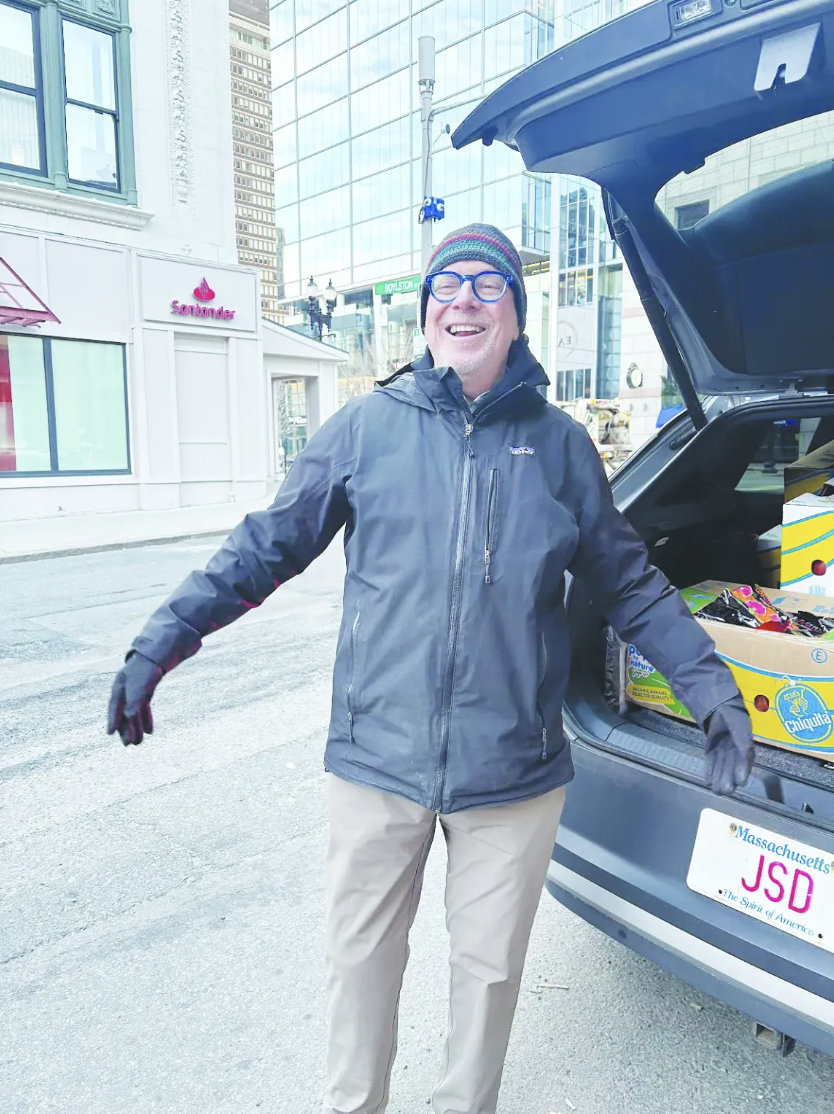
    Jeff Schwartz (right), of Food Rescue US-Boston, helped to load in boxes of apples, oranges and other grocery items from Trader Joe’s is loaded in the back of Virginie Forget’s car on March 19

    “We are a bread basket to ourselves and could be to the world,” said Schwartz.

    Food Rescue US, founded in 2011, is a national volunteer-based nonprofit whose mission is to combat food insecurity and food waste by recovering donated food from cafes and grocers that would normally be tossed away and giving the times to organizations that serve the needy, such as housing shelters and food banks.

    The program operates at 51 sites in 25 states plus Washington, DC.  The local program serves communities from Boston to Sharon.  

    Food waste is the leading material in US landfills and the cause of 8% of all greenhouse gas emissions, according to the Massachusetts Department of Environmental Protection.  

    Data also show that food insecurity affects more than one in three Massachusetts households, about 2 million people, according to Project Bread, a nonprofit that works to eradicate hunger.

    Schwartz said food insecurity is an ongoing issue in Boston, and many people who learn about Food Rescue US-Boston “are shocked” to find out how much food gets wasted.

    Forget, the new director of Food Rescue US Boston, said she was drawn to the grassroots nature of the organization and its critical mission.  

    A native of Paris, Forget recalled going to the farmers market weekly and buying fresh foods that are absolutely necessary. She came to the East Coast for her MBA and left to work in the food industry in California, where she said she witnessed food waste firsthand. When she returned to the region after the Covid-19 pandemic, she said she sought volunteering roles focused on combating food waste.

    “People aren’t aware of what a big problem it is,” Forget said, adding that 46 % of food waste in Boston is caused by people who buy far more food than they can consume weekly.

    They let them “rot in their refrigerators,” she said.  

    Forget joined Food Rescue US-Boston in 2023, after meeting with former director Charlie Burns, she said. She took over Burns’ role in February.

    At Trader Joe’s recently, Forget and Schwartz loaded groceries into Forget’s car that were driven to Boston Rescue Mission, a housing shelter near downtown.

    Schwartz said he found out about the local Food Rescue program through his wife Nancy and was “astonished” by how much food gets wasted.

    Schwartz, who has had one leg amputated, said that lifting a fully stuffed cardboard box of produce can be “a bit much sometimes,’’ but he gets help from Trader Joe’s staff and other volunteers.

    “People at both ends are extraordinarily helpful,” he added.

    Virginie Forget, the new director of Food Rescue US-Boston, unloads food surplus outside Trader Joe’s on Boylston Street on March 19.

    The program also uses an app that allows volunteers to check when a “rescue” is requested and when a delivery is complete.  

    Both Schwartz and Forget said their work gives them a sense of purpose, while also building a community of mission-minded volunteers.

    As Forget scrolled through the app recently, her phone rang with fellow rescuer Ann DeBiasio on the line.

    DiBiasio asked if Forget could join her and Schwartz at Levain Bakery on Newbury Street, which had a surplus of products to donate.

    DiBiaso said she moved to Boston in August from Shrewsbury, Massachusetts, and wanted something to do after her  retirement. A former food pantry volunteer in Worcester, DeBiasio is passionate about giving back to her community. .  

    Forget said she counts on word-of-mouth and the coral stickers to raise awareness about her program. She is also planning to expand rescue operations to other neighboring towns.

  • Rats! Boston Battles Rising Rodent Population in Beacon Hill

    Diego Osorno, executive chef at a Beacon Hill restaurant, The Paramount, says he isn’t afraid of anything, but the countless rats he’s seen scurrying throughout Beacon Hill are starting to get on his nerves. 

    The rats don’t seem to be afraid of anything either. 

    “They’re not scared of people anymore,” he said. When he goes out to the back stoop for a cigarette, he said his presence doesn’t deter the dusty brown Norway rats from racing to and fro in front of him, even during the day.

    Rats may have resided in Boston since the 1700s but it has only been a year since Mayor Michelle Wu launched the Boston Rodent Action Plan (BRAP), a cross-departmental effort to track and measurably decrease the rat population. 

    Now the plan is beginning to roll out in Beacon Hill, which is designated as a priority neighborhood due to its high call volume of rodent-related complaints.

    “Citywide data suggests the population is on the rise, which is why this coordinated, cross-departmental effort from the city is so important,” Councilor Sharon Durkan said in a recent statement.  

    Since BRAP’s launch in the summer of 2024, Boston’s Inspectional Services Department has responded to at least 2,639 rodent-related 311 calls.

    What prompts all the calls? The answer may not surprise anyone who’s lived in a big city. In addition to warming climates and rats’ rapid breeding rate, the city’s rodent report, written in coordination with New York City’s renowned rodentologist Bobby Corrigan, narrows in on one key factor: food waste. 

    “Improperly stored trash, overflowing barrels, and open bags create a buffet for rodents,” said Durkan. 

    Due to its density, aging infrastructure, and limited alley access, city officials say waste management poses a greater challenge in Beacon Hill than in other neighborhoods.

    “We do not have trash cans because people don’t have a driveway or garage to store them,” said Patricia Tully, executive director of the Beacon Hill Civic Association. 

    Monday and Friday are trash days in Beacon Hill. The afternoon before, many residents put their rubbish on the street in plastic bags, where it is vulnerable to overnight rat rampages until trash pickup the next day. 

    Tully said the ideal solution, if not the practical one, is for residents to separate their food waste and drop it off at one of two compost centers near Beacon Hill. Otherwise, she urges residents to put their trash out as close to pickup time as possible, although she said getting up before 6am to take out the trash is a tall order, especially in the winter months.

    “The Civic Association has always hoped to change the trash pickup time,” Tully said.

    To address the issue, Durkan sponsored a public hearing at City Hall to hear resident testimony and explore the possibility of same-day put-out and pickup of residential waste and sealed bins for commercial trash. 

    One strategy underway began as a suggestion from a Beacon Hill resident, Durkan said. Working with Beacon Hill’s tree warden to ensure greenery remains healthy in the process, the pilot program layers a wire mesh fabric on tree beds to prevent rats from entering and burrowing. 

    Over the past year, Durkan said she has also partnered with the Beacon Hill Civic Association and the city’s neighborhood services to walk Charles Street and survey missing bricks, which have nearly all been fixed. The team is also working with the city to eliminate every documented rat nest. 

    John Ulrich, assistant commissioner of the inspections department, said the city’s campaign to control rats has recently finished collecting baseline data on rodent activity using new technologies such as sewer traps. While the project is at too early a stage to draw conclusions, he said the coordination of all city departments on rat mitigation is “promising.”

    “This is a quality-of-life issue,” Ulrich said. “Rats cause damage to infrastructure, tree beds. They live in our sewers and burrow in breaches in the sewer lines.”

    “Their teeth constantly grow, so they’re gonna constantly chew,” he said, explaining that adult rat teeth never stop growing, an adaptation that once allowed them to gnaw through nuts and roots in the wild, but now allows them to chew through electrical wires and damage  vehicles

    In addition to their supernatural teeth, rats can be difficult to manage due to their prolific breeding abilities. According to a Facebook post the inspections department made as part of a public awareness campaign, “A single pair of rats can produce up to 2,000 offspring in just one year.” 

    Beyond physical damage, Durkan said there’s an “ick” factor that influences how people feel about their neighborhood. “If residents regularly see rats running across sidewalks or near their homes,” she said, “it takes away from the sense of cleanliness.” 

    Durkan said the city will continue to do its part, but it’s important residents stay vigilant in eliminating food sources for rodents. She recommends the use of heavy-duty trash bags if people do not have space for closed-top bins, and putting out trash as close to the collection time as possible. Refraining from feeding birds and cleaning up dog waste is also critical, she said. 

    “With everyone working together, including residents and community groups,” she said, “I’m confident we’re moving in the right direction.” 

    Rodent activity can be reported to 311.