

Tag: Green Newton

  • Newton Energy Commission launches survey to understand barriers to home electrification

    Newton Energy Commission launches survey to understand barriers to home electrification

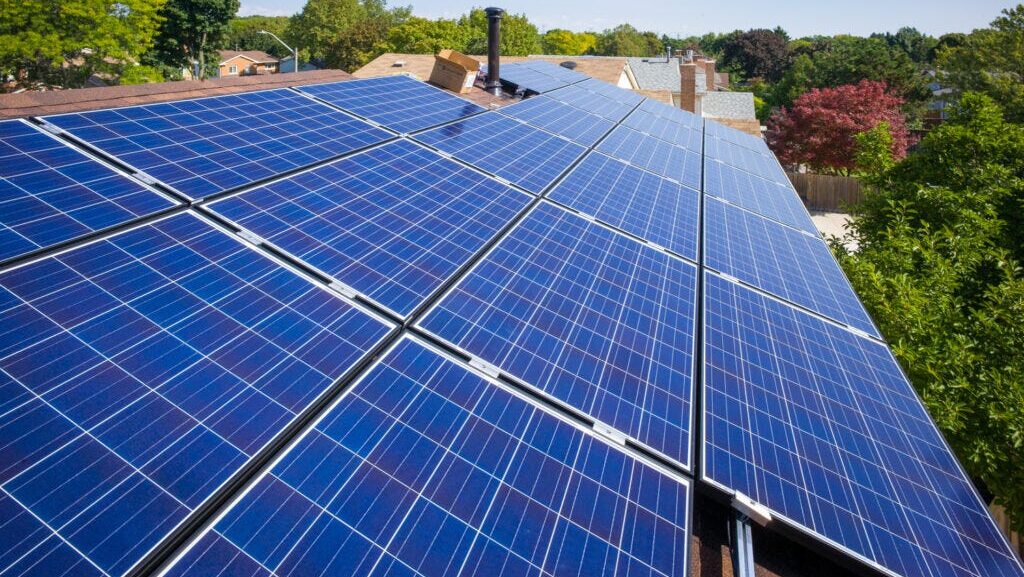
    Solar panels. Public domain photo

    The city of Newton aims to become carbon neutral by 2050, but reaching that goal will require transforming nearly 25,000 homes into fully electric households. And environmental advocates say it starts with something basic: knowing what’s actually inside people’s homes.

    To gain a better understanding of what’s being used in Newton homes, the Newton Energy Commission—in partnership with Green Newton, 350 Mass Newton, and Mother’s Out Front Newton—launched a survey aimed at single-family homeowners. 

    “There’s a lot of conversation at the policy level—both for the city and the state—about this subject, and a lot of it is quite honestly uninformed by what’s the current state,” said Jon Slote, a volunteer member of the Newton Energy Commission and a retired solar engineer. “We wanted to take an objective view and find that out.”

    Slote said the survey is designed to answer two fundamental questions: What heating sources and appliances are Newton residents using, and what is stopping them from switching to electric alternatives.

    Massachusetts has been working toward this kind of transformation for years. In 2008 the state passed the Global Warming Solutions Act and in 2021 updated the act to set a goal of cutting greenhouse gas emissions at least 57% below their 1990 levels by 2030. According to Massachusetts Clean Energy and Climate Metrics, residential fuel combustion remains one of the key factors the state must address in order to complete its climate goal.

    Judy Jacobs, executive director of Green Newton, said the survey is as much about fixing poor-quality data as it is about gathering new data. “Right now, the decisions are being made with incomplete or overly conservative data,” she said, “And in some cases those costs are being estimated much higher than the real cost.”

    For Jacobs, better data means better outcomes for residents. “We really want to get the data we need about costs and barriers and help that inform decisions so that it ultimately benefits Newton residents,” she said.

    That data could ultimately shape how residents heat, power and cook in their homes in the years ahead.

    “One of the things that’s pretty clear, when we think about carbon neutrality, is you need to reduce the emissions of greenhouse gases that are being produced by everything we do on a day-to-day basis,” Slote said. “All of us who live in homes in Newton, over time, we need to think about replacing gas and oil and propane uses with electricity.”

    The survey, which went live March 16, asks homeowners about their heating systems, hot water, cooking appliances, dryers and other energy uses. The survey is funded by a $3,000 microgrant from the Village Bank, which will help cover costs to mail surveys to Newton residents. 

    Additionally — to encourage participation — three respondents will be randomly selected to win free gift cards ranging from $50 to $250. Residents who complete the survey can also request a free consultation with one of the city’s volunteer energy consultants.

    For some Newton residents, the survey won’t be necessary. They’ve already decided to switch to all-electric products. 

    Rachel White has fully electrified her home after years of gradual changes. She began with her stove, then tackled heating and hot water in 2023 when her central air conditioning system was failing.

    “The motivation for doing that was that I really wanted to reduce exposure to the emissions associated with gas while cooking,” she said.

    White said one unexpected benefit was the quiet. “The air blows so smoothly and slowly from heat pump systems that they’re barely noticeable when they’re operational,” she said.

    She also acknowledges cost as a legitimate concern but says she breaks it into two categories—upfront costs and operating costs—and says the investment has been worth it. White said solar panels, which she installed alongside the heat pump system, have helped offset rising electricity costs. 

    “For folks who do have good solar exposure, the solar panels pair really, really nicely with an all-electric house,” she said.

    Debra Kriensky had a similar experience. Eight years ago, she and her family moved to a Newton home that ran mostly on oil —something she described as both expensive and frustratingly loud.

    “Even within our first year we were like, ‘We would love to do something about this and get off oil,’” she said. “Not just because of the environmental concerns, but also it was expensive and the prices kept changing.”

    Like White, Kriensky replaced appliances gradually throughout her time living in her home rather than doing it all at once. 

    Kriensky said she discovered heat pumps through a Green Newton webinar. “I’m grateful for organizations like Green Newton, for example, because if I hadn’t randomly come across one of their webinars on heat pumps, I don’t know that I would’ve even known about it as an option.”

    Her family has since gone fully electric and recently added solar panels to manage expensive electric bills.

    “Our home has been much more comfortable—everything’s been quieter,” Kriensky said. “I definitely think it was worth it.”

    Slote said he hopes the survey will help to inform further conversations about electrifying homes in Newton. “We’re very excited about the notion of trying to find some neighborhoods where people would like to collectively electrify and get off the gas system,” he said. “And we want to be a big support for that.”

    If you’re a single-family homeowner and are interested in filling out the survey, click here

    ****

    This story is part of a partnership between the Newton Beacon and the Boston University Department of Journalism.

  • Newton begins three solar projects as part of carbon neutral goal

    Newton will install solar panels on three additional City buildings, bringing its total solar projects to 27, as part of an effort to make the city carbon neutral by 2050.

    The new rooftop installations at Peirce Elementary School, Lincoln-Eliot Elementary School, and the Cooper Center for Active Living will contribute to the $1 million-plus annual solar savings by the City and schools, according to an article in the City’s newsletter written by Sam Nighman, the City’s Co-director of Climate and Sustainability, and Climate Action Coordinator Caroline Weiss.

    The solar projects at both schools are in early stages of construction, while the installation at the Cooper Center will begin after construction is finished in December, according to Nighman. The most recently completed solar project, on the roof of Wiliams Elementary School, began operation in May.

    “For us, it’s been driven primarily by the environmental benefits,” Nighman said. “We have a commitment to, by 2050, having the whole city be carbon neutral.” 

    City officials say the solar expansion demonstrates Newton’s clean energy commitment to residents and businesses. Weiss said solar panels installed on City buildings “are a great way to lead by example and show residents what’s possible in terms of solar arrays. They see it all around the city. Maybe that can be an inspiration to install in their own homes or businesses, too.”

    Homeowners who make clean-energy improvements, including solar, are eligible for a 30% federal tax credit, which expires December 31. Another incentive is the newest version of the Solar Massachusetts Renewable Target program, which provides payments to homeowners for every kWh of energy produced by their solar system. The state also deducts 15% from income taxes, up to a maximum of $1,000, for the cost of renewable energy installations.

    Weiss said that although the City isn’t able to provide additional incentives in place of the expiring federal credit, officials are working to educate residents on existing incentives to encourage solar installations. However, some state lawmakers seem open to the idea. In a Senate hearing on climate change and global warming last week, Elizabeth Mahony, the commissioner of the Department of Energy Resources, said policy makers should consider additional environment-friendly incentives.

    “We have to consider how it impacts the state budget,” she said, “but again, I’ll keep saying it, these are projects that help all of us.”

    Mahony also said that additional incentives could come through changes to the SMART structure in 2026.

    “I have always tended to assume that tax credits can be difficult,” she said, “so we’re trying to address it through what we have at our control, which is these incentive levels.”

    Another speaker during the hearing, Hannah Birnbaum, the chief of advocacy for Permit Power — an organization that aspires to lower solar prices by streamlining the process — suggested ways to reduce the soft costs of solar (expenses other than materials and labor).

    Birnbaum said smart permitting, which issues instant permits for solar panels on homes, could shave $5,500 off the cost of a typical installation. Matthew McAllister, CEO of SolarAPP+, which also aims to lower the soft costs of solar installations, advocated for remote inspections of solar panel installations in homes, which would trim the cost of solar panels for homeowners. 

    He said the average residential solar and battery system costs $35,000 in the United States, while the same system would cost $12,000 in the UK, Australia, or Germany. A large reason for the difference is the soft costs, which McAllister said could be mitigated through modern processes.

    Bob Persons is an energy coach in Newton, someone who can answer homeowner questions about climate and energy. He said the City can do more to promote the use of solar and inspire interest in renewable energy. Fewer than half of the questions he receives are about solar.  

    Persons said the work of Green Newton, an organization focused on improving the environment and the way resources are used in Newton, deserves more attention.

    “Newton’s a pretty rich community, and one way to start making things happen is for people who can afford it to get it started,” Persons said. “And, of course, the Trump administration is cancelling all the incentives and everything that people would like to use, but there are still people interested in doing their part to help save the planet.”