Tag: ICE

  • Chris Boyd campaigns for Congress on a call to invest in region’s future

    Chris Boyd campaigns for Congress on a call to invest in region’s future

    Chris Boyd is still waiting for his American dream.

    Growing up in Bellingham, Boyd experienced firsthand the struggles of a low-income American family and remembers when the 2008 recession hit home. With his single mother providing their only income, Boyd said, his family had to rely on public assistance programs.

    “Let’s make sure that we’re investing in these programs to make life more affordable so that we can actually get that American dream,” Boyd said, “because we were promised an American dream and I’m still waiting for that deposit in my bank account.”

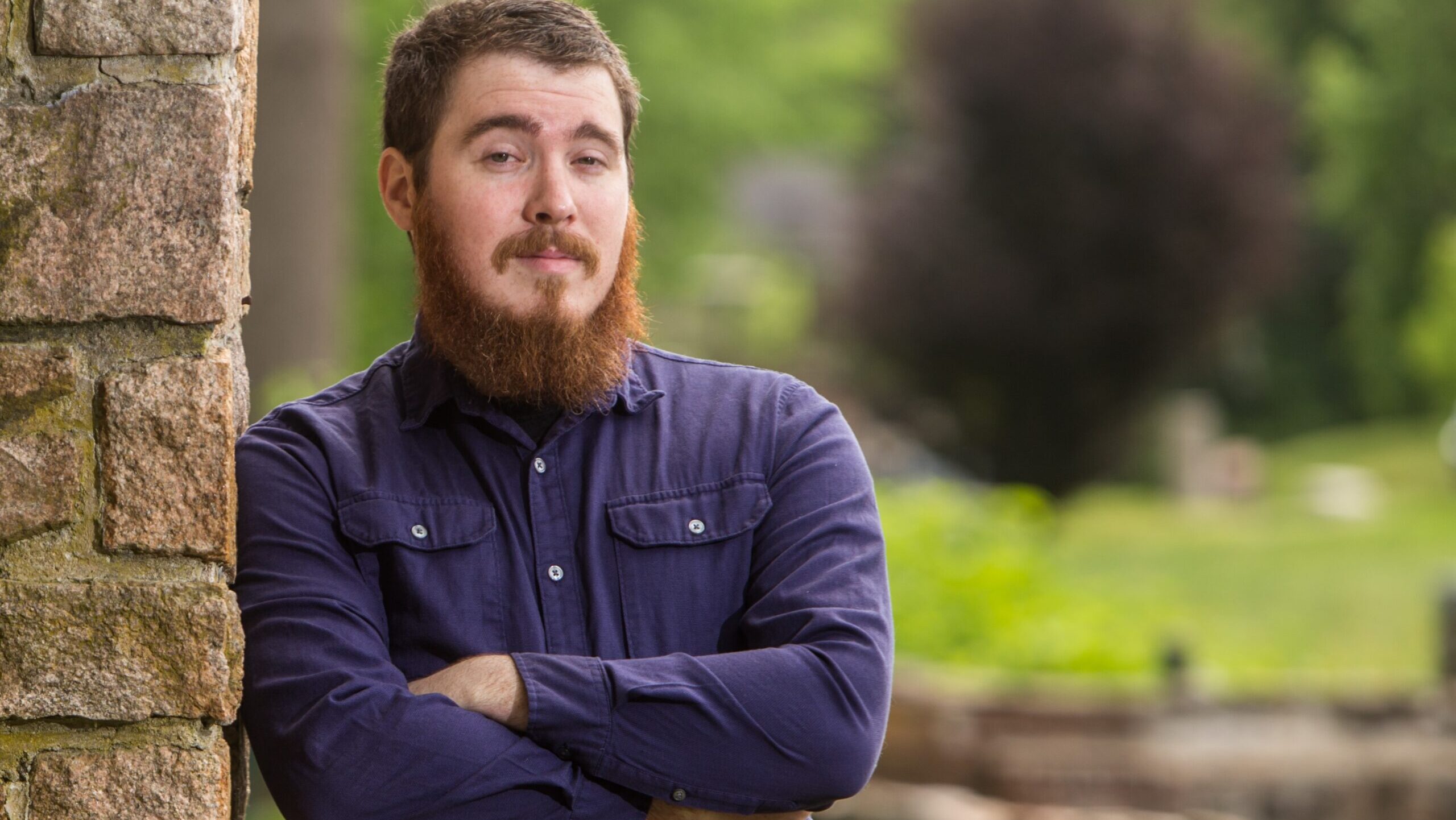
    Boyd, 31, studied music at Rhode Island College and became a music teacher. Now he’s running in a five-way Democratic primary for Congress in Massachusetts’ 4th House district in an attempt to unseat Rep. Jake Auchincloss.

    Boyd said his decision was the culmination of decades-long frustration with Democrats not willing to act on issues they had campaigned on.

    “It’s really that lack of fight and that lack of action that has slowly been building up over time,” Boyd said.

    Boyd said he wants to ensure that public assistance benefits such as the Supplemental Food Assistance Program will be protected for future generations.

    He said it isn’t just his campaign—it’s “ours,” including the volunteers and community members Boyd connects with. He’s campaigning on three pillars: democracy, affordability and investing in our future.

    These pillars were based on discussions and conversations Boyd has had with volunteers, people at Democratic caucuses and community meetings.

    Congressional candidate Chris Boyd, shown here with Martha Durkee-Neuman of LUCE, participates in a protest against Immigration and Customs Enforcement on the Newton Centre Green. Courtesy photo

    Boyd condemned the nation’s involvement in overseas conflicts such as those in Iran and Gaza.

    “We shouldn’t be supporting bombs going overseas,” Boyd said. “We did 20 years of that.”

    Boyd said he supports overturning Citizens United, abolishing the U.S. Immigration and Customs Enforcement agency and protecting transgender rights.

    “We are supposed to be the beacon of liberty and democracy and freedom and protecting human rights on this planet,” Boyd said. “We have supposedly set ourselves up in that role, but we’re not acting like it.” 

    In the area of affordability, he wants to tackle issues like student debt relief, create more affordable housing and work against AI replacing jobs.

    He has visions for public job programs similar to the New Deal, support for Medicare for All and school funding.

    “Thinking about investing in our future, we want to show our children and say, ‘Listen, your country cares about you,’” Boyd said.

    Boyd said his experience growing up in a low-income household makes him a strong candidate for Congress.

    “I’m a normal person,” Boyd said. “I’m not a millionaire […] and I don’t have all these big connections. But what I do have is that perspective of growing up with that struggle and seeing what our public programs can do and all the great things that we can do when we come together as a country.”

    He said his ability to connect with the public on these issues and their anxieties about the future help him run a compelling campaign. His election, he said, would bring to Congress a perspective that is lacking—that of the average American.

    “I have that experience of actually talking to people and listening and seeing and helping people through these struggles,” Boyd said. “And we don’t have a lot of that in Congress today.”

    Congressional candidate Chris Boyd, left, participates in a protest against Immigration and Customs Enforcement on the Newton Centre Green. Courtesy photo

    Boyd said his main frustration with Auchincloss’ leadership is the amount of corporate money the congressman has accepted for his campaigns. In 2023-24, the top contributors to Auchincloss were American Israel Public Affairs Committee, RA Capital Management and Deerfield Management.

    “We can just do so much better in 2026,” Boyd said.

    Boyd questions why Auchincloss accepts this money despite opposing the Supreme Court’s landmark 2010 decision in Citizens United v. FEC that removed financial restrictions on corporations’ donations to political candidates.

    “It’s really two-faced of him to keep accepting all of this money,” Boyd said, “and if I believe that he really wants to overturn Citizens United, if he wants to show that, he will return all of the corporate money.”

    Auchincloss won 22.4% of voters in the nine-candidate Democratic primary in 2020, meaning 77.6% of voters were against his election.

    But Boyd also said that if his poll numbers are not the “highest” come the primary election, he’d be willing to step away from the race to prevent a split primary.

    “The progressive cause is more important than any one candidate,” Boyd said.

    As Boyd campaigns, he said, he will stand on the values that he came into this race with.

    “My values are that we should be making sure … everybody does have a chance to get that American dream that we were promised,” Boyd said.

    ****

    This story is part of a partnership between the Newton Beacon and the Boston University Department of Journalism.

  • At City Hall vigil, calls for justice for Emmanuel Damas, who died while in ICE custody in Arizona

    At City Hall vigil, calls for justice for Emmanuel Damas, who died while in ICE custody in Arizona

    Speakers called for probe into actions by ICE, DHS, and local law enforcement in Boston and Suffolk County…

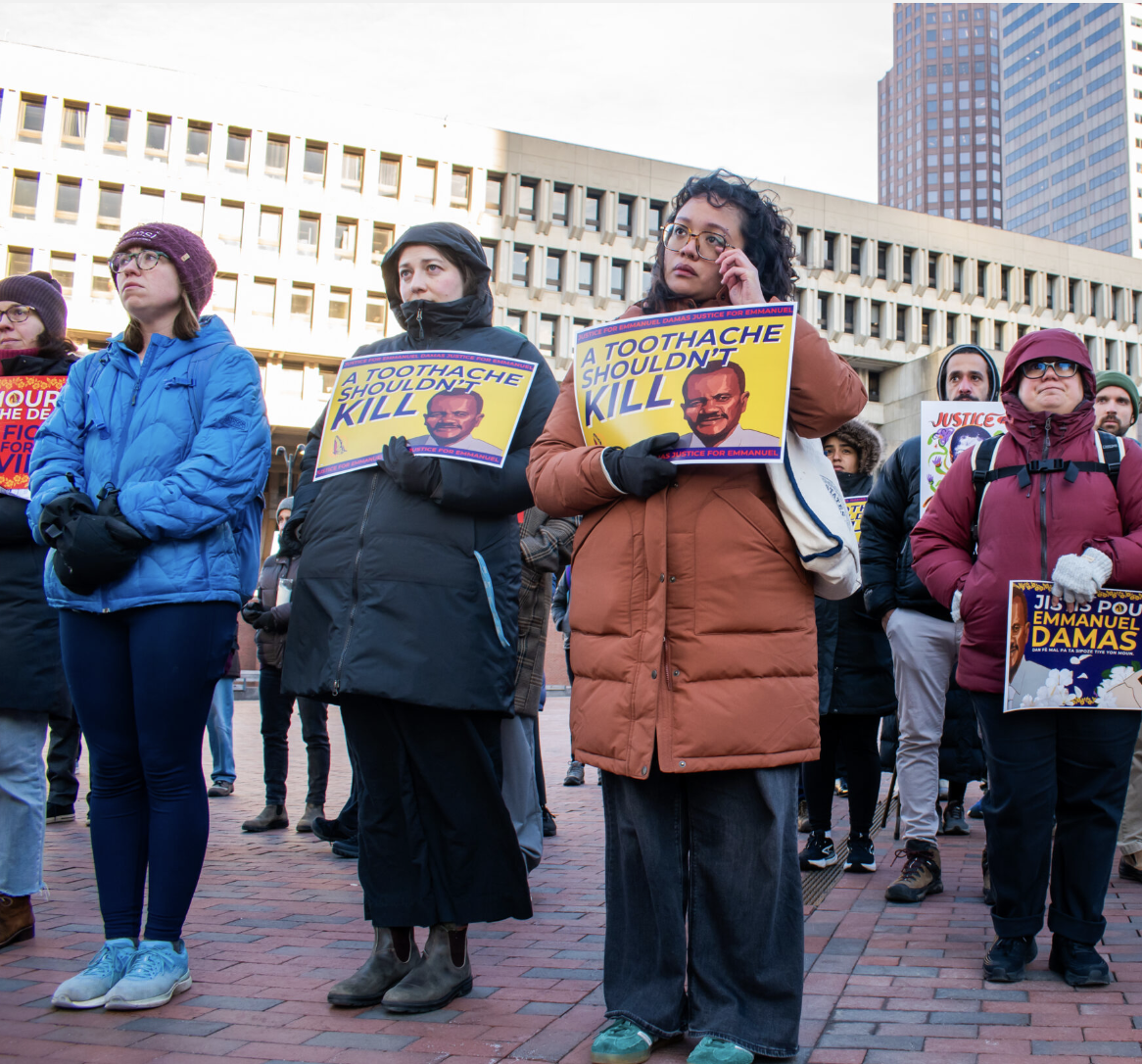
    More than 100 people stood in frigid weather at Boston’s City Hall Plaza Wednesday evening to mourn the death of Emmanuel Damas, the 56-year-old Haitian man who died in an Arizona ICE detention center on March 2.

    “America, we can do better than that,” Damas’ brother, Presner Nelson said. “We are better than that, and we expect better than that from our government.”

    Other vigil speakers called on state and federal politicians to launch an independent criminal investigation into the actions of US Immigration and Customs Enforcement (ICE) that they say resulted in Damas’ death. 

    Emmanuel Damas’s twin brothers, Presner and Presly Nelson spoke at the vigil alongside City Councillor Ruthzee Louijeune. Kelly Broder photo

    What his family says started as a toothache turned tragic when Damas was allegedly unable to access proper and timely health care at the Florence Detention Center in Arizona. The federal Department of Homeland Security (DHS) and ICE officials have publicly refuted that allegation and have said Damas was taken to three different medical centers for treatment.

    Damas arrived legally in Dorchester in 2024 from Haiti and died after being taken to a facility in Phoenix for a cardiothoracic workup. The Laken Riley Act required he be held pending his asylum appeal. His original asylum claim was denied in 2025, filed after he was taken into custody by ICE in Boston last September.

    Vigil attendee Kate Billman-Golemme said she found the news of Emmanuel Damas’s death “deeply upsetting” and “morally offensive.” Kelly Broder photo

    The medical liaison for ICE notified Damas’ family that they were permitted to visit him eight days after he was intubated on a ventilator in the intensive care unit at the John C. Lincoln Medical Center, according to an ICE statement

    “We should not have to use your pain to call shame to a system that is every day abusing our neighbors — our immigrant brothers and sisters,” said City Councillor Ruthzee Louijeune, a daughter of Haitian immigrants. “I am so angry.” 

    Immigrant advocates asked Mayor Michelle Wu and Gov. Maura Healey to initiate an independent review of Boston and Suffolk County law enforcement, who arrested Damas and who submitted his fingerprints at the Nashua Street Jail into a federal database.

    Local representatives of LUCE believe the fingerprinting is probably what alerted ICE.

    The scene on Boston City Hall Plaza on Wed., March 18, 2026. Kelly Broder photo

    Hannah Hafter, a member of the Dorchester hub for LUCE, said Damas’s family is financially responsible for a full autopsy and for the transport of Damas’ body back to Haiti. 

    “His mother says she can’t stand the idea of him being buried in the country that rejected him and killed him,” Hafter said. The family has a GoFundMe page. 

    Brian Concannon, the founder and executive director of the Institute for Justice & Democracy in Haiti, urged members of Congress to end the attempt to terminate Temporary Protected Status (TPS) for immigrants through Congresswoman Ayanna Pressley’s discharge petition that would extend TPS. 

    Speakers at the vigil further demanded that Healey shut down the Boston Regional Intelligence Center, known as BRIC, an organization formed after the Sept. 11, 2001 terrorist attacks that allows data sharing between state and federal officers.

    Latoya Gayle, a candidate for state Senate who volunteers with LUCE Network Massachusetts, said she is outraged by Damas’ treatment in ICE custody.

    “He didn’t deserve what happened to him,” Gayle said in an interview. “His family doesn’t deserve this. We don’t need another family to have to deal with that.”

    Representatives from the LUCE immigrant advocacy group, Immigrant Family Services Institute (IFSI) and local elected leaders like Councillor Miniard Culpepper attended the vigil for Emmanuel Damas. Kelly Broder photo

    Organizers also called for a divestment from CoreCivic, the private for-profit prison company that held Damas in the Arizona detention center. Vigil organizers said Citizens Bank finances CoreCivic and The GEO Group, two of the largest private operators of immigrant detention centers. 

    So far this year 12 people – including Damas – have died in ICE custody, according to the agency’s own records. An additional 31 died in ICE custody in 2025. 

    This story is part of a partnership between the Dorchester Reporter and the Boston University Department of Journalism. 

    Emmanuel Damas was living in Dorchester until his arrest and detention in Sept. 2025. Family photo
  • ICE agents spotted in Jamaica Plain, other neighborhoods

    Immigrant and Customs Enforcement agents were allegedly spotted in Forest Hills recently, and one person was “pulled off the street” in Roslindale Square, according to City Councilor Benjamin Weber, who spoke at the Boston Police Department’s District E-13 community meeting recently.

    Weber said while he was unsure about the Forest Hill sighting, the Roslindale incident on the morning of Feb. 5 came from “credible” sources.

    Their statements align with other reports of ICE agents in the Boston area in recent weeks.

    Last month, state Senator Liz Miranda, whose district includes Jamaica Plain,  highlighted on her Instagram page “rumors” of impending ICE raids in Roxbury and Dorchester, with a focus on members of the Cape Verdean community.

    She shared a list of “trusted organizations,” key contacts for legal aid and information to help those impacted know their rights.

    “To our immigrant neighbors and families. You have rights, no matter your immigration status,’’ the post said,  “You are not powerless. You are not alone.”

    The Jamaica Plain Gazette reached out to Miranda’s office for comment but did not hear back by press time.

    At the District E-13 meeting, Boston Police Lieutenant Warren J. Hoppie told the virtual gathering of 15 residents that the department does not receive information from federal agencies working in Boston and that information is only provided by residents calling the police.

    “We want you to call if you see a violation of state law or violation of city ordinance,” Hoppie said. “If you’re in fear of your safety or something else’s safety, please call us.”

    Michael Reiskind, a member of the Jamaica Plain Neighborhood Council, also said he was informed about the Roslindale incident and that ICE agents left the resident’s car blocking the street with the keys left inside.

    Reiskind said that the council has been informed of possible ICE activity in the Mildred C. Hailey Apartments in JP.

    Police said they have not heard anything about ICE sightings from officers who usually circle the area to look for unhoused people.

    Many neighborhoods, including Jamaica Plain, have watchers who train for spotting and alerting community members of ICE sightings through whistles and other means.

    Carla-Lisa Caliga, a volunteer “watcher” who said she monitors ICE activity in her community, raised questions at the meeting about how she could otherwise help her community.  

    Caliga said that the watcher organization saw what appeared to be ICE vehicles in Hyde Park, Roslindale and JP.

    “I’m one of the people that potentially can be arrested by ICE, and I was born in Boston, because I am not going to back down from them. I’m not going to attack them, but I am a watcher,” Caliga said, “We are getting whistles.”

  • Some Residents Raise Concerns about Anti-drone Effort

    With millions expected to descend onto the World Cup this spring, some Boston residents voiced concerns about the implementation of anti-drone technology that might be deployed to monitor the games.

    They said they are suspicious about what would happen to the technology when the matches are over and who will have access to it, given preexisting surveillance devices in Boston.

    They also recall this month’s spectacle in El Paso, Texas, when US Customs and Border Protection agents used an anti-military laser to shoot down what they said were cartel-linked drones, only to discover they were party balloons.

    “We’re hungry for order, we’re hungry for structure and I’m hungry to hear what logistics will look like because we haven’t heard anything,” said Eryn-Ashlei Bailey, a member of the Jamaica Plain Neighborhood Council.

    The state announced last month that it received $21.2 million in grant funding from the federal government to cover safety measures, including additional personnel and methods to detect, destroy or disable malicious-drone activity at the World Cup. The investment will ensure state and local law enforcement agencies “are equipped to safeguard residents and visitors during events like the World Cup,’’ said public safety and security Secretary Gina Kwon in a press release.

    The grants include nearly $11 million for the Boston Police Department, nearly $4 million for the Foxborough Police Department and nearly $7 million for the Massachusetts Police Department.

    Funding comes from the federal Counter-Unmanned Aircraft Systems Grant Program, which is administered by the Federal Emergency Management Agency.

    “These grants will help state and local police agencies bolster security, training and equipment to keep residents and visitors safe throughout the games and surrounding celebrations,” Gov. Maura Healey said in a press release announcing the grants.

    The grants are part of a larger $500-million initiative that will be split over the 2026 and 2027 fiscal years, according to FEMA documents. The World Cup and America 250 celebrations will receive priority, with unallocated funds directed to next year.

    FIFA World Cup 2026™ will be staged across 16 host cities in the United States, Canada, and Mexico, and include 104 matches. It is expected to attract 5 million people.

    Boston will host seven matches this summer at Gillette Stadium in Foxborough, according to Boston Host Committee for the World Cup’s website.

    In addition, thousands are expected to descend onto Boston City Hall Plaza to celebrate the game in the heart of the city, and World Cup watch parties will be held throughout the neighborhoods.

    Authorities have said that as part of their World Cup planning, they aim to keep the public safe.

    Bailey said that she is concerned about counter-drone technology deployed in communities that face constant pressure from Immigration Customs and Enforcement agents. She said she also worries about overpolicing people in communities of color who are fearful of ICE.

    “People are afraid,’’ she said. “Then you’re bringing in this mass, powerful technology. The default would be, ‘We don’t want this technology. We want to protect our neighbors.’ ”

    She said she hopes authorities will hold public conversations in communities near the World Cup, including Boston, about how these safety measures would be used.

    David Chase Brewster III, another neighborhood council member, said while JP will be a distance away from the Boston World Cup matches, he is concerned about the increasing use of technology by people with bad intentions and by the government, which is supposed to protect the people.

    Drones are inexpensive, small and easy to hide, he said.

    “I see this being a concern of the Boston police,” said Brewster. “I would be happy if bad guys aren’t driving drones into my house.”

  • In council forum, topics run the gamut from affordable housing to immigration, rent control, bike and bus lanes

    Part of the at-large panel (l-r): Erin Murphy, Henry Santana, Ruthzee Louijeune, Marvin Mathelier and Alexandra Valdez at a Hibernian Hall forum on May 22, 2025. Photo by Georgia Epiphaniou

    Seventeen candidates for City Council seats fielded questions about affordable housing, immigration enforcement, and other topics last Thursday evening (May 22) at a forum at Roxbury’s Hibernian Hall.

    Nine candidates for the District 7 seat and eight for the four at-large seats participated in the nearly three-hour forum, which drew more than 100 people and was moderated by Yawu Miller, editor in chief of The Flipside, and WGBH reporter Saraya Wintersmith.

    The at-large field
    All four incumbent at-large councillors running for re-election attended the event: Ruthzee Louijeune, Julia Mejia, Henry Santana, and Erin Murphy. City election officials have also certified nomination signatures for five challengers, so far: Will Onuoha, Marvin Mathelier, Alexandra Valdez, Yves Mary Jean, and Frank Baker. All but Mary Jean were in attendance.

    Baker previously served as the District 3 councillor for 12 years. Valdez is the director of Boston’s Office of Cultural Affairs, and Onuoha worked as the executive director of the Mayor’s Office of Fair Housing & Equity, among other posts in over two decades in city government.

    Marvin Mathelier, a Marine Corps Reserve veteran, said his goal is to bring to the City Council the values instilled in him by military service.

    At-Large City Council panel: (from l to r) Will Onouha, Julia Mejia, Erin Murphy, Henry Santana, Ruthzee Louijeune, Marvin Mathelier, Alexandra Valdez and Frank Baker. Photo by Wen Qi

    Asked how they would make Boston more affordable, Mathelier, Valdez, Santana, and Louijeune give similar answers about supporting rent control, community involvement, budgeting, zoning, mixed-income social housing, and reusing old buildings.

    Onuoha introduced a new idea on workforce housing, targeted to families that earn too much to qualify for affordable housing but can’t afford market rate housing. He says no one should pay over 30 percent of their income for housing.

    “Affordable housing is not affordable,” he said. “That’s a myth that we tell people.”

    Mejia said she supports a displacement tax, a fee that she says would mitigate the loss of residents and businesses due to rising property values, typically caused by gentrification.

    “I’ve been questioning this whole idea, because we’re getting displaced in high numbers” she said.

    Murphy talked about education and workforce development.

    The candidates gave varying answers about how they would support communities targeted by ICE. Baker and Onuoha recommend that immigrants stay off social media. “Do not say anything bad about the government,” Onuoha said.

    Baker thinks Boston police should have a relationship with ICE to create transparency. “There should be some sort of liaison with ICE to see where they’re going, what they’re doing,” he said.

    At-Large City Council panel included (from left to right): Marvin Mathelier, Alexandra Valdez and Frank Baker. Photo by Wen Qi

    Most of the candidates said the city should do more to educate immigrants about their rights. Mejia, who was born in the Dominican Republic, said she survived Trump’s first term and can do it again.

    “I’m prepared to stand up to Trump,” she said, while reinforcing the need to educate immigrants about their rights.
    There was some support among the candidates for bike and bus lanes.

    “I don’t want to walk by no more ghost bikes,” Louijeune said. “I don’t want that. I don’t want that for our children, to say that someone died here because we didn’t do our job to build a safer, better city.”

    Baker said the city should explore expanding water transportation and Valdez and Mejia emphasized that each neighborhood needs its own plan for bike and bus lanes so it makes sense to businesses and residents.
    “People can’t do one size fits all,” Mejia said.

    Murphy blamed increased traffic congestion on bike lanes and speed bumps. “I think it’s important that we don’t just wake up one day and find out that our streets look different and we didn’t have to say anything,” she said.

    In a “speed round,” everyone except Onuoha, Baker, and Murphy said they support statewide rent control legislation. Everyone except Baker said “yes” when asked whether they support inclusionary zoning requiring 20 percent of housing in market-rate developments to be income restricted.

    Onuoha, Valdez, and Baker went on record opposing an elected school committee and against abolishing the Boston police gang database. Everyone else voted yes on those questions.

    There was unanimous support for approving a $4 million increase in the city’s rent subsidy program to provide permanent housing for 130 homeless families.

    Baker was the only candidate who didn’t answer a question about whether universities should increase their payments in lieu of taxes, known as PILOT funds. Baker held his paddle sideways, refraining to answer and drawing an eruption of laughter from the crowd.

    District 7

    District 7 City Council panel: (from l to r) Wawa Bell, Samuel Hurtado, Said Abdikarim, Said Ahmed, Mavrick Afonso, Miniard Culpepper, Roy Owens, Natalie Juba Sutherland and Jerome King. Photo by Georgia Epiphaniou

    The first part of the forum focused on the District 7 seat now held by Tania Fernandes Anderson, who recently pleaded guilty to two of six federal corruption charges after allegedly arranging a kickback scheme that netted her $7,000. Fernandes Anderson, who has said she intends to resign from the seat before her term expires at the end of the year, is not running for re-election.

    Nine candidates have qualified for the ballot for the preliminary election to be held on Sept. 9, with early voting starting on Aug. 30: WaWa Bell, Samuel Hurtado, Said Abdikarim, Said Ahmed, Mavrick Afonso, Rev. Miniard Culpepper, Roy Owens, Natalie Juba-Sutherland, and Jerome King.

    The candidates began by explaining what makes them qualified for the job.

    “I think that our community has been ill-represented for a long time,” said Bell, who went on to say he wants to continue the “positive work” of Fernandes Anderson, who was in attendance at the event.

    Miller asked the candidates how they would work to make District 7 more affordable. Bell expressed support for rent control and a cap on how much landlords can earn.

    The candidates all agreed to advocate for the statewide “Homes for All Massachusetts” rent control legislation that would limit rent increases and ban no-fault evictions. The response came during rapid-fire questions for which candidates had to respond with a paddle with “yes” on one side and “no” on the other.

    Bell and Culpepper emphasized a push for more homeownership, while Juba-Sutherland mentioned a need for more financial literacy among homeowners.

    “What financial literacy does [is] it teaches us how to manage our money,” Juba-Sutherland said. “Because we can actually say, ‘Yes, we can own our homes,’ but can we keep our homes?”

    Afonso, who is the director of external affairs at the state’s Executive Office of Housing and Livable Communities, called for the development of “surplus land” and accessory dwelling units for affordable housing.

    Candidates answered questions about how they would support communities targeted by US Immigration and Customs Enforcement. King called himself a “fighter” and questioned who ICE agents are.

    “All I see is a bunch of people running around with shiesties on,” King said. “They don’t show their face.”

    Nearly all candidates expressed some form of support for community members targeted by ICE, except Owens, who did not answer the question and went on to talk about congestion pricing.

    Both Hurtado and Abdikarim emphasized educating immigrants about their constitutional rights. Afonso said he supports more funding for legal resources for immigrants.

    From left: Said Ahmed, Mavrick Afonso (standing), Miniard Culpepper: and Roy Owens. Photo by Wen Qi

    “This is a sanctuary state,” Afonso said, ”so let’s provide these people the counsel that they need if ICE comes to try to take them away.”

    During rapid-fire questioning, all candidates backed Boston’s inclusionary zoning policy requiring 20 percent of units in market-rate developments to be income restricted and indicated support for amendments that would increase participatory budgeting funds.

    Bell, Hurtado, Owens, Juba-Sutherland, and King said they oppose the Wu administration’s decision to lease White Stadium to a professional women’s soccer team. Abdikarim, Ahmed, Afonso and Culpepper all said they support the plan.

    All except for Juba-Sutherland and Owens voted to abolish the Boston Police Department’s gang database. Juba-Sutherland voted “no,” and Owens abstained from the question.

    Hurtado was the only one of the nine candidates to vote against a fully elected school committee.

    A strong turnout at the Boston City Council Forum, Hibernian Hall, Thursday, May 22, 2025. Photo by Georgia Epiphaniou