Six months ago, Brenda Romero’s husband called her from a courthouse, crying tears of joy. He had just been approved for political asylum. The celebration didn’t last long, however. As Romero’s husband walked out of the courthouse, he was detained by immigration agents.
“In a matter of minutes, our joy turned into trauma,” Romero, who has lived in Chelsea for 12 years, said in Spanish at a Statehouse hearing Wednesday. She and the translator were both in tears.
The arrest of Romero’s husband brings up another dilemma for her. Romero said her daughter was the victim of a “horrific crime” that’s now the subject of a pending court case.
“I am agonizing over whether to continue pursuing justice … not because I do not want justice, but because I am afraid to walk into a courthouse,” Romero said. “Because the last time that my family walked out of a courthouse with hope, my husband was taken away.”
Romero’s story is not unique. Last year, 614 people were arrested by federal agents in courthouses across the state, according to Black and Latino Legislative Caucus Chair Andy Vargas, D-Haverhill.
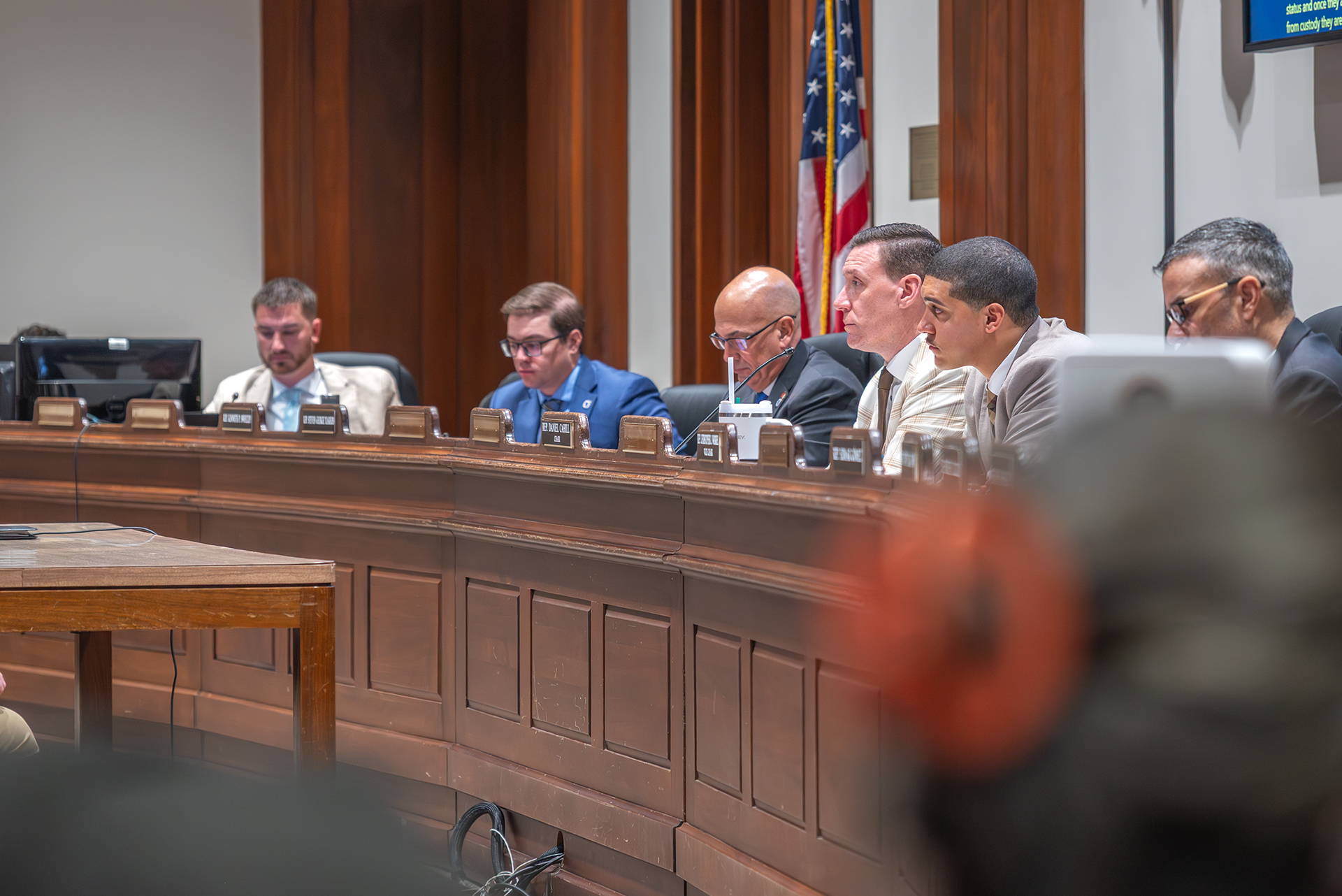
Romero, along with dozens of other immigrants, advocates, law enforcement officers, sheriffs and lawmakers, testified during Wednesday’s public forum, held by the Committee on Public Safety and Homeland Security on a bill called the PROTECT Act. The room was overflowing with people, prompting employees to remove the wall between two hearing rooms to create more seating.
The bill, which members of the Legislature’s Black and Latino Caucus filed in January, aims to strengthen protections for immigrant communities across the state. It focuses on courthouse protection, due process rights, detention facility conditions and law enforcement regulations.
Corinn Williams, director of the Community Economic Development Center of Southeastern Massachusetts, said in an interview with The Light that ICE has arrested several people at New Bedford District Court.
In one case, ICE detained Candelaria Natalia Tzunux Pu of New Bedford after a hearing in New Bedford District Court in December. She spent a week at the U.S. Immigration and Customs Enforcement Office in Burlington and was released after a medical emergency.

Courthouse protections
The bill aims to prevent situations like Romero’s by protecting immigrants in and around courthouses. It states that the fear of civil immigration enforcement at courthouses “undermines access to justice.”
The PROTECT Act would ban the state’s court officers and trial court employees from arresting, detaining, or holding someone because of a civil immigration matter; allowing immigration agents into nonpublic courthouse areas without a warrant; or initiating contact with immigration agents to help carry out a civil arrest. The Executive Office of the Trial Court would be required to file a quarterly public report on immigration enforcement activity on courthouse grounds.
The bill also seeks to prohibit civil immigration arrests in or around courthouses, including while someone is traveling directly to or from court, unless there is a judicial warrant or court order signed by a judge. It’s one of several bills in state legislatures across the country that seek to restrict the actions of federal law enforcement.
Rep. Christopher Markey, D-Dartmouth, said he thinks some parts of the bill are “nearly impossible to enforce.” This includes protecting immigrants traveling to and from courthouses from arrest, which “puts local law enforcement in conflict with ICE,” he said. He also questioned how immigration enforcement agents would know an individual is going to or from court.
However, Markey said some protections are necessary to ensure immigrants’ rights and safety.
“I think the expectation of the average citizen is that we would be aggressively going after the most violent individuals who are in jails or out of jails, who are predators,” Markey said. “But I don’t think [the expectation is] going into schools or going into churches, where people — but for their legal status in the United States — have not committed a crime. And I think that most people agree with due process and the need to make sure that rights are protected, people are safe, and families know where others are.”
The PROTECT Act doesn’t include protections for schools or places of worship, but a bill proposed by Gov. Maura Healey does.
Rep. Christopher Hendricks, D-New Bedford, said he “wholeheartedly” supports the PROTECT Act.
“I think the record that ICE has of trampling on people’s rights, trampling on the Constitution, violating people’s Second, Fourth, Sixth and Fifth Amendment rights routinely — I think we should have a very, very strong response to this,” Hendricks said.
He also suggested additions to the bill, noting that the state should provide guidance on what to do if the “street is flooded with ICE agents and they don’t have warrants, and they kick in people’s doors.”
Hendricks added that the bill should protect local and state police if they intervene when immigration agents are acting “unlawful[ly].” He emphasized the difference between local law enforcement and ICE, which he called “a rogue group operating without warrants.”
Rep. Steven Ouellette, D-Westport, and Sen. Mark Montigny, D-New Bedford, declined to comment on the bill. Rep. Antonio F.D. Cabral, D-New Bedford, did not respond to multiple requests for comment. Rep. Mark Sylvia, D-Fairhaven, did not grant an interview.

Due process and detention facility conditions
The PROTECT Act aims to reform due process and conditions in immigration detention facilities.
The Plymouth County Correctional Facility is the only state facility in Massachusetts holding detainees on behalf of ICE. At the public forum, Plymouth County Sheriff Joseph McDonald reported that there are 474 men in ICE custody in his facility. He added that they typically stay around 20 days, and 243 of them list an address in Massachusetts as their primary residence.
Under the bill, immigration detainees in state facilities would receive written notice of their rights and instructions for contacting an attorney in their primary language. They would have access to confidential, unmonitored phone calls with their attorney and one phone call to whomever they choose within two hours of intake.
The bill would also increase transparency about detainees’ locations. It would require detention facilities to maintain an electronic locator system, provide a telephone hotline for callers to obtain the location of and contact information for the detainees, and inform designated contacts within six hours of transferring the person to or from the facility.
The bill requires facilities to provide translated intake materials and interpretation for medical, mental health, disciplinary, legal and grievance interactions. It would require facilities to provide transportation to, or remote access for, mandatory government appointments.
Law enforcement regulations
The bill would create new limits to local law enforcement’s cooperation with federal immigration agents.
Sheriff’s offices across the state are cooperating with ICE, even without formal contracts or partnerships, The Light reported in October. Local jails have shared a mix of information with federal immigration agents — booking logs, court dates, and release times.
The bill would ban much of this cooperation, prohibiting sheriffs and other Massachusetts law enforcement from providing federal immigration agents advance notice of a person’s release date, time or location. (Bristol County Sheriff Paul Heroux restricted information-sharing with ICE in November.)
The bill would also prohibit law enforcement agents from asking about someone’s immigration status unless it’s required by law, they have a judicial warrant or court order, or it’s necessary to prove a state crime.
The legislation would also ban future 287(g) agreements, which allow local law enforcement to perform the duties of federal immigration officers. It includes an exception that allows agencies to collaborate with federal enforcement agents on serious criminal cases. Barnstable County Sheriff Donna Buckley told lawmakers at the hearing that this exception “doesn’t make any sense.”
Under the PROTECT Act, police officers seeking certification or recertification in Massachusetts would have to disclose whether they worked for ICE or U.S. Customs and Border Protection, “for purposes of assessing training needs and ensuring compliance with the commonwealth’s standards for de-escalation and bias-free policing.”
The bill would also make it easier for immigrant victims of serious crimes who cooperate with law enforcement to obtain documents to apply for protections through a federal visa program.
Local advocates support bill
Lisa Maya Knauer, co-founder of the New Bedford-based Centro Comunitario de Trabajadores, said it is important for immigrant communities to know that people in office represent them, even if they cannot vote. Still, she questioned the bill’s impact, saying that immigration enforcement agencies don’t follow the law.
Knauer said that courthouses are among ICE officers’ “favorite locations.” Because of this, she said the bill is “extremely important.”
“We see people are fearful about going to court,” Knauer said. “If they don’t keep their court date, then they get cited and are eligible for deportation. If they do keep their court date, they might be picked up by ICE.”
Knauer said she spoke on her own behalf, not on behalf of the Centro Comunitario de Trabajadores.
The CEDC’s Williams also stressed the importance of courthouse protections.
“ICE is weaponizing public institutions like courthouses to undermine trust and to erode our community’s access to justice,” she said. “We should all be very worried about this.”
Jamie Perkins is a graduate student in journalism at Boston University, covering state government for The Light as part of the Boston University Statehouse Program. Email them at jperkins@newbedfordlight.org.