Tag: Massachusetts General Brigham

  • Massachusetts lawmakers push to direct more healthcare spending to primary care amid access crisis

    Massachusetts lawmakers push to direct more healthcare spending to primary care amid access crisis

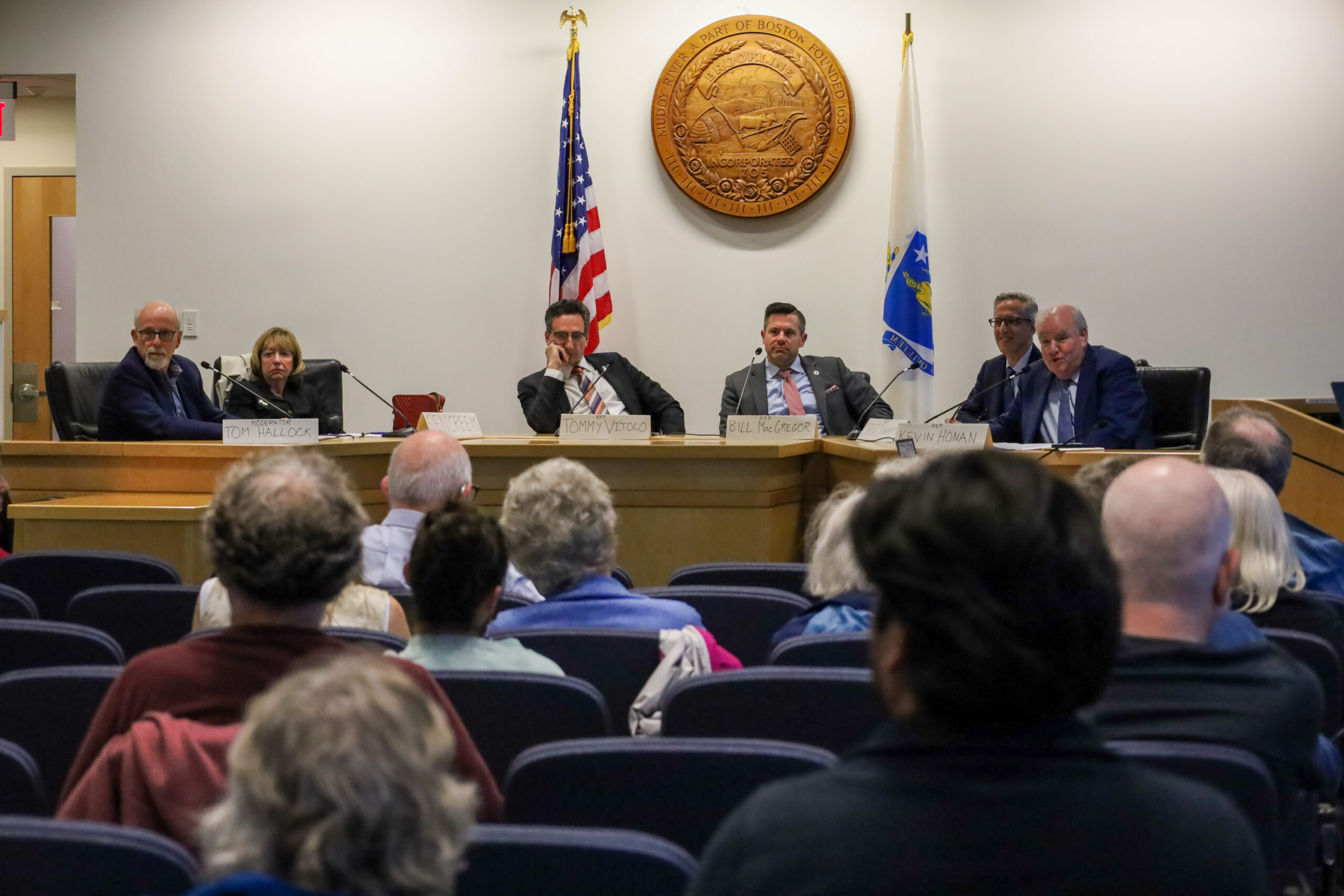
    Greg Schwartz, second from right, is one of the Massachusetts lawmakers working on increasing access to primary care. Photo by Jacqueline Manetta

    Only about 6.7%  of total health care dollars spent by insurers and providers in Massachusetts go toward primary care, less than half the average in other high-income countries and a level that coincides with almost 1 in 3  Bay Staters reporting difficulty accessing primary care, according to the most recent state data.

    Last December, a state task force convened by the Health Policy Commission recommended increasing that share to 15%  of total health care spending to address what physicians describe as a growing access crisis.

    In line with that goal, lawmakers have introduced three bills this session collectively known as “Primary Care For You” (PC4You) , which would increase the portion of overall health spending directed to primary care. One version, filed by Rep. Greg Schwartz, D-Newton, who represents parts of Brookline, faces a March 17 reporting deadline before the Joint Committee on Health Care Financing.

    At a Statehouse briefing last month, physicians involved in an ongoing unionization effort among primary care doctors at Massachusetts General Brigham (MGB) joined lawmakers to argue that reforms are urgently needed.

    Schwartz, currently the only practicing primary care physician in the Massachusetts Legislature, said his bill would address burnout and staffing shortages by allowing practices to hire and retain more clinicians and support staff.

    “It’s not that medical residents aren’t interested in going into primary care, and it isn’t that they’re not ready to take a lower salary,” Schwartz said in an interview. “It’s that they just don’t want to practice in an area of medicine that doesn’t have administrative support. Those resources are just not provided to primary care the way that they are for some of the specialty care practices.”

    At the briefing, Dr. Zoe Tseng, a primary care physician at Brigham and Women’s Hospital, said the question she hates to hear most is whether she is accepting new patients.

    “I really dread this question,” Tseng said. “Because I hate to say no when I know there’s so much need.”

    Tseng said more than 60 primary care physicians have left Mass General Brigham in the past three years, describing “significant moral distress” among doctors who feel “that our patients’ needs are increasingly at odds with the profit-driven decisions at MGB.”

    Physicians also noted that approximately 250 MGB primary care doctors voted in 2025 to unionize with Doctors Council SEIU, with roughly 88% in favor. The health system has challenged the National Labor Relations Board’s determination of which physicians are eligible for inclusion in the union, delaying contract negotiations.

    In a written statement, Mass General Brigham said it is taking steps to address primary care shortages and physician workload, including hiring additional clinicians and expanding programs intended to reduce administrative burden and improve access to care.

    Addressing the unionization effort, the system said it is “committed to creating a workplace where all physicians, clinicians, and staff feel heard and valued,” and that it asked the National Labor Relations Board to review whether the proposed bargaining unit was “appropriate under the law for acute care hospitals” and is awaiting the board’s decision.

    ‘This is how things get missed’

    Dr. Kristin Gunning, a primary care physician at Mass General Hospital who has practiced for 26 years, said the workload has become unsustainable.

    “For every hour we see patients, we have an hour of unpaid work,” Gunning said, adding that full-time primary care physicians can often work 80 hours or more a week.

    She said seven doctors and one nurse practitioner left her practice within seven months, leaving roughly 5,000 patients without their regular physicians. The remaining doctors absorbed hundreds of additional patients while already fully paneled.

    Gunning argued the shortage stems from decades of underinvestment in primary care as hospital systems prioritize more profitable specialty services.

    “Preventing disease is not profitable,” she said. “The money is in lucrative diseases such as cancer and cardiovascular disease.”

    Dr. Benjamin Kerman, a primary care physician at Brighman and Women’s Hospital, read a statement from his patient, Natasha Andino, describing rushed appointments.

    “I pay for insurance, but I still find myself rationing my questions, choosing what fear I’m allowed to say out loud before time runs out,” Andino wrote. “This is how things get missed. This is how treatable problems become pricey because no one had time to catch them early.”

    Three bills, one problem

    PC4You refers to three bills filed by Sen. Cindy Friedman, D-Arlington, and Reps. Schwartz and Richard Haggerty, D-Woburn. All seek to increase total primary care spending, but through different mechanisms.

    The Schwartz and Friedman  bills would require the Health Policy Commission to set annual benchmarks for primary care spending, raising the share of total health care expenditures devoted to primary care to at least 12% by 2029. Entities that fail to meet targets could be required to file performance improvement plans and face civil penalties. The bills would also create a primary care board to study longer-term payment reforms, including a potential shift to per-member, per-month payments, but would not immediately implement that model or create a funding mechanism. 

    Haggerty’s bill  would raise primary care spending to 15% by 2029 and immediately establish a Primary Care Stabilization Fund financed through required insurer contributions. The bill would immediately implement a prospective per-member, per-month payment model for participating practices, paid from that fund.

    Similar versions of Haggerty’s proposal have been filed in previous sessions but have not advanced. Schwartz said his approach is intentionally more incremental.

    “It doesn’t require a wholesale change in the way that care is paid for,” he said, arguing a less disruptive model may be more likely to gain support from insurers and hospital systems.

    Friedman’s bill was reported favorably out of the Joint Committee on Health Care Financing in June 2025 and is now before the Senate Committee on Ways and Means. Haggerty’s bill has remained before the Joint Committee on Health Care Financing since last May. All three bills must be acted on by both chambers by July 31, or they will die with the session.

    Dr. Justin Holtzman, who runs an independent primary care practice in Brookline, said he supports additional funding but does not believe spending alone will solve the crisis.

    “Who would say no to more money?” Holtzman said.

    He argues that consolidation and “anti-competitive” behavior among the region’s large hospital systems, not just underinvestment, have created barriers for independent physicians like himself.

    “It sucks being a doctor in Eastern Massachusetts,” Holtzman said. “Over time, the hospitals have bought up all these primary care practices, the doctors eventually retired, and now nobody wants to come and work for them.”

    Holtzman described a case from several years ago involving a patient with severe psychiatric needs whose insurance required care within the Mass General Brigham system. When he attempted to refer the patient to psychiatry at Massachusetts General Hospital, he said he was initially told the department could not accept the referral because he was not an MGB physician.

    “So I said, ‘All right, let’s get this patient in an appointment with a primary care doc in your clinic,’” Holtzman said. “They said, ‘That’s fine. It’ll be two and a half years before they can get in.’”

    Holtzman said he later spoke with the department chair and was told the service was overwhelmed and could not take his referral because it was struggling to accommodate patients already within the health system.

    “He said, ‘Listen, we just can’t do it. We have so many patients that we can’t even see our own patients, let alone patients outside our health system,’” Holtzman said.

    Mass General Brigham disputed Holtzman’s account. In its statement, the health system wrote: “To reiterate, regarding specialist referrals, Mass General Brigham does not have any policies prohibiting referrals from non-MGB physicians.”

    “So what do I do?” Holtzman said, arguing that in a system with more independent physicians, referrals could move more quickly and patients could access care more reliably.

    “If I know an independent doctor, I can call and say, ‘This patient is pretty sick — can you see them?’ and they’ll get them in right away,” he said. “I can’t do that with the big hospitals, and almost all the doctors now are employed by the big hospitals.”