
Tag: Maura Healey

  • South Coast lawmakers lay out priorities for fiscal 2027 state budget

    South Coast lawmakers lay out priorities for fiscal 2027 state budget

    From playgrounds to addiction treatment, New Bedford legislators are advocating for money for their communities in the state’s fiscal 2027 budget. Each lawmaker is pursuing earmarks for his district as negotiations over the spending plan unfold this spring. 

    The Massachusetts House is working on its own version of the next state budget, which should go into effect July 1. Gov. Maura Healey launched the process with her proposed version on Jan. 28, setting her priorities in a year where federal cuts and policy changes are creating uncertainty.

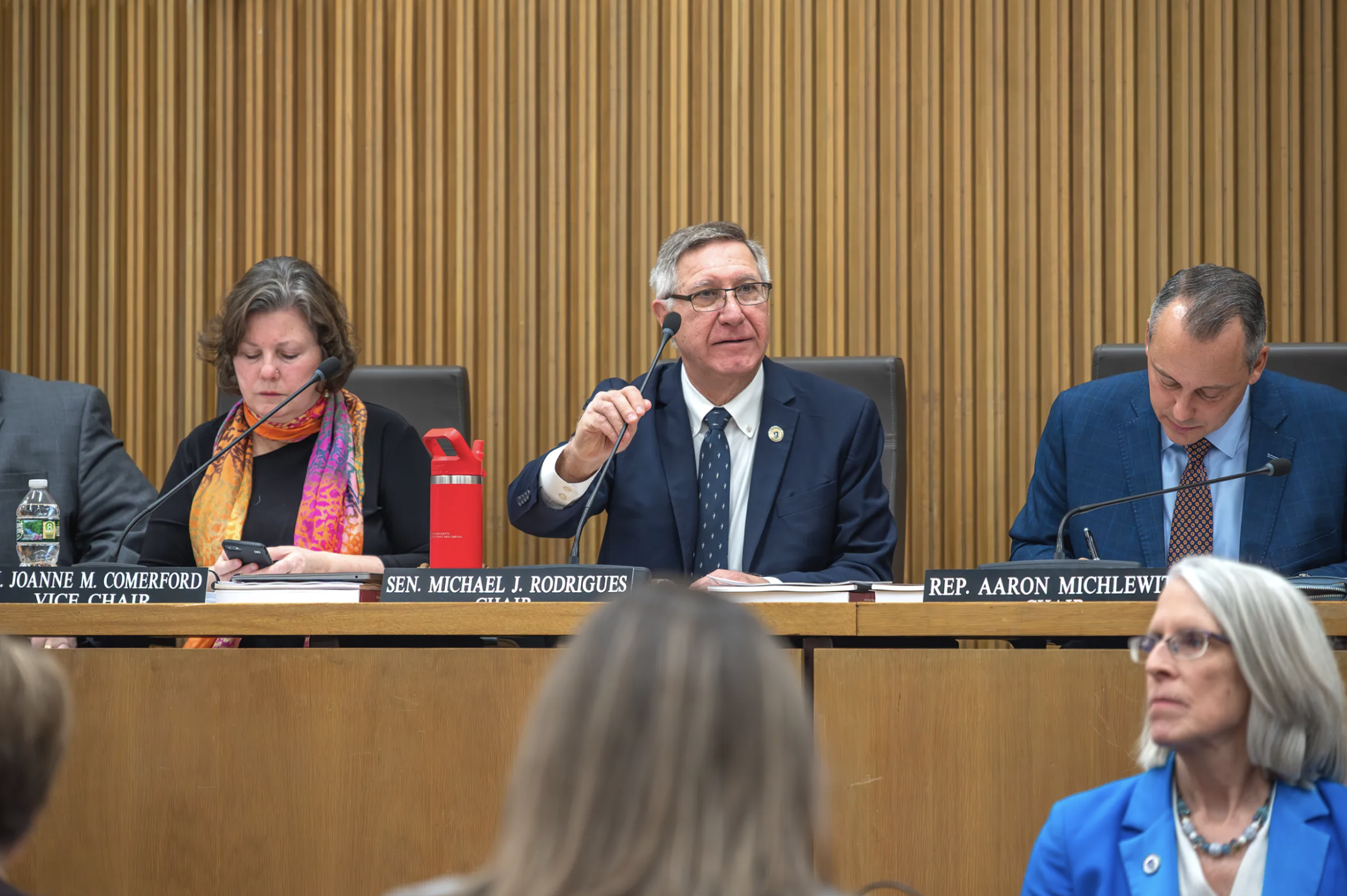
    The Legislature’s Ways and Means Committee met on Feb. 11 to discuss Gov. Maura Healey’s proposed FY27 budget. From left to right: Senate Vice Chair Joanne Comerford, Senate Chair Michael Rodrigues, and House Chair Aaron Michlewitz. Credit: Jamie Perkins / The New Bedford Light

    New Bedford lawmakers’ earmarks for their districts

    Rep. Christopher Hendricks, D-New Bedford, said a four-term lawmaker like himself usually gets three local earmarks in the annual budget. 

    The first budget amendment that Hendricks plans to file to a House Ways and Means Committee budget, due out in April, is for the Leduc Center for Civic Engagement at University of Massachusetts Dartmouth to provide transportation for the America Reads/Counts program. 

    University students in the program tutor and mentor struggling and at-risk students in community centers, elementary schools and preschools. Last year’s budget provided $75,000 for the program. 

    His second earmark is for Girls Design Academy in New Bedford, an after-school program for third through fifth grade students that focuses on life skills and STEAM education (science, technology, engineering, arts and mathematics). The fiscal 2026 budget allotted $50,000 to the program. 

    Hendricks also plans to request funding for Positive Action Against Chemical Addiction, a New Bedford organization that offers youth programs, housing initiatives, employment support and community outreach. Hendricks secured $25,000 for PAACA in fiscal 2026. 

    Rep. Steven Ouellette, D-Westport, said he’s looking for a new floating dock at the state boat ramp in Westport and a “revamp” of the playground at Desmarais Park in Fall River. 

    Ouellette is also weighing options to address the failing HVAC system at Acushnet Elementary School. Last April, the town of Acushnet voted down a temporary tax increase (a debt exclusion) for up to $4.2 million in air quality improvements due to a mold infestation. He said he hopes to secure around $10,000 for replacement air filters. 

    Last year, Rep. Mark Sylvia, D-Fairhaven, earmarked $40,000 for Coastal Foodshed to support food security issues in Greater New Bedford, $25,000 for the Whitfield-Manjiro Friendship Society, and $25,000 for a Fairhaven Council on Aging kitchen upgrade. 

    In fiscal year 2027, Sylvia said he plans to file amendments for Coastal Foodshed and the Whitfield-Manjiro Friendship Society again. He noted that he is still speaking with his constituents to identify additional requests. 

    “I look forward to co-sponsoring a number of different New Bedford-specific earmark requests, and will be working with the other members of the delegation on that,” Sylvia said. 

    Rep. Christopher Markey, D-Dartmouth, said he plans to earmark money for the South Coast LGBTQ+ Network to fund programming for high school students and older adults. He wants to fund UMass Dartmouth law school’s Justice Bridge program, in which recent law school graduates provide reduced-cost services. 

    And he wants to fund a digital sign for UMass Dartmouth to be placed between I-195 and Route 6. The sign would announce events and other activities, and Markey said he hopes it will strengthen the connection between the school and the town. He is requesting $75,000 for each amendment and plans to sign on to other lawmakers’ earmarks. 

    Rep. Antonio F.D. Cabral, D-New Bedford, is looking to earmark funding for youth programming at the Dennison Memorial Community Center and opioid treatment services at the New Bedford Community Health Center. 

    He is also focused on arts and cultural organizations such as AHA! and the New Bedford Festival Theatre, noting that they are not only important institutions but also economic drivers for the city. 

    “[The budget] is one of the most important pieces of legislation that we do every year, so it’s important to me,” Cabral said. “It’s always important to stay focused, stay engaged, and talk to all the stakeholders.”

    Sen. Mark Montigny, D-New Bedford, told The Light that he “probably [has] as many earmarks as most delegations combined” because of his seniority and past experience as the Senate Ways and Means chair. 

    He said it’s too early in the Senate’s budget process to list his exact earmarks, but noted that he tends to focus on services for children and older adults. 

    Over his 33 years on Beacon Hill, Montigny said, he has earmarked millions of dollars for children’s programming in the New Bedford area, including for the Boys and Girls Club, Youth Opportunities Unlimited and NorthStar Learning Centers, where he funded an “extensive” music program.  

    “[Children] shouldn’t rely on the lucky ZIP Code they’re born into, or the school district they’re born into or the means of their family,” Montigny said. 

    South Coast lawmakers share statewide priorities

    Some South Coast lawmakers also told The Light about statewide changes they’ll advocate to include in the budget. 

    Markey suggests adding two policy changes to the budget bill. 

    He wants to implement a carbon credit system, enabling businesses to earn credits for adopting environmentally friendly electrification practices and sell unused credits for profit. Similar programs exist in California, Oregon, Washington and New Mexico. 

    He says carbon credits would help create a smoother transition to clean energy. “People are unrealistic that you just turn on and turn off a switch and it’s just going to be fine — like, go shut the pipelines down and everything’s fine,” Markey said. “This is a way to make sure that we continue on that transition without having huge economic devastation to companies. And it would incentivize clean companies to come to Massachusetts, where they know that they can not only produce their products, but they can also create a source of revenue through the credits.” 

    Markey’s second policy targets “street takeovers,” where groups — often children and teenagers — swarm the street in cars and ATVs, blocking intersections and harassing other drivers. The proposal would penalize participants by seizing their vehicles.

    Ouellette said his priorities include keeping school lunches free. Massachusetts made school lunch and breakfast free for all students starting in the 2022-2023 school year. “And [I want to] make sure our public safety and our schools stay up there,” Ouellette said. 

    Ouellette noted that each of his towns’ departments of public works is seeking additional funding “so there’s no shortage of need.” 

    Cabral said he will push for increased local aid for cities and towns. He added that he has been working to improve the formula for allocating unrestricted local aid, including filing legislation to create a commission to evaluate the formula and provide recommendations. 

    Sylvia says he hopes to increase funding for school districts under the state’s Student Opportunity Act. 

    Montigny said that because of an experience with his father’s nursing home, he files a legislative proposal each budget season requiring nursing homes to hold patients’ beds for 20 days if they are hospitalized. According to Audra Riding, general counsel for Montigny, the bed-hold policy succeeds every budget. Because the annual budget is only valid for a fiscal year, Riding said Montigny has a bill to “permanently enshrine” the policy into law. 

    He also said he plans to continue funding a stroke-prevention program, including billboards that raise awareness of stroke symptoms. He added that he has an idea to address human trafficking that he plans to advance in the budget, but declined to share the details.   

    Montigny said he also hopes to include a “major subsidy” to address the high cost of energy. 

    He also said he hopes for increased local aid. 

    “I’m hearing across the board, people are frustrated with the formula, and they don’t feel that they’re getting enough back from the state,” he said. “I have never seen as much consensus from the people I represent that the cost of living is exceedingly difficult, and they’re angry as hell about it.”

    Montigny added that every budget has room for cuts and tighter spending. As Ways and Means chair, he once cut every earmark in an effort to push lawmakers to advocate for what they truly wanted. 

    Healey’s proposed budget 

    The House budget will amend Healey’s fiscal year 2027 budget plan, which totals $63 billion, a 3.8% increase over the 2026 fiscal year. This includes $2.7 billion in Fair Share tax spending — the additional tax on income over $1 million. 

    Healey’s budget depends on an estimate that Massachusetts will collect $45 billion in tax revenue in fiscal year 2027, a 2.9% increase over the current fiscal year’s expected amount. 

    At the Legislature’s Ways and Means Committee hearing on Feb. 11, Administration and Finance Secretary Matthew Gorzkowicz said the administration attempted to limit the growth of accounts and cut costs rather than eliminate programs. He said he expects health care costs to be the greatest challenge in managing the budget in fiscal year 2027. 

    Healey proposed $10.4 billion across local aid accounts, a 4.4% increase over fiscal year 2026. Cities and towns rely heavily on the state’s local aid, as it is the second largest source of municipal revenue, behind property taxes. Much of it is tied to specific mandates and services.

    Healey’s plan includes a 2.5% increase in unrestricted general government aid. This falls short of the Massachusetts Municipal Association’s request for an increase of 26.5% above fiscal 2026. 

    The association wrote that such a boost “would restore a measure of balance to a state-local fiscal partnership that has drifted out of alignment for more than a decade.”

    Healey’s budget fully funds the final year of the Student Opportunity Act, offering $7.6 billion in Chapter 70 aid. That would guarantee a minimum per-pupil aid of $75 for all school districts, in addition to what the current Chapter 70 formula provides. This is a 50% cut from the current fiscal year’s minimum of $150.

    Federal actions impact the budget  

    The budget comes at a “challenging time,” Healey said at the February hearing. In the past year, the Trump administration stripped $3.7 billion in federal funding from Massachusetts, including $1 billion in health care cuts, according to Healey. The federal government also made cuts to food programs, public safety and emergency response, public health and disease prevention, broadband access and energy supply, she said. 

    “In the past year, Donald Trump has essentially taken a hatchet to state budgets across the country,” Healey said. 

    Evan Horowitz, executive director of the Center for State Policy Analysis at Tufts University, said that while the federal government’s actions will affect the budget, he would “not put [his] faith” in the $3.7 billion figure.

    “These cuts are coming in so many strange ways, through so many different channels, and with so much uncertainty,” Horowitz told The Light. “On the one hand, it’s sort of undeniable, I think, that we’re getting less money from the feds. Some of that is grants for programs that we run, but they’re also changing the rules for the programs.” 

    He noted that Trump’s “One Big Beautiful Bill Act” changed the qualification requirements for SNAP and for Medicaid, known as MassHealth in Massachusetts. The federal government will owe the state less money because fewer people will qualify.

    “In some sense, it’s a lot harder for budget writers than if we just could say, ‘oh, there’s going to be a shortfall in this account,’” Horowitz said. “We know there’s gonna be a shortfall, but we can’t judge how big it is, and it may show up in weird places. That’s really the challenge.”

    The Healey administration is also attempting to address the federal government’s shortfalls through legislation, including a proposal for a refundable tax credit of up to $5,000 for farms that donate their products to food banks and pantries. 

    Lawmakers will spend the next several months debating the budget, with the House budget typically passed in April and the Senate’s in May. Fiscal year 2027 begins July 1, but Massachusetts often misses the deadline and is one of the last states to file its final budget. 

  • Student Opportunity Act enters its final year in MA. What’s next?

    Gov. Maura Healey’s fiscal 2027 budget proposal of $63.36 billion calls for cutting the minimum per-pupil aid increase in half from the current year, reflecting declining enrollments and changes in federal aid. But Senate President Karen Spilka said MetroWest communities have seen significant increases in school funding already, thanks to the Student Opportunity Act.

    “In MetroWest alone, some communities have seen their state aid nearly double in the time since its passage (in 2019),” Spilka, D-Ashland, said in a statement given to the Daily News.

    Spilka helped spearhead the law through the Legislature more than six years ago. The measure increased Chapter 70 aid and other funding that year by $1.5 billion over inflation for Massachusetts K-12 public education. Now entering its final year, the bill has provided an estimated $2.3 billion to local school districts.

    Gov. Maura Healey, pictured in 2023, told the Joint Ways and Means Committee last month that her budget would allocate $7.6 billion in Chapter 70 aid to local school districts. Marc Vasconcellos/The
    Enterprise

    Healey told the Joint Ways and Means Committee in early February that her budget would allocate $7.6 billion in Chapter 70 aid and guarantee a minimum per-pupil aid of $75 for all local school districts. The current year allocates $7.36 billion for Chapter 70 aid, with a minimum allocation of $150 per pupil, a historic high.

    State leaders plan to revise the Student Opportunity Act during fiscal 2027, the governor said. Its current focus has been to provide funding to districts with high concentrations of low-income students, while also directing investments to support special education programs.

    “The Student Opportunity Act was also structured to ensure that every child in the Commonwealth has the opportunity to receive a quality education, regardless of background or ZIP code,” Spilka said, adding that in MetroWest municipalities the funding has gone to teachers’ salaries as well as modernizing facilities.

    “In our enrollment in specific student groups, the Student Opportunity Act has certainly helped us funding wise, to support students and staff,” added Lincoln Lynch IV, executive director of finance and operations for Framingham Public Schools.

    Legislator didn’t feel state was giving her town enough aid

    Spilka said she spearheaded the legislation based on her personal experience with how funding was distributed to her children’s schools in Ashland, saying she felt the state education budget was not giving her hometown the funding it “deserved,” due to “the way the state formula was structured.”

    This year’s 50% reduction comes as more municipalities are seeing declines in enrollment, pushing additional districts into minimum-aid status. External factors, such as federal funding cuts, have also influenced the amount of state-allocated student aid.

    In response to a question from House Ways and Means Chair Aaron Michlewitz, D-Boston, about the future of the Student Opportunity Act, Healey acknowledged that “as a general matter, we recognize that cities and towns across the state are really struggling with their own budgets right now.”

    But Massachusetts is also feeling strained by federal cuts to the state’s Health and Human Services budget, particularly a $2 billion cut from MassHealth, according to Massachusetts Municipal Association.

    In the face of those constraints, lawmakers last month agreed to take a fresh look at how the state and municipalities divide education costs.

    Despite those pressures, Spilka said the Senate “remains committed to working alongside educators and communities to find solutions that help deliver a world-class education for every Massachusetts student.”

  • Some Residents Raise Concerns about Anti-drone Effort

    With millions expected to descend onto the World Cup this spring, some Boston residents voiced concerns about the implementation of anti-drone technology that might be deployed to monitor the games.

    They said they are suspicious about what would happen to the technology when the matches are over and who will have access to it, given preexisting surveillance devices in Boston.

    They also recall this month’s spectacle in El Paso, Texas, when US Customs and Border Protection agents used an anti-military laser to shoot down what they said were cartel-linked drones, only to discover they were party balloons.

    “We’re hungry for order, we’re hungry for structure and I’m hungry to hear what logistics will look like because we haven’t heard anything,” said Eryn-Ashlei Bailey, a member of the Jamaica Plain Neighborhood Council.

    The state announced last month that it received $21.2 million in grant funding from the federal government to cover safety measures, including additional personnel and methods to detect, destroy or disable malicious-drone activity at the World Cup. The investment will ensure state and local law enforcement agencies “are equipped to safeguard residents and visitors during events like the World Cup,’’ said public safety and security Secretary Gina Kwon in a press release.

    The grants include nearly $11 million for the Boston Police Department, nearly $4 million for the Foxborough Police Department and nearly $7 million for the Massachusetts Police Department.

    Funding comes from the federal Counter-Unmanned Aircraft Systems Grant Program, which is administered by the Federal Emergency Management Agency.

    “These grants will help state and local police agencies bolster security, training and equipment to keep residents and visitors safe throughout the games and surrounding celebrations,” Gov. Maura Healey said in a press release announcing the grants.

    The grants are part of a larger $500-million initiative that will be split over the 2026 and 2027 fiscal years, according to FEMA documents. The World Cup and America 250 celebrations will receive priority, with unallocated funds directed to next year.

    FIFA World Cup 2026™ will be staged across 16 host cities in the United States, Canada, and Mexico, and include 104 matches. It is expected to attract 5 million people.

    Boston will host seven matches this summer at Gillette Stadium in Foxborough, according to Boston Host Committee for the World Cup’s website.

    In addition, thousands are expected to descend onto Boston City Hall Plaza to celebrate the game in the heart of the city, and World Cup watch parties will be held throughout the neighborhoods.

    Authorities have said that as part of their World Cup planning, they aim to keep the public safe.

    Bailey said that she is concerned about counter-drone technology deployed in communities that face constant pressure from Immigration Customs and Enforcement agents. She said she also worries about overpolicing people in communities of color who are fearful of ICE.

    “People are afraid,’’ she said. “Then you’re bringing in this mass, powerful technology. The default would be, ‘We don’t want this technology. We want to protect our neighbors.’ ”

    She said she hopes authorities will hold public conversations in communities near the World Cup, including Boston, about how these safety measures would be used.

    David Chase Brewster III, another neighborhood council member, said while JP will be a distance away from the Boston World Cup matches, he is concerned about the increasing use of technology by people with bad intentions and by the government, which is supposed to protect the people.

    Drones are inexpensive, small and easy to hide, he said.

    “I see this being a concern of the Boston police,” said Brewster. “I would be happy if bad guys aren’t driving drones into my house.”

  • Lawmakers on verge of passing new literacy standards legislation

    Late last month the Massachusetts Senate unanimously passed The Right to Read bill that the House had approved without objection last fall, moving the Legislature a big step closer to the creation of a new statewide standards for literacy education grounded in “evidence-based” curricula, including professional development for educators and supplemental funding for public schools. The final version of the bill is now in progress. 

    These actions follow Gov. Maura Healey’s awarding of $3.3 million in Partnership for Reading Success – Massachusetts literacy grants to 25 school districts last August, as part of the administration’s Literacy Launch initiative, which supports reading skills in students from kindergarten through third grade.

    While Massachusetts ranked first in 2025 in the National Assessment of Education Progress — known as the Nation’s Report Card — nearly one-third of K-3 students in the state fall below benchmark levels, according to the Department of Elementary and Secondary Education. (DESE). 

    “What really drove this bill forward was the data showing where reading levels stand five years after the pandemic,” said state Sen. Nick Collins of South Boston, a bill sponsor, in a statement to The Reporter. “Too many students are still falling behind in the early grades, and we know that if a child struggles to read early on, it affects everything that comes after.”

    The bill would ensure that students from kindergarten to third grade will learn to read using phonics, phonemic awareness, fluency, vocabulary, and comprehension practices. Schools would have three DESE-approved options to implement curriculum, including a free comprehensive curriculum provided by the department, a list of curriculum options that meet evidence-based criteria, or a waiver authorizing another curriculum that meets the same standards but has not been reviewed or approved by DESE.     

    The legislation would also create an Early Literacy Fund with $25 million in “Fair Share” funding to help support districts with implementation and educators’ professional development. Additional resources are to be made available by DESE. 

    Educators for Excellence —a teacher-led organization advocating for increased involvement in education legislation — held a panel discussion last Wednesday (Feb. 18), where educators from schools across the state discussed the current challenges facing their students and the importance of the Right to Read bill. 

    Nearly 83 percent of educators in the state believe all teachers should use high-quality, evidence-based instructional material, according to a 2025 survey by the organization. Others say evidence-based curriculum isn’t one-size-fits-all, and limiting the teaching tools educators can use may result in students with unfulfilled needs. 

    Along with an updated curriculum, the bill would implement twice-yearly assessments to measure reading progress and screen students for dyslexia. If it appears that a student has fallen behind, schools will be required to contact a parent or guardian within 30 days.

    “This legislation is about making sure every child gets strong, research-backed reading instruction, no matter their ZIP code,” Collins wrote. “It has broad support from groups like MassPotential, The Reading League Massachusetts, EdTrust, and Decoding Dyslexia, all of whom have pushed for more consistency in how reading is taught across the commonwealth.”

  • Examining Marblehead school vaccine rates

    As controversy over childhood vaccinations rages nationwide, student immunization rates in Marblehead have remained steady over the past three years, with most schools reporting 90% or more of pupils have gotten all vaccines required by state law.

    Dr. Thomas Massaro, a retired pediatrician and the chair of the town’s Board of Health, said the community’s demographics likely play a key role in maintaining consistent vaccination rates.

    “Massachusetts is a pretty progressive state, and Marblehead is consistent with that,” he said. “About 77% of residents have at least one bachelor’s degree, and it’s an affluent community. People understand the benefits of vaccines, they judge them, and they decide to go ahead.”

    Statewide, the number of students with all vaccines required for school averages 94.4% for kindergarten students and 90.7% for grade 7 students. Pupils in some parts of Massachusetts are getting vaccinated less and requesting more exemptions in recent years, Department of Public Health data shows. Vaccination rates have been decreasing nationally since the COVID-19 pandemic, especially for kindergartners and as more parents question their effectiveness, though Massachusetts was recently rated by one national study as the state with the highest vaccine rates for all residents.

    State and local governments have the authority to impose vaccine requirements for students in their communities, though the U.S. Centers for Disease Control has traditionally recommended a vaccine schedule for those attending school. The CDC announced this month it was dropping recommendations that school-age children get six vaccines previously encouraged for students, including those aimed at preventing respiratory infections, Hepatitis A and B, and meningitis. Gov. Maura Healey, a Democrat, immediately announced students in Massachusetts would still be required to get all vaccines mandated by state law, which include some of those eliminated by the CDC.

    Massachusetts children, from those attending day care and pre-school programs through those attending college in the commonwealth, are required to get a slate of vaccines as they progress through grades, including those preventing chickenpox, polio, diphtheria and measles, among others.

    In December, state officials issued an alert about potential measles exposure in Massachusetts after an out-of-state visitor contracted the disease. Since 2020, there has been only one case of a Massachusetts resident getting the measles, state records show.   

    But for the first time in three decades, the number of measles cases in the U.S. rose to over 2,000 last year, according to the CDC. All 50 states require vaccinations for students, though Republican Florida lawmakers, including Gov. Ron DeSantis, have been battling to limit vaccine requirements. 

    Each year, the Massachusetts DPH surveys all day care, pre-school and kindergarten programs and middle and high schools, to gather immunization data on those in seventh and 12th grade.  Those grade levels are targeted to align with the required state-required vaccines for children of those ages. 

    Students can request a medical exemption from the vaccines if certified by their physician or a state can waive exemptions if mandated immunizations conflict with a student’s religious beliefs. Like the rest of the nation, medical and religious student vaccine exemption rates in Massachusetts have risen in the past four years, according to data shows. 

    In Marblehead, exemption rates across all programs and schools have hovered between 0% and 6% at the highest since 2022, DPH data shows. A bill pending in the Massachusetts legislature would remove the ability for a student to obtain religious exemptions, mirroring New York, Maine and Connecticut and California, which have eliminated them. 

    Massaro said the pandemic undermined public trust in government across age groups.

    “One of the long-term negative consequences of the pandemic was a loss of faith and trust in public health,” he said. “Vaccines are the prime face of public health to young people. If the pandemic caused overall questions about whether they can trust the CDC or FDA, then it’s not surprising there’s been a slight diminution.” 

    Massaro also warned that misinformation circulating at the federal level may further undermine confidence. 

    “We’re subject to a much bigger decline with all the misleading information coming out of (the U.S. Department of) Health and Human Services right now,” he said.

    Polls by the Kaiser Family Foundation show widening partisan divides over support for routine childhood vaccinations. At the same time, states have begun to diverge significantly in how they regulate school immunization requirements. New York and California eliminated nonmedical exemptions after large measles outbreaks in the past decade. Other states have moved in the opposite direction. Idaho, Oklahoma and Utah have expanded or clarified access to exemptions, reflecting the broader national debate. 

    “It is a balance between the individual and the community,” Massaro said. “People need to trust the systems that protect them.”