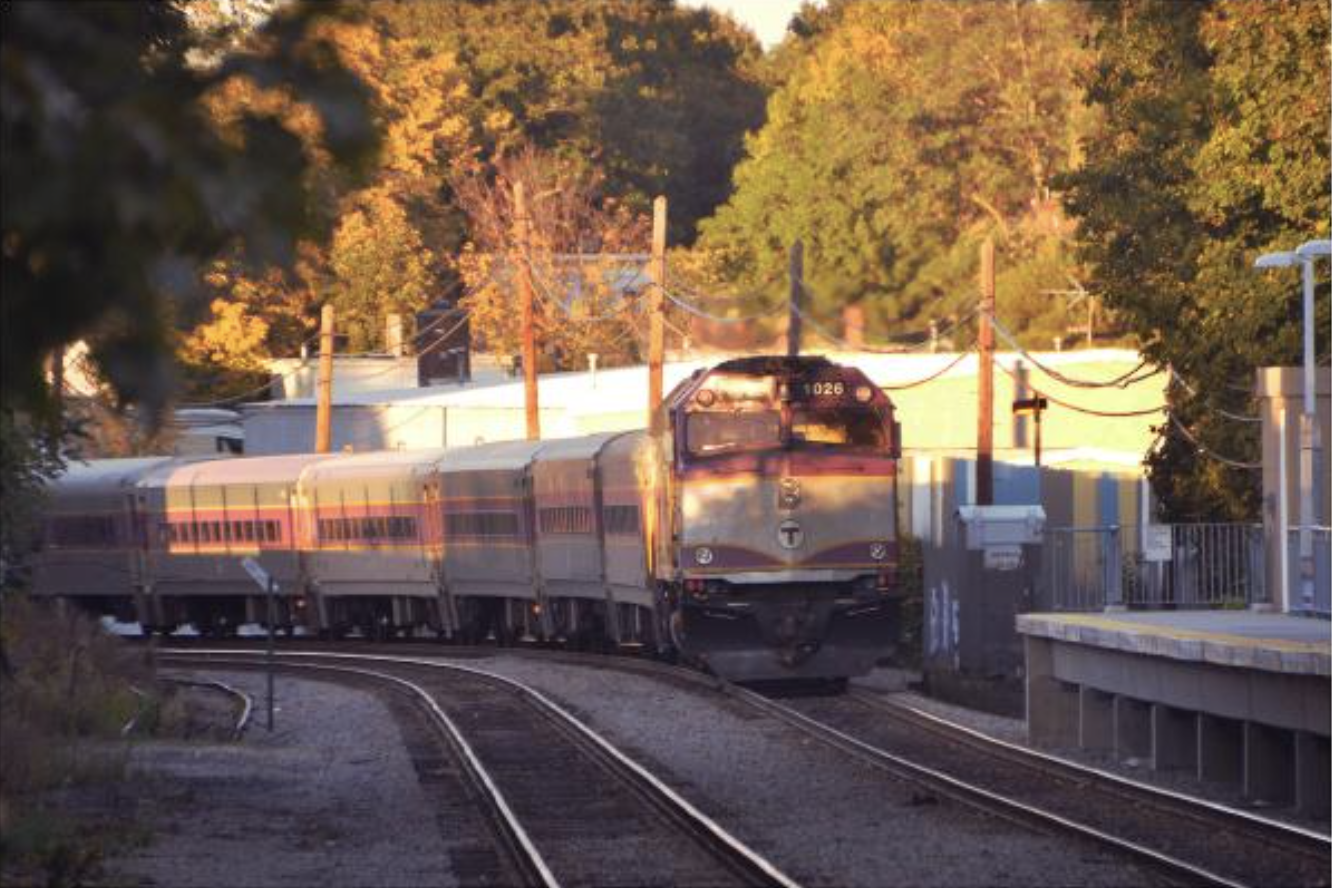
On April 7, the Massachusetts Bay Transit Authority (MBTA) announced it will suspend service on parts of the Green Line for infrastructure upgrades from April 22 to April 30.
The B branch will be closed between Kenmore and Boston College stops. The MBTA will offer free service on the 57 bus between Kenmore and Packard’s Corner between April 22 to April 24, and April 27 to April 30. Due to accessibility issues, shuttle buses on the B branch will not stop at Packard’s Corner, Griggs Street, or Allston Street, according to the MBTA website. During the weekend of April 25, Green Line shuttles will also replace service between Copley, Boston College, Brookline Hills, and St. Mary’s Street for more infrastructure upgrades.
According to a statement from MBTA’s Deputy Press Secretary Lisa Battison, the MBTA is planning to update train infrastructure, continue installing the Green Line Train Protection System (GLTPS). The MBTA official website says that the GLTPS “combines vehicle and wayside equipment to avoid train-on-train collisions, provide stop signal overrun protection, and incorporate speed enforcement for the Green Line.”
In a statement written to Allstonia, Battison wrote that the MBTA’s upgrades during the closure will “build on the success” of the Track Improvement Program.
“This regular, planned renewal and revitalization work is ongoing and continuous, ensuring the long-term stability of our infrastructure and preserving the system for future generations of riders.”
According to Battison, the infrastructure upgrades will also include the replacement of 130-year-old troughs near Kenmore station. Previously, the MBTA had closed train service for two weeks along a larger portion of the Green Line for similar trough replacement.
These upgrades to the Green Line come in the wake of a newly proposed capital budget plan that will span 2027 to 2031, and aims to increase efforts to modernize the public transit system in Boston to build for the future, according to the MBTA’s Capital Investment Plan (CIP).
The CIP aims to upgrade “inaccessible above-ground Green Line stations” on the line, while also being able to increase service capacity. The CIP’s goal is to make sure that all stations on the Green Line’s B and C branches are fully accessible.
While the closure of the stops along the B line will be supplemented with free shuttle service and additional free service on the 57 bus, it will affect thousands of people who rely on the Green Line.
Liam Tuohey-Kay, a Boston University student, lives off campus and relies on the Green Line to commute to school and work.
“It adds at least another forty five to an hour of travel time per day,” he said. “We have six stops here on campus, and at least twice a year, all of those stops are unusable because of maintenance.”
Aidan O’Kane, another BU student living off campus, found the closure inconvenient due to the fact that it is planned right before finals week at Boston University starts. While he has stopped using the Green Line to commute, he said that it is generally not helpful.
“I kind of stopped taking the T earlier in the semester because it was just so inconsistent, so overcrowded, it was just making me late to class every day. It was too stressful,” he said.
O’Kane also feels that shutdowns occur on the Green Line too frequently. He says that he thinks the shutdowns don’t help much with improving the Green Line as a whole.
“I don’t understand what kind of public transport needs to be shut down four times a year,” he said. “Since I’ve been here, there’s been a lot of infrastructure things. They’ve shut it down a bunch of times, and I don’t think it’s got any better in any way.”
Both O’Kane and Tuohey-Kay say that they were not aware of the closure until recently. While the MBTA announced the closure on their website, they did not make any other posts on their social media accounts like X or Instagram.
“I think they should do a way better job at communicating when things are going to be down, because it does affect a lot of people’s lives, including my own,” Tuohey-Kay said. “They do, quote, unquote, infrastructure updates every couple months, and the T is still, it’s always late.”
An online movement to rename a T station is gaining traction after a local librarian learned that it memorializes a family that included an enslaver.
The Ruggles station on the orange line gets its name from Ruggles Street, which is just south of the stop. The street was named in 1825 for Roxbury’s Ruggles family, according to a 1910 volume of “A Record of the Streets, Alleys, Places, etc.” published by Boston’s Board of Street Commissioners.
The entrance to Ruggles MBTA station. Kelly Broder photo
Matthew Weidemann, a librarian at Needham Free Public Library, runs an Instagram account – @rename_ruggles – on which he posts videos nearly every day about why he wants the T station renamed. The account has accumulated over 1,700 followers.
Weidemann created the account after sitting on the T wondering where station names came from. He learned that Timothy Ruggles, a member of the Roxbury family for which the street and station were named, was a Loyalist military officer and enslaver in the 1700s.
“People just assume that names are just kind of neutral, or they just exist like the weather, but they aren’t,” Weidemann said. “They’re all a choice, and we can make better choices.”
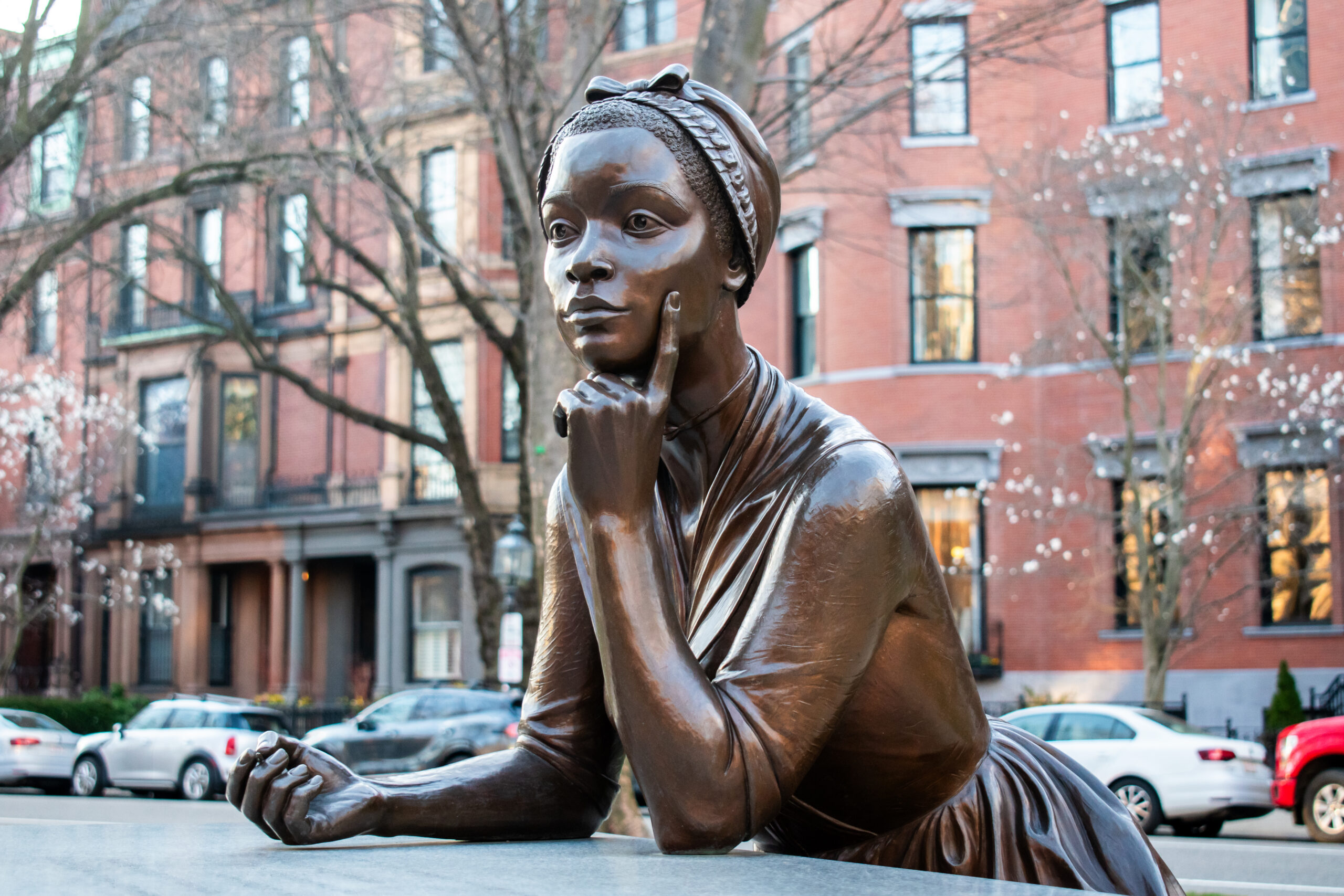
Weidemann’s posts argue that Ruggles should be renamed Wheatley Station. Phillis Wheatley, born in West Africa, was enslaved and brought to Boston in 1761. John and Susanna Wheatley bought her around age 7 and taught her to read and write in English. She became a prominent poet and author, and is regarded as a trailblazing pioneer of black authorship.
“To me she represents both the promise and the failures of America,” Weidemann said.
A statue of Phillis Wheatley resides in the Boston Women’s Memorial. Her 1773 volume “Poems on Various Subjects, Religious and Moral” was the first book published by an African writer in America. Kelly Broder photo
But Weidemann is open to another option. David Ruggles, an abolitionist born in Connecticut who is not known to be directly related to Timothy, helped to free enslaved people through the Underground Railroad, including Frederick Douglass.
“That kind of interesting juxtaposition is almost reason enough to just consider intentionally naming it after him,” Weidemann said.
Many of New England’s Ruggleses come from one prominent Roxbury family who emigrated from England in the 1600s and spread across New England over generations, leaving their mark wherever they went. Some were politicians, military figures, and local elites.
Almost 400 years after the family first landed in Boston from England, the Ruggles name has stretched across all six New England states.
Maine has the Ruggles House Society, a museum in Columbia Falls sharing the architecture and culture of the Federalist era. Ruggles Mine in New Hampshire invites campers to stay atop Isinglass Mountain in Grafton. Vermont is home to an engineering company with the name and a shared housing community for older adults.
In Rhode Island, a beloved college resource dog shares the name. Salve Regina University’s labrador retriever was named by students and inspired by Ruggles Avenue, a street on the Newport campus. The pup’s handler and resource officer, Michelle Caron, said she did not know of the name’s complex history, and that she is concerned about the connection. That street was named after Nathaniel Sprague Ruggles, a likely relative of Roxbury’s Ruggles family.
“Over the years those names stay the same,” Roxbury historian Leland Clarke said. “But history sometimes can get clouded.”
Clarke, a Boston University professor of fine arts and music, has a special interest in Roxbury history. He grew up in the neighborhood and authored a book, “Something Worth Saving: Forgotten People, Places, and Events That Helped Shape America,” about Roxbury’s history.
He said there are several examples of street names in the Boston area that were named after once-prominent families but have become more of a reminder of the region’s history and less about honoring those it was named for. Examples in Roxbury include the Warren and Dudley names.
A March 2023 blog post, written under the pen name Riverside Lechmere, proposed renaming stations with “names that are now long divorced from our memory.”
The author declined to speak with the Dorchester Reporter and share their real name but wrote in an email that they “only wished to start a conversation, not endorse a conclusion.”
Betty Ruggles Tolias, from Middleboro, is a descendant of the Roxbury Ruggles family. Betty said she is descended from John Ruggles, whose brother, Thomas, was Timothy’s great-great-grandfather.
She was shocked to hear that Timothy was an enslaver.
“I think the people of Roxbury should do what they think is right,” Tolias wrote in a message to this reporter. “I pray they remember there are Ruggles who care about minorities of all types. We care a great deal.”
Byron Rushing, president of the Roxbury Historical Society, said he would support renaming the station after the abolitionist Ruggles. But he was hesitant to throw out the original Ruggles name because it was named for the family, not one particular enslaver.
“If you’re in a [slave-owning] family and you did not own slaves, the whole family doesn’t lose its right to be honored,” Rushing said.
Boston has a recent history of renaming landmarks due to the city’s racist past.
In 2018, the city changed Fenway Park’s nearby Yawkey Way to Jersey Street after the Red Sox petitioned to remove the former club owner’s name over acts of racism under his leadership.
Dudley Square was renamed Nubian Square in 2020 to embrace the neighborhood’s African roots. The Dudley name came from a 1600s colonial governor, Thomas Dudley, who served in office when slavery was legal.
Many T riders have no clue where the “Ruggles” came from.
Cole Eidson, a psychology professor at Northeastern University who uses Ruggles Station frequently, said he would support renaming efforts. Dorchester resident and orange line rider Leny Marrero said it “felt like it was a no brainer” when Dudley Square was renamed to Nubian Square and would like to see the same for Ruggles.
Weidemann’s Instagram account shared a petition that calls on Mayor Michelle Wu to rename the station. But the renaming process actually starts with the T.
The process to rename a station happens under the MBTA’s Station Naming Committee, a five-member group that discusses proposed names before giving a recommendation to the T’s general manager.
“It’s a very difficult and challenging conversation. It doesn’t divide us,” Clarke said. “It brings us together, and it sparks the conversation. What else is out there that we need to look into, to explore and to celebrate?”
Changes are coming to two Arlington bus routes on April 5, when the 87 and 350 routes will be streamlined. The changes come from MBTA’s multi-year Better Bus Project, and will bring more service to the town.
The project, announced in 2018 and expected to be completed in 2029, aims to improve the MBTA’s service, matching demand levels and improving facilities. While MBTA ridership averages are still short of pre-pandemic levels, recent jumps in ridership are making the need for updates crucial to manage rising demand.
“Improving bus service and connectivity continues to be a major priority for the MBTA. Keeping the entire system in mind, we aim to create an even more robust network and are consistently looking at ways to enhance service. We are proud of the ongoing work our employees partake in to improve bus service year-round, including accessibility upgrades, route changes, and rider outreach/education,” an MBTA spokesperson said in an emailed statement.
The change is designed to eliminate non-standard patterns, increasing simplicity and connectivity. For example, routes like the 87 run “short-turn” patterns, where the bus will turn at Clarendon Hill instead of traveling the entire route from Lechmere to Arlington Center.
This means that riders between Clarendon Hill and Arlington Center are not served by the 87’s non-standard route. In eliminating the “short-turn,” the 87 will run its current full-length route only, which will increase service to Arlington.
Non-standard patterns will also be eliminated on Route 350. Currently, some runs skip the North Burlington Road and spend the entire route on Cambridge Street. This change will provide more service and connection to the retail area and Lahey Hospital.
Arlington Town Manager Jim Feeney said his office hasn’t received any concerns regarding the change, adding that based on information from the MBTA, it appears Arlington may get more service, especially on weekends.
The town can expect to see a 23 percent increase in service of the 87 on weekdays, a 30 percent increase on Saturdays, and an 8 percent increase on Sundays, according to MBTA data.
Eliminating non-standard patterns will cause timetables to shift. However, the change should have no significant downside, according to the MBTA.
Riders of the short-turn pattern of the 87 should see no changes, except that outbound riders to Clarendon Hill will now need to cross Broadway. As the bus will now continue to Arlington, it will not pull directly into the busway.
Non-standard route riders of the 350 will no longer be able to use the stop at Cambridge Street and Burlington Mall Road, as the full route does not service that stop. Users of that stop can use the 76 Cambridge Street stop instead, which is less than a quarter of a mile up the road.
This story, published Feb. 27, 2026, is part of the Boston University Statehouse Program.
Town Meeting members will vote on an amendment to the town’s MBTA Overlay District that would bring affordable housing standards in line with the rest of Winchester while maintaining state compliance.
Article 4, proposed by the Planning Board, would update the MBTA Overlay District — a zoning area that allows multifamily housing near public transit. The change would align the overlay’s affordable housing rules with those already in place with the two underlying zoning districts, the Center Business District and the Main Street Mixed-Use District.
Under the current MBTA overlay rules, projects of 10 units or more must designate 10% of their homes as affordable. When that 10% results in a decimal, the number is rounded down.
“So by example, if you have 19 units, you’re developing 10% of 19, [affordable housing would] be 1.9 units, and that would round down to one unit,” said Planning Board Chair Brian Vernaglia.
Article 4 would change the rounding method so that any fractional unit rounds up instead. So 1.9 units would round up to 2 affordable units. The proposal also lowers the threshold for when affordable housing requirements apply, from 10 units to six, again aligning it with neighboring districts.
The MBTA Communities Act, a state law passed in 2021, requires towns with access to MBTA service to create zones that allow multifamily housing near public transit. Winchester approved its overlay district in spring 2024, covering about 48 acres within a half-mile of the town’s MBTA station.
The town in August 2024 received a letter from the Attorney General’s Office confirming Winchester’s overlay district as being in compliance.
“A fairly simple amendment to our compliance,” said Town Planner Taylor Herman.
Herman said one of the original requirements for the compliance was to submit an economic feasibility analysis, completed in June 2025. The study cost $7,500, out of the $15,000 allocated at a prior Town Meeting. The town had to work with an outside consultant to prove to the state what the inclusionary housing number could be.
I-ching Scott, a Winchester resident and member of the Housing Partnership Board, said Article 4 balances adding affordable units to meet SHI goals with requirements that are reasonable for developers.
“My concern as a resident of Winchester is that long-term folks cannot afford to move into something within town,” Scott said. “So encouraging development near town would be great for those right-sizing.”
The change could help Winchester move closer to its state-mandated goal of having 10% of its housing stock qualify as affordable, Scott said.
“We’re just a little bit shy of 5% right now, and we just really backlogged getting that going,” she said
Vernaglia said the zoning will not change that number substantially and that the proposal has faced little pushback.
“This is a very small change,” he said. “We’ve received unanimous favorable action from the Select Board, the Housing Partnership Board, and the Affordable Housing Trust in favor of this article.”
While the original MBTA zoning law was “challenging and controversial” statewide, Herman said, this amendment simply fine-tunes what Winchester already passed.
“The biggest thing is that it doesn’t disrupt our compliance,” he said. “It just makes our rules consistent.”
If approved, the amendment will go to the Attorney General’s Office for review before being added to the town’s bylaws.
For residents like Scott, that would mark progress — not a dramatic shift, but a meaningful one.
“It’s a really positive step for our town,” she said. “I hope Town Meeting members will vote yes.”
This article was originally published on November 2, 2025.
Construction workers worked on accessibility upgrades at Natick Center Station (Photo by Jennifer Lambert)
It’s been five years since construction began on major accessibility updates at Natick Center Station, and commuters are still waiting for it to be done.
The MBTA is spending $40 million rebuilding the station with two new elevators, two accessible ramps and six stairways. The project was supposed to be completed in three years, but it has dragged on for five. The MBTA now says it should be done this year.
Riders, such as Jeff Richards, say they’ve been left in the dark.
“It’s just been painfully slow, and then when you ask, you get nothing,” said Richards, a longtime resident of Natick who has commuted daily on the train to Kendall Square for almost a decade.
Richards said he noticed during his daily commute that South Station’s renovations, which are nearing completion, have made significant progress.
“In that time, they built a skyscraper above South Station,” Richards said.
Once a loyal rider of the Natick Center stop, Richards now drives to West Natick because of the ongoing construction and limited train schedules.
“It was a 12-minute walk [to Natick Center], and I loved it,” Richards said.
A “Building a Better T” sign was displayed outside of Natick Center Station (Photo by Jennifer Lambert)
Jory Lucas, a Natick resident who takes the train into Boston about five nights a week, said that during construction it’s sometimes difficult to find what platform the train is coming in on.
“I’ve actually missed the train because of the wrong tracks,” he said. “You just constantly have to look at the MBTA app. You have to constantly keep an eye on it because it’s changing just nonstop. Now everybody stands on the bridge in Natick because they don’t know what side it’s coming on. Then when they see it, they all run to one side.”
Until this week, the MBTA had shared few public updates. After the Natick Report inquired about the lack of updates, the project’s webpage was updated Wednesday with a clearer timeline and more detailed information.
Here’s what you need to know about the delays in construction at Natick Center Station and what’s coming next:
The MBTA says the station will be completed this year.
Construction began in February 2020 and was estimated to conclude in 2023. More than five years later, the MBTA has updated its timeline to indicate that the train tracks will be shifted to their final location in early summer 2025, the new accessible platforms will come into service in late summer, and the project will be completed in early fall.
A commuter rail train, inbound to South Station, arrived at Natick Center station. (Photo by Jennifer Lambert)
“The MBTA is proud to be upgrading stations across the system, including Natick Center Station, especially in an effort to improve accessibility. We are anticipating Natick Center Station to be open by the end of the year and we appreciate the community’s patience as we work to get to that point,” the agency wrote in a statement via email.
Lucas, who works as a builder at JMAC Development Corp., said he believes the project could be done by the end of 2025.
“I don’t just have the commuter perspective,” he said. “I also watch these guys work. These guys have stepped it up in the last three months, they’ve been non-stop … The way they’re going now, I could see it being done [by the end of the year].”
Delays were caused by the COVID-19 pandemic and construction restrictions, according to the MBTA.
Within weeks of the project’s start date, the COVID-19 pandemic disrupted labor availability and supply chains, resulting in setbacks that persisted long after the initial shutdown. The MBTA also designed the work to minimize interruptions to service on the Worcester Line, requiring crews to work around active train operations.
Instead of using weekend shutdowns, tasks were done overnight, which helped cut busing costs but extended the construction schedule. Keeping the station open to riders throughout the project also limited productivity.
Progress was also slowed by more specific issues, including a 2021 storm in Texas that knocked out the factory producing fiber-reinforced polymer–a modern material replacing concrete and rebar–for the station’s platforms.
Riders say the delays have upended their commutes, and they feel left out of the loop.
For Jeff Richards and others who have expressed frustration on social media, the biggest frustration is a lack of communication from the MBTA. He said the “bare minimum” would be transparency.
The Natick Center Station sign was displayed at the station, with a map. (Photo by Jennifer Lambert)
“It’s keeping their page up to date and being transparent about why they can’t maintain the schedule,” Richards said. “And I think with any references to COVID and supply chains, there has to be something that’s concrete. Who’s overseeing this? Why isn’t the T there every day? How many people are on the project? How much money has been spent on this? Those are the questions.”
The lack of communication, he said, weakens trust in a system he wants to believe in.
“I want the system to be awesome because I would rather be dragged by someone’s car on a hot day on the [Mass.] Pike than drive,” Richards said.
The project has been years in the making, long before construction began.
In a Facebook comment, Josh Ostroff, director of capital strategy for the MBTA, noted that accessibility planning for Natick Center Station began more than a decade ago. In 2012, the Natick Select Board approved $80,000 for a feasibility study and conceptual design at the station. That led to approval in 2016 and eventual construction approval. At the time, Natick Center was the busiest commuter rail station in the system that was still fully inaccessible.
The project will include major accessibility upgrades.
When completed, the station will include high-level platforms, elevators, ramps, canopies, bicycle parking, new signage and emergency lighting. It will also include a rebuilt pedestrian bridge.
Richards says he does not believe the project will be completed when the MBTA says it’s going to be.
“There’s so much that has to be done, and I just don’t see it being done by the end of this year,” he said. “I think it’s going to be more 2026 before that station’s open.”
This story is part of a partnership between the Natick Report and the Boston University Department of Journalism.
The trolley rumbles up to the Ashmont/Peabody Square platform on a shallow incline before it creaks and rattles to a stop at the eastern terminal of the Mattapan Line. The doors open squeakily to let out a stream of passengers.
New riders heading toward Mattapan take their place. The car shudders into movement and screeches slowly around the looped track, descending swiftly onto its route again.
State Rep. Brandy Fluker-Reid, who represents parts of Dorchester, Mattapan, and the town of Milton, said the Mattapan Hi-Speed Line, which runs on a 2.6-mile loop through those neighborhoods, is like a “roller coaster.” She wasn’t the only one with that thought in mind.
“I’ve never been a fan of it. It just looks outdated,” said Chichi Hernandez, an employee at Sweet Life Bakery and Cafe in Lower Mills. She used to commute on the trolley 10 years ago from Ashmont to the Milton Station stop. Today, she drives. “It makes me a little nervous.”
The Mattapan Line is the last MBTA rapid transit line still using Presidents’ Conference Committee streetcars, which were introduced in the city in 1937. The last of these vehicles on the Green Line were retired in 1985, but the Mattapan trolleys have been running continuously for more than 80 years and are the oldest PCC cars still in service in the country.
The MBTA laid out significant changes planned for the Mattapan Line in March 2018, starting with a refurbishment of the remaining serviceable PCC cars. Alongside these developments, the T introduced proposals in 2019 to bring the line’s eight stations up to ADA standards and revamp infrastructure while laying the groundwork to bring Type 9 light rail cars currently used on the Green Line to the Mattapan Line within the next 8 to 10 years.
Most recently, in March 2024, engineers were seeking permits to drill “exploratory borings” along the tracks to prepare the transition to Type 9 cars, which require less maintenance and can transport 212 passengers per car (PCCs can carry up to 130 riders). A year later, those Type 9s are nowhere in sight.
The project is in its eighth year this month. Only two of the nine PCC cars have been redone, far behind schedule.
Legislators, including Fluker-Reid and state Sen. Bill Driscoll, and some of their constituents are frustrated with how long plans are taking, coupled with a seeming lack of explanation from the T.
“It’s clearly not a priority for the MBTA. That is evident in the fact that […] we don’t know what’s going on,” Driscoll said. “If workers were actually being posted and tasked with doing the work, I have a hard time believing that it would take this long.”
The MBTA invested $127 million into refurbishments and the transformation combined, a total that has not changed since 2018. With potential changes in funding availability and the consistent project delays, Driscoll wondered whether the ongoing projects will cost hundreds of millions of dollars or if the money still exists.
“It’s a real concern because of how long these delays are continuing. That money could go elsewhere or evaporate.” Driscoll said. “I think the T really needs to be the one to answer that question.”
When plans were first announced, the MBTA aimed to complete refurbishments on its current trolley cars by 2020. Driscoll, whose constituency resides in Milton, said the MBTA “reset” its timeline on the project in 2022 following delays caused by the pandemic, unforeseen lead paint removal, and the complexity of the refurbishment. The first revamped trolley went into service in spring 2022, followed by a second in the summer. The T promised a new trolley every five to six months, but the remaining seven have not been updated.
“[In 2022], there were MBTA officials saying, ‘We know we need to repair the relationship here with the ridership and constituency and elected officials and that we haven’t lived up to commitments. Going forward, this is the reset,’” Driscoll said. “It has not happened.”
When Driscoll requested an update on the refurbishments after the Neponset River flooded Milton Station in February and disabled two trolleys, he did not receive an immediate response.
Within the reset, the MBTA promised quarterly updates for legislators whose constituencies live along the line and biannual public community meetings. The MBTA hosted its last public meeting on the transformation project in June 2023 and does not have another scheduled in 2025. Both Driscoll and Fluker-Reid confirmed they last met with the organization in June 2024 and have not confirmed a new meeting.
Fluker-Reid recalled that the MBTA took legislators on-site to see trolley refurbishments in action at the start of the reset, compared to the current lack of updates.
“In that meeting and that site visit, we received quality information in terms of what was happening,” she said. “It seems as though our information became less clear as the project became further behind in timeline.”
Before her time in office, Fluker-Reid said there was talk in community meetings as early as 2012 about the possibility of Type 9 light rail cars replacing the PCCs. The timeline then was also 8 to 10 years for the project. With continual delays, Fluker-Reid said, she and some of her constituents now wonder whether refurbishing the trolleys is still worth the time or money. New parts for the trolleys are difficult to obtain because of the age of the vehicles.
“The community has been of the impression that these [Type 9] lines would be here […] And even when having done the reset, they still have not met the deadlines that they articulated,” she said. “It’s really hard to build community trust and establish credibility when they say that this is the new timeline, and then they fail to meet the benchmarks of said timeline.”
Former Lower Mills resident Linda Lewi, once a regular commuter on the Mattapan trolley from the Milton Station stop, said she felt that upgrading the line was a “second thought” to the MBTA. When the T demolished the decrepit Adams Street stairwell at Milton Station in 2023 to begin making the station ADA compliant, Milton community leaders expressed long-held frustration on how little the MBTA had committed to improving the stop; they claimed the stairwell had been in disrepair for a decade and the demolition plan would only make poor conditions worse. The town had sued the MBTA the year prior on the issue.
“The MBTA clearly had absolutely no intention to do anything,” Lewi said, calling conversations at community meetings “circular.” “And nobody can ever give a good reason why it’s so slow.”
In its last community meeting – in June 2023 – on the Mattapan transformation project, the MBTA said that an accessible sloped walkway was in “early planning and design.” The old entrance to the stairwell on Adams Street remains unchanged today, with access blocked off. Passengers have to walk across the neighboring Extra Space Storage parking lot to reach the platforms from Adams Street.
Regardless of setbacks with the transformation, some riders have fond memories of the 1940s PCCs. Dorchester resident Kathy Glynn remembered hopping on the trolleys for fun or to get around the city while growing up in Jamaica Plain. She was also open to a newer system for the Mattapan Line.
“The important thing is that there’s a connectivity and that the schedule is such that it runs frequently enough,” she said, adding that there needed to be enough infrastructure at stops for passengers. “Other than that, I don’t have a problem if they change the style.”
Robert Cromwell, who is 78, has been riding the Mattapan trolley for as long as he can remember. As for getting him to his destination, he says the current cars work well enough.
“I look at the things that I can change, the things I can’t change,” he said. “If I didn’t like it, then what would be one of the reasons? Is it not going to my stop? Yeah, it goes to Mattapan Station. Is it frequent? Pretty much.”
As project delays have piled up, Fluker-Reid and Driscoll have continually questioned the T on what will happen to the Mattapan Line. Before his more recent update request, Driscoll wrote to MBTA General Manager Phillip Eng and MassDOT Secretary Monica Tibbits-Nut in February 2024, asking whether the T was committed to completing Mattapan Line-related projects, because communication had returned to “relative silence.” He said he did not get a clarifying response.
In response to the Dorchester Reporter’s request for an update, the MBTA wrote that it was “committed to delivering safe, reliable, and improved service for the public across all our modes.”
The statement continued, “We fully and deeply understand how important the Mattapan Line is to the community and have been assessing the Mattapan Transformation effort to date to determine how best to move this project forward. We thank the community for their patience in allowing us the necessary time to ensure the next public meeting will provide sufficient information that demonstrates our commitment.”
During her first term, Fluker-Reid sat on the Legislature’s Joint Transportation Committee. During an oversight hearing in 2023, she invited Eng to ride and experience the trolley to highlight the importance of the ongoing projects. Though an MBTA liaison said that Eng would be open to taking the trolley, he has not yet accepted the offer.
Fluker-Reid noted that Mattapan and Dorchester residents often feel “forgotten” by large organizations like the MBTA because of the slow, uncertain progress on projects meant to benefit predominantly Black and Brown neighborhoods.
“We all want what’s best for our community,” she said. “It’s an outdated system that is somewhat dilapidated; it does not meet the needs of modern day travel and transit; and this community deserves and needs something better.”
This story derives from a partnership between the Dorchester Reporter and the Boston University Department of Journalism.