Tag: medford

  • Medford mini-forest aims to reduce heat, increase biodiversity

    A volunteer-run nonprofit is planting a mini-forest at Tufts Park to increase Medford’s tree canopy and biodiversity.

    The mini-forest will cover about 1,100 square feet at Tufts Park, a popular off-leash dog park site. Work is under way, and planting will begin in September.

    By increasing canopy coverage, TreesMedford aims to reduce heat, strengthen air quality, manage storm water and make the area healthier and more livable, according to the advocacy group’s website.

    The nonprofit is focused specifically on heat island neighborhoods, said Jared Ingersoll, chair of the TreesMedford mini-forest subcommittee.

    Heat islands are urban areas with lots of structures and little greenery. They often have higher temperatures than surrounding areas with more natural landscapes and tend to be in environmental justice areas, which are places disproportionately affected by environmental hazards, often in marginalized communities. Glenwood, South Medford and Wellington are focus areas with heat islands listed on the organization’s website.

    TreesMedford sought public input to determine where to plant the forest, Ingersoll said. The group selected Tufts Park because of its “large, open, unutilized space,” he said.

    When vetting sites, TreesMedford considered whether they had invasive species nearby, proximity to water, exposure to sunlight, and trees already there, Ingersoll said.

    Map showing location of Tufts Park in Medford, where TreesMedford will install a mini-forest. COURTESY/Google Maps

    Dan Bender, a volunteer with TreesMedford and owner of Wilderscaping, a landscape designer, said one of the goals is to bring in a diverse group of trees, so the entire forest is not vulnerable to diseases that might sweep through the area.

    The budget for the project is $11,000 to $12,000, Ingersoll said. TreesMedford received a $10,000 grant from the Medford Community Fund Committee to cover some of the costs.

    The mini-forest follows the Miyawaki method, a dense-planting style developed with native trees and plants. This differs from typical street-tree planting because plants and trees are placed close together so they compete for light and close canopy faster, which helps limit weeds, create habitat faster, and reduce maintenance over time, according to the TreesMedford website.

    “The idea is you can sort of supercharge tree growth by simulating the conditions of a really healthy forest environment,” Bender said.

    In the mini-forest’s first few years, there is significant growth, Ingersoll said. By reintroducing these natural communities, certain wildlife in the city can be restored.

    “The mission is to find as close to what we find in the woods down the street,” Bender said.

    TreesMedford hopes to bring in about 50 volunteers to help plant the mini-forest, Ingersoll said. The organization has begun working with Curtis-Tufts High School and hopes to involve other nearby schools. He said he wants the community to think about tree coverage, but he also wants to provide a community event.

    Soil prep is set to begin at the end of May. There will be two opportunities for community involvement: Site Preparation Day May 23 and Community Planting Day Sept. 19.

    The forest will take around 10 years to grow, Ingersoll said, and for the first three years it will need to be regularly maintained before nature can take over.

    Mayor Breanna Lungo-Koehn said if this mini-forest works, she could see the city potentially planting another one and would love to see more ways to increase tree coverage across different avenues, including mini-forests and tree plantings.

    Once the canopy is established, the next step is introducing forest-floor species and flowers, Ingersoll said, and to add flower beds on the perimeter of the forest. Ingersoll said one of the project’s goals is to educate people on different ways to use their own space.

    Once the forest is finished, Bender said, the park will be a space he looks forward to using and enjoying.

    “We need healthy, intact forests,” Bender said “We need biodiversity. We need genetic diversity in those forests so that, as we sort of progress as a species and a society, we can preserve a little bit of what matters out there.”

    This story is part of a partnership between Gotta Know Medford and the Boston University Department of Journalism.

  • Medford’s urban forest needs some TLC and some funding, according to a new report

    Medford’s urban forest needs some TLC and some funding, according to a new report

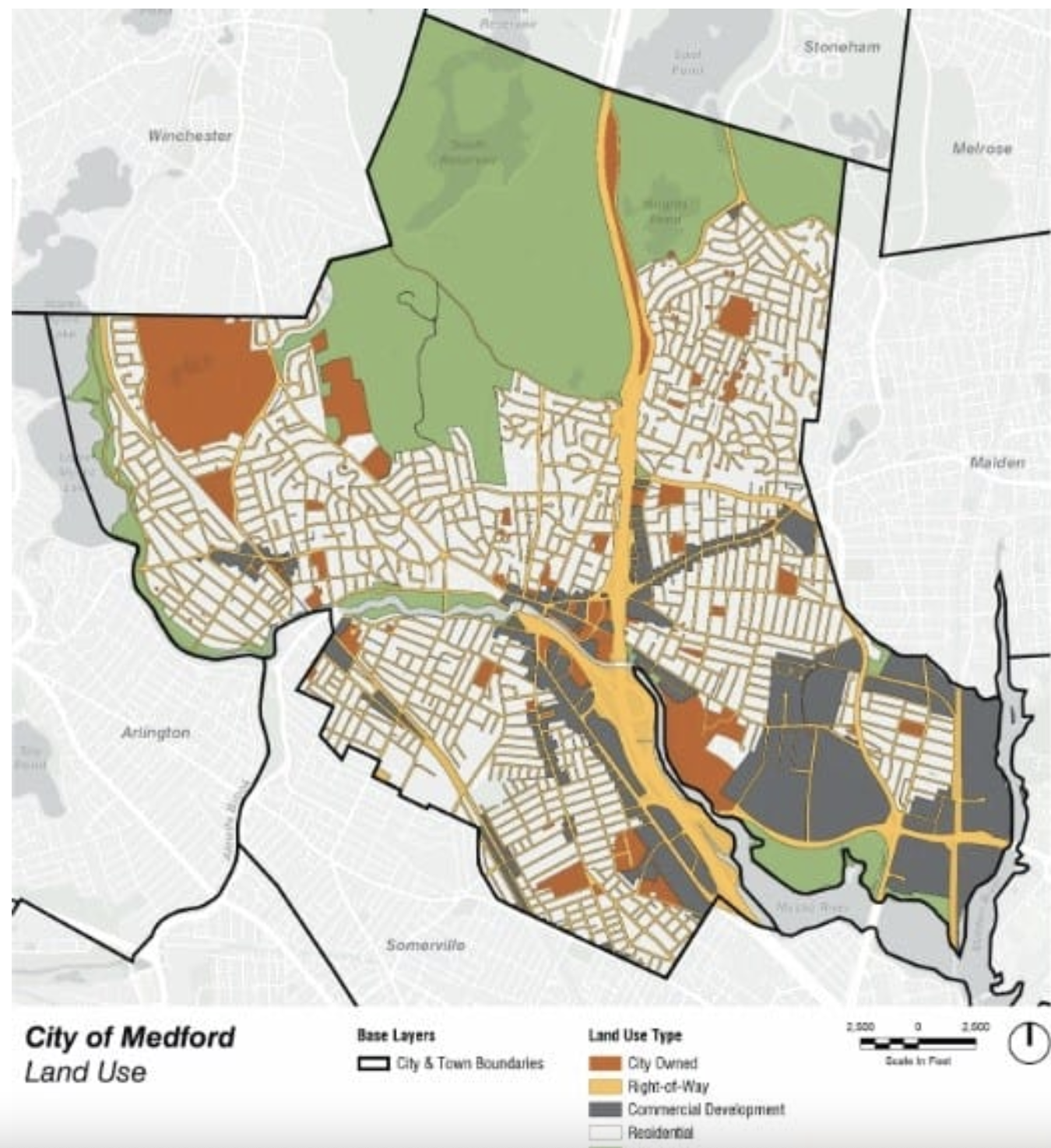
    Graphic created by Weston & Sampson for Medford’s Urban Forest Management Plan shows current land use in the city. COURTESY/City of Medford and Weston & Sampson

    Medford should focus on growing, protecting and maintaining trees as key strategies for creating a “healthy, resilient and equitable urban forest,” according to a new report.

    The Urban Forest Management Plan recommends strengthening tree ordinances and standards, maximizing tree canopy in limited spaces, and increasing staffing, tree diversity, and annual tree plantings. Doing so would help the city address issues of canopy loss and a lack of canopy coverage.

    The City Council unanimously passed a motion on March 10 urging the city to implement the plan and set a goal of having canopy coverage of 35% in residential areas within the next 10 years. It requests that the city allocate resources in upcoming budgets to carry out these goals.

    Medford’s tree canopy — the layer of leaves and branches visible from above — declined citywide by about 1.2% from 2015 to 2021, according to the report. While any loss is unwanted, 1.2% is “actually not bad” when compared to other communities that have lost canopy faster, said Matthew Soule, a team leader at Weston & Sampson, the engineering and environmental consulting firm hired to do the report.

    The plan, which was funded by the state, recommends that efforts to create this urban forest should be prioritized in environmental justice areas, which are places disproportionately affected by environmental hazards, often in marginalized communities. Vacant sites and sites with dead trees should be inspected for planting, and the city should look into replacing species in poor condition.

    The report recommends that by 2030, the city double the number of trees planted every year. Soule, who explained the report’s findings during a March 30 presentation at the Medford Public Library, said doubling the current number of trees planted annually from 200 to 400 would reverse projected tree losses over time.

    “If we stuck with 200 trees a year, it becomes much harder to get that to make up those losses,” Soule said.

    The presentation also called for the city to increase its forestry budget by $400,000 a year in order to reach these 2030 goals and to add three positions–an additional forester and two laborers. These increases would allow the forestry department to plant and manage more trees, Soule said.

    Amanda Bowen, who is co-chair of TreesMedford, a volunteer nonprofit that supports tree planting and stewardship, said the goals to increase the budget and staff are realistic but might require grant funding. Some cities charge developers for removing trees and pointed towards that as another way to build funding, she said.

    Residents at the March 30 presentation expressed concerns and excitement at the report’s findings. Concerns included the survival likeliness of trees, why more money is not spent on watering, pruning and maintaining the trees once they are planted, and the city’s role in trees on private land. Medford Public Works Commissioner Tim McGivern said the city has no obligation to spend public money on private resources but tries to help out where it can.

    McGivern said the inventory of public trees is the most powerful finding from the report. Medford’s private roads are absent from the inventory, he said, but the city can still plant on private property if it has the permission to do so.

    Residents can request that the city plant trees in their neighborhood, said Medford Tree Warden Aggie Tuden. If multiple residents on a street request trees, they’re more likely to get them, Tuden said.

    There are about 10,000 public trees in Medford. About 10% of them are in poor condition, and 1% are dead.

    There are challenges to planting trees in Medford, Soule said. Some sidewalks are too small, and there is limited space in some areas. To address this, he said trees can be planted more densely and between trees that are expected to die soon.

    City Councilor Justin Tseng said there are ways to find funding to plant more trees, such as grants. Plans often die in filing cabinets, he said, and he wants to make sure that that doesn’t happen here. 

    “You need a spark like this meeting to galvanize people together,” Tseng said. 

    This story is part of a partnership between Gotta Know Medford and the Boston University Department of Journalism.

  • Medford High School Best Buddies Program fosters inclusivity, leadership

    The school’s Best Buddies club, which is celebrating its first anniversary, is dedicated to bridging social, physical and economic gaps for people with intellectual and developmental disabilities.

    Medford High School’s Best Buddies club celebrates its first anniversary this month. Pictured, from left, are Co-Advisor Kasey Goldberg, Student Leadership Team members Savannah Brazell and Kelly Dao, Communication Coordinator Katherine Beagan, Vice President Norah Berson, and President Violet Freimark. GOTTA KNOW MEDFORD PHOTO/Crystal Yormick

    The school’s Best Buddies club, which is celebrating its first anniversary, is dedicated to bridging social, physical and economic gaps for people with intellectual and developmental disabilities.

    In the halls of Medford High School, about 30 students who might otherwise not have met have found a place to connect. Twice a month, they spend time with one another through activities like baking, crafting and celebrating holidays.

    This club is the school’s chapter of Best Buddies, an international organization dedicated to bridging social, physical and economic gaps for people with intellectual and developmental disabilities. The program, implemented here in March 2025, hosts group events and provides one-to-one matches between students with and without disabilities. It will celebrate its first anniversary this month. 

    “There’s just never been an entry point for some of these kids to meet, and that’s where [the] Best Buddies program comes into,” said John Skerry, a co-adviser of the program and a teacher at Medford High. 

    Student leaders in the club said they’ve gone outside their comfort zones, met people they wouldn’t have met otherwise, and presented in front of the Medford School Committee and at the club fair. They’ve raised money, taken on leadership responsibilities, and made new friends since joining Best Buddies. 

    “I get shy a little bit because I don’t socialize. I have social anxiety,” said sophomore Savannah Brazell. “Now that I’m a Best Buddies director, I feel like I’m coming out of my shell and talking to people.”

    The club began with group activities last year, said Kasey Goldberg, Medford’s other Best Buddies co-adviser. Goldberg, who is a teacher for Medford High’s Access Program — a life skills, special education program — said this school year the club implemented one-to-one matches between students. Now when the group hosts big activities, students with a match can also hang out with their buddies during that time. There are currently 10 pairs of students with buddies, but a one-to-one match is not a club requirement.

    “So [there are] 20 students total who have a match,” Goldberg said. “Then the other 13 either weren’t interested in having a match or couldn’t make the time commitment, but they still wanted to be in Best Buddies and a part of the group.”

    The students who do have buddies are paired based on interests and personality or through the organic connections they make. Goldberg said having a buddy helps students who are shy to communicate with someone rather than sitting alone. 

    “You’re still friends and connect with everyone in the club, but it’s like that person is kind of your person to sit down next to them first at the club,” said junior Norah Berson, the club’s vice president. 

    President Violet Freimark said the club has helped people connect like she has with her buddy, who she said usually keeps to herself. 

    “I’ve been able to make a good connection with her when she usually wouldn’t reach out to people, which is always very nice,” Freimark said.

    Some of the student leaders said since they’ve been introduced to their buddies through the club, they notice each other much more across campus than before. 

    “Ever since we’ve become buddies, I see them at least three times a day,” Berson said. “We always say hi to each other.” 

    Berson said she’s formed an “out-of-school and in-school connection” through the program. She said she joined because she wanted to be a part of a supportive environment and now sees her buddy three times a day. 

    “This feels great to kind of be a leader and connect with people that I don’t know as well and also just share Best Buddies to other people,” Berson said.

    Because the program is so new, an important aspect is educating people about it and what it means to its members, said sophomore Katherine Beagan, the club’s communication coordinator. Beagan and her buddy Kelly Dao are on the student leadership team together.

    “I wanted to make sure that everybody was in a place where they could feel safe and where they could be themselves because it can sometimes be hard to foster that environment in high schools,” Freimark said. 

    Skerry said he started the program last year because he wanted to foster inclusively at the school. Goldberg said she saw a notice last year about Best Buddies coming to Medford High. It’s the “perfect opportunity” for her students to become involved with an after-school club setting, she said. 

    “It’s been a great time so far, and it’s great to see my students so involved,” Goldberg said. “The inclusion aspect is just amazing to see.” 

    Skerry and Goldberg said the Medford community has been receptive to the program. Local businesses have sponsored some of the club’s events, like pumpkin decorating, and donated snacks for meetings. The school’s culinary program donated a sheet cake for one of its events, Skerry said.

    While the program has stayed within the high school so far, Skerry said he hopes to expand to the middle school and to participate in events with Best Buddies programs at other schools. 

    Organizers said they always welcome more people to join the club, but they have a good group right now, too. 

    “It’s so heartwarming every time that I leave there,” Goldberg said. “It just feels so good to see the inclusion and how happy my students get having a buddy.”

    This story is part of a partnership between Gotta Know Medford and the Boston University Department of Journalism.

  • Medford Polar Plunge benefits Special Olympics

    Medford Polar Plunge benefits Special Olympics

    These brave souls took the Medford Polar Plunge just before the Blizzard of ’26 hit. The event was co-hosted by Medford Police and the Medford Chamber of Commerce.

    About 50 people took turns immersing themselves in a truck-size basin of frigid water outside Hormel Stadium Sunday, Feb. 22, to raise money for Special Olympics Massachusetts.

    The second Medford Mobile Polar Plunge, which was hosted by Medford Police and the Medford Chamber of Commerce, raised about $8,000 of its $15,000 goal. Participants could sign up individually or as teams, and fundraising sources included sponsorships and donations. The event included free food, free car wash vouchers, and an after-party at Ford Tavern.

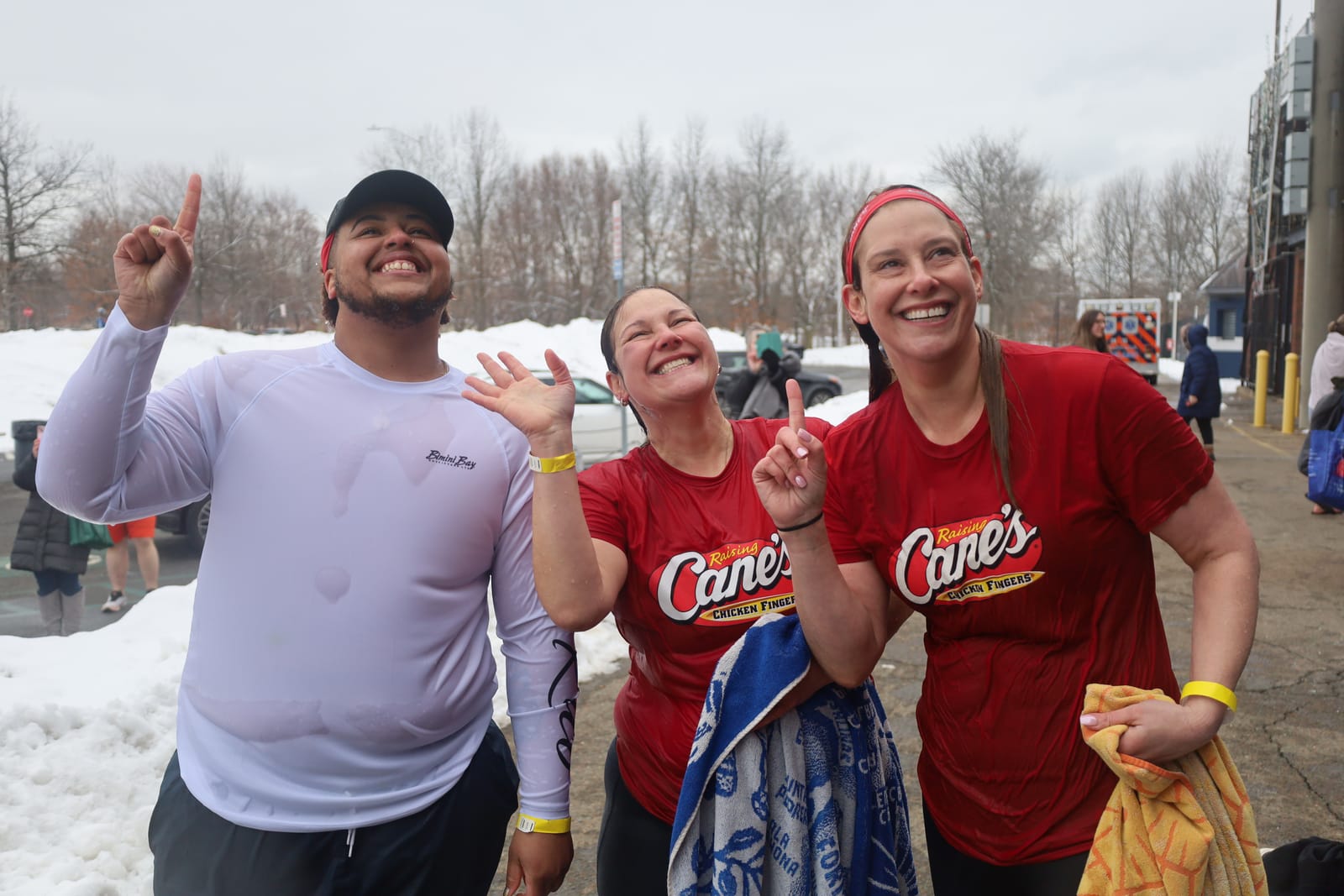
    Carly Ciarletta (center) celebrates post-plunge with her sister and another co-worker. The sisters wore matching Raising Cane’s shirts for the event. GOTTA KNOW MEDFORD PHOTO/Crystal Yormick

    Participants included members of the Medford Police Department, Tufts University students, and other community members. The crowd gathered beforehand in the parking lot outside the stadium, where people could sign up at the last minute and some sponsors had tables to promote their businesses. 

    Medford Chamber of Commerce Executive Director Laura O’Neill said the event was a way for the Medford business community and Police Department to come together and make a positive impact. 

    “It’s our way of helping the police raise money for Special Olympics,” O’Neill said. “The police do a lot of business in Medford, and it’s a coordinated effort for a great cause.” 

    Medford Police Public Information Officer Jessica Walsh said the organizers first met at Medford National Night Out, and the idea blossomed from there. The plunge, run by the Law Enforcement Torch Run of Special Olympics, was a collaboration between the Medford Police Department and the Medford Chamber of Commerce. A professional diver was on hand to assist participants.

    “It’s just such a community endeavor,” O’Neill said. “We love that the businesses and that the police all get together.” 

    People had different reasons for participating. Some said they have family or friends with special needs, while others said they wanted to give back to the community and bring people together. 

    “It’s just a great way for people to come out to do something outside of their comfort zone,” said Kylie Cronin, fundraising coordinator for Special Olympics Massachusetts. “Our big thing is to jump for inclusion.” 

    There are 31 other plunges happening around Massachusetts, according to the Special Olympics website. Participants chose different ways to jump in, ranging from cannonballs to belly-flops to jackknives. 

    GOTTA KNOW MEDFORD PHOTO/Crystal Yormick

    Medford Mayor Breanna Lungo-Koehn said she plunged because Medford has several inclusionary programs across the city she wants to support, along with the police department and Special Olympics. 

    The event was originally planned for Feb. 8 but changed because of cold temperatures.

    Anthony Petrelis and Jon Sencabaugh, who plunged for the Beyond Podcast team, said they saw the event after it was delayed, so they were able to sign up. 

    “[This is] allowing kids the opportunity of all walks of life [and] giving them the opportunity to do what everyone else can do,” said Sencabaugh, whose 6-year-old daughter has special needs. 

    The team, which raised $420, the second highest amount, credited their podcast audience. 

    It took about 20 minutes for all plungers to go, and many met the water with yelps and gasps. One man outstretched his arms and asked the crowd, “Are you not entertained?” They cheered, and he jumped in.

    Some wore bathing suits while others wore clothes or costumes. Two sisters wore matching Raising Cane’s T-shirts. There were awards for “Most Spirited Plungers,” which went to the brothers of Theta Chi, which is a fraternity at Tufts University, “Most Spirited,” which went to Petrelis, and “Top Fundraiser” and “Top Fundraising Team,” which went, respectively, to Walsh and the Medford Police Department. Walsh raised just over $2,000, individually, and the MPD team as a whole raised over $3,000. 

    “It’s just such a good reset,” said Carly Ciarletta, area leader of marketing at Raising Cane’s, sporting a red Raising Cane’s T-shirt. 

    Those plunging expressed a mix of excitement and apprehension before entering the water. 

    “I’m freezing just thinking about it,” Lungo-Koehn said.

    Walsh said the event will hopefully continue each year and continue to get more people involved. 

    To learn more and to make a donation, visit https://fundraise.specialolympicsma.org/events/946.