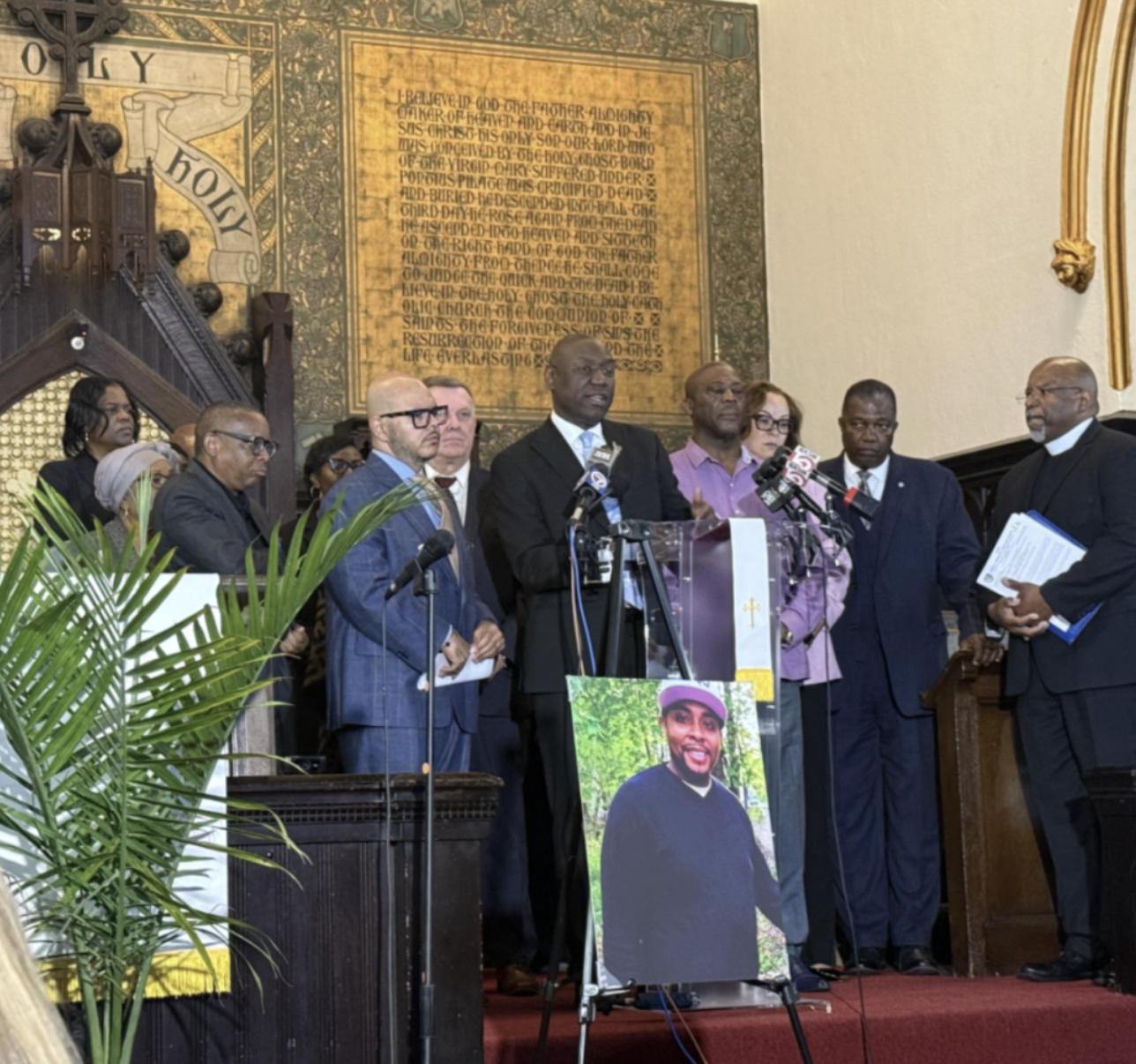
Attorney Ben Crump (center) speaking at the Grant A.M.E. church on Thursday. Crump is representing the family of Stephenson King Jr., a Dorchester man who was fatally shot by a Boston police officer last month. Credit: Truman Dickerson
A high-profile civil rights attorney representing Stephenson King Jr.’s family said Thursday that King was in the midst of a mental health crisis when Boston police fatally shot him and that body camera footage from his shooting should be released.
“If the officer did nothing wrong, then we should be able to see it on the video,” said attorney Ben Crump, adding that “we believe that video will reveal very disturbing actions.”
King, a 39-year-old Dorchester man, was fatally shot by Officer Nicholas O’Malley March 11 after King stole a woman’s vehicle and parked it on a street in Roxbury. O’Malley fired three shots as King was maneuvering the car, believing, according to his defense attorney, that King was about to strike another officer on scene.
O’Malley was arraigned on a manslaughter charge March 19. He pleaded not guilty and was released on personal recognizance. An assistant district attorney said body cam footage showed King was trying to drive away when O’Malley fired the shots and that neither officer was in danger of being struck.
King’s family painted a picture of a man with serious, unaddressed mental health issues who was loved by his family and failed by the state’s mental health system. His father, Stephenson King Sr., said King had been to two hospitals the day of the shooting but was discharged from each.
“His father took him to the hospital, and he somehow got released, and he went to another facility and exhibited paranoia symptoms even there, and then he left,” Crump said. “He took a car and then he parked it. None of it makes any sense.”
Though members of King’s family met with Suffolk District Attorney Kevin Hayden’s office Thursday morning, Crump said he and the family have yet to see body camera footage of the incident.
Asked directly if he would sue the Boston Police Department to gain access to the body cam video, Crump deferred, saying “we intend to explore every possible legal remedy available to the family to get justice.”
Boston City Councilor Miniard Culpepper, whose district includes the area where King was shot, said he asked the council to file a summons for the video Wednesday, but it was objected to.
“The video will show us the truth about what actually happened,” Culpepper said. “When we ask to see a body cam video, it should be readily available.”
Culpepper said he would again ask the council to file a summons next week. He said he believes Boston Police Commissioner Michael Cox is within his rights to independently release the video, despite the ongoing investigation by Hayden’s office.
Members of King’s family, who took turns speaking at the pulpit of Grant African Methodist Episcopal Church, teared up at points as they described a loved one who was crippled by delusions.
“He still loved his nieces and nephews, his brothers and sisters. He still came to every function that we had,” said King’s sister, Ebony King Gibson.
King “was one of the kindest, most generous young men,” said Tina Petigny, the fiance of King’s father.
Petigny said she would often see King speaking to people who weren’t actually there. King’s father said King had recently been putting pieces of paper into electrical sockets, believing that people were watching him.
King’s father, a retired Massachusetts corrections officer, said he wants to see the video of the shooting.
“I want to see his face when it really happened,” he said. “Knowing my son, he would’ve been home. He would’ve been home.”
This story is part of a partnership between the Dorchester Reporter and the Boston University Department of Journalism.
A Boston police officer charged with manslaughter after he shot and killed a Dorchester man suspected in an apparent carjacking in Roxbury last week was released on personal recognizance after his arraignment Thursday.
The officer, Nicholas O’Malley, 33, of West Roxbury, pleaded not guilty to the manslaughter charge in Roxbury Municipal Court. He left court with his family and is on paid leave, said Larry Calderone, president of the Boston Police Patrolmen’s Association.
Officer O’Malley and his attorney, Kenneth H. Anderson, during the arraignment on March 19, 2026. Truman Dickerson photo.
O’Malley fatally shot Stephenson King, 39, of Dorchester, on March 11 after King allegedly tried to flee during a alleged carjacking pursuit in Roxbury shortly before 10 p.m. O’Malley’s attorney, Kenneth H. Anderson, told the court that O’Malley feared for another officer’s life and fired three shots at King during the encounter.
But Assistant District Attorney Ian Polumbaum told the court that body camera footage and the testimony of an eyewitness showed that “Mr. King was trying to drive away” when O’Malley fired the shots.
“Neither officer was in the path of the car or being in danger of being struck by it at the time,” Polumbaum said.
Polumbaum asked Judge Steven Kim to set bail at $25,000, while Anderson asked that O’Malley be released on personal recognizance.
As a condition of his release, O’Malley will have to surrender any firearms, according to court records.
Prior to the encounter, King allegedly stole a woman’s car after assaulting her and ordering her out of the car, according to a criminal complaint. He was unarmed and “did show the officers his hands at times” but did not shut off the vehicle or unlock the doors, according to the complaint.
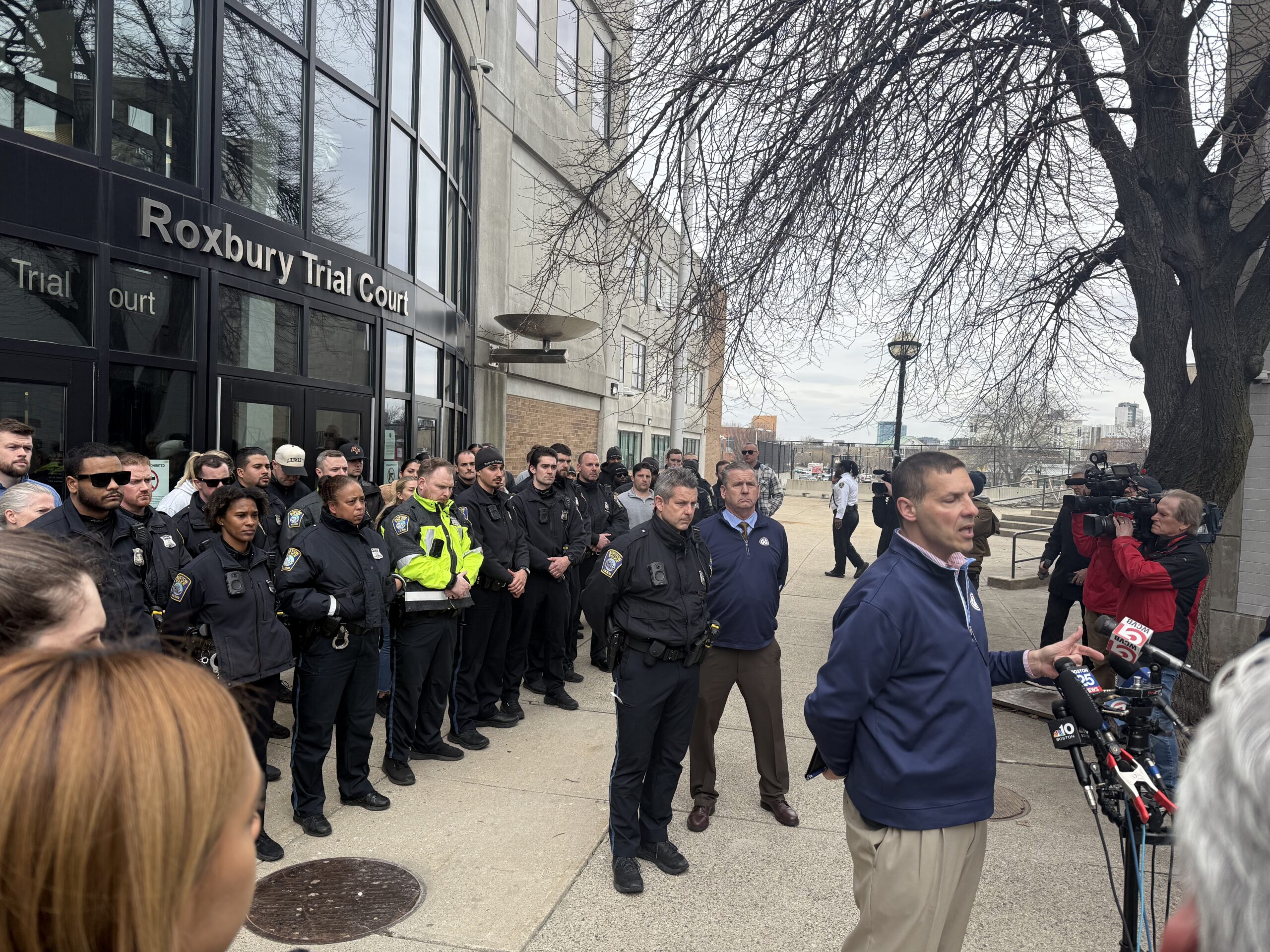
Suffolk District Attorney Kevin Hayden (right) and Assistant District Attorney Ian Polumbaum spoke to reporters after the arraignment in Roxbury Trial Court on March 19, 2026. Truman Dickerson photo.
Speaking to reporters after the arraignment, Suffolk District Attorney Kevin Hayden said his office will not release body camera footage of the incident to the public. He also said his office will show evidence to a grand jury and pursue the manslaughter charge in Suffolk Superior Court, although that has not happened yet.
Some 50 BPD officers were present in the courtroom during the arraignment. Calderone, of the patrolmen’s association, said a Boston police officer has not been arrested and charged in connection with an officer involved shooting in at least 30 years.
“I’ve been involved in probably 100 or more police shootings. This is the first one anyone’s ever been arrested,” said Anderson, O’Malley’s attorney.
Anderson and Calderone took exception to the nature of O’Malley’s arrest at his home this morning, claiming that he would have willingly brought himself to a police station or court to face charges.
“This is election year tactics,” Anderson added, appearing to reference this year’s district attorney election.
Hayden disputed that charge, saying the evidence was clear that King was not driving towards O’Malley or the other officer on scene when O’Malley fired the shots.
“This has nothing to do with public opinion, has nothing to do with politics,” Hayden said. “This has to do with us following the facts and the applicable law.”
City Councilors Miniard Culpepper and Brian Worrell, in a joint statement issued Thursday, thanked Hayden’s office for “their swift action” in filing charges against O’Malley.
“As elected city officials, it is our responsibility to build bridges between our community and law enforcement, and transparency is the foundation on which that trust is built,” the councillors wrote.
Calderone was visibly angry at times as he spoke to reporters outside the courthouse. He said Polumbaum and “whomever else is involved in this investigation” are “jumping to conclusions” and scapegoating O’Malley.
O’Malley “was in fear of his partner’s life,” Calderone said. “Just because the camera shows an officer on the other side of the car, with the totality of the circumstances that were taking place, does not mean that the other officer had him in his vision.”
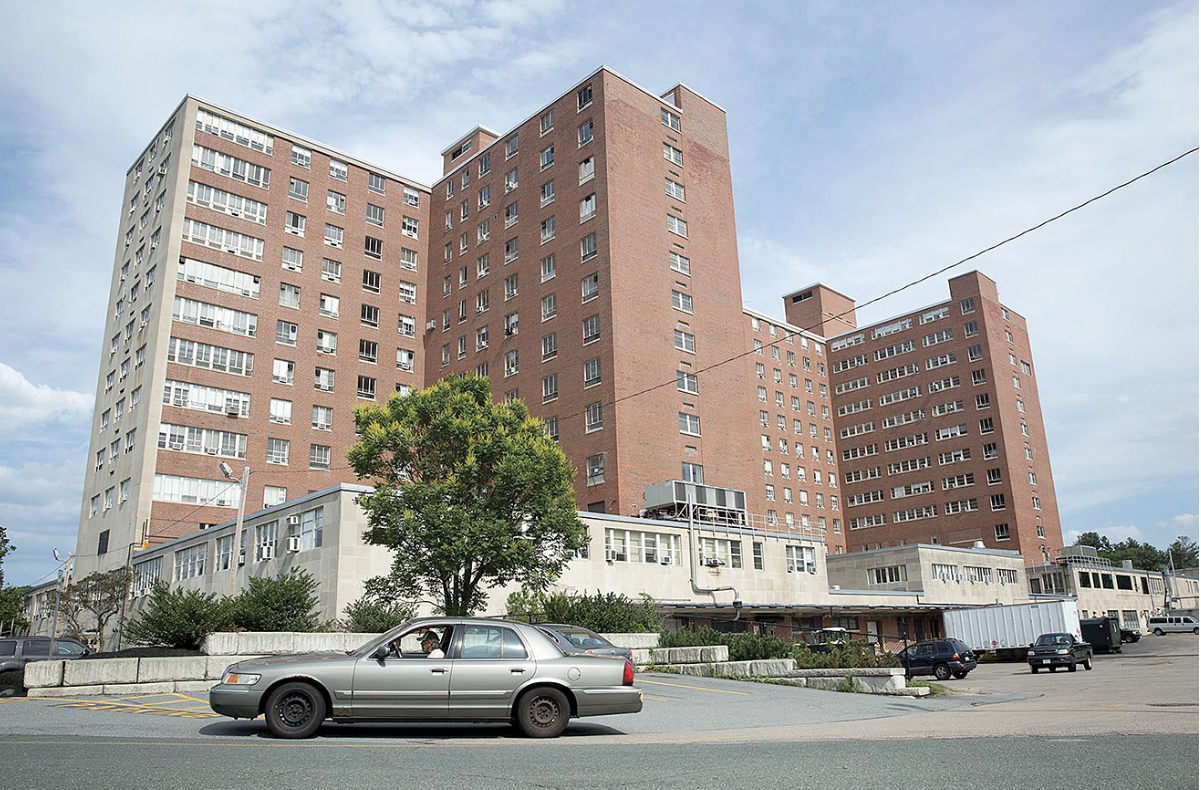
A renewed discussion over uses for the soon-to-be-vacant Lemuel Shattuck Hospital property next to Franklin Park has prompted new ideas – and a rise in tension among interested parties.
State officials last year scrapped a Boston Medical Center-led plan to redevelop the property as a recovery campus following the relocation of the hospital and its 260 beds to the East Newton Pavilion in the South End next year.
In the months since the BMC plan dissolved, advocates and coalition representatives have been eager to present their ideas to the state Executive Office of Health and Human Services (EOHHS).
More than 100 community members gathered last Thursday night (Feb. 27) for a “listening session” with several state agencies at Edward Brooke High School on American Legion Highway in Dorchester. Members from the Department of Mental Health, the state housing cabinet, and EOHHS attended – as did a host of state public health officials that included Shattuck CEO Fatima Watt.
Catharine Hornsby, senior advisor for the state Health and Human Services cabinet, said the process is a complete reset with no preconceived notions. Beside her is Josh Cuddy of the Executive Office of Housing and Livable Communities. Seth Daniel photo
Catharine Hornsby, senior advisor for EOHHS, said they came with no preconceived notions and a presumption that many in the audience might already know more than the state officials. It was, she said, a “full restart” that will inform a new Request for Proposals (RFP).
Two main camps quickly emerged — those who want some form of supportive housing built, and those who want the 13.3-acre lot turned over to more community-based plans in abutting Franklin Park. Supportive housing is a type of facility that combines under one roof behavioral health and substance use disorder (SUDs) support services.
In addition to input, the state is seeking ideas for how to incorporate that input, possibly establishing a community advisory board to oversee its actions regarding the project.
The existing Shattuck serves patients through a combined approach of medical and psychiatric treatment and the hosting of rehabilitation and recovery programs. Non-profit provider programs at the Shattuck, which include a methadone clinic, a Pine Street Inn shelter, residential treatment programs, and outpatient psychiatric services are not part of next year’s move. Bay Cove CEO Kevin Martone said at the meeting that they want to remain on site.
The Morton Street property was deeded to the Commonwealth of Massachusetts in 1949 with a statutory restriction requiring that the land be used for public health purposes.
Some who favor the supportive housing idea said it should be designated for people recovering from SUDs. Other proposals aired include housing for veterans, a village for abutting senior citizens looking to downsize, mothers reuniting with their children, and other populations that could benefit from a combination of housing and support/health services under one roof.
Dorchester’s Dianne Wilkerson, a former state senator, proposed a “senior citizen legacy village” with senior housing, urgent care, a 24/7 pharmacy, and a veterans’ center.
Former Sen. Dianne Wilkerson spoke at the meeting. Seth Daniel photo
“This is not your grandmother’s addiction,” she said. “The idea of an addiction village here – there’s a reason why no one else has done this in the United States. It doesn’t make sense.”
Many at the meeting said they were concerned about a high concentration of people in varying stages of substance use recovery living together, citing the increased relapse rate when individuals in recovery are surrounded by active drug users.
Dorchester’s Marti Glynn and Jamaica Plains’s Patricia Clifford – both retired public health workers – said that sort of situation is detrimental to recovery.
Patricia Clifford, an abutter to the Shattuck site on the Jamaica Plain side and a retired employee, said putting those in recovery together in large numbers isn’t a good idea. Seth Daniel photo
“When people are trying to get clean and are in close contact with active users it is an insurmountable task,” said Clifford, who retired from the Shattuck in 2023.
In contrast, members of the Housing and Health on Morton Street Homes Coalition (HHOMS) – a group that supported and worked with the BMC proposal – said they want any new plan to include at least 200 supportive housing units and to allow substance use recovery and mental health providers in the facilities.
Dorchester’s Shameeka Moreno, a member of HHOMS and organizer for Boston Tenant Coalition, appeared frustrated as she addressed opposition to the supportive housing idea.
“If this community cares about the kids, give us housing for moms going through reunification,” Moreno said. “Give us places for our kids to play where we still can have that green, but we can still have that housing, too.”
Asserting that green space a form of public health, Karen Mauney-Brodek, president of the Emerald Necklace Conservancy, wants the site to be turned over to Franklin Park.
Mattapan’s Kenya Beaman said the Shattuck was considered a “scary” place when she was growing up, and she’d like to see it become community-oriented and inviting. Seth Daniel photo
“The Parthenon of parks could be reborn under this administration,” Mauney-Brodek said. “The park is a limited resource. We have limited green spaces in the city.”
Moreno countered that she has seen disparities in how support services are regarded by some other community members. Opponents of the housing idea said they agree that more supportive housing is needed in Boston, but they add that the Morton Street campus is not the place for it.
“It’s good for my Black kid, but it’s not good for a predominantly white neighborhood,” Moreno said. “That’s what I hear when you say, ‘Not in the Emerald Necklace, not over here.’ This is the city. This is what comes with the city.”
State Rep. Chris Worrell said in an interview that he wants to hear every idea, and that “no idea is dumb. We could create something very beautiful.”
In an interview, District 7 City Councillor Miniard Culpepper said that he was opposed to the former BMC plan and emphasized his support for community input on the project.
“Whenever you have a diversity of opinion, you come up with a good result,” he said.
While he said he does not specifically support one plan over another, Culpepper did say he was against developing a 400-unit supportive housing complex, and he added that the residents in the immediate area who opposed the BMC plan should be represented on the advisory board.
“Whatever leverage I have,” Culpepper said, “I’m going to use it to make sure whatever the residents decide goes into that facility.”
State Sen. Liz Miranda (above), who attended the meeting, said she was happy the state “agreed to start this process over.” And State Sen. Nick Collins said in an interview that he wants to see a review of the facilities and cost-benefit analysis done before the community decides on a proposal. He said he wants to explore the possibility of “retrofitting” what’s there.
“I think we should take a step back and say, ‘What can we do with the existing building?’” Collins said.
There is no clear timeline for the future listening sessions or next steps in the process, but the state again emphasized that community input will be at the forefront this time around.
“[Community members] feel like the trust is shattered,” Worrell said. “This is the first step of building that trust and letting the community know that this is truly a community led process.”
His brother, District 4 Councillor Brian Worrell, added, “I’m hopeful that this state-led process will result in a use that serves Bostonians for generations to come and reflects the will of our residents.”
This story is the product of a partnership between the Dorchester Reporter and the Boston University Department of Journalism. The Reporter’s news editor, Seth Daniel, contributed to the article.
Part of the at-large panel (l-r): Erin Murphy, Henry Santana, Ruthzee Louijeune, Marvin Mathelier and Alexandra Valdez at a Hibernian Hall forum on May 22, 2025. Photo by Georgia Epiphaniou
Seventeen candidates for City Council seats fielded questions about affordable housing, immigration enforcement, and other topics last Thursday evening (May 22) at a forum at Roxbury’s Hibernian Hall.
Nine candidates for the District 7 seat and eight for the four at-large seats participated in the nearly three-hour forum, which drew more than 100 people and was moderated by Yawu Miller, editor in chief of The Flipside, and WGBH reporter Saraya Wintersmith.
The at-large field All four incumbent at-large councillors running for re-election attended the event: Ruthzee Louijeune, Julia Mejia, Henry Santana, and Erin Murphy. City election officials have also certified nomination signatures for five challengers, so far: Will Onuoha, Marvin Mathelier, Alexandra Valdez, Yves Mary Jean, and Frank Baker. All but Mary Jean were in attendance.
Baker previously served as the District 3 councillor for 12 years. Valdez is the director of Boston’s Office of Cultural Affairs, and Onuoha worked as the executive director of the Mayor’s Office of Fair Housing & Equity, among other posts in over two decades in city government.
Marvin Mathelier, a Marine Corps Reserve veteran, said his goal is to bring to the City Council the values instilled in him by military service.
At-Large City Council panel: (from l to r) Will Onouha, Julia Mejia, Erin Murphy, Henry Santana, Ruthzee Louijeune, Marvin Mathelier, Alexandra Valdez and Frank Baker. Photo by Wen Qi
Asked how they would make Boston more affordable, Mathelier, Valdez, Santana, and Louijeune give similar answers about supporting rent control, community involvement, budgeting, zoning, mixed-income social housing, and reusing old buildings.
Onuoha introduced a new idea on workforce housing, targeted to families that earn too much to qualify for affordable housing but can’t afford market rate housing. He says no one should pay over 30 percent of their income for housing.
“Affordable housing is not affordable,” he said. “That’s a myth that we tell people.”
Mejia said she supports a displacement tax, a fee that she says would mitigate the loss of residents and businesses due to rising property values, typically caused by gentrification.
“I’ve been questioning this whole idea, because we’re getting displaced in high numbers” she said.
Murphy talked about education and workforce development.
The candidates gave varying answers about how they would support communities targeted by ICE. Baker and Onuoha recommend that immigrants stay off social media. “Do not say anything bad about the government,” Onuoha said.
Baker thinks Boston police should have a relationship with ICE to create transparency. “There should be some sort of liaison with ICE to see where they’re going, what they’re doing,” he said.
At-Large City Council panel included (from left to right): Marvin Mathelier, Alexandra Valdez and Frank Baker. Photo by Wen Qi
Most of the candidates said the city should do more to educate immigrants about their rights. Mejia, who was born in the Dominican Republic, said she survived Trump’s first term and can do it again.
“I’m prepared to stand up to Trump,” she said, while reinforcing the need to educate immigrants about their rights. There was some support among the candidates for bike and bus lanes.
“I don’t want to walk by no more ghost bikes,” Louijeune said. “I don’t want that. I don’t want that for our children, to say that someone died here because we didn’t do our job to build a safer, better city.”
Baker said the city should explore expanding water transportation and Valdez and Mejia emphasized that each neighborhood needs its own plan for bike and bus lanes so it makes sense to businesses and residents. “People can’t do one size fits all,” Mejia said.
Murphy blamed increased traffic congestion on bike lanes and speed bumps. “I think it’s important that we don’t just wake up one day and find out that our streets look different and we didn’t have to say anything,” she said.
In a “speed round,” everyone except Onuoha, Baker, and Murphy said they support statewide rent control legislation. Everyone except Baker said “yes” when asked whether they support inclusionary zoning requiring 20 percent of housing in market-rate developments to be income restricted.
Onuoha, Valdez, and Baker went on record opposing an elected school committee and against abolishing the Boston police gang database. Everyone else voted yes on those questions.
There was unanimous support for approving a $4 million increase in the city’s rent subsidy program to provide permanent housing for 130 homeless families.
Baker was the only candidate who didn’t answer a question about whether universities should increase their payments in lieu of taxes, known as PILOT funds. Baker held his paddle sideways, refraining to answer and drawing an eruption of laughter from the crowd.
District 7
District 7 City Council panel: (from l to r) Wawa Bell, Samuel Hurtado, Said Abdikarim, Said Ahmed, Mavrick Afonso, Miniard Culpepper, Roy Owens, Natalie Juba Sutherland and Jerome King. Photo by Georgia Epiphaniou
The first part of the forum focused on the District 7 seat now held by Tania Fernandes Anderson, who recently pleaded guilty to two of six federal corruption charges after allegedly arranging a kickback scheme that netted her $7,000. Fernandes Anderson, who has said she intends to resign from the seat before her term expires at the end of the year, is not running for re-election.
Nine candidates have qualified for the ballot for the preliminary election to be held on Sept. 9, with early voting starting on Aug. 30: WaWa Bell, Samuel Hurtado, Said Abdikarim, Said Ahmed, Mavrick Afonso, Rev. Miniard Culpepper, Roy Owens, Natalie Juba-Sutherland, and Jerome King.
The candidates began by explaining what makes them qualified for the job.
“I think that our community has been ill-represented for a long time,” said Bell, who went on to say he wants to continue the “positive work” of Fernandes Anderson, who was in attendance at the event.
Miller asked the candidates how they would work to make District 7 more affordable. Bell expressed support for rent control and a cap on how much landlords can earn.
The candidates all agreed to advocate for the statewide “Homes for All Massachusetts” rent control legislation that would limit rent increases and ban no-fault evictions. The response came during rapid-fire questions for which candidates had to respond with a paddle with “yes” on one side and “no” on the other.
Bell and Culpepper emphasized a push for more homeownership, while Juba-Sutherland mentioned a need for more financial literacy among homeowners.
“What financial literacy does [is] it teaches us how to manage our money,” Juba-Sutherland said. “Because we can actually say, ‘Yes, we can own our homes,’ but can we keep our homes?”
Afonso, who is the director of external affairs at the state’s Executive Office of Housing and Livable Communities, called for the development of “surplus land” and accessory dwelling units for affordable housing.
Candidates answered questions about how they would support communities targeted by US Immigration and Customs Enforcement. King called himself a “fighter” and questioned who ICE agents are.
“All I see is a bunch of people running around with shiesties on,” King said. “They don’t show their face.”
Nearly all candidates expressed some form of support for community members targeted by ICE, except Owens, who did not answer the question and went on to talk about congestion pricing.
Both Hurtado and Abdikarim emphasized educating immigrants about their constitutional rights. Afonso said he supports more funding for legal resources for immigrants.
From left: Said Ahmed, Mavrick Afonso (standing), Miniard Culpepper: and Roy Owens. Photo by Wen Qi
“This is a sanctuary state,” Afonso said, ”so let’s provide these people the counsel that they need if ICE comes to try to take them away.”
During rapid-fire questioning, all candidates backed Boston’s inclusionary zoning policy requiring 20 percent of units in market-rate developments to be income restricted and indicated support for amendments that would increase participatory budgeting funds.
Bell, Hurtado, Owens, Juba-Sutherland, and King said they oppose the Wu administration’s decision to lease White Stadium to a professional women’s soccer team. Abdikarim, Ahmed, Afonso and Culpepper all said they support the plan.
All except for Juba-Sutherland and Owens voted to abolish the Boston Police Department’s gang database. Juba-Sutherland voted “no,” and Owens abstained from the question.
Hurtado was the only one of the nine candidates to vote against a fully elected school committee.
A strong turnout at the Boston City Council Forum, Hibernian Hall, Thursday, May 22, 2025. Photo by Georgia Epiphaniou