
Tag: Music

  • Q&Allston: DIY music scene, Beatles love, and new music with Allston band Winkler

    Q&Allston: DIY music scene, Beatles love, and new music with Allston band Winkler

    Cooped up in the small green room at the Rockwell Theatre in Somerville (255 Elm St), I spoke to the five member Allston-Brighton based band, Winkler, 30 minutes before their performance in Rockwell Theatre. 

    The band members consist of Christian Schmidt (drums), Maddy Simpson (vocals), Justin Schaefers (vocals), Danny Edlin (bass), and Alex Massey (guitarist).

    This interview has been edited for clarity.

    How did you guys form Winkler?

    Christian: Maddy used to have a Youtube channel where she would upload videos of musicians playing in a dorm room, kind of like a Tiny Desk spinoff, and we were friends and lived on the same floor. And then Justin did one of those, and we were just hanging out with them and we became friends and so we played music together. We had a different bassist and a different guitar player at one point, a few years ago, but then eventually we reeled in Alex and Danny.  

    Where did Winkler’s name come from?

    Justin: We had one song kind of finished called, Winkler. I think it was a play on words, because there was a line in the song that had to do with Happy Days; it’s a TV show. We had a gig coming up and no band name and we were like maybe we should just use the title of the song we have finished. You know, it’s dangerous because once they put it on the poster the first time, you either have to make a whole big thing about changing it. So for better, for worse, we’ve been Winkler for this whole time.

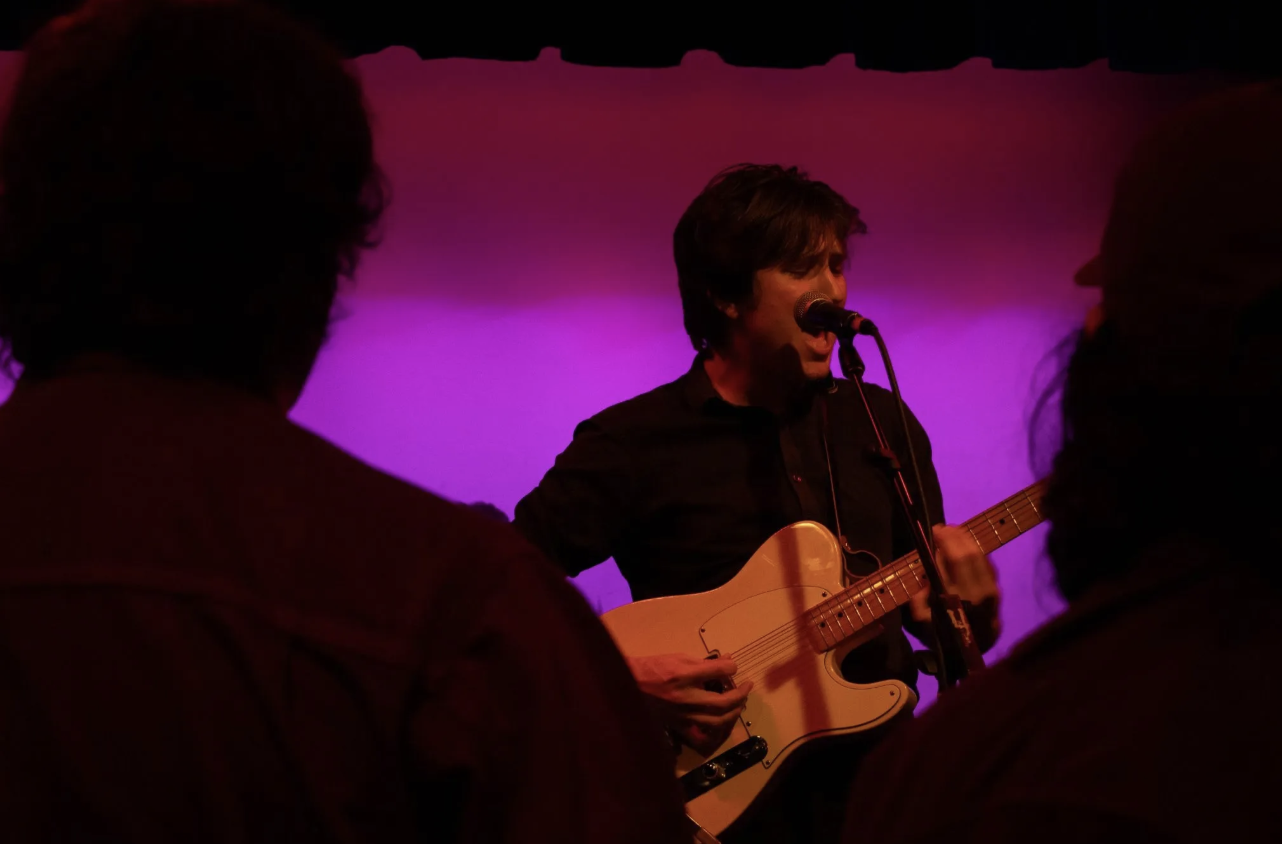
    Justin Schaefers, Winkler’s lead singer performing at Rockwell Theatre in Somerville, M.A.. By Belinda Afful.

    What was your first gig as a band?

    Justin: We played at a house venue. It was called the Green Thumb. No longer exists. It was on a street called Gardner Street. It was in a basement apartment, I’m pretty sure. So a lot of the times we’d set up in, like, looking at the kitchen the whole time. It was fun.

    Where were the rehearsal spaces you guys practiced in?

    Christian: There’s a rehearsal place on Fordham Rd in Allston that we used to play at but pretty soon we moved into a place that we could play in the basement. 

    Danny: Nowadays, we practice split between a house in Brighton and a house in Allston, world’s apart.

    Winkler’s Spotify description is “Making Music in the bedroom for the bedroom,” what does that mean to you guys?

    Justin: It’s a little cheeky. It’s hard to think of a bio. I think we came up with that at one point because we wrote it down. But we did at one point make all the music in a bedroom with just the equipment we had and now we usually do it in a basement. 

    What was the inspiration for your sound? And what artists are you guys most inspired by?

    Justin: I think we all approach it from, we have like a common love for some music, and then we all deviate in our own special ways at the moment.

    Winkler: Our big shared interest is the Beatles. 

    Justin: When we’re in the car for a long enough time, though, sometimes we’ll have multiple hour drives to a show, because I think you get to the point with the Beatles where you just really feel you get to know them. It’s really like a parasocial relationship. So we spend a lot of time hyperanalyzing their relationships with each other. And really just being insufferable. There’s a term Disney adult, well I think we’re Beatles adults. 

    Alex Massey, Winkler’s guitarist performing at Rockwell Theatre in Somerville, M.A.. By Belinda Afful.

    What was it like making music during COVID-19?

    Maddy: Christian and I lived together the whole time and then we lived with Justin. We had already decided before COVID that we were all going to be together. We had signed the lease. And then COVID happened. And we were like, well, what do we do? So we all moved into the house anyway and then it was really easy to make music because there wasn’t anything to do, except to make music.

    Christian: We would send each other demos and stuff. We’re all just noodling on our own for a while. I think we all got a little better over the time we couldn’t play together because of how much we were forced to play a lot.

    I saw that you hosted a front-yard performance in 2022 rather than the basement shows. How has your choice of performance venue shifted since then?

    Christian: I think that show, particularly, we played a duo show. It was very low stakes. So I guess that affected the set because we played some new stuff that we were working on or just tried out some new songs for the first time. Sometimes it’s nice to have a show that’s pretty low pressure to try new things.

    Danny: I feel like generally, we take shows based on factors you would imagine, like whether we’re available, where it seems fun.

    Justin: Now it’s nice because we’ve been playing shows for long enough to where we just want to play with bands we like and vibe with and maybe when we’re first starting out, we’re like, we’ll play anything. 

    Maddy: But now we can say yes, only to things we want to.

    What is the writing and production process for making your music?

    Justin: It’s been a couple different ways. The first record, a lot of the songs were like fully done beforehand, and then we made different arrangements. Then we played live, some songs we added strings to and everything. The last one was a really weird album. We took a lot of time to experiment, so we got to find a lot of results we worked up otherwise. But now we’re just playing so much and we’re playing the next batch of songs that we’re going to release. I feel like that’s gonna influence how this next batch sounds. Maybe we’ll just record them all how we play them live. It changes.

    I read from your Allston Pudding interview that you guys had a love for Home Analog recording, how do you incorporate that into your production? 

    Christian: I think literally it just makes things sound distorted. So it’s always nice to have a little distortion around the drums and the bass and it gives the guitars taste. Because it only records up to a certain frequency, it gets rid of the really high and harsh frequencies sometimes, which helps fuse together a bunch of different instruments, when they’re all a little rough around the edges. It helps it sound more satisfying. 

    Alex: It’s also like a different process. You have to arrive at different stuff when you’re moving physical knobs and watching tape spin around.

    Christian: I would say it feels more like high stakes too. If you are recording digitally, then you can always just infinitely redo things. But sometimes with the tapes, it’s like we already recorded over this one spot a bunch of times. We should just do it.

    How important is it for you guys to be independent artists in Allston? What are some obstacles that you guys face being independent artists in Allston/Boston?

    Maddy: I really love Allston, and also just Boston DIY in general because everybody’s so supportive of each other. People go to each other’s shows and ask each other to play shows. What I love about Allston-Brighton is that the people that put on shows aren’t necessarily musicians themselves, or people that play in bands. A lot of the time, people who just really love DIY music and want to organize DIY music. I think that’s really cool about Allston right now, like there’s people like that and the people who are in bands. We all support each other and we’re all friends in real life too. It’s a big community of people. 

    Danny: I think a lot of the infrastructure in Allston is really good. Like it’s a lot of muti-family homes that can house a bunch of people and they have a bunch of space, which I think is naturally more creatively generative than a two-bedroom apartment where you can’t make a ton of noise. There just is common space in these bigger houses and a lot of people in other neighborhoods or in other cities don’t have that. So I think that’s like partially why a lot of reasons like Allston-Brighton are pretty good for making music but they’re problems with that we still have neighbors and stuff that everyone deals with.

    Maddy: I think one of the challenges is that in Allston the rent has risen astronomically and so it pushes artists farther out of Allston. I mean that’s why three out of the five of us live in Brighton because we can’t afford to live in Allston, though we love Allston. It also drives out the place where we would play, so like the Great Scott, like O’Brien’s is about to close for however many months. And then there’s nowhere to play in Allston. So then we come and we play in Somerville instead because that’s where all the 100, 200 cap venues are.

    Alex: The problem with Boston in general is like the lack of small, like 100 cap, venues, which is like I think why the house venues step up and attempt to fill that way.

    Justin: The cops will, on like a semi-annual basis just shut everything down. I guess COVID, nothing happened and then we got like a couple of good months of playing and then like three of the premier places either got shut down fully by the police or were nervous about the presence. 

    What were the transition periods like when the group members changed?

    Justin: We played some really weird shows. For a couple of months before Danny joined, we were between bass players, like Alex played bass a couple times, sometimes we played no bass.

    Winkler: And we did like acoustic. Electric guitar, drums. It sounded just like garbage. I mean interesting maybe. It wasn’t great. 

    Maddy: Both times we needed to find a new player, which was very easy because Alex came and saw us at a show right after COVID.

    Alex: I saw Winkler and I was like, I think I’m probably going to be in Winkler.

    Maddy: And then when our last bassist, Ava moved, we were devastated. So it took us a few months to like bounce back cause she was so wonderful, but then Danny’s done a good job.

    Danny: I played on bills with Winkler from another band and knew everyone personally, at least a little to some degree. I wasn’t a total random. 

    Maddy: We told Danny that he could audition, but then we never auditioned anybody else.

    Justin: Yeah, this is probably right. 

    If you could choose one word to describe your relationship with one another, what would that be and why?

    Winkler: Rock, cause it’s all for rock, everything we do. You gotta do something. So you might as well do rock.

    Would you say each of you have a different sound/style? What is it like trying to blend individual voices or parts together?

    Maddy: It’s like what Justin was saying earlier, we all have shared interests, but then our differing interests all combine into Winkler.

    Justin: What’s nice is we all know how to play a Winkler song. Even with newer songs, not that it’s repetitive in nature, but I think we’re all good enough in the craft and know what would fit to make it blend. 

    Alex: I think we’re probably the best Winkler cover band.

    Justin, you recently released your album Modest Hits, can you tell me the process of that and how it worked with being the lead singer of Winkler?

    Justin: Those were all just recordings made on my phone. So it was sort of fun because those were ideas I had that I was working on in my own time. But of course, that’s such a different vibe than Winkler, where the whole thing is that there’s five people playing individual parts. But it’s cool. We all have different creative endeavors that all contribute back to Winkler.

    Cicada Summr, a song released in Bazooka Baby, your latest album, gives a much different vibe compared to the other songs released on the album. Is there a reason why you chose to take this creative route on the song?

    Christian: I guess with any song we record, just the idea of the song you sort of imagine like a way you think it should sound, like it has a little landscape of its own. Most other songs, we usually like okay this one makes sense with drums, bass, guitar live but that one we started with the synths and added the drum machines and that it just ended up being different because we had to piece it together part by part. So I think that made it sort of more like a collage, more than other songs. And I guess we kind of wanted it to sound like She Wolf by Shakira. 

    Maddie: I think the thing about being in a band, there’s this idea that you have to have like one sound, but I think actually you can really do whatever you want. I think it’s actually a strength to be able to do things that are really weird and out of the realm of what somebody thinks you should sound like. People think that Winkler is whatever, but we could really be whatever we want. 

    Maddy Simpson, Winkler’s singer, performing at Rockwell Theatre in Somerville, M.A.. By Belinda Afful.

    What is one of your favorite songs to perform?

    Maddie: Fire by Winkler

    Alex: We have a song called Mexico that’s not out that I think it’s awesome.

    Christian: That one’s fun to play. I like that one too.

    Danny: I love City Rain.

    Justin: There’s a new song of ours called Fire, which is just fun because it’s so easy. You can really sit in it without having to think about what’s going on.

    Are there any pre-performance rituals you guys do before a performance?

    Maddy: We usually just hang out, we usually eat dinner.

    Christian: We do hang out, but definitely when we have a show, it’s like we know that the five of us are going to hang out 

    Danny: The biggest thing about it is that we’re all required to be friends with each other.

    What is an artist that you would like to work with in the future?

    Justin: I like John Andrews and the Yawns and we are big fans of this singer named Devendra Banhart. 

    Christian: That would be a dream to like open for him

    Maddy: We’ve been able to open for some people that we really love, which is really cool.

    Justin: There’s a lot of artists that I love to run into in a coffee shop. I really want to be their best friend but I don’t think Paul McCartney would want to do anything right now.

    Is there anything in the future that listeners should anticipate?

    Maddie: This is going to be our most rocking record yet because our first record was like folk rock and then our second record was like folk.

    Alex: My mom called it our acid era.

    Christian: I feel like this album, more so than other albums, is the one we could most accurately just play live. All the other two albums had songs like acoustic or electronic, but this next album was pretty much like band instrumentation.

    Justin: Which is great because even when we’re putting out the last two, there’s certain songs we like, we’ll do it for these release shows and if we go on a tour for it, but then we’ll probably like phase it out because other songs were better in a performance.

    Winkler performing at Rockwell Theatre in Somerville, M.A.. By Belinda Afful.
  • Using the Arts to Confront the Racism That’s Not Always Seen

    Inside Belmont High School’s Black Box Theater on Friday, Feb. 27, music and poetry will take on a subject some communities might believe they have already solved: racism.

    But for organizers and performers behind the upcoming Black History Month concert, the issue is not the loud, obvious version of racism most Americans picture. It’s the quieter kind. The kind marbled within misguided intentions and policies out of step with stated values.

    “This is not about yelling about racism at people,” musician Alastair Moock said. “But if nobody in the room feels challenged, we haven’t succeeded.”

    The Friday concert, featuring folk musicians Moock, Reggie Harris and Massachusetts Poet Laureate Regie Gibson, is part of Voices Rising, a new joint series by Passim’s Folk Collective and the Boston-based arts organization The Opening Doors Project. The series pairs curated music with candid conversations about race and identity across New England.

    In Belmont, the conversation carries weight.

    Belmont Against Racism, the local volunteer organization co-sponsoring the concert, was founded in 1992 after Los Angeles police officers were videotaped beating motorist Rodney King and the unrest that followed their acquittal. Residents formed the group out of concern that racial tensions seen nationally could surface locally.

    More than 30 years later, President Didier Moise says the work is far from finished.

    “I almost laugh when people say, ‘Well, racism is over,’” Moise said. “The effects of racism are still around us.”

    Moise, a Haitian American who has led the organization for more than two years, said Belmont’s efforts focus less on overt hostility and more on structural and institutional patterns that can be harder to see.

    “One of our missions is to encourage dialogue and awareness of institutional racism,” he said. “It’s very subtle.”

    That nuance is exactly what Moock says the concert aims to explore.

    “There are very different versions of racism,” said Moock. “There’s the loud, angry ‘I don’t like you because you don’t look like me’ version. But the version we are more focused on is what I would call liberal racism.”

    He describes it as “learning the vocabulary, saying the right things, and then being hypocritical about that with your actions.”

    An example, he said, is people who put Black Lives Matter signs in their yard and then fight affordable housing in their neighborhood.

    Moock, who co-founded The Opening Doors Project in 2021 with Stacey Babb, said the organization centers around “amplifying voices of color and advancing interracial conversations about race.” He believes those conversations are especially necessary in predominantly white suburban towns.

    “Black and brown communities are very aware of issues of racism and bias,” he said. “Conversations need to happen in white spaces more than they need to happen in any other spaces.”

    Black people make up 1.6% of Belmont’s population, according to the 2024 census. A reality Moock said can create both a challenge and an opportunity for change.

    “We get a pretty self-selecting crowd,” Moock said of past performances in communities with similar demographics. “Particularly in wealthy, predominantly white suburbs.”

    The goal is not to shame audiences, he added, but to invite reflection.

    “By virtue of showing up, they’re showing intention,” he said. “They want to learn. They’re meeting us halfway.”

    Still, he says comfort alone is not success, the organizers hope is to help the community reflect, and music makes that possible.

    “Using music as a way of digging into these conversations is an important piece of it,” Moock said. “Music brings people’s guard down and brings them together.”

    Gibson, who uses his African American lens to write poetry that often explores citizenship, democracy and public life, says the concert provides another avenue for civic engagement.

    “The rise of racism … it’s a social malaise that we have not solved,” Gibson said. “These things are just below the surface.”

    Gibson, who lived in Belmont from 2001 to 2006 and whose wife served on the board of Belmont Against Racism, said racial bias does not always present itself as open hostility. In some cases, he said, it surfaces in policy debates and in resistance to change.

    “When I was on the Human Rights Commission in Belmont,” he said, “there were folks who were expressly on the committee to make sure nothing changed.”

    He cited an incident years ago when flyers opposing interracial relationships circulated in town, an episode that prompted residents to launch a “Hate Has No Home Here” campaign in response.

    Gibson says art offers a way to ask difficult questions without closing doors.

    “My aim,” he said, “is to create a space that makes better citizenship possible.”

    That mission runs through the broader Voices Rising series, a program that includes an Indigenous Peoples’ Day concert, a Martin Luther King Jr. Day concert, two Black History Month concerts and other events. Each performance blends music with moderated dialogue, allowing artists to respond to one another and to audience questions.

    The Folk Collective at Passim, an artist-led initiative dedicated to expanding the narrative of folk music, partnered with The Opening Doors Project to bring the series to communities across New England throughout 2025 and 2026.

    Moock, who has spent three decades as a performer and teacher, said his own understanding of race has evolved through that work.

    “One of the privileges of whiteness in America is not having to think about your skin color,” he said. “White Americans often don’t think of themselves as having a race.”

    He said part of his role in interracial conversations with Harris is to acknowledge that privilege openly and honestly.

    “The single most important thing we’re doing in these spaces is modeling what healthy conversations and friendship can look like,” he said.

    Moise hopes the Belmont concert will build on that model locally. The organization has previously hosted film screenings, discussions and cultural events during Black History Month and Indigenous Peoples’ Day, often in response to students and families who felt certain histories were not fully acknowledged.

    “If you cannot even acknowledge a segment of society’s culture,” Moise said, “how could you say that you see these groups through a compassionate lens?”

    The concert, he said, is less about performance and more about presence.

    “We’re trying to build an inclusive and inviting community,” he said. “It has to be based on dignity and mutual respect.”

    Kallejhay Terrelong is a journalism student in Boston University’s Newsroom program, a partnership between the university, The Belmont Voice and other news organizations in the Boston area.

  • Sotheby’s Real Estate Office hostsJP Tiny Desk Concert series

    Local real estate agent Brian Fizer has turned Sotheby’s real estate office into an intimate concert venue on select Thursday nights in Jamaica Plain. Free to attend, the “JP Tiny Desk Concert Series” features Boston musicians with a side of charcuterie boards and the opportunity to bring your own booze. 

    “Every event people say ‘Oh, this is the highlight of my week…it’s so nice to see this space right in the middle of JP used this way,’ ” said Fizer in a recent interview. “It’s all been great feedback.”

    Located at 673 Centre St., Sotheby’s doubles as a hub for neighbors to unite over local music that Fizer said feeds off community camaraderie. Just behind its reception desk wall, Sotheby’s office adds itself to JP’s reserved scene of daily shows at Midway Café and weekly sessions at Brendan Behan Pub.  

    “Community is really important in JP, but let’s do something just to give back to the community,” said Fizer on his motivations to create the concert series. “It was just a way for us to reach out to people.”

    Fizer called on Carol Palmer and Andrew Brilliant — his coworkers on the Brilliant Places real estate team — to help form the series. Palmer and Brilliant’s experience helping throw JP First Thursdays helped bring Fizer’s idea to life. Tiny Desk will have its third session Feb. 12 featuring the Sado Domestics, a grassroots trio that will bring an upbeat, rock-driven sound. Fizer has noticed the crowd grow to upwards of 40 people, spanning from children to retirees. 

    “I remember thinking like there’s just not a lot of instances in our current society where you get to hang out across generations,” said Fizer. 

    The Sado-Domestics will be the first group to break from the jazz theme lineup. According to the band’s website, their “sound is an acoustic-leaning blend of folk, roots and rock.” The group will perform as a trio, with lead singers and guitarists Chris Gleason and Lucy Martinez joining Jimmy Ryan on the mandolin.

    Åsa Runefelt, a jazz vocalist and Berklee College of Music graduate, highlighted Fizer’s commitment to creating the “intimate” and “live” space the poster tagline advertises. She said she felt thankful not only for his generosity to open up the office, but to the venue’s ironically good acoustics.

    “It happens to be a really great venue,” said Runefelt. “He thinks about the lighting, there’s some art on the walls, the chairs are comfortable, but it’s close enough to the musicians.”

    Runefelt performed alongside Brian Freeman, accompanying her vocals on the piano as she sang from her debut album “Night Flower,” released in December. Runefelt said the crowd responded with heartfelt claps to her new releases, whereas Tiny Desk fulfilled her wish to find a sharable concert building. It was just last year she walked the streets of JP to find an office that could benefit from hosting events after store hours.

    “I thought ‘maybe there’s a possibility here for sharing a space, and then he just comes up with his idea,” she said. “It’s amazing.”

    As a performer Runefelt elaborated on the freedom jazz breeds to create an improvised sound experience, especially when live. She said that music has a power to bring people together who may be strangers due to its finite lifespan.

    “Making a painting, this painting hangs there, you can enjoy it forever, but for musicians, it’s just a fleeting moment of living,” said Runefelt.

    Gleason, the co-lead singer of the Sado-Domestics, praised the mutual benefit to the audience and artist. Gleason performs all around Greater Boston, with monthly concerts at the Square Root in Roslindale and at the Sanctuary Cultural Arts Center in Maynard. He said that now more than ever in-person events can positively impact people who otherwise would stay inside.

    “Music is therapeutic, but it’s good for the audience, too,” he said. “We all spend so much time on our devices or watching television.”

    Fizer also said Tiny Desk can inspire a digital detox for attendees in its third space. He deemed  Sotheby’s intimate setup as an unplugged experience where people can socialize with less digital interaction.

    “It’s just, ‘you’re here to enjoy music, right?” said Fizer. “You see people talking to each other, which is really cool and doesn’t always happen in an East Coast city.”

    But as far as an official goal for Tiny Desk, Fizer settles on community. 

    “Human connection, interaction, community — and what better way to do it than listening to music that perhaps is a genre you’ve never listened to,” he said. “We feel that’s kind of the anecdote to a lot of our problems.”

  • Two worlds on the same street: How a violin bridges Beacon Hill with the unhoused community 

    In the small, dimly-lit community center turned chamber hall on 74 Joy St., Jennifer Stevens is brought back to her grandparents’ living room. There, she would watch the piano strings dance as her great uncle played. Sometimes she sat beneath the baby grand, enveloped in the amplified acoustics of the instrument’s underbelly. 

    “That was my playground,” she said. 

    The benefit concert held on Oct. 15 for Shelter Music Boston, performed by the organization’s artistic director and internationally-acclaimed violinist, Adrian Anantawan, aimed to provide Stevens’ experience to the thousands of homeless people living just outside the cozy confines of Beacon Hill. 

    More than 5,500 people live without shelter in Boston, according to the 2025 U.S. census.

    “For many people, connecting them to music, particularly classical music, brings them back to a simpler time, when life was less complicated,” said Mark Lippolt, who works for the organization’s development committee. 

    Now celebrating its 15th anniversary, Shelter Music Boston will perform more than 100 free concerts this year at shelters for homeless people, those recovering from substance abuse, or fleeing domestic violence. 

    “Classical music unfortunately can be seen as something that’s very ivory tower, and only for people who can afford it,” said violinist Anantawan, who was born without a right hand. Whether life’s challenges stem from a disability or other circumstances, the Canadian musician says the stigma is the same.

    “That’s always been a big mission for me,” Anantawan said, “to be able to find ways that this particular art form can be accessible and inclusive for as many people as possible, and to try to remove the stigma of what or who this music is for.”

    At 10 years old, Anantawan’s elementary school required students to pick up the recorder. With only five fingers, that simply wasn’t an option, and he and his parents began searching for a more suitable instrument. Anantawan found his calling on a Sesame Street episode featuring violin virtuoso Itzhak Perlman. It was the first time the aspiring musician saw someone on TV who somewhat resembled him.

    “He had polio, a disability as well, but played the instrument beautifully,” Anantawan said. He told his parents he’d made his choice.

    With the aid of a prosthetic adapted to hold his bow, Anantawan has now played all around the world, from the White House to the Athens and Vancouver Olympics. He has performed for Pope John Paul II, the late Christopher Reeve and the Dalai Lama. 

    Amidst his piling accolades, Anantawan partnered with a hospital and after-school program to make chamber music accessible to children with disabilities. Now he says he hopes to bring his local, disadvantaged community the same sense of fulfillment he found through the violin. 

    When Shelter Music Boston plays for homeless communities, Anantawan said musicians are not only performing, they are pronouncing the audience worthy of beautiful music.

    The night of the concert in Beacon Hill, Anantawan and his piano accompanist, Jennifer Hsiao, played a lullaby by the Indian American composer, Reena Esmail. Some audience members closed their eyes, others swayed to the melody. When the song ended, Anantawan opened the floor to a discussion, and attendees shared feelings evoked by the performance. 

    In a neighborhood where the average home value exceeds $1 million, Anantawan said that night’s conversation reminded him of audience reactions at shelters. 

    “All of us come from a parent or a family, and our hope is that the music that we continue to play really resonates with you as much as someone in a shelter,” Anantawan said to the audience. 

    Even though classical music was first composed for kings and queens, he said, “they were getting at very human elements that can be accessible to any of us.”

    Anantawan said he hopes the opportunities afforded by affluence isn’t lost on Beacon Hill’s residents. “What do we do to be able to make sense of that privilege?” he asks. “And what do you do as responsible members of the community to be able to uplift and to see all people as whole people?”

    The evening closed with a three-part sonata by the French composer Claude Debussy, a piece that blends a disparate array of styles and techniques. The bow drew out the ethereal first act, abruptly followed by the sinister, dance-like rhythms of the second. The violinist and accompanist suspend the musical tension for more than 10 minutes before taking a breath in sync, releasing the final act’s rapid triumph. 

    “You’re really getting a sense of the work that we do here,” Antawan said, addressing the audience. “Which is, essentially, the human universal work of just making spaces beautiful and making our worlds as beautiful as we can through this power of art and music.” 

  • Going to Porchfest this weekend? Here are 10 groups to watch for

    by Hazel Nystrom


    Brookline Porchfest  happens Saturday from 11 a.m. to 6 p.m., so get ready to roam the streets and soak up all kinds of music.

    The lineup features more than 100 bands whose self-described genres range from “indie alt emo” and “original traditional folk” to “psychedelic dance party” and “everybody’s favorite tunes.”

    If you’re feeling overwhelmed by the daunting list, here are 10 groups to keep an eye out for. 

    We Became Whales

    1:10 to 2:10 p.m. at 1398 Beacon St.

    What started in 2019 as five Boston University students jamming in an Allston basement has become We Became Whales , an indie rock band “with a lot of punk and funk influence,” says guitarist and singer Aidan McCall. 

    Expect to hear songs inspired by King Gizzard & the Lizard Wizard. Need more We Became Whales? Their murder mystery concept album is slated to release on Halloween.

    “It’s going to be the coolest porch in Coolidge,” McCall said. 

    Em Wise

    3:10 to 3:40 p.m. at 25 Jenness Rd.

    At 23 years old, indie-alternative singer-songwriter Em Wise  hopes to “connect with people through [her] songs,” she said. With a “unique, dynamic sound,” Wise’s music draws from her personal experiences with identity and love. 

    Classically trained in viola, Wise says her music finally “clicked” when she picked up guitar. If you like songs with “themes of queerness, love, loss, heartbreak,” Wise says you’ll like her music.  

    The Strummerville Ukulele Club featuring The After Jam

    3 to 4:30 p.m. at 361 Washington St.

    It won’t get more light-hearted than Strummerville Ukulele Club . Composed entirely of ukulele players, Strummerville accepts anyone and everyone, of all ages and all experience levels. Alongside classic sing-alongs, expect to hear “songs that have no business being played on the ukulele,” said John Soares, Strummerville’s co-leader.

    “It’s a little messy, it’s a little bit of a train wreck at times, but we lean into it in the best way,” Soares said. 

    Strummerville seeks to cultivate a friendly and welcoming environment as the group tours Porchfests in the Greater Boston area, Soares said. “You’re not going to find a more fun band.”

    Neponset Monastery

    1:50 to 2:20 p.m. at 85 Stanton Rd.

    Neponset Monastery  is a genre-bending goth “post dark-wave” punk band, with vastly ranging musical influences. You “haven’t heard a band that sounds like us,” said Sidney Lyon, the band’s singer. 

    If you aren’t into the goth style, Lyon said you should still give Neponset Monastery a shot.

    “Even if you don’t like the genre, you will feel the energy of my performance in a way that promotes empathy and connection,” Lyon said. “It’s very human, very raw, very real.”

    For Lyon, Neponset Monastery is all about human connection. “We are a goth punk band, but we are also really warm, kind, friendly people.” 

    Seth Hanson

    1:50 to 2:50 p.m. at 7 Griggs Terrace

    You might know Seth Hanson  as Mr. Seth, the persona he takes on when he performs his music for children. While he plays music for both children and adults, the former allows him “ a different kind of freedom and simplicity and silliness,” said Hanson, the 30-year-old artist and music teacher.

    While he won’t perform as Mr. Seth this weekend, this family-friendly artist hopes to create a welcoming environment on his porch, and to simply “play some songs that are nice to hear.”

    Usually Seven

    5 to 6 p.m. at 69 Columbia St.

    Usually comprising seven members, this jazz group, part of the music school Music Makers Studio  usually meets at 7 o’clock, says Mark Leccese, band member and former journalism professor.

    A Brookline Porchfest veteran, this aptly named seven-piece combo jazz band has played the event since 2018. Lecesse hopes to add to the “vibrant scene of amateur musicians” in Boston, he said. 

    To Leccese, Brookline Porchfest adds to that scene by making “music by members of the community, for members of the community.”

    Vices Inc

    4:50 to 5:20 p.m. at 81 Toxteth St

    Check out Vices Inc  for a taste of alternative rock, a sound that evolved from the band’s pop punk beginnings. 

    But even if you don’t love rock music, Vices Inc might have something for you. They play rock-inspired covers of pop hits like Chappell Roan’s “Pink Pony Club” and Taylor Swift’s “Shake It Off.”

    “We play what the crowd is looking for,” said guitarist Jagger Hicks. “We’ve done everything from rock to dance music to country music.”

    The Wiggly Tendrils

    2 to 3 p.m. at 188 Winchester St

    Acoustic guitar, electric cello, analog synthesizer, mandolin, banjo and electric violin — these are the instruments that make up The Wiggly Tendrils  “quirky” sound. The four-piece band is a “cross between a farmer’s market string band, and Star Wars cantina band,” said Conor Loughridge, the band’s principle singer and songwriter. 

    The band is working on an album that will comprise of around 100 songs, each dedicated to a single tree. Loughridge often wanders the Arnold Arboretum to find the album’s next subject.

    If you’re looking for “songs about science, science fiction, love, fantasy, or trees, you really can’t find a better band than us,” Loughridge said.

    Brighton Jazz Trio

    12 to 1:00 p.m. at 30 Stanton Rd

    Brighton Jazz Trio  plays jazz throughout the ages, with a mix of New Orleans jazz and more modern styles. The trio of clarinetist, guitarist and upright bassist will be playing Porchfest for the third time this year.

    For clarinetist Andy Moore, Porchfest provides a “festive spirit” and brings music back to its humble beginnings. 

    “You’re just playing to the people,” Moore said. “That’s what music was like thousands of years ago.” 

    Jam Sandwich

    4 to 5 p.m. at 34 Manchester Rd

    Together for 15 years, Jam Sandwich  (not to be confused with Jammwich , another band playing Brookline Porchfest) is a primarily classic rock band that has something for everyone. 

    “We play everything from the ‘50s through the 2000s,” said guitarist Rich Miller. “Beatles, Rolling Stones, Elvis, Beach Boys, Tom Petty, Skynyrd.”

    Grab a shaker or a tambourine provided by the band, and jam out to your favorite classic rock songs. 

    This story is part of a partnership between Brookline.News and the Boston University Department of Journalism.

    This article was originally published on September 24, 2025.

  • Lexington’s third annual Porchfest returns Sept. 27

    Lexington’s streets, or rather, porches and patios, will be occupied by bands and musicians this weekend during the town’s third annual Porchfest, a festival that debuted in Ithaca, New York in 2007, and has been spreading across the U.S. and Canada ever since.

    The goal is “connecting the community to our shared humanity, in this case, through music,” said Eric Hellweg, a co-organizer of the event who will perform with his band, The Rusty Muskets“As long as we see continued support, positive feedback, and engagement … from the Lexington community, we’ll consider it a success and keep doing it.”

    The Lexington Council of the Arts and Mass Cultural Council, co-sponsors of the festival, coordinate publicity, advertising, and administration of the event.

    Organizers said the festival’s first year featured 60 acts playing at about 50 houses. This year, 120 bands will jam at 65 homes around Lexington.

    Macy Howarth, a Lexington resident, said she enjoyed watching the community come together at last year’s event. “Watching all the kids dancing around … people walking in on their bikes and whatnot, going house to house, it was so awesome.”

    Porchfest requires months of planning, Hellweg said, but it’s worth the work. “It’s so great to see some hosts really leaning into their role – publicizing it themselves, providing food, and having open house parties that day.”

    Jenna May, a Billerica resident, will perform from 2-3 p.m. at 47 Parker St. She describes her music as “journal pop,” an introspective and intimate expression that often features lyrics from her personal journal.  May said her parents’ business, Crickets Flowersdrew her to town.

    “Playing at the Lexington Porchfest felt like a great way to connect with the community as an artist.” 

    Porchfest features many genres – find everything from jazz, pop, punk, funk, and rock & roll to Korean traditional drumming, Turkish folk music, and 17th century tavern tunes. This map will help visitors navigate the festival. The event’s rain date is Sunday.

    The previous two festivals have had memorable moments, according to Lisa Herbert, the event’s co-organizer. One of them, she said, was a performance by RockStar Graduates, a band of young adults whose members learned music by ear. They are scheduled to play at 1 p.m. at 22 Hudson Rd.

    “We’re now placing music at downtown locations like Cary Library, Visitor Center Lawn, and Emery Park, which is exciting,” said Hellweg. ‘We’ve also secured the light pole banners downtown this month to help get the word out. In the future, we’d love to see community involvement continue to grow.”

    Organizers say the purpose of Porchfest is simple, yet elegant – to bring people together.

    Lexington resident Erin Wang says it’s working. “I’m always amazed by how talented the residents are,” she said. “We can walk around with the kids, seeing the neighborhood and enjoying the music and talent.” 

  • Strummerville Ukulele Club expands to Brookline with monthly jam sessions at the library

    The Strummerville Ukulele Club attracts a large crowd. Photo by Maeve Callaghan.

    Two dozen people strum ukuleles, filling the second floor of the Brookline Village Public Library with the catchy melody of Creedence Clearwater Revival’s “Bad Moon Rising.”

    Welcome to the Brookline meetup of the Strummerville Ukulele Club, which invites both seasoned and brand-new ukulele players to jam in a group of 20 to 30 people on the second Tuesday of every month. Even those who do not own ukuleles are encouraged to participate, as the library has several to loan for the evening.

    “For us, the beauty of all of this stuff is it doesn’t cost a lot, and it’s fun,” said John Soares, one of the leaders of the Strummerville Ukulele Club.

    Strummerville began in 2015 in Somerville at the Arts at the Armory, where it also hosts monthly meetups. A member of the Somerville community suggested that they host a regular event in Brookline.

    “We never thought to come to Brookline,” Soares said. “We came to Brookline, and we got a ton of people.”

    Nick Howarth became involved with Strummerville in 2016 while in search of a new hobby. He quickly became a regular member, and the following year he began to lead the group.

    Since January, the members of Strummerville have gathered at Hunneman Hall in the Brookline Village Public Library. Doors open at 6 p.m., and attendees play music from 6:30 to 8:30 p.m. using the official Strummerville Ukulele Club songbook. They then play and sing songs for the first 45 minutes followed by a 15-minute snack break.

    The songbook includes 200 songs. The material ranges from folk, classic rock and contemporary pop to much more. Their favorites include “Come Sail Away” by Styx and “I Went to the Library” by The Wiggles.

    Brookline resident Don Sherak, a new member of the Strummerville Ukulele Club, was walking down the street in Coolidge Corner when he discovered the club. “My son had given me a ukulele as a gift, and I figured, how hard can it be?” he said.

    “It’s nice to come out of the workspace and think music, sing music, and make music with people,” Sherak said. “It’s about community.”

    A poster for the Strummerville Ukulele Jam. Photo by Maeve Callaghan.

    Sarah Bastille, a Brookline resident and longtime member of the Ukulele Union of Boston, said she was thrilled to hear that Strummerville planned to host an event in the area. Previously, she found herself commuting to Somerville to attend jams.

    “I was so excited when they said they were going to do a Brookline one,” Bastille said. “People love the ukulele!”

    Haworth and Soares are always willing to take requests for songs from the group – which June Lestrange did at the June gathering in Brookline. Lestrange, who lives in Winchester, plays in five groups, but she’s taken a liking to the Strummerville environment.

    “I’m in the mood for ‘Psycho Killer,’” Lestrange said. “My other groups won’t play it – they’re too rigid – but Strummerville is great.” Soares and Howarth excitedly took the request and led the group in playing the familiar rhythm.

    Soares and Howarth said they try to make everyone feel welcome, even if they don’t know how to play. “Even if you don’t know the song, you can pick it up easily,” Howarth said.

    Strummerville is the perfect place for those fond of brief moments of off-key singing, laughter and a lively jam.

    “That wasn’t right at all, but I did it with confidence,” Soares said while strumming his ukulele in front of the group. “That’s my favorite part.”