Tag: Newton South High School

  • Newton South High School Mock Trial Team shares the strategy behind their state win ahead of Nationals

    Newton South High School Mock Trial Team shares the strategy behind their state win ahead of Nationals

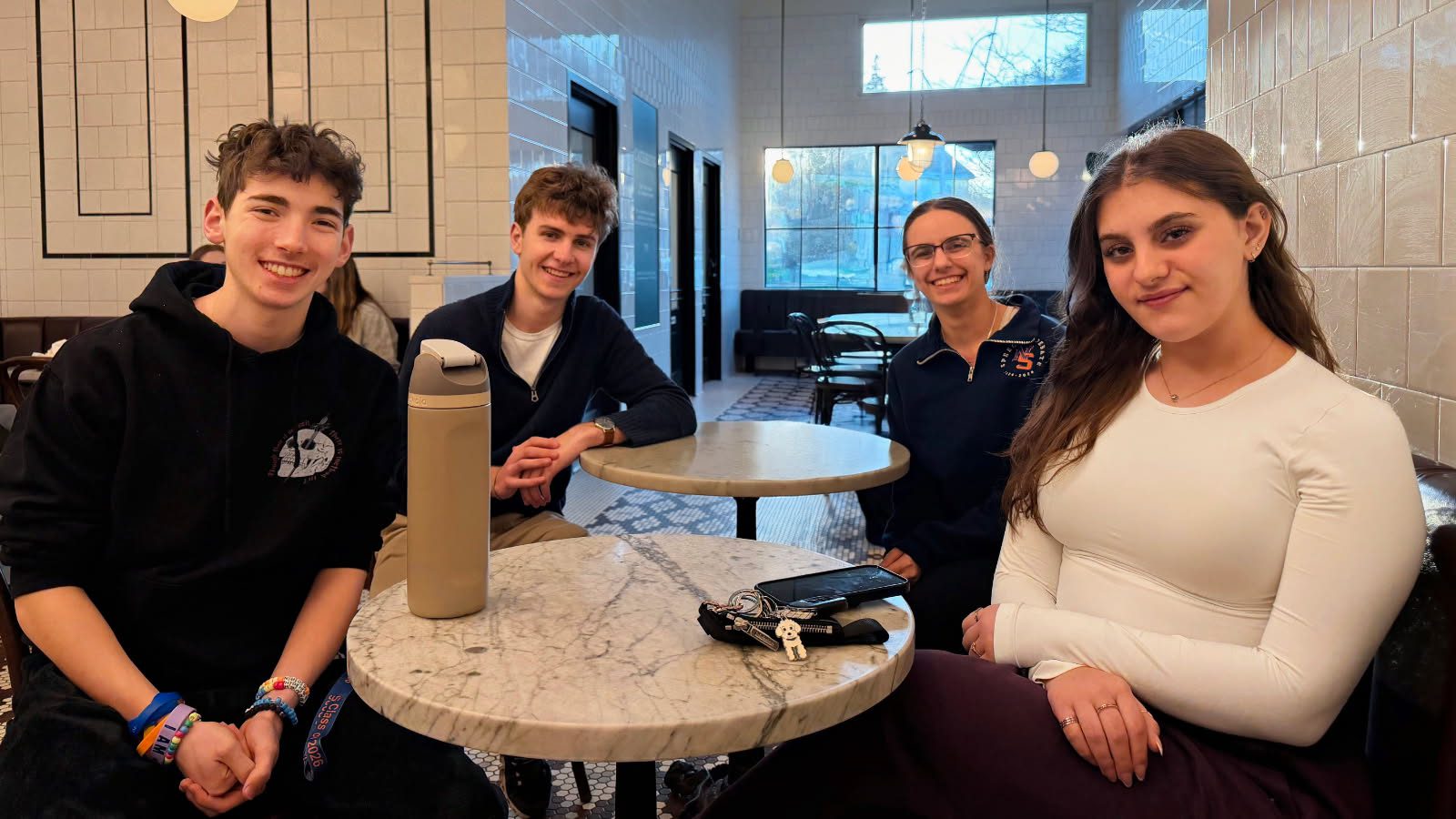
    Newton South Mock Trial Team prepares for national competition. Front: Owen Butler, left, and Emily Zisow, right. Back: Theo Younkin, left, and Sofia Telio, right. Courtesy photo

    A courtroom filled with mystery, jealousy and a peanut allergy found Audrey South guilty of poisoning Ava Maru on the set of their TV show, “Steepton Mystery.”

    The most surprising part of the case? It was entirely fake.

    It was the Newton South High School Mock Trial Team that told the story at the Massachusetts mock trial championship March 20—and won. Arguing as the prosecution, the team beat Dover-Sherborn and secured its first state championship since 2008 and is now preparing for the national tournament May 7-9 in Des Moines, Iowa.

    As prosecutors, the team argued that Audrey South, the director of “Steepton Mystery,” murdered Ava Maru, driven by lingering resentment from their university days. The defense sought to cast doubt on that narrative, claiming the death was either a tragic accident or caused by another actor, Lugansky Cook, whose jealousy over losing the lead role provided motive.

    “By the time you get to finals both teams are just so incredibly good that it was honestly a toss-up,” said Sophia Telio, one of the Newton South captains. “We ended up winning on a 2-1 judge split.” Months of preparation led to that moment. The team—led by their captains Emily Zisow,  Sophia Teilo, Theo Younkin and Owen Butler—developed nearly two dozen examinations and witness testimonies, refining arguments and performances in daily practices leading up to the competition.

    But the trial was not just about legal reasoning. It was also about performance, the team explained.

    On the stand, Lugansky Cook, portrayed by Owen Butler, became one of the case’s most memorable figures. As questioning intensified, Butler leaned into the role.

    “As the defense asked the last questions, I got a little choked up,” Butler said. “I think my fake crying was pretty good.”

    The drama escalated during cross-examination when Butler, still in character, pushed back against a confusing line of questioning.

    “I kept saying, ‘Sorry, I don’t understand the question,’ but finally I said, ‘Are you threatening me?’” he said.

    The courtroom reacted immediately. The presiding judge cut in: Mr. Cook, please answer the question. Teammates later said the moment felt strikingly real.

    Beyond the theatrics, team members point to something less visible as the key to their success: their culture.

    “We put in a lot of time and a lot of effort and we have a really strong and supportive team,” Younkin said.

    That approach meant long nights, constant collaboration and a team that stayed connected well beyond scheduled practices, reviewing scripts, running arguments and supporting one another.

    “Mock trial is like when you eat really good food—you just keep coming back to it,” Butler said.

    Even amid the intensity, the team found ways to keep things light. While preparing for states, they coached a freshman witness who struggled to sound convincing on the stand.

    “Because he’s younger, he had a younger-sounding voice,” Telio said. “So we trained him to speak a little older. It was like a Pavlovian soundboard trick. We’d play a TikTok audio every time he reverted back, and it would snap him into the older voice.”

    The method worked, and the freshman went on to deliver one of the strongest performances of the competition as an expert witness. 

    While young, many members of the Newton South team are keen on becoming lawyers, which they attribute to their love for argumenting, interest in social justice and even acting and improv. But even outside mock trials, the students are just as busy: tutoring kids, working in journalism or student government.  

    After battling through preliminary rounds—elimination playoffs to the state championship—the team is turning its attention to nationals, where they will face a new challenge: a civil case centered on a wrongful death during a citywide scavenger hunt in Des Moines. With only about a month to prepare, far less than the months they had before, students are once again diving into evidence, arguments and strategy.

    For a team built on both discipline and camaraderie, the next case is not simply another story to tell but another chance to prove it.

    “Apparently New York and Texas are pretty good,” Butler said about the biggest competitors. 

    “We’ll see, but if we want to put positive vibes out there, I’d say we’re the biggest threat,” Zisow responded.

    ****

    This story is part of a partnership between the Newton Beacon and the Boston University Department of Journalism.

  • Lions’ Pride: Newton South alum Veronica Burton enjoys breakout WNBA season

    By Ruyuan Li

    From the hardwood of Newton South High School to the bright lights of the WNBA, Veronica Burton has had a remarkable rise. In her first season with the Golden State Valkyries, she won the league’s Most Improved Player award.

    Back home, her community couldn’t be prouder. 

    “I’m really happy for her that the combination of her work and the opportunity that she got in Golden State were able to fit in a way where she was able to show everyone what she’s capable of,” said Joe Rogers, who coached Veronica through her high school years at Newton South, where she graduated in 2018.

    Born and raised in Newton, Veronica Burton played four years at Newton South High School and was captain for two years. She broke the school’s all-time scoring record with a total of 1,817 points—nearly 400 points more than the previous record. 

    In the 2025 season, the first season she played for the expansion franchise Golden State Valkyries, she averaged career highs of 11.9 points, 4.4 rebounds, 6.0 assists and 1.1 steals in 44 games.

    Emily Chang has known Burton since fifth grade, and the two had played together at Newton South for two years. Seeing Burton win the Most Improved Player award this year didn’t surprise her.

    “She’s not the tallest player, and she’s not the strongest player, but she is so smart with how she plays and her decision making is so quick,” Chang said. “She’s able to see things 10 steps ahead before they’re about to happen, and she’s able to always make the right pass or make the right decision.”

    Chang said Burton’s work ethic and basketball IQ have always been strong, which made her stand out from the others. 

    Burton’s journey in the WNBA was not smooth at the start. After playing four years at Northwestern University, she was selected the seventh overall pick in the 2022 WNBA draft, by the Dallas Wings. 

    As a rookie, she played limited minutes. From 2022 to 2024, she played for Dallas Wings, Connecticut Sun, and AZS UMCS Lublin, a Polish university sports club. In 2024, the Valkyries selected Burton in the expansion draft, which became a turning point in her career.

    Burton, 25, said the opportunity she got is the main factor contributing to her success.

    “I think the organization instilled a lot of confidence in me and gave me a lot of opportunity from my coaches, my GM, and everyone,” Burton said in an interview with the Newton Beacon. 

    Looking back, Burton said playing in Newton and serving as the team captain in high school helped her develop leadership skills that benefit her today.

    Burton had played in the boy’s league in middle school–and was named the league’s MVP. “It stretched my mind and obviously challenged me physically too,” she said.

    Rogers, who is in his 11th season coaching for Newton South High School, said he remembers vividly how excellent Burton was.

    “She was the best player, and people were looking to her,” Rogers said. But that meant Burton had to deal with the pressure of every opponent trying to stop her.

    Gifted players often go to prep schools and play with “all-star” teams, Rogers said, “but she didn’t do that. She stayed at her public school.”

    Athletics run deep in the Burton family. Veronica’s father, Steve Burton, was a quarterback at Northwestern University and is now sports director at WBZ-TV in Boston. Her grandfather, Ron Burton, also played football for Northwestern and in the late 1950s was the first-ever draft pick of the Boston Patriots. In fact, every member of her immediate family has played a Division I sport.

    “There’s a saying that my dad used to say: Once you stop getting better, you’re no longer good,” Steve Burton said. “So no matter if it’s sports or our jobs, we’re always trying to get better every day.”

    Steve Burton said it’s always exciting to watch Veronica play. “The most important thing is no matter how high she goes, she stays grounded,” he added.

    Veronica Burton said the close-knit community has shaped her both as a player and a person.

    “The support that I had throughout Newton was instrumental to the rest of my career,” Burton said.

    This story is part of a partnership between the Newton Beacon and the Boston University Department of Journalism.

  • Candidate Jenna Miara seeks to strengthen School Committee’s relationship with community

    Jenna Miara said she decided to run for the School Committee in reaction to the distrust between the school system and Newton community.

    “It became clear to me that we needed to change the way that we approached some of the challenges and the language that we use to describe what’s happening in the schools,” Miara said. “Based on my professional experiences and my personal perspectives, I think I bring a lot of really critical tools to help move those important changes forward.”

    Miara, 47, will face fellow Newton native Ben Schlesinger Nov. 4 in the race for the Ward 5 seat. Emily Prenner, the vice chair and current Ward 5 seat holder, is not seeking reelection.

    Miara grew up in Newton and attended Newton South High School until she was 16, then left when her parents accepted professorships at Columbia University in New York. She studied American History at Columbia for her undergraduate education before continuing to Stanford Law School.

    She and her husband returned to Newton in 2021 to be closer to their families and enrolled their two children in Angier Elementary and Brown Middle School, the schools she had attended as a child.

    “I noticed that both schools are much more inclusive of all kinds of different learning styles and of students with disabilities and other challenges,” Miara said. “I think that’s really great to see. I’ve been really happy with my kids’ experiences.”

    A big issue that drew Miara to run for school committee, she said, was the sense of distrust among community members after Mayor Ruthanne Fuller’s unsuccessful 2023 campaign to override Proposition 2½. The proposal would have added $9.2 million to the 2024 budget and increased the annual tax bill of a $2.1 million house – the median value in Newton – by $290. After the override failed, Newton was forced to make budget cuts. 

    “If we want to have the ability to come back to the voters and ask for an override to pay for things that the school district needs, we need to start working now to rebuild a sense of trust in partnership with the larger community,” Miara said, “to be clear communicators about what the schools need and what the financial realities of the city budget are.”

    As the executive director of the Interest on Lawyer Trust Accounts Committee, a Massachusetts-based organization that funds legal aid programs, Miara said she has learned communications and social media strategies that she intends to implement as a committee member.

    “Something I’d like to do as a member of the school committee and maybe have the entire school committee as a group come up with more of a communications plan so that everyone in the city feels more informed,” Miara said.

    She also said she believes she can streamline communications with unionized workers at Newton’s schools, especially with her experience as a member of a legal service workers union.

    “I’ve been very involved in collective bargaining from both sides of the table,” Miara said. “I’ve worked in unionized environments, supervised unionized staff and implemented collective bargaining agreements for many years.”

    School choice, a program that enables schools to accept students from other districts, is a divisive topic among Newton parents. Superintendent Anna Nolin has supported school choice, but Miara and community members are skeptical of the program.

    “I would say I’m not convinced on that yet,” Miara said. “I’m open to hearing what she has to say. I want to see some more data from other districts about how the finances have worked out. I want to listen to all the stakeholders in Newton that would be impacted.”

    Amid the war between Israel and Palestine, antisemitism has become an issue in Newton schools. Miara said she has a zero-tolerance policy when it comes to discrimination. 

    “It’s an incredibly important issue to me on a personal level,” Miara said. “I’m Jewish. I’m raising two Jewish children. The palpable rise in the number and intensity of antisemitic hate incidents in this country is deeply upsetting, and I think the schools have an important role to play in combating that.”

    Miara has spent a lot of her career fighting discrimination through litigation and policy as an attorney for firms in Los Angeles and Chicago. 

    “The schools need to be constantly thinking of proactive strategies and responsive strategies,” Miara said. She said she wants members of the School Committee to ask themselves, “What kinds of education and programming are we doing in the schools to counter bias and prejudice, and what kinds of policies do we have in place to deal with incidents when they do happen?”

    She said her years of serving the communities she has lived in have equipped her to handle Newton’s schools.

    “My entire career has been committed to public service as a legal aid lawyer and an anti-poverty advocate and now a nonprofit leader,” Miara said. “It’s core to my sensibilities that we work every day to ensure everybody has access to the support and the opportunities they need to succeed.”

  • Sidebody’s road from Newton South High School to Boston Calling

    Sidebody at Boston Calling (Ben Stas/Noise Floor)

    In 2007, Lena Warnke transferred from the United Kingdom to Newton South High School, where she met a spunky girl, Martha Schnee, in her math class who had dark, curly hair and a distaste for arithmetic. 

    “Martha would raise her hand every day in math class and ask, ‘Why do we need this in real life?’ Every single day,” Warnke said.

    “It’s so funny and ironic that I’m now the drummer,” Schnee said. “It can be mathematical. Not that it is for me specifically, but I’m learning a very applicable use.”

    The two became friends and started playing music together in their senior year with another classmate, Hava Horowitz. The three members of the Newton South Class of 2011 and a fourth member, Cara Giaimo of Sherborn who joined a few years later, make up the Somerville-based indie rock band Sidebody.

    After over a decade playing local venues and basement parties, they got the chance to play at one of New England’s biggest festivals, Boston Calling, last month, sharing the stage with major acts such as Cage the Elephant, Luke Combs and Sublime, with at least 40,000 people in attendance that day.

    With Horowitz on vocals, Warnke on bass, Schnee on drums and Giaimo on guitar, the group creates a distinct blend of punk, rock and electronic influences. However, each member refuses to bind themselves to one genre or instrument. The women are known to rotate instruments and make up songs onstage, and occasionally introduce a synth or “street trash horn” into the mix.

    They all have day jobs. Horowitz, 32, is a leadership and communication coach. Warnke, 32, is an educator and cognitive scientist. Schnee, 32, is an artist and visiting lecturer in studio foundations for drawing at the Massachusetts College of Art and Design. Giaimo, 35, is a freelance science journalist. But by night, the women tear up local venues.

    Their success can be traced back to their freshman year in the halls of Newton South High School.

    Warnke met Horowitz in a global studies class. Coming from the U.K., Warnke said she experienced “culture shock” when she saw Horowitz’s eccentric style.

    “I remember you had short pink Uggs that were signed by all of your friends in eighth grade, and I had never seen Uggs before,” Warnke said.

    “Yeah, I think they had a hole in the toe,” Horowitz laughed.

    They got close while participating in Newton South’s WISE program, which allows seniors in good academic standing to pursue a part-time or full-time community service, research, or personal project instead of taking a full course load.

    “We were like, ‘Hey, let’s drop out of classes and do something fun,’” Horowitz said.

    The three friends dropped four of their six classes and opted for part-time projects exploring photography and visual art. Soon they started to jam. 

    It was this class that planted the seeds of their project, and after years of honing their skills and hours locked inside together during the pandemic, it bloomed into the distinct sound they make today. With synth riffs and spoken-word lyrics, the band’s style is reminiscent of ‘80s pop grooves and the ‘90s Riot Grrrl punk.

    “Lena and I did the project together,” Horowitz said, “and she taught me how to draw, and we made a comic book together, and Martha did a project related to photography.” 

    The women from Sidebody pose for a picture, date unknown. Courtesy photo

    One day in school, less than a year after they started playing together, the band discussed names. After an amusing conversation about body parts in which Martha mentioned her side body, they decided on the name “Sidebody.”

    They began playing their instruments in high school, but it wasn’t until the pandemic that the band took their music to the professional level.

    The band members credit Newton South’s many extracurricular resources and programs with fostering creativity among students. 

    “The school itself was really invested in the arts … the theater, music program, band, a cappella,” Horowitz said. “There was just a lot of investment.”

    Many of Sidebody’s projects are made possible through connections they made at Newton South. The videographer who filmed their latest music video was the beatboxer in Horowitz’s high school a cappella group, the Newtones. Their music producers also went to Newton South.

    “By the time we graduated high school, it was like a 300-person friend group,” Horowitz said.

    Giaimo met the group several years later, after her roommate let the band practice in her basement in Somerville. She taught herself guitar at 15 years old and has played and written music ever since.

    “We like to say that Cara has an honorary degree from Newton South High School,” Horowitz said.

    One night, Giaimo and her roommates had a party, and Sidebody played a few songs for the crowd.

    “I don’t know, I just thought they were awesome,” Giaimo said. “I just really liked the show. And I could tell that they were just goofing around and having fun, but I thought the songs were really good.”

    The band is now deeply involved in the Somerville community through local venues, zines, and activist movements. They make their own designs for T-shirts, costumes, and other merchandise.

    “We’ve lived here for a long time, and we’re pretty rooted and invested in sustaining living here,” Warnke said. “It’s not easy to live in Somerville as an artist. It’s very expensive.”

    They rent a space at Central Street Studios in Somerville to house their printing press business and other art ventures. Recently, they learned that the owners are selling the building. They and 30 other tenants who are part of a nonprofit called The Arts and Business Council are trying to purchase it.

    “We started a fundraiser,” Warnke said, “and we are raising money from the community to try to get the sale to go through so that the building can remain as an affordable artspace in perpetuity.”

    Sidebody at Boston Calling (Ben Stas/Noise Floor)

    Sidebody at Boston Calling (Ben Stas/Noise Floor)

    The band has survived years of physical and mental obstacles together, contributing to the band’s ever-changing identity. After over a decade with each other, Sidebody embraces their collective chaos.

    “It’s very hard to define what the kind of music we create is, how we all switch instruments,” Horowitz said. “It really just reflects the changing nature of the band.”

    From their high school years to now, they have categorized the phases of their band into three eras: pre-music, music, and post-music. In high school, the musicians used to “wing it” during performances; now their sets are thought out. 

    As they have worked together longer, they have put more structure and attention to detail into their sets.

    “I think we did go through a curve where we got better enough to be like, ‘We don’t know anything,’” Giaimo said. “Now I think we have moved past that, and we are, like, learning more and stepping into our confidence again.”

    Even at Boston Calling, the band made sure to include an improvised jam in their set. Playing at Boston Calling was a dream come true for them.

    “It was unreal… And to be on the biggest stage in New England was so fun,” Schnee said. “All of our families were there, and parents were there. That was really cool to have.”