
Tag: Olympics

  • A Cambridge teen is the nation’s best junior épée fencer

    A Cambridge teen is the nation’s best junior épée fencer

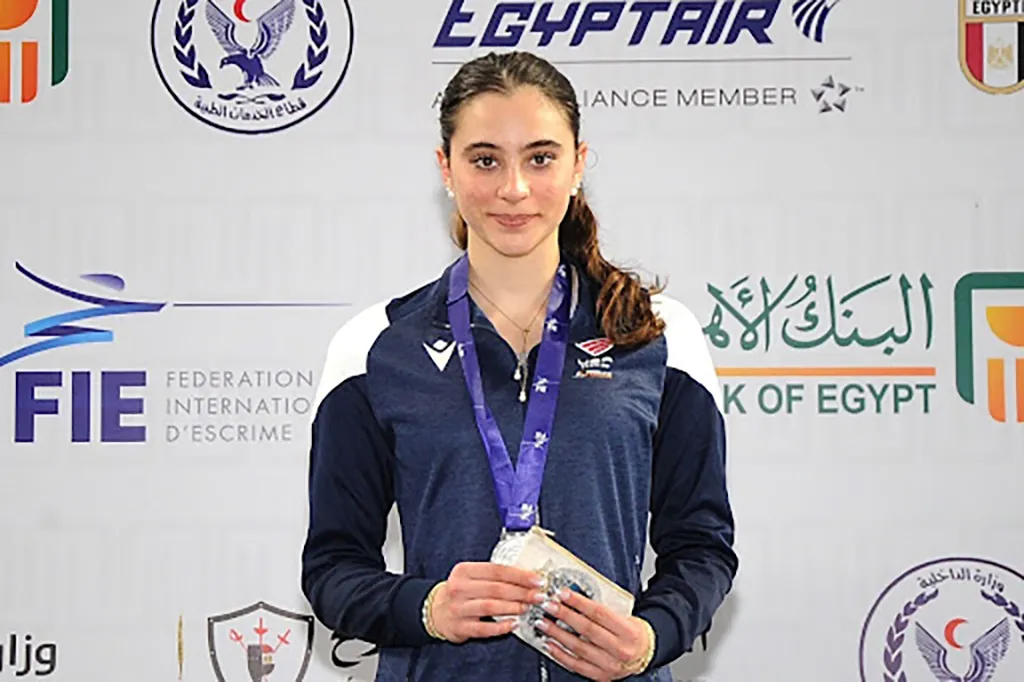
    Natalya with her silver medal in the Cairo Junior World Cup Credit: Mohamed Mostafa

    Sophomore at CRLS will compete in the world championships

    A 16-year-old Cambridge resident has become one of the nation’s top-ranked fencers. Now she’s preparing for the world championships next month in Brazil.

    Natalya Cafasso ranks first in the United States in both the junior (under 20) and cadet (under 17) categories in épée. Épée is the only blade in fencing for which the whole body is the target, unlike the two other blades, foil and sabre.

    For her, competing at the 2026 International Fencing Federation Junior & Cadet World Fencing Championships is a dream come true. She has been fencing since she was 6 years old and competing since she was 13. “It feels amazing. I never thought I would be in this position,” said Cafasso, a sophomore at Cambridge Rindge & Latin School. “Representing USA is a big deal, and it feels amazing that I can represent my country at the highest level.”

    On top of her dominance in the U.S. junior and cadet categories, Cafasso is ranked seventh in the world in junior women’s épée and 13th in the U.S. in senior women’s épée. 

    Even with her experience, the opportunity to represent the U.S. at one of the highest levels of fencing is a daunting task. Regardless of the pressure, Cafasso wants to stay focused.

    “It’s always a lot of pressure, because you travel all that way for one event, but I try not to think about it at all. I try to be present in the moment,” she said. “The results don’t matter as much to me. Obviously they matter, but it’s not like hanging above me, like I need to do this.”

    Natalya facing off in tournament competition. Credit: Mohamed Mostafa

    Cafasso had a rocky start to the season, but over the last five months she found success. She has reached the podium in her last four competitions, bringing home a silver and three bronze medals.

    She sees this run as a “butterfly effect.” Before her four medals, she narrowly made the U.S. roster for the junior world cup in Hong Kong in November.

    “If I never qualified for that competition, none of this would have happened,” said Cafasso. “I think that’s really interesting to look back on, because my whole entire life would have been different if I didn’t make that one competition.”

    Even though she placed 22nd in the competition, just having the opportunity to be on the team and compete showed her she belonged. 

    Daniel Hondor, Cafasso’s coach at the Olympia Fencing Center, noticed a shift in her attitude after the competition in Hong Kong. Ever since then, her game has taken a step up.

    “Before the first one, she was, ‘Am I ready for this? Do I belong there? Do I not belong there?’ and once she actually made the first bronze in Spain, she got the confidence and maturity that she needed,” Hondor said. “Once she convinced herself that she belonged, she mastered it.”

    Hondor and Cafasso have put in countless hours of work and training to get her to where she is. Cafasso spends five to six days a week at the Olympia Fencing Center working on her craft.

    Natalya celebrates after a win. Credit: Mohamed Mostafa

    Aside from fencing, Cafasso holds a 4.0 GPA at CRLS. When she’s not competing, training or traveling, she spends her time studying and catching up on work. She often studies on overnight flights and in the airport. 

    Regardless of the outcome in Rio, Cafasso is striving for an even bigger goal in her future – the Olympics in 2028.

    “The Olympics are very much the goal,” said Martin Cafasso, Natalya’s father. “At this point, she’s 13th in seniors, with two years to go before L.A.. It would be still a long shot for an 18-year-old, particularly in épée, to get there, but she feels like she can do it.”

    This story is part of a partnership between Cambridge Day and the Boston University Department of Journalism.

  • Dropkin reflects on winning silver medal at Olympics

    Korey Dropkin (rear) and his mixed-doubles partner Cory Thiesse (front) won a silver medal in mixed doubles. (Photo courtesy Korey Dropkin).

    Korey Dropkin began curling when he was a “little man that couldn’t even walk” at Broomstones Curling Club in Wayland, hoping that one day he would compete in the Olympics.

    Two decades later, after a nearly five-hour bus ride through the towering evergreens and snowtopped mountains of Cortina d’Ampezzo, Italy, he finally arrived at the entrance to that dream.

    At the 2026 Winter Olympic Games, Korey Dropkin and his mixed-doubles partner, Cory Thiesse, won six of the nine round-robin games, securing a spot in the semifinals, eventually bringing them to the final game against Sweden, where they fell just short of gold.

    In the end, Dropkin left with not only a silver medal but also an experience he said was “everything and more” than he expected.

    “One of my big goals and dreams of the week was not just to get on the podium, but to showcase how much I love the sport and how fun and energetic and complicated and strategical and physically demanding the sport of curling is,” he said. “And I think we really accomplished that.”

    Record-setting performance

    The duo’s performance at this year’s Winter Olympics also set multiple records, including the first mixed-doubles team in curling history to win the first four consecutive games at the Olympics, the first American female to medal in curling, and the first American team to medal in mixed doubles.

    Dropkin, a real estate agent who’s lived in Duluth, Minn., for the last 13 years, said that without Broomstones, he would have never become a curler.

    “Broomstones is definitely responsible for so much of my career and so much of the tradition of the sport, and why I fell in love with curling in the first place,” he said. “It’s a special place in my heart.”

    Rich Collier, president of Broomstones, said Dropkin is the first from the club to medal at the Olympic Games.

    “Everyone at the club is just incredibly proud of the accomplishment,” Collier said. “To rise to that level on the world stage is really admirable.”

    Broomstones hosted a watch party for the gold medal game, drawing in more than 50 people, from Dropkin’s family friends and those who used to play against him, to those who have never met him. Collier said “the excitement level was quite high” as everyone cheered the team on, decked out in red, white and blue, with American flags in hand.

    Collier said he thinks Dropkin’s achievement will inspire the next generation of curlers at Broomstones.

    “I’m sure there are a lot of kids that are now coming up through the junior program that are seeing, ‘Oh, wow, that is possible. I’m in the same program that spawned that Olympic medalist’,” he said.

    Korey Dropkin said the Olympic Games are “so, so different” from a typical event because of the pressures and stressors that arise from “the weight of the country on your sleeve.” In addition, there are distractions constantly “pulling you left and right,” from prominent figures showing up to people wanting the athletes’ time and attention.

    “It’s the biggest beast in the world when it comes to a sporting event, and there’s millions and millions watching,” he said. “You don’t quite understand the magnitude of it until you’re there experiencing it.”

    During their game against Canada, one such distraction occurred when Thiesse pointed out to her partner that his mom, Shelley Dropkin, was sitting next to Snoop Dogg, who was wearing a T-shirt and jacket with the players’ faces on them.

    Shelley Dropkin said Snoop Dogg’s agent asked her to sit next to him so she could explain the sport of curling to him. As she was talking to him, she also discussed the “humanity” of curling with him, she said.

    “There’s no shoving or pushing or being verbally demeaning to people on the ice,” she said. “You may think it or feel a frustration inside, but you don’t publicly do that.

    And he said, ‘We need more of this in the world.’ I said, ‘We do.’”

    Days later, when the Super Bowl aired live on television, a segment following the halftime performance showed various pictures of Snoop Dogg, including one of him beside her at the curling match.

    Keith Dropkin, Korey Dropkin’s dad, said throughout the Olympics he and Shelley received numerous messages from people tuning in to the games, including many who are not curlers but watched the team for their positive energy and enthusiasm.

    “It was remarkable that all these messages that we got, they weren’t red, they weren’t blue, they were red, white and blue,” Keith Dropkin said. “Everybody pulled together for a common purpose, which we so desperately need in this country.”

    Journaling helped

    Amid the chaos of the games, Korey Dropkin found peace writing in a journal, gifted to him by his best friend right before leaving the U.S. for the Olympics.

    “‘You spent your whole life chasing this dream,’” Korey said, recalling what his friend told him as he was handed the journal. “‘Before you know it, with a blink of an eye, it’s going to be behind you.’”

    The morning after Korey Dropkin and Thiesse lost two consecutive games to Great Britain and South Korea during the round-robin portion of the tournament, he poured out his emotions onto the page. Throughout the rest of the tournament, he said, there were a few paragraphs he kept going back to.

    “No matter what happens from here on out, whatever happens these next three games, I knew my parents, my family, were going to be proud of me, whether we made the playoffs or not, whether we were on the podium or finished last place,” Korey Dropkin said, reciting what he wrote in the journal from memory.

    Beyond Snoop Dogg putting his arm around his mom, the best part of the entire experience for Korey was his family being there to watch him live out his dreams.

    “It was just so special having our family and our friends there,” he said. “We don’t get there by ourselves. It takes a whole village, and I wouldn’t be a curler without my parents, without my brother, and I wouldn’t be able to do this and maintain the household that I have without my fiancé.”

    Shelley Dropkin said friends and family from around the world, including around 40 people from Duluth Curling Club, came to the games to cheer on Korey.

    ‘You can’t fear failure’

    Korey said he’s had a sphere of support around him during his highest and lowest points, including being “one rock away” from making the Olympic Trials in 2017 and 2021. In these moments, he said, “you can’t fear failure.”

    “It’s really easy to fall into a state of depression and disappointment and frustration and anger,” he said. “But to be able to pull yourself out of that, to stand up, to move forward, to use that as fuel for your fire and a bigger sense of motivation to keep on pressing forward and being resilient … You know, it’s the man in the arena that gets the acknowledgement.”

    Korey’s end goal is to professionalize the sport of curling, a movement he is currently leading in the U.S. as the captain of Frontier Curling Club.

    Frontier is the United States-based team in the Rock League, the first professional curling league in the world, which is set to begin in April.

    Korey’s next step is to decompress and focus on the Rock League, but in four years, he plans to head into the French Alps for another shot at Olympic gold.

    “We’ll be back,” he said. “We’ll be back.”