

Tag: parks

  • A park crawl of Allston-Brighton

    A park crawl of Allston-Brighton

    McKinney Park

    The McKinney Park sign behind the dugout at the baseball field. Photo By Sarah Cruz. 

    At McKinney Park (74 Faneuil St), a bustling expanse of playgrounds, basketball courts and wide soccer fields, young children gather on the field for soccer practice while teens bump arms in a basketball court. Elderly neighbors and young families walk through the entrance from surrounding homes that line the park. 

    The city has been planning renovations to McKinney Park since 2016. Pam Mullaney, co-founder and treasurer of the Friends of McKinney Park, said she and her neighbor, Michael Bianchi, decided to start the group after the COVID-19 pandemic delayed the City’s plans.

    One of McKinney Park’s playground structures. Photo By Sarah Cruz. 

    Mullaney said she saw firsthand, working for Councilor Breadon with the Friends of Chandler Pond, how much of a difference neighborhood advocacy groups can make. 

    “When a group of neighbors becomes organized and advocates for a park, it makes a huge difference,” Mullaney said. “It can help the neighborhood and the Boston Parks and Recreation Department by having one organized point of contact when some tough decisions are approached.”

    McKinney Park’s renovations are expected to conclude in 2027 and will include splash pads, better park lights and natural turf fields.

    One of the most contentious issues, Mullaney said, is whether the new renovations should include artificial turf. It might mitigate the park’s existing drainage issues and extend sports seasons. On the other hand, neighbors worry about the plastic’s impact on health and heat conduction, especially during hot days. McGuirk and Mullaney point out that the hot rubber would be unbearable to step on in Boston’s heat. 

    According to the National Library of Medicine, the bits of rubber cushioning artificial turf may contain hazardous chemicals classified as carcinogens, neurotoxicants and endocrine disruptors; however, there are not enough studies showing how they actually impact people’s health.

    Elle, almost 1 ½ years old, at the soccer field at McKinney Park. Photo by Sarah Cruz.
    Phoebe, 12 years old, at the soccer field at McKinney Park. Photo By Sarah Cruz.  

    Mullaney and Bianchi started the friends group to give their neighbors a place to voice their opinions.

    “We’re expecting great things in the park,” Mullaney said. “Just more opportunities as the neighborhood continues to be more diverse.”

    Patricia McGuirk, who is on the board of the Friends of McKinney Park, has lived on Goodenough Street, one of the streets lining McKinney Park, her entire life. She said that the park is a great neighborhood resource, especially for families who don’t drive.

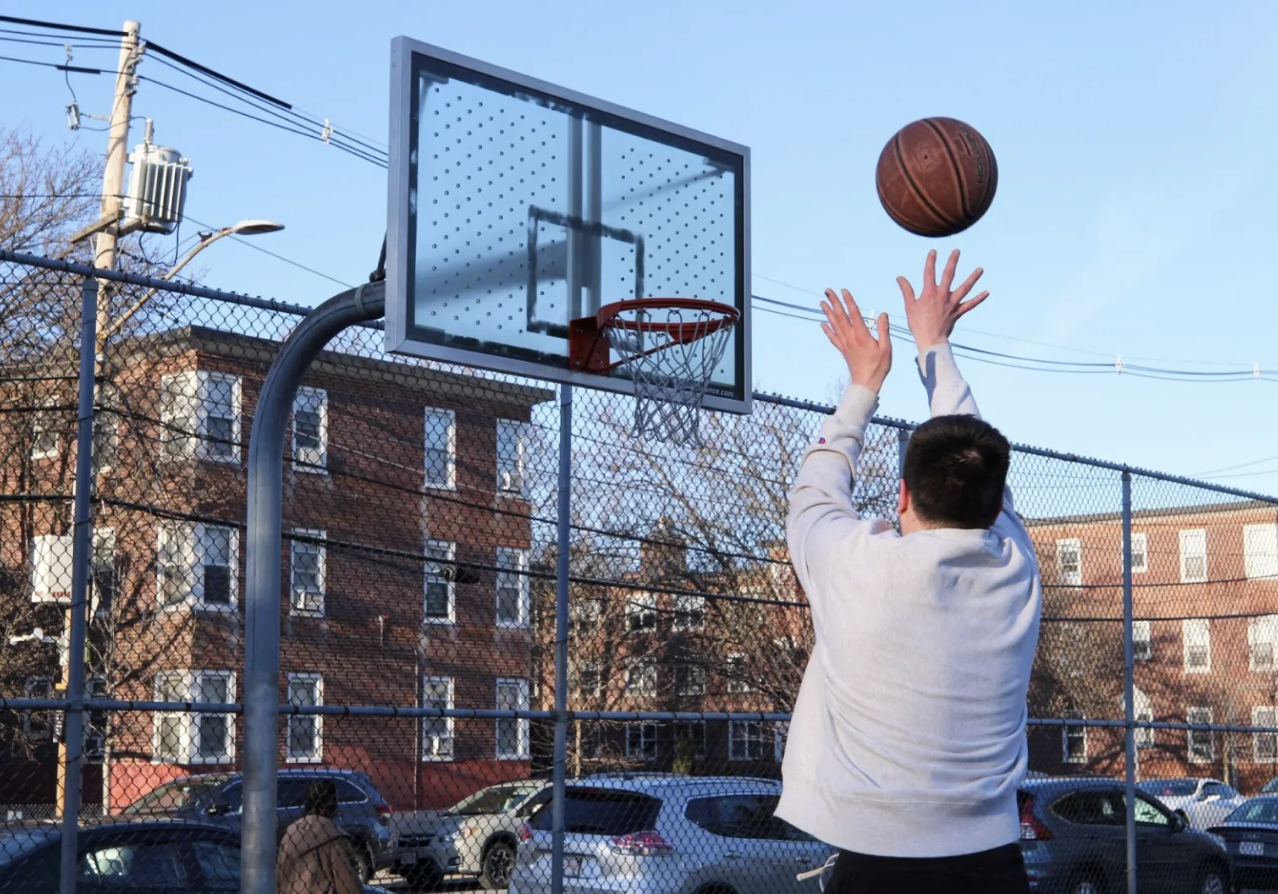
    Brian Cerow plays basketball at the court in McKinney Park. Photo By Sarah Cruz. 

    “I wish we had more trees, more open space, more places for kids to just be kids,” McGuirk said.

    McGuirk described how she took her kids to baseball practice at McKinney Park when they were young. Now, she takes her grandkids to the playground. 

    Established in 1930, McKinney Park has had a long-standing presence in the Allston-Brighton neighborhood. 

    In the 19th century, the area that is now McKinney Park was mainly open fields but contained a few houses near the side of Faneuil Street. 

    McKinney Park was formerly the area delineated under Patrick Kenney and Hiram Barker in this 1890 map. Courtesy of Brighton Allston Historical Society. 

    In the 19th century, the area that is now McKinney Park was mainly open farmland but contained a few houses near the side of Faneuil Street. The infamous Winship family made Brighton, at the time, the epicenter of cattle trade and a significant horticultural hub in New England. 

    Nearby, on much of the land from the corner of Market and North Beacon Street to the river, there were the Winship Gardens. These nursery gardens were a regional attraction. People would come from far and wide using the Boston and Worcester Railroad to see them.  

    In 1937, after McKinney Park was eventually created, a group of 50 children held a demonstration to protest the stalled completion of the park’s field house, where officials had yet to install showers or other accommodations. 

    Charles River Community Garden

    Charles River Community Garden sign. Courtesy of Julian Knight. 

    The Charles River Community Garden (1450 Soldiers Field Road) is sandwiched between the narrow, western side of the Charles River and the busy Soldiers Field Road speedway, where cars zoom past. Runners and bikers speed down a trail towards the Charles River Park. When we meet her on a sunny April afternoon, Susan Bellows, a Charles River Community Garden council member, jokes that if you close your eyes, it almost sounds like you’re on the beach.

    It’s a sunny April afternoon, and Bellows treads lightly along the garden’s woodchip paths, identifying the few small green roots that have sprouted up so far: carrots, onions and strawberries. 

    Blossoming yellow daffodils in Charles River Community Garden. Photo by Sarah Cruz. 

    The garden is quite bare around this time of year — it’s too early for growing. Each plot is separated with wood planks, and one has a batch of yellow daffodils that add a pop of color. 

    In the summer, the garden turns into an all-you-can-eat buffet for voles, rabbits, birds and squirrels, and some gardeners already have built makeshift fences — even entire cages — to keep the critters out. 

    Bellows, who has been involved with the garden for over 30 years, has endless stories about animal mischief — like the time her husband and son went to the garden late one night and turned on their flashlights only to find a colony of rabbits in the garden.

    A faux owl in a garden plot to ward off hungry animals. Photo By Sarah Cruz. 

    Bellows said when planting starts in the summer, zucchinis, tomatoes and unusual varieties of squash fill the garden.

    “It’s a very international group of gardeners of all ages who bring their gardening techniques and plant preferences and knowledge,” Bellows said.

    The 240-square-foot garden houses around 75 plots and over 100 gardeners. Anyone interested can sign up on the Charles River Community Garden website, where they’ll be placed on a waitlist. There is a 30-dollar annual fee, and members must volunteer two days a year laying down fresh chips, clearing out weeds and trimming roots or trees.

    Sometimes people will abandon their gardens, Bellows said, and at that point, Henry Shapiro, the Charles River Community Garden coordinator, will pull people from the waiting list. 

    Aerial view of Charles River Community Garden. Courtesy of Ross Duncan-Brown. 

    With funding from the Massachusetts Department of Food and Agriculture’s community garden program, Hensler and 20 friends started the garden in 1979 after she could not find an available plot at Herter Garden in Herter Park, according to the Charles River Community Garden

    As a board member, Bellows manages shipments to the garden, organizes work activities and supports gardeners when they have disagreements or complaints. She joined the Charles River garden after moving to Cambridge from Los Angeles. 

    “I realized how nice it was when you live in a city and feel like you could still go out and be in a garden and be part of a community,” Bellows said. “

    Chandler Pond 

    View of Chandler Pond from Lake Shore Road. Photo By Sarah Cruz. 

    Lake Street bleeds into Lake Shore Road as Chandler’s Pond (Lake Shore Road) comes into view and an array of trees frame the water as it ripples in the breeze. Geese float in the pond amidst the peaceful silence.

    Neighbors of the pond walk along the curved path in the adjoining Alice E. Gallagher Park. There is a mix of light chatter and a rhythmic tapping of dog paws. 

    Residents fish along the edge of the water, patiently waiting for a catch. On a patch of grass, two people lounge across a blanket, eagerly sketching the scenery before them.  

    During the New England winters, the pond completely freezes over. In the 19th century, it acted as a fruitful source of ice for residents before the invention of refrigeration and electricity. 

    Local horticulturist and entrepreneur William C. Strong excavated Chandler’s Pond in 1855, establishing an ice-harvesting business. In 1858, he sold the pond and its adjacent ice house to ice merchant Malcolm Chandler. 

    The pond in the late 1800s with Kenrick Street in the foreground and Chandler Mansion on the center right. Courtesy of Brighton Allston Historical Society. 

    He created Strong’s Pond, which is largely gone now, to the west of Chandler’s Pond seven years later. With the introduction of refrigeration, the two owners engaged in fierce competition over the ice business until they eventually sold off their properties to respective buyers. 

    After a trail of different owners, developer George W. Robertson acquired Chandler’s Pond in 1925 and subdivided the area into lots for residential development. The City of Boston then obtained the pond in the late 1930s and, under the persuasion of then-City Councilor Maurice Sullivan, created the Alice Gallagher Memorial Park on the southwestern rim of the pond in honor of the local activist.  

    Boston Parks and Recreation’s sign for Alice E. Gallagher Park and Chandler Pond. Photo By Sarah Cruz. 

    “It’s kind of unique,” Charlie Vasiliades, the vice president of the Brighton Allston Historical Society (BAHC), said. He explained that many of the ponds in the metro Boston area were later filled in. 

    It is “the last survivor of nearly twenty ponds, which once dotted Allston-Brighton,” according to the BAHC website

    Concerned for the pond’s run-down state, Genevieve Ferullo and fellow Brighton residents founded the Chandler Pond Preservation Society in 1996. 

    In a 1998 interview between the BAHC and members of the Chandler Pond Preservation Society, neighbors recall how clean the pond was during the ‘40s and ‘50s, when most of the Chandler Pond residents first moved to the area.

    The pond water. Photo By Sarah Cruz. 

    “In the spring, I remember, you could go around and see the turtles,” Alan Morgenroth said. “It was nice and clear, you could see all the flora down the bottom.”

    Some neighbors describe the pond shrinking, overgrown reeds along Kenrick Street and yellow algae growing on the water’s surface. 

    In 1998, the Boston Parks Department and Chandler Pond Preservation Society collaborated with Harvard University and the City of Boston’s Urban Wilds Program on a dredging project, according to the Friends of Chandler Pond website. The project removed the pond’s surface sediment and planted wetland species along its shoreline to protect wildlife. 

    The organization was renamed to Friends of Chandler Pond in 2019, according to the Friends of Chandler Pond website. 

    Now maintaining the pond for over 30 years, the non-profit organization collaborates with the City of Boston to advocate for the pond’s preservation. 

    Sign detailing how the city of Boston has helped to preserve the pond through the Boston Community Preservation Fund. Photo By Sarah Cruz. 

    The organization also collaborated with Crawford Land Management to develop a vegetation management plan in 2020, according to the City of Boston’s Chandler Pond improvements master plan, but has not yet been implemented.

    Volunteers regularly hand-harvest invasive species in the water and fundraise for geese mitigation efforts.

    This story is part of a partnership between Allstonia and the Boston University Department of Journalism.

    Correction, April 12: A previous version of this article incorrectly stated that Susan Bellows was a board member of the Charles River Community Garden. She is a council member of the Charles River Community Garden.

  • Residents share thoughts for Weston’s open space

    In Weston, you can’t walk more than a half mile before reaching a trailhead, a fact Kristin Barbieri says distinguishes the town from other Boston suburbs.

    “You can go wander off down a trail in Weston without looking very hard, and I find that completely unique,” Barbieri said at a recent public forum, an event designed to help residents envision Weston’s open spaces over the next decade.

    “I hope we continue to do that and open up more routes into our trails for everyone,” she added.

    Dozens of people spoke during the public meeting on Oct. 26, imagining a town with connected parks, fields, trails and safe bike routes. Residents expressed a desire for neighborhoods with access to open spaces and winter-friendly features on the Mass Central Rail Trail, amenities that would make Weston appealing in every season.

    The input, officials said, will guide the town’s Open Space and Recreation Plan (OSRP), a state-mandated road map that describes how the town will manage 2,000 acres of protected land and nearly 100 miles of trails through 2035. Massachusetts communities are required to have a plan for open spaces in order to qualify for state grants, including those that fund park improvements and conservation land acquisitions.

    “For us on the Conservation Commission, the open space and recreation plan is really our strategic plan,” said Conservation Administrator Jordan McCarron.

    The state’s shift to a 10-year update cycle has been better, he said, because many projects require long-term funding, consultants and coordination. The plan helps the town stay ahead of climate and maintenance challenges, McCarron said, such as invasive plants, forest pests and deteriorating trails. “We need to be able to access state funding,” he said, “and we can’t do that unless we have an updated and valid OSRP that’s been approved by the state.”

    Recreation Director Chris Fitzgerald said residents’ expectations have evolved since the last plan in 2017.

    “We’ve seen an increase in the variety of sports being offered in town and also the number of participants, both youth and adult sports,” he said. In response to demand, the town installed a cricket pitch at Cherry Brook Field for the Adult Cricket League of Weston last April.

    If the last decade was about building and upgrading, McCarron said the next decade is about connection. In a townwide survey, residents said they rely more on cars than they’d like when accessing open space and recreation areas. Instead, they would like safer ways to walk or bike.

    “This update is going to be focused fairly heavily on connectivity between our existing properties and neighborhoods, schools and athletic areas,” McCarron said.

    Scattered trail easements and nerve-racking parking problems, he said, are two issues that complicate residents’ access to natural areas.

    “The biggest outcome should involve just better connectivity to all of the recreational resources in town,” said Fitzgerald. “There will be more of them that you can reach without having to hop into a car.”

    Many speakers at the forum pushed the idea further, challenging Weston’s leaders to protect the town from development while becoming a regional model for managing climate-related issues.

    Nearly 20% of residents who took the survey said they don’t use Weston’s recreation offerings because they don’t know what’s available. Teenagers and older adults were highlighted as underserved groups. Other residents called for more children’s playgrounds, indoor recreation facilities and community events.

    “If people are not utilizing the recreational programming and facilities and our open space and trails, one of the main reasons is because they just don’t know about them,” McCarron said.

    Staffing issues, he said, are a challenge in the town’s Conservation Department, which manages 2,000 acres of land, more than 30 habitat meadows and nearly 100 miles of trails.

    “I’m the only full-time person, and I have two part-time staff,” he said, “but together they are less than one full-time equivalent.”

    McCarron said much of the hands-on work, from Stewardship Saturday projects to boardwalk repairs, is done by volunteers and the Weston Forest & Trail Association.

    “We still have to rely on … goodwill in order to get the real work done of keeping our open space accessible and in good shape.”

    Over the coming months, consultants and staff will update the inventory, set goals and bring the plan to boards and committees for support before submitting it to the state’s Division of Conservation Services. A final public presentation and state review are expected in early 2026, with the finished plan guiding decisions through mid-2035 or mid-2036.

  • Play it Forward: Newton’s Artful Pianos make music for all

    Ninn Davis photographs Tom Page while he plays a painted piano, titled “Koi Notes,” painted by Raquel Fornassaro, located in Newton Centre. Photo by Miu Tung Rong

    A symphony of sound and color takes over the streets of Newton as the Artful Pianos installation returns for the summer.

    Seven hand-painted pianos are scattered throughout the town, transforming parks and other public spaces into art galleries and stages for spontaneous performances.

    “When you walk through the villages of Newton and you see these pianos out, there are all kinds of people playing them,” said Lisa Rucinski, program manager of the Newton Cultural Development Center, which organizes Artful Pianos. Coming from a musical family, Rucinski said she understands that music can bring people together, and she takes pride in maintaining this Newton tradition. 

    The seven pianos, each painted by a different artist and given a name, are all across town through Labor Day:

    • “Embrace Everything,” by Ashley Jin, is along the Upper Falls Greenway.
    • “The Harvest,” by Columba Kenner, sits outside the Auburndale Library.
    • “In Full Bloom,” by Jenn Dua, is in Farlow Park.
    • “Somebody Come & Play,” by DaNice Marshall, is in Austin Street Plaza. 
    • “Find Zen Within,” by Gary “Zen” Chen, sits outside City Hall.
    • “Koi Notes,” by Raquel Fornasaro, livens up Newton Centre Green.
    • “Forget-Me-Not,” by Michael Talbot in Officer English Park, Newton Highlands. 

    Now in its eighth year, the Artful Pianos 2025 installation invites residents to sit down, play and take part in interactive art.

    Luca Dalzell and Ethan Lan play a painted piano, titled “Koi Notes” by Raquel Fornasaro, located in Newton Centre, while a passerby stops to listen. Photo by Miu Tung Rong

    But these pianos aren’t just for music lovers or aspiring performers.

    “People who give their pianos away for this project love to see their old pianos put to use,” Rucinski said. “Meeting the artists, seeing the focus, painstaking detail, and how much they love and get attached to their pianos–it’s just a win-win.” 

    Raquel Fornasaro, a longtime Newton resident and artist, painted the only grand piano in this year’s collection–the rest are uprights. Her piano, titled “Koi Notes,” is adorned with lily pads and koi fish, paying tribute to Crystal Lake, a picturesque 33-acre natural pond in the heart of Newton.

    Fornasaro said her vision was to bring “calmness to the busyness” of Newton Centre with her serene depiction of the lake near her house. Crystal Lake, she said, is “the place where my kids usually go whenever it gets warm. For me, it [has] extra memories of having young kids there.”

    The process of creating the piano installation begins months in advance with help from a team of movers, artists and volunteers.

    It begins with donors looking to part with their old pianos. Greg Livingston, who tunes all of the pianos, evaluates the instruments before they are selected to be in the exhibit.  

    In Farlow Park, Michael Lonzana plays a painted piano titled “In Full Bloom,” painted by Jenn Duan. Photo by Anny Zheng Wu

    Once enough pianos are identified, Griffin Piano Moving transports them to the Newton Bath House at Crystal Lake, a makeshift art studio where the painters work.

    Piano Pals, a group of local volunteers, care for the pianos all summer. They monitor the weather and rush in with tarps whenever rain threatens. Every morning, volunteers like Garrett Van Siclen head to their designated locations to unveil the pianos and return every evening to protect them from the morning dew.

    “If they aren’t getting wrapped and they aren’t being protected from the moisture of the rain, they’re quickly not going to be able to be played anymore,” Van Siclen said. 

    Van Siclen said he enjoys hearing melodies drift through Newton’s neighborhoods–whether it’s a child playing his first notes, an artist bringing her vision to life, or people pausing from their commutes home to listen.

    Van Siclen has witnessed the magic this installation has brought to Newton over the past three summers.

    “Last year,” he said, “there was a couple, and they would come up here every night and play the piano.”