

Tag: restaurants

  • Lexington considers “Skip the Stuff” bylaw to cut restaurant waste

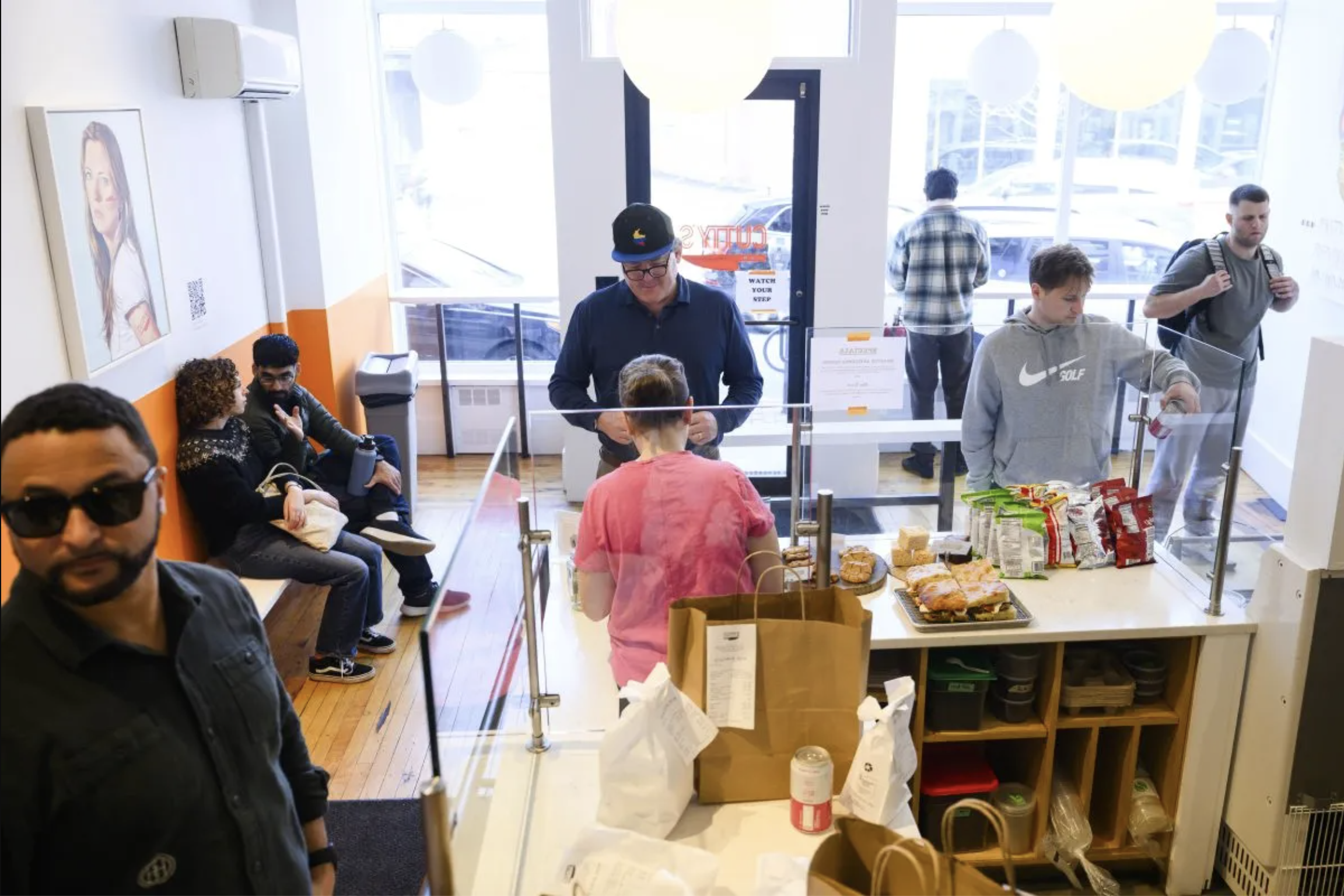
    Lexington Town Meeting Members will vote on a citizens’ petition to adopt a “Skip the Stuff” bylaw that would require local restaurants to ask customers before adding single-use plastic utensils or condiment packets to takeout orders. The vote will take place during the annual Town Meeting beginning March 30.

    “The point of the bylaw is for the restaurants to have to ask as opposed to automatically just putting this stuff in there when people don’t need it,” said Laura Swain, primary petitioner of the bylaw and a member of the Lexington Waste Reduction Task Force. 

    The “Skip the Stuff” initiative is part of a national campaign by the same name. Cities including Denver, Chicago and Washington, D.C., have adopted it, with California, Washington and New York establishing similar legislation at the state level.

    In Massachusetts, a “Skip the Stuff” bill sponsored by state Rep. Michelle Ciccolo was referred to the Committee on Environment and Natural Resources last February. Newton, Brookline, Wellesley and Swampscott have already passed similar laws. 

    The petition builds on the town’s Zero Waste Plan, which was adopted in 2023. Lexington began phasing out the use and distribution of single-use water bottles in 2024 and has since launched a curbside composting program and a reusable food container initiative for local restaurants.    

    When petitioners visited more than 70 percent of restaurants, they discovered that some Lexington eateries were already in compliance with the spirit of “Skip the Stuff,” with restaurants such as Avenue Deli, Royal Indian Bistro and Clay Oven publicly supporting the bylaw.

    Other restaurant owners said the change could hinder customer service and prevent customers from getting the utensils they need. 

    According to the official motion, the town’s Board of Health would enforce the proposed bylaw. A restaurant’s second violation would result in a $25 fine; a third, $50.

    “We are passionate about reducing waste, but we also don’t want to be this burdensome government bylaw,” said Alex Tsouvalas, a member of the Lexington Waste Reduction Task Force. “We want to support these small businesses. We wanted to engage them and have them be part of the dialogue.” 

    On the surface, the proposed policy may seem trivial, supporters say, but they believe “skipping the stuff” is an important step in Lexington’s commitment to reducing waste. 

    “Our Skip the Stuff” bylaw initiative, I think, folds really well into this landscape with the town,” said Janet Kern, a petitioner of the bylaw and vice president of the nonprofit LexZeroWaste. “More people are aware of this unnecessary waste cluttering their drawers at home, just being thrown right into the trash. So, I think people are ready for this.”

    If passed, the bylaw would take effect Jan. 1, 2027. 

    This story was written by a journalism student in BU’s Newsroom program, a partnership between the university, The Lexington Observer and other news organizations in the Boston area.

  • Proposed law could require minimum gratuity during busy seasons

    Jared Forman, owner of Deadhorse Hill Restaurant in Worcester, said the bill is adding more complications by only allowing restaurants to charge a service fee during peak seasons

    As the holiday season approaches, restaurants expect to see large crowds celebrating with friends and family. But servers facing heavier workloads during the busiest days of a year may actually get fewer tips, according to a Massachusetts lawmaker proposing legislation to address the issue.

    A bill offered by Rep. Manny Cruz, D-Salem would allow restaurants to charge parties with more than four a minimum service charge of no less than 19% during peak restaurant seasons that a municipality would define.

    Servers often worry if diners will leave tips during October, the peak season in Salem where about 1.5 million tourists visit the town for Halloween activities, packing restaurants, according to Cruz.

    “[The servers] are working incredibly hard, and the folks wouldn’t leave tips. And I’ve heard these stories countless times,” he said.

    The bill makes the minimum gratuity optional for restaurants, Cruz emphasized. Municipalities determine their peak seasons, and restaurants decide whether it is the right fit for them.

    But having different rules in each municipality causes confusion, said Jen Ziskin, director of Mass Restaurants United.

    “We are in the business of creating great experiences for our guests and for our communities,” she said, worrying that the proposed gratuity will affect diners’ experience as peak seasons start and end at different times in each town.

    Ziskin, who owns two restaurants in Brookline, thinks diners become skeptical of the services they receive if a mandatory gratuity replaces tipping.

    “It’ll create this kind of assumption from the guests that if anything goes wrong,” said Ziskin, “it’s because the gratuity was included, and it might have nothing to do with that. It might be a kitchen issue, it might be a staffing issue.”

    Ziskin also believes that diners tend to tip less when a mandatory gratuity appears on their bill. Last year, Ballot Question 5, which called for an increase in the minimum wage for tipped workers, was voted down. Many tipped workers thought it would result in customers tipping less. Their opposition indicates that dining and hospitality should continue to be a tipped industry, she said.

    Lawmakers need to clarify if this bill will conflict with the “junk fees” guidelines from the Attorney General’s Office that took effect in September, which require restaurants to disclose additional gratuities for large parties on the menu, Ziskin said.

    Some restaurants have adopted an automatic service charge model.

    Jared Forman, owner of Deadhorse Hill Restaurant in Worcester, started charging a service charge of 20% on every bill when the restaurant reopened after the pandemic.

    Forman said the bill is adding more complications by only allowing restaurants to charge a service fee during peak seasons, hoping the rules are consistent and simple.

    “It’s very difficult to deal with your guests when these things are constantly changing,” he said.

    At his restaurant, instead of a tip pool shared by servers, kitchen employees such as line cooks and dishwashers also share the 20% surcharge. Forman thinks it levels the playing field between the front of house and back of house workers, as the latter are often people who are immigrants, who can’t speak perfect English and have fewer advantages.

    “I like the idea that everybody in the restaurant is of equal value and you can pay them according to that value, ” he added.

    December is typically the busiest time at his restaurant and most restaurants in Worcester, Forman said. Charging customers higher prices during the peak season will discount their experience and diminish the enjoyment of a holiday dinner.

    “I want the restaurant to be about hospitality, not about finding a good deal.”

  • Liquor License Laws to be Updated

    Ninety-two years after a Yankee-dominated state government limited the sale of liquor licenses to prevent Irish American politicians in Boston from gaining more influence, city and state politicians are finally taking steps to fix the issue.

    Earlier this year, state lawmakers approved a law allowing cities to upgrade restaurants’ beer-and-wine licenses to all-alcohol. The Boston City Council adopted the resolution in September.  Now, the city’s licensing board will set rules for granting the license, and final approval from the state Alcoholic Beverages Control Commission is expected early 2026.

    “A lot of the restaurants affected by this [were] concentrated in the North End, Beacon Hill, Back Bay, the South End,” said North End Councilor Gabriela Coletta Zapata, the bill’s sponsor, at a hearing last month. “This provides an opportunity for them to share in the economic prosperity [of liquor sales]. Restaurants really do operate on thin margins.”

    Zapata added that the old fears surrounding all-alcohol licenses relating to an increase in public disturbance reflected “an outdated narrative” that no longer fits Boston’s restaurant scene. “These are really places centered around food and the culinary experience,” she said.

    Like many political conflicts, Boston’s battle over liquor licenses tracks to two quintessential issues – power and money.

    After Prohibition ended in 1933, the Massachusetts Legislature refused to let Boston issue its own liquor licenses. At the time, City Hall was run largely by Irish American politicians under Mayor James Michael Curley, whose working-class base clashed with the Yankee establishment at the statehouse. By keeping licensing power at the state level, lawmakers could control who was allowed to sell alcohol in Boston, limiting a major source of money and influence from Curley’s allies. Historians say the decision reflected deep political and ethnic divisions that many people believe still shape Boston’s liquor laws today.

    For Kevin Flemming, president of the North End Neighborhood Council, the reform is long overdue. He said the restrictions were “really a ploy by the old Yankee legislators at the State House to control the Irish politicians in Boston.”

    The number of North End restaurants allowed to sell liquor could more than double under the new law, according to data published by the city. Currently, only 32 of 87 restaurants with alcohol licenses are allowed to sell spirits.

    Flemming said the change could be a boom for businesses.

    “Clearly they feel like they can increase their revenues by having full alcohol,” he said. “So, I don’t really see any downside in it because at least in the North End, everyone applying for these are pretty much established restaurants. No one’s trying to open a nightclub or change their hours.”

    Testimony ran strongly in favor of allowing beer-and-wine license holders to convert to full alcohol service at a city hearing last month. Mimi Chan, co-owner of Dynasty Restaurant in Chinatown, told councilors the change would let her serve traditional Chinese spirits such as baijiu or rice wine, which are not permitted under her current license.

    “It would allow a more authentic dining experience for our customers,” she said.

    City Council President Ruthzee Louijeune also voiced support for the new bill. “By creating opportunities for these businesses to grow,” she said, “we’re investing in the future of our neighborhoods – raising the bar for equity and opportunity.”

    The Boston Licensing Board is drafting regulations for converting beer-and-wine licenses into full alcohol licenses. The city will sponsor outreach events and workshops to help eligible restaurateurs understand the process. To qualify, business owners must file a petition with the licensing board and submit required forms to the Massachusetts Alcoholic Beverages Control Commission. The first wave of upgrades could be approved within months, city officials say, meaning some restaurants may begin serving cocktails by early 2026.

    Applicants will be required to pay a $200 state fee, $100 to the licensing board and $170 to cover the cost of publishing a legal notice in the local newspaper. The board will hold a public hearing, send certified mail to neighbors, and evaluate whether there is a “public need” in the location. After local approval, the application will be forwarded to the state for final consideration.

    The new law does not sanction an unlimited pool of new liquor licenses. Under Massachusetts law, the number of full-alcohol and beer-and-wine licenses Boston can issue is still capped by the state Legislature. The reform simply allows existing beer-and-wine license holders to apply to upgrade to full-alcohol service, creating a new class of nontransferable licenses that cannot be sold on the private market. Boston’s older transferable licenses, established under the state quota decades ago, still exist and can be bought and sold with state approval. Supporters say the new non-transferable licenses make the system more equitable, even as the overall cap on liquor licenses remains in place.

    Full liquor licenses have sold for $200,000 to $600,000 on Boston’s private market in recent years, according to city records. Beer-and-wine licenses have cost about $50,000. By contrast, the new nontransferable licenses will only cost standard filing fees. The wide gap illustrates why many small business owners say they were locked out of the system until the recent changes.

    Councilor Coletta said the new policy marks a turning point for a neighborhood long known for its restaurants but has been hemmed in by outdated liquor rules. “It’s an opportunity for them to share in the economic prosperity,” she said, adding that full licenses can help businesses stay competitive and expand their profit margins.  “These are places centered around food and the culinary experience. This reform just lets them serve what their customers are already asking for.”

  • A ‘little bright spot’: Amid federal cuts, four Berkshire restaurants receive over $68,000 to feed those in need

    This year, four Berkshire restaurants received over $68,000 to cook food for those in need.

    The funds are from the MassDevelopment’s Food Insecurity Grant Program for Independent Restaurants. The award was part of $900,000 distributed to 31 restaurants statewide.

    In Pittsfield, BB’s Hot Spot, Marie’s North Street Eatery and Mazzeo’s Ristorante received $11,420, $13,000 and $10,000, respectively. The largest share went to Bigg Daddy’s in North Adams, which received $34,200.

    The money enabled local restaurants to prepare meals that they delivered to food banks, pantries, senior centers, schools and emergency food distribution sites. Restaurants applied after MassDevelopment invited them for the grant. They were then paired with local food pantries.

    According to Franklin County Community Development Corp. Program Manager Hannah Sobel, the program delivered almost 45,000 meals across western Massachusetts.

    “I’m happy to do so to make sure people are fed,” said BB’s Hot Spot owner Ronny Brizan.

    This program comes at a time of uncertainty for the future of fighting food insecurity, amid heightened concerns over the rising cost of living. Federal funding cuts to the Supplemental Nutrition Assistance Program, or SNAP, could increase food insecurity across the U.S., placing more responsibility on states to fill the gap.

    The current government shutdown could also affect funding for SNAP benefits in the coming months.

    According to a survey from the Greater Boston Food Bank, 39 percent of households in Berkshire County faced food insecurity in 2024. The Food Bank of Western Massachusetts assisted an average of about 25,000 people per month that year. More than 40 food pantries and meal sites operate in the Berkshires.

    “It’s closer to home than you think. There are people in your community who struggle to put food on their table, whether you call it food insecurity, call it whatever you like. But they’re struggling to feed themselves. And they are working people, they’re senior citizens, they’re children,” said Food Bank of Western Massachusetts Executive Director Andrew Morehouse.

    Changes to SNAP will increase eligibility requirements that people need to meet to qualify for the benefits, going into effect sometime this year. Morehouse said the changes will include increased work requirements which could affect those who can’t get work due to disabilities, transportation access or systemic inequities.

    “We’re very concerned. SNAP is the largest anti-hunger program in the country,” he said.

    The loss of benefits will likely drive more people to seek assistance from food pantries, Morehouse said, adding this surge could put food banks under a lot of pressure to meet heightened demand. In addition, the federal government discontinued an annual national survey that food banks previously used to assess food insecurity across the country.

    The Food Bank of Western Massachusetts moved to a larger facility two years ago, and Morehouse said the additional staff and equipment have helped staff meet heightened demand during periods of increased need.

    For now, SNAP benefits for the month of October are protected. A longer shutdown could eventually affect SNAP, and it is already affecting other federally funded programs.

    State Rep. Tricia Farley-Bouvier, D-Pittsfield, said the state is committed to keeping Massachusetts’ four food banks running. She added that with programs like MassDevelopment’s, she always wants to make sure funding reaches as far west as Berkshire County.

    “Things are difficult in this world right now, and then we see some little bright spots,” said Farley-Bouvier. “I don’t think any one of these things is the answer to it all, but isn’t it great that we have a way that we can make differences here and there.”