Tag: Science

  • Families gather for Winchester High School Science & Engineering Night

    Families gather for Winchester High School Science & Engineering Night

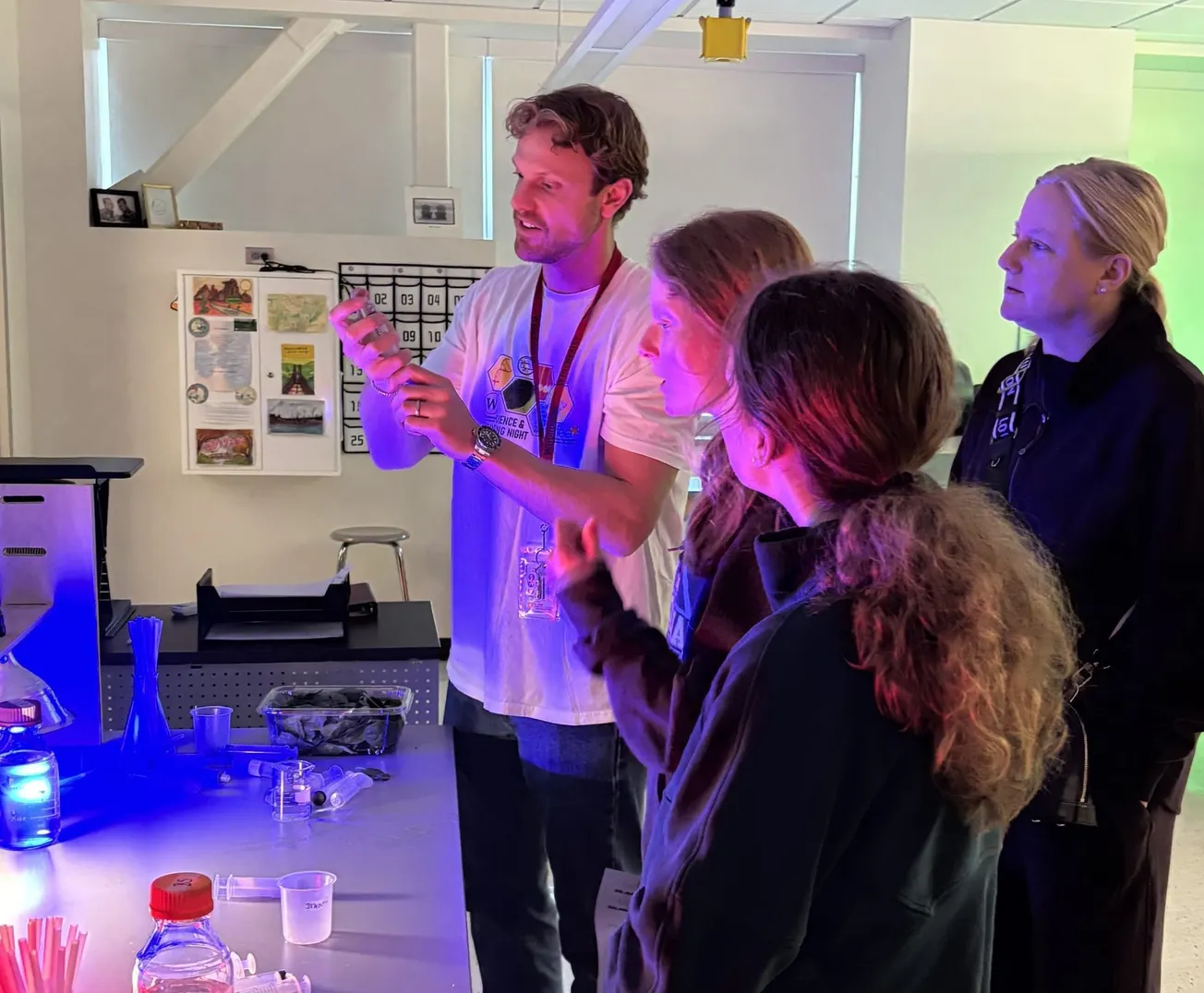
    Science teacher Ben Lawhorn demonstrates a photosynthesis lab in the biology room during Winchester Science & Engineering Night on April 2. COURTESY PHOTO/ANN RITCHIE

    Hundreds of families funneled into Winchester High School on April 2 to look at specimens through microscopes, toy with 3-D modeling on computers and try out pulse oximeters.

    Science & Engineering Night invited parents and children in grades K-8 to visit the high school and watch 39 demonstrations of what students learn in the high school’s 13 science courses. The event, which drew 471 families, also showcased students’ projects and the school’s equipment.

    “It’s great to show people in the town what science offerings they have here,” said Brendan Connors, a parent attending the night with his son, Ian.

    Science Olympiad member Amelia Huang helps the Abbott family explore density in the chemistry room during Winchester Science & Engineering Night on April 2. COURTESY PHOTO/ANN RITCHIE

    The equipment shown to families was paid for with grants from the Winchester Foundation for Educational Excellence, a nonprofit dedicated to raising money for Winchester’s public schools. The organization also funded the event.

    The event was planned as a collaboration between the biology and engineering departments.

    Ann Ritchie, director of science for grades K-12, said she hopes the night will encourage more collaboration among departments in the school.

    High school students who were part of the National Honor Society and the school’s Science Olympiad team ran demonstrations.

    “The way the big kids and little kids interact is so inspiring,” Ritchie said. “That’s what makes this night so unique.”

    Students planned most of the activities. One student asked if they could bring in the Mystic River Association to do a demonstration about herring migration and how citizen scientists count the fish during their migration, Ritchie said.

    “The [high school] kids are excited,” said Ipshita Chakladar, one of the teachers who organized the event. “We get our energy from them.”

    Ethan and Wesley Bates test their hand-eye coordination outside the applied neuroscience room during Winchester Science & Engineering Night on April 2. COURTESY PHOTO/ANN RITCHIE

    The first floor of the high school included 3D printing, a robotics demonstration, a construction and manufacturing booth, and a booth for the foundation.

    An engineering section on the first floor showcased the engineering classes’ creations as well as the wood shop. The creations included a safe made out of wood, a xylophone and a garbage compactor.

    On the second floor, families participated in activities that showed off the biology and anatomy courses. Activities included a brain speed test that asked kids to match the hand symbols pasted to a wall within 10 seconds and test their understanding of anatomy by naming parts of a model.

    Within the high school’s library, families could test out button-making machines, music production, wood burning machines and 3D modeling computer program. There was a showcase of high school students’ projects, including a jacket that helped people with period cramps.

    National Honor Society volunteer Talia Co invites the Parikh family to explore an optical illusion in the applied neuroscience room during Winchester Science & Engineering Night on April 2. COURTESY PHOTO/ANN RITCHIE

    Anthony Zidell, a resident of Crescent Road, came with his daughter to check out what the high school had to offer.

    “It’s really remarkable to see everything the high school has access to,” Zidell said, adding he couldn’t wait to send his daughter to the high school.

    K-8 students who came said their favorite parts of the event were the wood shop, the heart monitors and the robotics.

    Aurelia Gugliotta, a student at Lynch Elementary School, went with her mother because she loves science.

    “I love it,” Gugiotta said when asked about her favorite part of the event. “All of it.”

    Tavishi Chattopadhyay is a journalism student at Boston University. This story is part of a partnership between Winchester News and the Boston University Department of Journalism.

  • Lexington teen earns $90,000 scholarship at national science and math competition

    Lexington teen earns $90,000 scholarship at national science and math competition

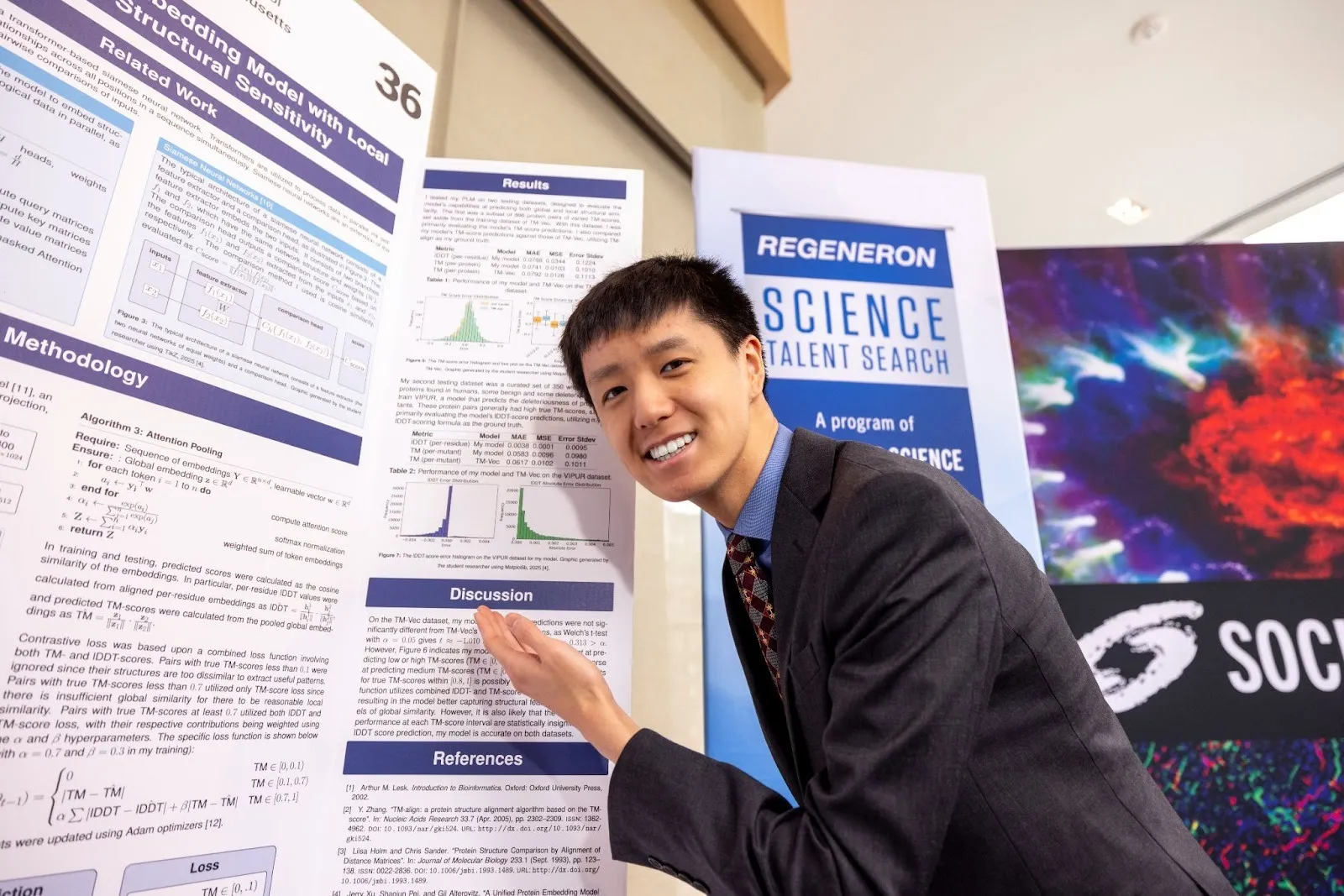
    Jerry Xu is pictured with his project poster at the Regeneron Science Talent Search 2026. / Credit: Regeneron Science Talent Search

    Lexington High School senior Jerry Xu believes that science can be approached in two ways. The first is through a textbook; the second is by making it come to life around you.

    Xu, 17, chose the second path. On March 10, he earned a $90,000 scholarship for placing fifth at the Regeneron Science Talent Search, the nation’s oldest and most prestigious science research competition for high school seniors. Xu created an Artificial Intelligence model that compares the three-dimensional structure of proteins, the molecules that build and repair tissue in the human body. From more than 2,000 applicants, judges selected him as one of 40 finalists to present independent research at the Regeneron Science Talent Institute in Washington, D.C.

    Genetic and medical researchers compare protein structures to understand how molecules function. Small variations in shape can alter a protein’s behavior and trigger disease. Xu’s tool reduced the time needed to analyze proteins from hours to minutes by converting them into correlated numerical patterns of the same size, rather than the current methods, which compare proteins of different sizes.

    Xu’s finish in the Regeneron competition is the highlight of a high school career defined by accomplishment. Last October, he led a team that created an AI chatbot that answers questions about the Lexington High School building project. He co-founded a summer lecture series that teaches biology and math to students of all ages, tutored programming students at the KTBYTE academy in Burlington, and captained the Lexington High School Science Bowl team to a regional championship.

    “I think that as a high schooler, using [science] in my community is one of the easiest and most impactful ways for me to apply my knowledge,” Xu said. “I’m really grateful that the town of Lexington is willing to accept me and try to guide me towards designing these products that are going to help the community.”

    ​Xu devoted the past year to researching, developing and coding his model through the MIT PRIMES Program, a year-long curriculum that offers research resources to high school students in the Boston area under the mentorship of Dr. Gil Alterovitz and Dr. Shaojun Pei, both of Brigham and Women’s Hospital.

    “One thing that really struck me is [Jerry’s] passion, his ability to think about things deeply and think about how to explore things at a deep level,” Alterovitz said. 

    Xu hopes researchers and scientists will use his tool to improve protein genetic analysis. He plans to continue working on the model after the competition.

    “There’s a couple of ideas that I have for my project. One of them is to expand the scale of my model,” he said. “There’s a lot of different directions that I want to explore with this project before I head off to college.”

    Xu plans to use the $90,000 scholarship toward college. He’s considering the Massachusetts Institute of Technology, California Institute of Technology, Yale University, and other schools. Before he makes his decision, Xu will prepare for the National Science Bowl in April and his approaching high school graduation. 

    This story was written by a journalism student in BU’s Newsroom program, a partnership between the university, The Lexington Observer and other news organizations in the Boston area.