

Tag: Soccer

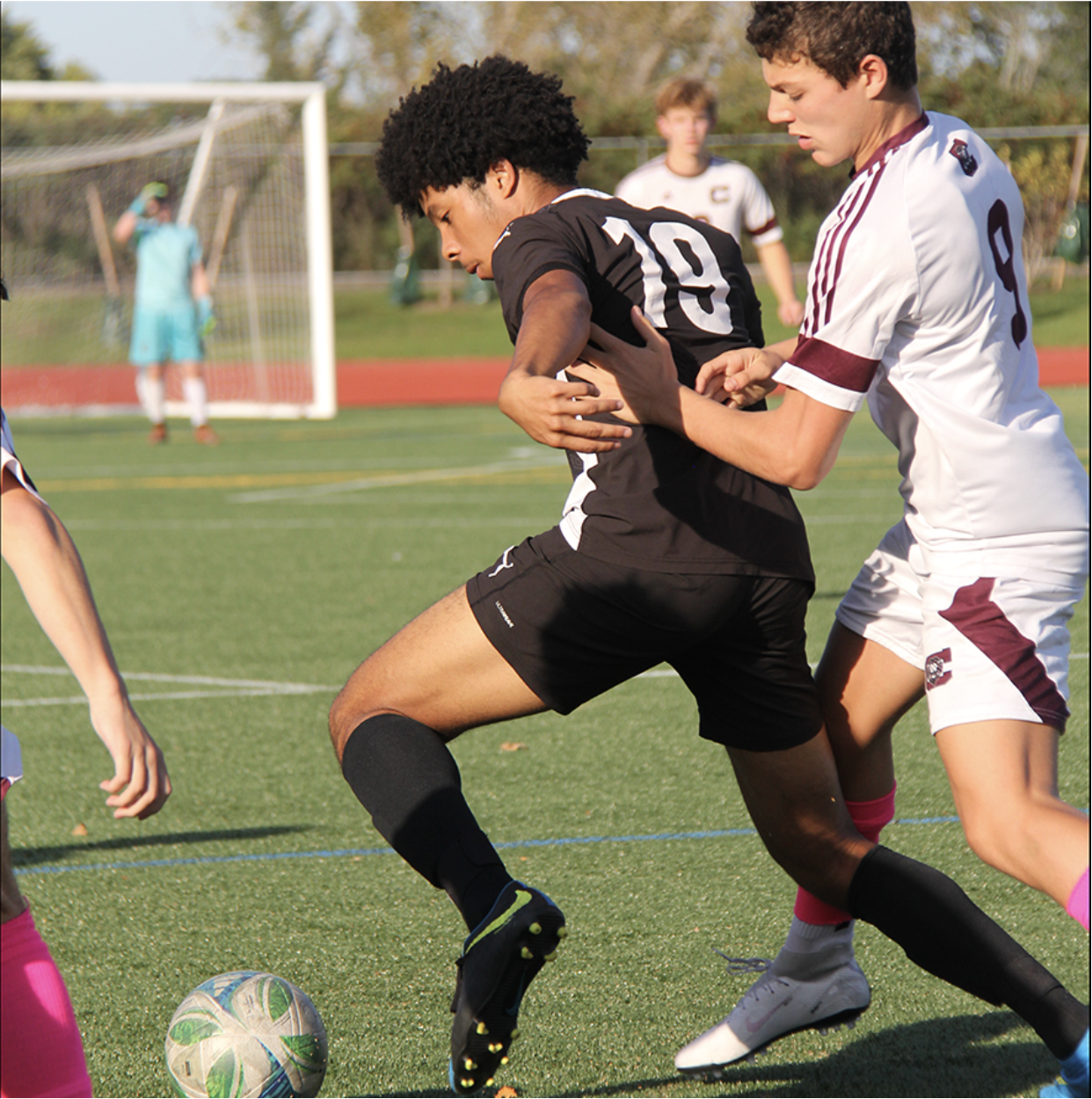
  • CRLS boys’ soccer beats Lexington on penalty kicks

    CRLS boys’ soccer beats Lexington on penalty kicks

    By Layla Penn
    With the score tied at 1 after 90 minutes and two 10-minute overtimes, the Cambridge Rindge and Latin boys’ soccer team was exhausted, but knew it had a job to finish.
    Most soccer players see penalty kicks as a nightmare, but the Falcons saw opportunity against Lexington. Co-captain Rhys Brown, Angel Nunez, Jamilsom Parker and Xavi Mir, all seniors, each drove home their penalty kicks, and sophomore goalkeeper Winslow Livley saved the second one from Lexington. That put CRLS ahead 4-2. The team watched as Livley faced his fourth shot, bounded to the top right corner of the net and pushed the ball into open air.

    There was a sharp moment of silence before the team ran to embrace Livley, confirming their win, followed by Cambridge students rushing onto the field to celebrate with the team.

    “It was incredible, there’s not really much to describe it with,” Livley said. “This was my first state (playoff) game, so I got into the flow, played just like I would in a regular game, and did a little bit extra in the end to save it all.”

    That kept Cambridge undefeated at home this season, and into its first Sweet Sixteen appearance in nearly two decades.

    All the scoring was in the first half, with a quick goal from the Minutemen followed by a Cambridge header from senior captain Giacomo Cotta-Ramusino Zambotti, set up by Xavi Mir off a corner kick.

    The 9th-seeded Falcons threatened multiple times in the second half through Rhys Brown, his brother Michael, and sophomore Mathis Asnake. On the defensive end, Livley and senior defender Angel Nunez made several plays to keep the Falcons in the game until the penalty kicks. Livley made a big save with two minutes left in the second overtime to keep CRLS alive.

    For the senior captains this was a new kind of special. “We’ve always been the team that’s been out in the first round, giving high-fives at the end, crying,” said Michael Brown, a co-captain along with his brother. “It was a great feeling to be out here with my brothers being seniors, big senior class. I just love being with them, and I love dancing with them.”

    Head coach Niko Emack (disclosure: Emack is a member of Cambridge Day’s board), said that goal keeper coach Noah Lawless, 23, has been a huge asset to the team, and credited him for Livley’s success. Lawless praised Livley, saying “I’m incredibly proud of Winslow. It’s not really something you can teach. It’s just straight instinct, and he just saved us today.”

    Emack also named Nunez, a Dual County League All-Star, the man of the match. “Angel was instrumental to our win,” Emack said. He noted that in addition to scoring his penalty kick, Nunez marked Lexington’s striker the whole game.

    In the quarterfinals CRLS will play 8th-seeded Weymouth, which beat Plymouth North 3-0.

    This story is part of a partnership between Cambridge Day and the Boston University Department of Journalism.

    This article was originally published on  November 5, 2025.

  • “Electric” play has CRLS boys’ soccer poised for the playoffs

    By Layla Penn
    The crunch of leaves on the ground mixes with the smack of soccer balls as Cambridge Rindge and Latin School players run shooting drills. Their breath hangs in the cold air, and they are still practicing in mid-fall,  signs that playoff season has arrived.

    The Falcons clinched a playoff spot with a 10-3-3 record, a leap from last year’s 5-9-4 finish. They are ranked ninth in the state in Division I, the largest high schools.

    The players credit the team’s success is a testament to their chemistry and growth, built through connections on and off the field. “This year, the team has never been more connected,” said senior captain Giacomo Zambotti, 17.

    To build up stamina for their upcoming season, they put a heavy emphasis on team bonding. “It really just started at preseason,” said senior Andre Baraglia, 17. “We would go jogging with the team, building connections with the players.”

    The team had four freshmen, a record – in years past it usually had one or two. With young players on a competitive team, the varsity veterans make an effort to make the players feel comfortable. “I don’t feel out of place,” said freshman Leo Davis,14. “The team takes really good care of all the freshmen.”

    Davis said senior captain Rhys Brown, 17, has been a role model both on and off the field.

    Head coach and former CRLS player Niko Emack, 29, leads a staff of five assistant coaches, four of whom are Cambridge Rindge and Latin alumni. For Emack, the team’s impact goes beyond the field. (Disclosure: Emack is on the board of Cambridge Day.)

    He said its success has brought pride and unity not only to the players but to the city. While Cambridge is considered a wealthy community, he said, many players come from families that struggle financially and often go overlooked.

    “The diversity that we bring to the field, the different playing styles and backgrounds, racially, socioeconomically, religiously, we see right here on the field,” Emack said. “It’s a statement about who we are as a city school.”

    The talent gaps on the team are so minimal that each of the nearly two dozen players has been getting minutes on the field, Emack said.

    “The players know that they can’t get complacent,” he said. “Everyone has to stay sharp, and give effort and because of that I think it’s created a healthier team dynamic.”

    Goalkeeper coach Noah Wallace, 23, said the players’ passion was on full display during senior night, where Zambotti tied the game against Newton North in the final five minutes after the Falcons trailed for most of the match. “Electric all around,” Wallace said.

    The team will find out its first playoff opponent at 1 p.m. Saturday, when the Massachusetts Interscholastic Athletic Association releases the bracket.

    Emack doesn’t care who they play or what the outcome is.

    “If we lose, if we tie, if things don’t go our way, and we work hard – I think we’ve built a strong team that we can live with those results if we know we give 110%,” Emack said.


    This post was updated Nov. 1, 2025, to correct that Falcons boys’ soccer has a 10-3-3 record.

    This article was originally published on October 31, 2025.

  • Wellesley sports fields to get lifesaving heart devices

    It’s a soccer Saturday morning at Sprague Field in Wellesley, a wholesome and healthy vision of Americana, featuring swarms of sweaty young athletes and sidelines populated by cheering parents, grandparents and siblings.

    It would be easy in this idyllic setting, standing in cool Autumn air with mid-morning sun on your shoulders, to feel insulated from the grim possibilities of life. With so much going right, what could possibly go wrong? Cardiac arrests, heart attacks and life-threatening arrhythmias are remote threats, until a kid is clutching her chest.

    Soon, Wellesley’s sports fields will be equipped to respond to cardiac emergencies. Two Automated External Defibrillators, portable devices designed to shock hearts back into normal rhythm, should be installed in coming months. Then coaches and others will be trained to use them.

    “I think, sadly, it’s not something that people become aware of until it’s something that affects them,” said Katie Stewart, a nurse practitioner specializing in cardiology at Massachusetts General Hospital. As a mom with young athletes, she knows the dangers. More than 350,000 cardiac arrests happen outside a hospital each year. Of those, 90% are fatal, according to a report by the Sudden Cardiac Arrest Foundation, a national non-profit group focused on eliminating preventable deaths. Approximately four out of every 10 sudden cardiac arrests in children are sports related.

    Stewart knows the statistics too well. She runs the Cardiovascular Performance Program with a team of physicians at Massachusetts General Hospital, is the advocacy chair for the Massachusetts chapter of the American College of Cardiology and a member of the American College of Cardiology Sports and Exercise Council.

    “Sudden cardiac arrest is the leading cause of death in youth sports. It can strike healthy kids with no warning on the field at practice or even on the sidelines,” she said. “We know that every minute without CPR and AED reduces the survival chances by 10%, so after about 10 minutes survival is almost zero. But with immediate CPR and AED, survival rates can triple.”

    Wellesley Health Department Director Lenny Izzo provided an update at a Board of Health meeting earlier in September. “Fire has put the purchase through, so we’re just waiting for the devices to be delivered,” he said, adding that AEDs are available at town buildings. He said two AEDs will be installed at Sprague and Hunnewell fields, followed by more in the future.

    Hypertrophic cardiomyopathy, a condition that results in the thickening of walls in the heart’s main pumping chamber, is often asymptomatic, according to a fact sheet from the National Institutes of Health. Emergencies can be triggered by strenuous physical activity.

    A 2018 NIH study estimated 18,000 Americans have shockable cardiac arrests in public each year, and about 1,700 lives are saved by AEDs. 

    “Wellesley has always been a leader in education in youth development, and public health,” Stewart said. “I think this is another chance to lead by making our athletic fields not just places for play, but also places of safety.” 

    Wellesley Fire Department Lieutenant Paul Delaney said the portable defibrillators will include a label with picture-based instructions, and simple audio directions are available in English and Spanish, so the device can be used by most people. 

    One major benefit of AEDs is this: the equipment is available 24/7. 

    “If AEDs are available in our community, and our community is trained to use them, we’re not just protecting the student athletes, we’re also protecting the parents, the coaches and the grandparents who are spectators on those fields,” Stewart said. 

    Wellesley United Soccer Club Intown Director Joe Morais said he’s always worried about children playing sports without nearby AEDs. He oversees the pre-K through third-grade program, and professionally coaches three club teams that play games at Elm Bank Reservation. 

    Despite being trained on how to use the devices, Morais said his teams have not had access to portable AEDs. 

    “It [will be] like a huge relief having one,” he said. “Before you start coaching every season you have to take like a safety sport course. It’s always terrifying going through because you’re like, ‘Oh, this could really happen one day.’” 

    AED training can be completed in as little as 30 minutes. Many Wellesley police officers carry the portable defibrillators in their patrol cars.

    “It’s rare to find an AED on a field like this,” said Wellesley Youth Field Hockey coach and parent Jonathan Gerbode-Grant, a nurse practitioner specializing in cardiology. He said he rarely considers the risk of playing sports without access to the devices. “Would it make me feel more comfortable, sure. Especially because adults and kids are around. We don’t know if anyone has a pre-existing health condition.”