

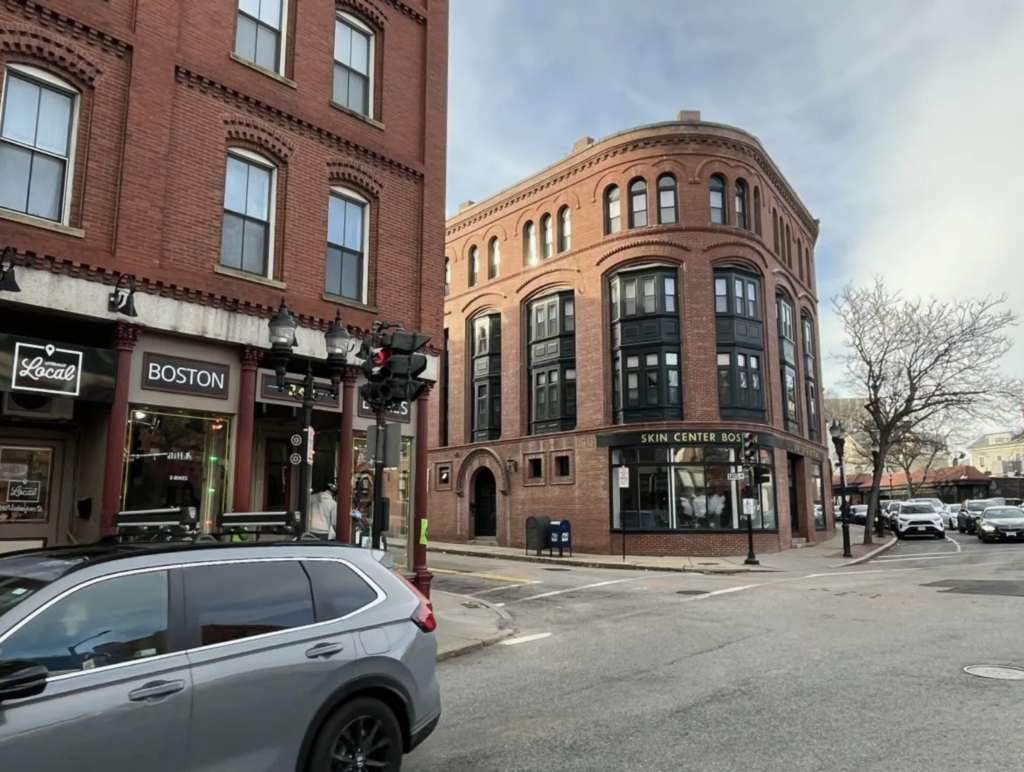
Two new parking studies in Brookline Village and Washington Square revealed that both neighborhoods have more parking than most drivers realize — but that better pricing, shared access and clearer information are needed in order to make them more accessible.
The studies were conducted by Stantec, the same engineering firm that carried out Brookline’s earlier Coolidge Corner parking study. Liza Cohen, a principal in Stantec’s urban mobility group and project manager for both studies, presented the findings at a March 18 Brookline Transportation Board meeting alongside senior principal Jason Schreiber and transportation planner Mitul Ostwal.
In Brookline Village, the study found more than 3,000 parking spaces but noted that not all of them are open to the public. Some are restricted to residents, while others are designated for specific businesses.
“What a lot of people experience is, they drive into the core of Brookline Village, they try to park right out front, and that is a challenge,” Cohen said. “What we’re looking to do is try to unlock those additional spaces to help ease that parking crunch.”
The studies came about as part of the town’s plan for a major upcoming redesign of Washington Street, which was opposed by business owners because it removes many parking spaces along the route.
In Brookline Village, peak parking demand falls around 9 a.m. and noon, while Washington Square “has more of a restaurant-hour skew to it,” Schreiber said in the meeting, “so parking is busier in the evening.”
The central recommendation for both neighborhoods is demand-sensitive pricing, a system in which spaces closer to the “core” cost more and spaces further cost less.
“If the spots out front are the same price as the spots that are down and around the corner, you’re basically incentivizing people to always hunt for those out-front spots,” Cohen said.
But Cohen was also careful to say this would not be an across-the-board price increase.
“A nuance to what we’re proposing is we’re not necessarily saying, ‘The price needs to go up all over the place,’” she said. “We’re saying, ‘You need to create a system where some parking is priced higher than others.’”
Other recommendations include active curb management, restructuring the commercial permit program and bicycle parking.
Cohen said parking is confusing in both neighborhoods, which contributes to the perceived shortage of spaces.
“Information in parking is huge, particularly in a place like Brookline Village that isn’t set up in a more simple parking system like a mall or an airport,” she said. “Streets are cranky, parking is down, and around the corner the regulations are different.”
A consistent finding in the studies, Cohen said, was how everyone develops their own interpretation of the parking rules. Businesses may tell drivers to park in a specific lot, she said. Centralizing that information through clear signage and maps can make a significant difference for drivers.
Stantec has begun working with the town to develop a public-friendly parking map for both neighborhoods.
Aria Sonderling, who lives just outside Washington Square and parks there nearly every day, said she has to rent a spot from the owner of her building because her apartment has no driveway.
“In an ideal situation, I would just be able to park right on the street next to my apartment,” she said in an interview.
When she’s out driving, Sonderling said she tries to find side street parking rather than paying for a spot closer in and said she’d be open to a system where you can park outside of central areas for cheaper.
Her biggest frustration, she said, is the overnight parking ban.
“I wish it was a lot more like Allston-Brighton, where you can get a resident sticker, because just my parking alone adds on a lot more to my rent,” Sonderling said.
John Bowman, a Precinct 10 Town Meeting member who spent his career designing urban traffic forecasting systems, said the reports confirmed that the parking supply is not the main issue.
“My main takeaway is that the parking studies showed that there’s plenty of parking space in those areas that needs to be managed better,” he said.
But Bowman still wasn’t clear who would be responsible for moving the recommendations forward.
“My question springs from a concern that this could be a study that sits on a shelf and nothing happens,” he said.
Cohen acknowledged that the implementation of the studies will require significant staff time and coordination across the departments, but said the town has already begun acting on some recommendations that may not yet be visible to the public.
“So hopefully that means it won’t sit on a shelf and not be acted upon,” she said.
Cohen also said that the report isn’t fully complete and the town will be providing the finalized version sometime this spring.
To watch the meeting, click here .
This story is part of a partnership between Brookline.News and the Boston University Department of Journalism.