Tag: Wellesley College

  • Reflecting on the Wellesley Inn’s demolition 20 years ago

    The first room to the left in the Wellesley Inn housed a large, ornate fireplace, a central part of the living room where residents would meet up to chat or solve jigsaw puzzles over tea and corn muffins. The room was adorned with dark and moody wooden accents, and community members would gather in one of the Inn’s three unique dining rooms, or by the rocking chairs on the front porch looking out over Washington Street. It was a place to eat, a place to meet, and a place to simply get together with friends and family. 

    But that was 20 years ago. 

    Now, in its stead, stands a luxury condo development with over 20 housing units above the businesses on the lower level. Gone are the days of the historic community gathering hub that held that lot for over a century, now home to a modern monolith, and to some, a shadow over the town. 

    Long-time Wellesley residents, like Beth Hinchliffe, mourn the loss of the Inn and what it stood for. Originally the Wellesley Tea Room, it was established in 1897 and remained the focal point of the town until it was sold to developers and demolished in 2006. 

    “It was really important in the life of the town, because it had grown up with the town,” Hinchliffe said. “It had a graciousness about it, and an awareness of history, of where we came from. It was a connection with all the generations that have come before.”

    Hinchliffe said she attended all sorts of events at the Inn throughout the years, from baby showers to wedding receptions to graduation and birthday parties. But above all, she said, it was a place for the community to come together, and one that hasn’t been replicated since. With three different restaurants — a tavern, a ballroom, and the original tea room — there was something for every occasion. 

    “It led to losing the sense of a town center, a community center, because it really was our community gathering place,” Hinchliffe said. “It was so much a part of all your life.” 

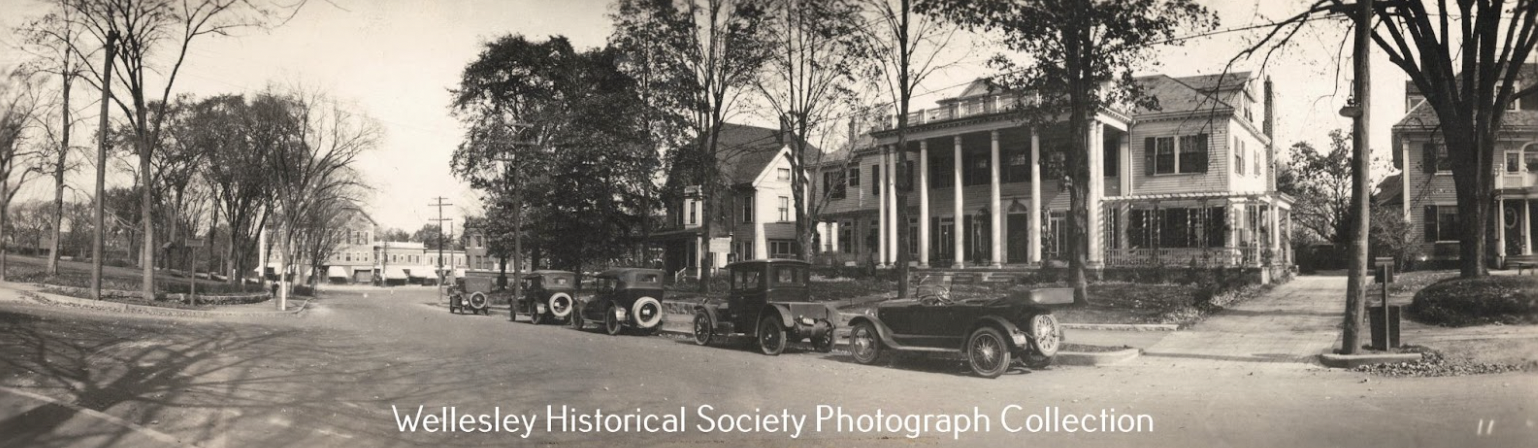
    Wellesley Inn (Wellesley Historical Society Photograph Collection)
    Inside the Wellesley Inn (Wellesley Historical Society Photograph Collection)

    She recalled going there after graduation to celebrate and how her parents went out to dinner there every year for Mothers’ Day. There was caroling in the winter, Easter egg hunts in the spring, and it was where everyone gathered after the annual Wellesley Veterans Parade. Her favorite memories, however, were sitting by the fireplace in the living room with friends and family, drinking tea and solving puzzles in the warmth of the flame.  

    “That room was like a big embrace,” she said. “I remember times I’d been out shopping with friends and we would just go in to get our tea in front of the fireplace.”

    Katherine “Gig” Babson has lived in the same house in Wellesley for almost 79 years and remembers the Inn as “a glorious structure,” with the columns and stairs providing an intense visual impact in the heart of town. In her 50 years of involvement in local politics, she served as a Select Board member for nine years and was on the committee when the building was torn down. 

    Babson said she has “very strong feelings” about the Inn being demolished instead of purchased by Wellesley College. 

    “My unfiltered view is that Wellesley College had a great opportunity to purchase it and make it into a boutique hotel for the benefit of Wellesley College students,” she said. “I think it’s a missed opportunity.” 

    At the time, there were movements from local residents to see if there was any way to preserve some part of the original building, but most people understood that it was incredibly expensive and would have been far too large of an undertaking to be feasible. 

    Wellesley Inn (Wellesley Historical Society Photograph Collection)
    Wellesley Inn (Wellesley Historical Society Photograph Collection)

    Tory DeFazio, a resident of almost 89 years and a Town Meeting member for over 50, said that the Inn originated as a family home and eventually expanded to serve the parents of the students at Wellesley College looking for somewhere to stay. Since then, those families and anyone else visiting Wellesley have had to stay in nearby towns like Needham or Newton, he said. 

    “When we had family weddings, the guests would stay there at the Wellesley Inn, and you could sit out on the front porch in a rocker and look at the traffic going by,” he said. “It was just a lovely environment, and they were always very gracious.” 

    It has been 20 years since the demolition itself, which fell exactly on Wellesley’s 125th birthday on April 6, 2006. That decision, though likely unintentional, was a blow to many who were already devastated by the loss of the historic building, with Babson referring to the choice as “a huge booboo.” 

    “If you’re going to take down something that a lot of people have strong feelings about, maybe you shouldn’t take it down on the town’s birthday,” she said. “They could have been more sensitive.”

    Hinchliffe remembered the day itself, noting that while people knew the demolition was imminent, nobody expected them to pick that day to tear it down. Friends called to her to avoid the “heartache” of the demolition, and “the town really got riled up when they tore it down on exactly the 125th birthday.” 

    “It was shocking to a lot of people,” DeFazio said. “It was gone before you knew it.” 

    While there are some visual similarities between the Wellesley Inn and The Belclare, the new development that took its place, they serve vastly different functions.

    “The columns are the only thing that remind me of the old Inn,” DeFazio said. “But there’s no porch, no rockers.” 

    The Belclare
    The Belclare (photo by Emma Mullay)

    On the ground level of the development, there are a number of shops that are rented out, although there has been a significant amount of turnover with them, DeFazio said. Above them are the luxury condos, selling for up to $3 million. 

    Lois Lee and Young Jo Kim, Wellesley residents of 22 years, didn’t live in town during the Inn’s prime and don’t remember it when “it was really being used.” 

    “It’s nice for having the option of a luxury condo right in the center of town,” Lee said. “They did a beautiful job with the building, and it is nice to have the retail on the first floor.”

    But while these condos provide a new life for the lot, others, like Hinchliffe, still deeply mourn that place it used to be. 

    “I just loved it, and I miss it,” she said. “I think everybody misses it.” 

    This story is part of a partnership between the Swellesley Report and the Boston University Department of Journalism.

  • Charlie Kirk shooting sparks reflection, worry among Massachusetts campuses

    By Emily Piper-Vallillo and Mara Mellits

    The fatal shooting of 31-year-old right-wing activist Charlie Kirk at Utah Valley University has shaken college students and administrators across Massachusetts.

    Kirk, a commentator and founder of the conservative group Turning Point USA, was shot and killed Wednesday while speaking on an outdoor stage in front of a large crowd. Authorities announced Friday that a 22-year-old man is in custody.

    Some Massachusetts college administrators and faculty said they hope this moment will allow people to unite across campus divides. But some conservative students said they don’t feel safe.

    “Colleges and universities should be places for peaceful and open dialogue without fear or threat of physical danger,” Wellesley College President Paula Johnson said in a statement. “This can be a time to come together across political and partisan divides; and our colleges and universities should help model this for our country.”

    Meanwhile, Harvard Kennedy School Professor Tarek Masoud said he hopes this tragedy will act as a “wake up call” to spur open dialogue and civil disagreement.

    “Observing how badly things can get out of hand will cause people again to kind of take a step back, lower the temperature and realize that we actually need to be having more of these dialogues,” he said.

    But some conservative students fear for their safety after Wednesday’s shooting.

    “I’m really terrified of what’s happened, and I think a lot of people are too,” said Massachusetts Institute of Technology student Spencer Sindhusen, president of the school’s College Republicans chapter.

    Sindhusen said at first he thought the shooting wasn’t real.

    “I was totally shocked,” said the junior, who saw the headline pop up during class. “You know, in the age of AI, I thought maybe it was a deepfake.”

    But when Sindhusen read reporting from The New York Times and a Truth Social post from President Trump, he realized it was true.

    “It was so sobering,” he said.

    Sindhusen, who started a student group that promotes civic dialogue, said the shooting will likely curtail free speech.

    “People are going to be afraid to speak up,” he said. “This actually concerns me a lot about the future of our open dialogue culture. We’re trying to engage in good faith conversations with people we disagree with, but then the other side might hate us.”

    In an email to the MIT community Friday, President Sally Kornbluth said that over the last week on campus she’s seen two hand-drawn swastikas, a sign wishing harm on a “conservative non-profit,” and multiple messages “celebrating violence.”

    “In the context of this week’s horrifying murder of Charlie Kirk at Utah Valley University, these manifestations of hatred towards others for their views, beliefs or identity are even more concerning,” Kornbluth wrote.

    She asked anyone with information about the incidents to report it to campus police. An MIT spokesperson said in a statement that “the safety of the people on our campus is always a top priority.”

    For other students like Jeb Allen, co-president of Amherst College Conservatives, Kirk’s killing came as less of a shock.

    “It just kind of embodies the insanity that’s taking place and normalized on these college campuses,” he said.

    The junior said he received “schoolwide backlash” after writing an article against DEI policies for the Amherst student paper earlier this year. Allen recounted that episode in a 2025 National Review piece, in which he writes of how he received “a death threat” and was “stalked, socially isolated, encouraged to transfer.”

    “It just hit really close to home,” Allen said. “Because it’s like when you’re a conservative at these institutions, this is what you get.”

    Republican clubs on several campuses said their members read messages online that they thought celebrated Kirk’s death. These comments were “particularly upsetting,” the group from Tufts University said in a statement.

    Members of the Boston University College Republicans were frightened by these reactions, said chapter President Zac Segal.

    “Being a conservative in a more liberal area, you know, when people are celebrating the death of a conservative figure — that makes you feel scared,” Segal said.

    Wednesday’s shooting compelled the BU College Republicans to pen an open letter to University President Melissa Gilliam, citing “hostility” on campus towards conservative students and asking for “appropriate security” at their events.

    A spokesperson for the university said he expects Gilliam to reply to the letter and emphasized that the school takes all necessary precautions to ensure safety for the BU community and campus guests. (Boston University owns WBUR’s broadcast license. WBUR is editorially independent.)

    Other local colleges also maintain they have robust security measures in place for campus events.

    Northeastern University requires pre-registration and checks IDs and bags at the door to enhance safety, according to Vice President for Communications Renata Nyul. The school also works with local law enforcement when necessary, she said.

    “The university also has a thorough vetting process for external speakers, which helps to ensure a diversity of viewpoints and a safe environment in which to discuss them,” Nyul said in a statement.

    A spokesperson for Harvard Kennedy School said the campus is accustomed to hosting high-profile figures.

    “We regularly work with campus security, Harvard university police, local, and other law enforcement agencies to ensure that our events can proceed safely and securely for event participants and guests,” he said.

    Kirk was scheduled to appear at Dartmouth College for a debate with progressive commentator Hasan Piker later this month. The Dartmouth Political Union, the group set to host the event, issued a statement Wednesday saying it was “horrified and heartbroken” over Kirk’s death.

    “Now, more than ever, it’s important that despite our differences we can see the humanity in those across the aisle,” the student-led group said. “Political violence will never be the answer to political disagreement. When we disagree, we must engage in discourse.”

  • Rain or shine, Wellesley College’s annual hoop rolling event is ‘full circle’ moment for graduating seniors

    Arushi Ghosh, the winner of Saturday’s hoop rolling race at Wellesley College, posed in her graduation gown with her hoop (Photo by Jennifer Lambert)

    Not even heavy rain could dampen the excitement Saturday morning as Wellesley College seniors ran down Tupelo Lane with wooden hoops in one of the school’s oldest traditions.

    The annual hoop rolling race, which dates back to 1895, marks a celebratory right of passage for Wellesley seniors. During the race, seniors sprint about an eighth of a mile while rolling wooden hoops. The objective is to keep the hoop rolling upright, but many seniors dropped their hoops, picked them up and kept running—even if it caused them to fall behind a bit. 

    Originally, it was said that the winner would be the first to marry, but today she “will be the first to achieve success, however the winner defines it,” according to Wellesley Magazine.

    Ezoic

    This year’s winner, Arushi Ghosh, was thrilled to fulfill what she sarcastically called her “ultimate purpose” at Wellesley.

    Arushi Ghosh stood proud in Lake Waban after being tossed in by two of her friends.
    Arushi Ghosh stood proud in Lake Waban after
    being tossed in by two of her friends
    (Courtesy photo from Arushi Ghosh)

    “The reason I came to Wellesley was to win hoop rolling,” joked Ghosh, an economics major from Hong Kong. “Forget about the bachelor’s degree–now I get a hoop rolling degree.”

    Ghosh and her friend, Gabriella Olavarria, were the first seniors to arrive. About two rows of people there were underclassmen saving spots for their “Big Sisters.” Some of those “littles” had been there since 6 a.m. Ghosh and Olavarria arrived around 8:10 a.m., almost an hour before the race’s 9 a.m. start.

    “We were texting from bed, and we were like, ‘Should we do it? Should we rally? Should we try to win?’” Ghosh said. “And then we got there, and we were the first seniors there, and all these underclassmen were bullying us because they were saving spots for their bigs, which is really sweet. But we were like, ‘OK, we’re here to win.’”

    @swellesleyreport Annual hoop rolling race @Wellesley College ♬ original sound – swellesleyreport

     Seniors Arushi Ghosh and Maya Lu-Heda, who were freshmen year roommates, posed in front of Lake Waban, where they also jumped into their freshmen year.
    Seniors  Maya Lu-Heda and Arushi Ghosh, who were roommates as first-year students, posed in front of Lake Waban (Photo by Jennifer Lambert)

    Around 200 seniors participated in the race–about a third of the approximately 600-person class of 2025. The race, which lasted only about 45 seconds, ended with Ghosh crossing the finish line and being tossed into Lake Waban by two of her friends. Throwing the winner into Lake Waban is a tradition that dates back to the 1980s, following a prank where a Harvard man posed as a Wellesley senior and won, according to WBUR.

    For many seniors, Saturday’s race was a full-circle moment. Ghosh recalled her first year at Wellesley, when she and her freshman-year roommate, Maya Lu-Heda, jumped into the lake together as part of the “Lake Jump” tradition. In this tradition, resident assistants pick a random day to knock on freshmen’s doors and bring them outside to jump in Lake Waban together.

    For many Wellesley seniors, who will graduate on May 16, the day was bittersweet.

    “It feels weird because I’ve been to watch hoop rolling, and now we’re the ones doing it,” senior Jessica Cohen said.

    hoop rolling
    Students gathered to take photos after the hoop rolling race (photo by Jennifer Lambert)

    The rain and potholes posed some challenges for the students, but they still embraced the spirit of the tradition.

    “I’ve been excited for this since sophomore year, so it’s a shame that it’s raining but a beautiful day nonetheless,” senior Ellie Gurguliatos said.

    For the seniors, many of whom had once stood on the sidelines cheering for older classmates, Saturday’s event marked an emotional milestone.

    “Everyone goes, but only the seniors roll the hoops,” senior Alaina Fox said. “It’s such a big tradition, especially in the rain. I’ve never seen it like this before.”

    Ghosh was happy she could finish her college experience by winning the race.

    “Now I’m at peace,” she said. “I’m like ‘I can graduate now.’”

    Wellesley College seniors Nyssa Youhn, Ellie Gurguliatos, Kathy Li, and Maya Lu-Heda posed with their hoops after the race.
    Wellesley College seniors Nyssa Youhn, Ellie Gurguliatos, Kathy Li, and Maya Lu-Heda posed with their hoops after the race (Photo by Jennifer Lambert)

    This story is part of a partnership between the Swellesley Report and the Boston University Department of Journalism.