

The addition of accessible parking spaces at Robbins Farm has made the playground easier to reach for visitors with disabilities, but some parents and accessibility advocates say there is still room for improvement.
The town announced Sept. 17 that two parking spaces had been installed in August at the playground, which, when it opened in 2024 after a $2.1 million renovation, was celebrated as Arlington’s first playground designed with “Universal Design principles to be fully inclusive.”
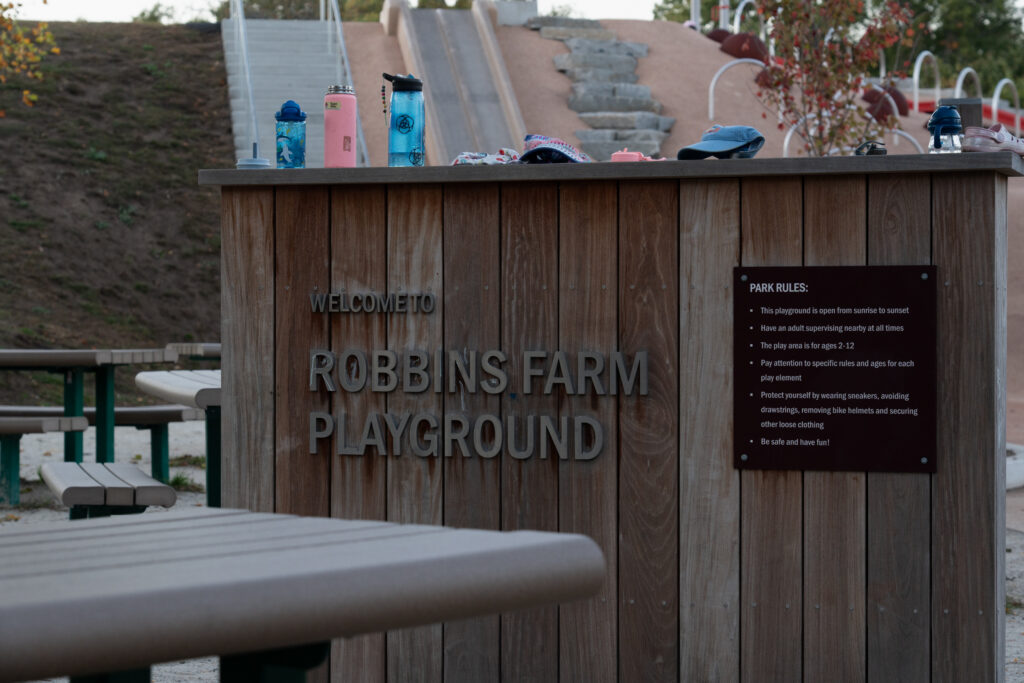
Along with the parking spaces, the project included a curb ramp, a new sidewalk carveout and a realignment of the sidewalk and fence along the park side of Eastern Avenue. The work was paid for in part by a $25,000 grant from the Massachusetts Office on Disability. (The park was closed for about a day in May to make emergency repairs.)
While the additions improve physical accessibility to the park for people with mobility impairments, parents of children with developmental disabilities say they still cannot use the playground safely.
Lauren Shrestha, a mother of three children with autism spectrum disorder and chair of the Swampscott Commission on Disability, said the lack of a fence remains a significant barrier for children who may elope or wander away without understanding the danger.
“My son will run into traffic,” Shrestha said. “So we don’t go to places that aren’t fenced in because it’s just not safe for him.” As a result, Shrestha said she doesn’t bring her children to Robbins Farm Park.
Leslie Stormes, a mother of a child with a rare genetic developmental disability, said her family has not returned to the playground after a difficult experience there when her son was younger. “It was kind of a disaster,” Stormes said.
Like Shrestha, Stormes said having a fenced-in playground is important for her son’s safety. Without it, he may run into the road and cannot ask for help if he becomes separated from her. She said the issue illustrates why accessibility must account for more than children who use wheelchairs or other mobility aids.
“People seem to forget that not all children understand safety,” Stormes said. “You’ve got autistic children, you’ve got kids with Down syndrome, and you’ve got kids with other disabilities that don’t understand how to keep their own bodies safe.”
Dawn Oates, founder of the Play Brigade and a mother of a child who uses a wheelchair, said seeking feedback from all members of the community is important when making a space inclusive, rather than just physically accessible.
“There’s accessibility and then there’s inclusion,” Oates said. “Somebody once explained it to me like this: accessibility means you can get into the birthday party, you can get up the steps and into the room. Inclusion means you can actively participate in all the activities.”
Making a space inclusive does not mean catering to just one person. Oates said that, from a disability perspective, it is viewing a community holistically to ensure no one feels like an afterthought.
The Robbins Farm Park playground project has been in development for years. The town held public-input meetings and listening tours in 2016 before the project entered a lengthy funding and planning period. During tours, residents raised concerns about wheelchair accessibility.
The town began soliciting proposals for design services in 2022 and sought public input through Zoom meetings. Construction began in October 2023.
The renovated playground partially reopened in November 2024 as Arlington’s first playground was “intended to be accessible for individuals with varying abilities.” However, the site did not initially have dedicated accessible parking spaces.
The two parking spaces were completed about 21 months after the playground reopened in November 2024. There is no record of a formal public comment process during this time period on the town website. The work was handled through a collaboration among Arlington’s Disability Commission, Engineering Division, Recreation Department, and Office of Diversity, Equity and Inclusion.
Arlington’s town manager, Jim Feeney, said the director of recreation and community services told him she was unaware of concerns about fencing and does not recall receiving any feedback about it. Feeney said these concerns did not cross his desk either, but this does not mean the town is not open to discussing the matter further.
“I wouldn’t foreclose on anything,” Feeney said.
The parking improvements are a positive step, Oates said, but accessibility should continue to be evaluated after a project is completed. “We’re recognizing that decades after the Americans with Disabilities Act (ADA) was signed into law, there’s a really big gap between the written word on the page that these rights are guaranteed and the actual ability to have that put into practice,” Oates said.
She said communities should aim to go beyond what is required by law and continue making improvements based on residents’ experiences.
“The ADA is a floor, not a ceiling,” Oates said.
