

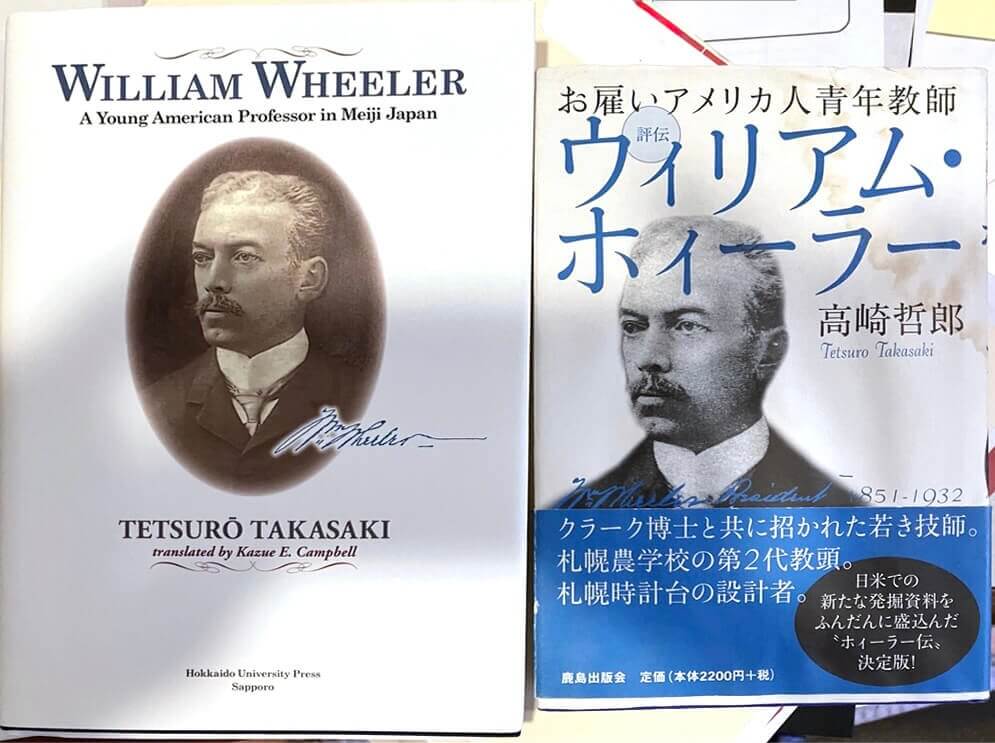
William Wheeler’s achievements in the realm of engineering are well-documented. But the Concord inventor and educator’s legacy also included building human connections half a world away.
This year, Concord marks the 150th anniversary of Wheeler’s 1876 voyage to Hokkaido, Japan. The trip helped lay the groundwork for an enduring link between the two countries.
“We are a sister city as well as a sister state, and as a sister city, we pay homage to him,” said Concordian Barbara Lee Flight, who, with her husband, Wilson, worked on a special 2007 forum on Wheeler’s legacy.
Wheeler “made a lot of connections with Japan,” she said. “He was not only an educator there, but the government at the time tapped his knowledge.”
Over the past two years, Flight has combed through records of the 2007 William Wheeler forum and found tapes of its programs. To mark the anniversary, the Concord Nanae Network, with the help of the town, has published materials from the forum and three of the four recordings online through the town’s searchable website, concordma.gov.
The ‘goat’
In 1875, the Japanese government contacted William Smith Clark, a professor at the Massachusetts Agricultural College — now the University of Massachusetts Amherst — to help establish an agricultural college in Hokkaido. Wheeler accompanied Clark, his professor, to teach mathematics, civil engineering, surveying, drawing, and English, but his work reached far beyond the classroom.
Wheeler’s Japanese students lovingly called their big-eyed, whiskered teacher “goat.” He left an indelible mark on Japan in the 1800s, helping establish and later leading Sapporo Agricultural College, now Hokkaido University, where he introduced modern agricultural techniques.
“That engineering talent that he had was [transplanted] to Hokkaido and helped build foundations there that have had impact until today,” said Emily Farrow, co-president of the Massachusetts-Hokkaido Association.
Farrow said the freshly available recordings help “memorialize that relationship and William Wheeler and remind people of that sort of innovative spirit.”
Wheeler was a key link between Concord and Nanae, said Alan Cathcart, Concord’s recently retired public works director, who participated in the 2007 program and a 2010 commemoration of the inventor’s contributions.
In West Concord, the clock tower at what is now the Harvey Wheeler Community Center resembles the Sapporo clock tower that Wheeler designed. “They value and revere that building and what it represents. And it’s ironic that [it] was a Concordian [who] designed it,” said Cathcart, who has visited Nanae with a Concord delegation as part of the towns’ ongoing bond.
Creative connectivity
In his 20s, Wheeler spent four years building bridges, canals, roads, and railways in Japan. In 1924, Prince Regent Hirohito awarded him the Fifth Order of the Rising Sun, Double Rays — a mid-level imperial honor — in recognition of his service. Every autumn, a delegation from Nanae visits Concord, continuing the cross-cultural exchange that Wheeler helped establish.
The anniversary of Wheeler’s journey is “just one more opportunity to kind of reflect back on the relationship that really is very strong between the U.S. and Japan, Massachusetts and Hokkaido, Concord and Nanae,” said Cathcart.
Wheeler “seemed to really understand how to harness the engineering aspect of a community and its transportation — connectivity, roads, bridges,” he said. “That’s the key.”
The engineer shaped Concord, too. A hydraulic systems specialist, Wheeler designed the town’s first sewer treatment plant and set up its water systems. He also designed systems in places like Watertown, Braintree, Wisconsin, and Florida. Wheeler was a prolific inventor who held nearly 100 patents. One invention, the Wheeler Bottom Filter, still handles wastewater at sites worldwide.
“He was very practical,” Cathcart said. “If something didn’t exist, he would figure a way to kind of create it. He was enlightening. He was innovative.”
This story was written by a journalism student in Boston University’s newsroom program, a partnership among the university, The Concord Bridge, and other news organizations in the Boston area.