

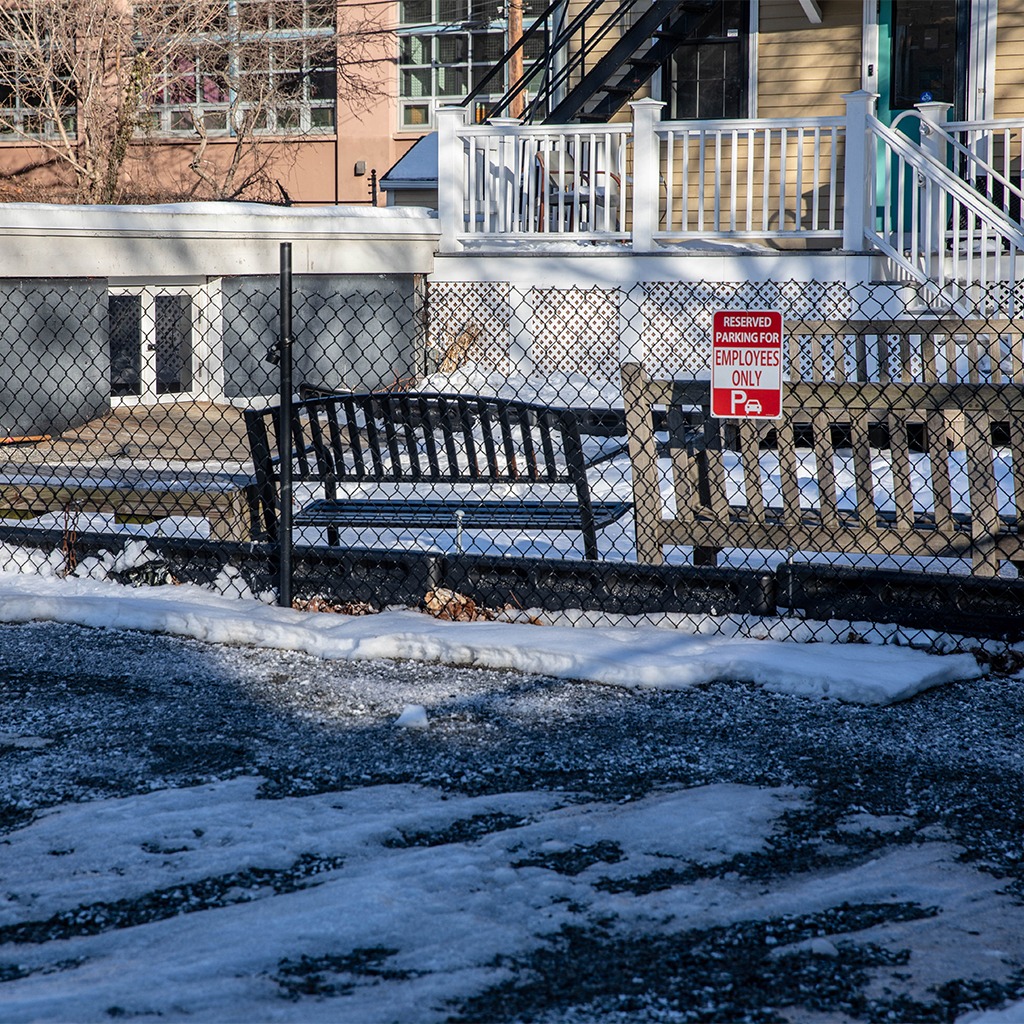
A plan to replace the parking lot at the Margaret Fuller Neighborhood House nonprofit with affordable housing met resistance Wednesday at a meeting with around a dozen residents, several of whom wondered where the parking would go.
The project, led by the Cambridge Redevelopment Authority and designed by Studio G Architects, would include eight to 12 units at 71 Cherry St. that could be apartments, townhomes or three-story condos. The developers are gathering community input to decide. The homes will be on the back side of the 9,000-square-foot lot facing Pine and Eaton streets, where the CRA hopes to begin construction by 2027.
It would be built under the rules of Cambridge’s Affordable Housing Overlay, zoning intended to make it easier to build affordable housing citywide. The 6-year-old idea to build on the parking lot, with construction once expected to start in 2023, was reintroduced in the spring, bringing this first community meeting.
“The CRA has made a public commitment to deliver at least 20,000 square feet of affordable homeownership housing,” said Kyle Vangel, the redevelopment authority’s director of projects and planning. “And we see this project as a way to deliver some of that commitment that we’ve made here.”
The project’s goal is to provide residents with affordable homeownership opportunities, the CRA says – in a way, a continuation of the work of the Margaret Fuller House to meet the needs of its neighborhood. Built in 1807, it was the childhood home of Margaret Fuller, the first female war correspondent, and has served as a community center since the Industrial Revolution. The Port community has relied on it to host events, a food pantry and recreational activities.
New pantry space and a community meeting facility would be part of the project, the CRA says.
Support and concerns
Neil Miller, 29, a longtime resident of Cambridge who recently moved to The Port, said he is proud of how much Cambridge has done to provide affordable housing opportunities and feels that the addition will be good for the community.
“Cambridge has done so much to encourage affordable housing,” Miller said. “It’s so great that this is taking advantage of the Affordable Housing Overlay to create homeownership for people in my neighborhood.”
Dorothy Lane, who lives near the Fuller house, said she is concerned that the city is putting more low-income housing in crowded low-income neighborhoods where there is a parking shortage.
“I’m 75 years old,” she said. “I work three days a week. When I come home at 7 or 8 I can’t find parking, and that is a concern. It’s just very unpleasant day to day to have to struggle to find parking two or three blocks away.”
The Fuller house parking lot is shared by many businesses in the area. Lane fears that the new units will cause people to look for parking along her street – making it even more difficult for her to park near her home.
Answers through design
She and her neighbors also shared a flurry of other concerns, including the “heat island effect” – higher temperatures in urban areas as trees and other greenery is paved over – as well as safety issues and a rat problem at the food pantry that could be worsened with more population density.
“Our neighborhood has some of the highest percentages of gun violence and shootings in the city,” said Daniel Jeffs, who opposed the lot as a location for the project. “We have a lot of rats from the food pantry, and that has been an ongoing problem ever since I lived here. So my question is, if you’re going to subdivide a lot, how is Margaret Fuller going to expand their food pantry capabilities? If they can’t currently run it on their footprint.”
A Studio G representative said the firm plans to work with the city to address residents’ environmental, safety and parking concerns.
“We’re meeting the city’s main factor requirements, and that is all about cool streets and heat island effect and planting trees,” said Rashmi Ramaswami, Studio G project manager. “Our hope is that by being able to design buildings that have reflective roofs, that have planted areas, in combination with the DPW shared streets initiative, some of those concerns that you have will improve things for the better.”
This development comes as Cambridge continues to change its zoning to create more housing. The Affordable Housing Overlay was updated in October to allow higher affordable-housing buildings by right in squares and along major traffic corridors; a vote this month allows four-story residential buildings to go into areas once limited to single- or two-family homes, and to go up to six stories if buildings include affordable units.
“The city has had success with some affordable homeownership projects in the past, including inclusionary units that are affordable homeownership and larger condo projects,” Vangel said. “But it’s relatively scarce. We’re excited to contribute to the housing ecosystem in the city for a project like this.”
This story is part of a partnership between Cambridge Day and the Boston University Department of Journalism.
This article was originally published on February 21, 2025.