Author: Anna Albrecht

  • Are we alone in the universe? A Lexington astronomer is raising eyebrows for asking whether a new interstellar object could be made by aliens.

    Are we alone in the universe? A Lexington astronomer is raising eyebrows for asking whether a new interstellar object could be made by aliens.

    By Anna Albrecht

    Hubble captured this image of the interstellar comet 3I/ATLAS on July 21, 2025, when the comet was 277 million miles from Earth. Hubble shows that the comet has a teardrop-shaped cocoon of dust coming off its solid, icy nucleus. Image: NASA, ESA, David Jewitt (UCLA); Image Processing: Joseph DePasquale (STScI)

    Abraham “Avi” Loeb, the Harvard astronomy professor and bestselling author, has dared to explore what he calls “the most romantic question in science”: Are we alone?

    “This question is a question that every lonely person asks,” Loeb said in an interview at his Lexington home. Too often, he said, humans become preoccupied with what happens close to us, in our home on the cosmic block. But Loeb looks beyond.

    Loeb has caught the public’s – and NASA’s – attention for his comments about a newly discovered interstellar object, known as 3I/ATLAS, that is hurtling toward the sun and through our solar system. NASA says it’s a comet. Loeb suggests it could be alien technology. 

    “What I’m doing as an astrophysicist is looking at nature on the biggest stage, which is the universe,” he said.

    Loeb, 63, has had a long and distinguished career. He’s written nine books and has been the longest-serving chair of Harvard’s astronomy department. He has long been interested in exploring the potential of alien life. Loeb has gained the critical and curious eye of the scientific community and the public for his commentaries and papers delving into the possibility of interstellar objects being alien technology – specifically in the case of 3I/ATLAS.

    The comet 3I/ATLAS – which is headed toward the center of the solar system and expected to reach its closest proximity to the sun Oct. 29 – holds the record for the highest velocity ever recorded of an interstellar object, at 130,000 miles per hour, according to NASA’s reports from August 2025. Loeb cited anomalies in the trajectory of the object as evidence of the potential of alien technology.

    Avi Loeb / Credit: Anne Albrecht

    Loeb reached into a bowl of seashells decoratively placed on his living room table, arranging a few in the shape of the Sun, Mars and Earth. One seashell remained in his hand to serve as 3I/ATLAS, moving around the others to show the path the object had followed.

    Loeb said 3I/ATLAS “is probably a natural object” but thinks it’s important to consider the possibility that it’s technological. 

    “We have the duty to consider a low probability event,” Loeb said, “just because the implications are huge.”

    NASA has disputed Loeb’s ideas that 3I/ATLAS is anything other than a comet, but that has not slowed him from exploring the topic through regular commentaries on his Medium page. Since the discovery of 3I/ATLAS on July 1, Loeb has rarely missed a day posting on his blog. He covers the new astronomical discoveries, the impacts they have for humanity and occasionally advice on how to respond to potential alien interaction.

    “What I write there is what I believe in,” Loeb said. “And sometimes, you know, it may not be right in retrospect, but that’s what I believe at the time that I’m writing it. And people connect to that.” He said he wants to encourage younger people to be curious – about both the known and unknown.

    Tony Pan, a former graduate student of Loeb’s who went on to found his own clean technology business called Modern Hydrogen, said that until meeting Loeb he found academia to be unfriendly. Loeb, however, was both creative and good at holding himself accountable to testable predictions, Pan said. 

    “It takes a lot of creativity to stick your neck out, and most creative predictions will be wrong,” Pan said. “Avi warned of that too. When you work on the frontier, a lot of your predictions will be wrong.”

    Many people have expressed skepticism of Loeb and his scientific commentary. The social media forum Reddit contains pages dedicated to discussing Loeb. A YouTube channel called “Professor Dave Explains” – with upwards of 4 million subscribers – calls Loeb a fraud.

    Loeb said science, to him, is “preserving what is left of your childhood curiosity.” He worries that scientists are motivated by the wrong reasons – to impress their peers – and that will rub off on the younger generation of people trying to break into scientific and academic fields. Loeb said he rarely regrets what he says. 

    Every day at sunrise, he jogs 3 miles. He said he enjoys the company of wild turkeys, bunnies and ducks, and that Lexington serves as a good reminder of where he came from: a small farm in Israel, where he became enraptured by philosophy. He recalled sitting on the tractor, reading late into the day. Now, he is the father of two daughters. 

    “He loves to talk about everything,” said daughter Lotem Liviatan Loeb, a junior at Harvard College studying neuroscience and physics. “You’d think that his interests are isolated to astrophysics, but they really aren’t.”

    Lotem Loeb recalled walks with her father throughout her life, where he would point to plants and talk extensively about each. She attributes most of her appreciation of the natural world to her father. 

    “He’s received  a lot of backlash recently,” she said. “But at his core he’s just trying to be the scientist and curious person that he feels society needs him to be.”

    This story is part of a partnership between LexObserver and the Boston University Department of Journalism.

    This article was originally published on October 27, 2025.

  • UMass Boston enrolls record number of in-state freshmen

    By Anna Albrecht

    UMass Boston says more in-state freshman enrolled this fall than in at least a decade.

    It’s the first year the public university is offering free tuition for Massachusetts residents from households making $75,000 or less.

    The Beacon Pledge, as UMass calls it, is a financial aid program that allows qualifying students starting this year to attend with no tuition payments or mandatory fees.

    “The best way to disrupt inequality is the distribution of knowledge,” Chancellor Marcelo Suárez-Orozco said in an interview with WBUR.

    Out of the 2,378 freshmen entering UMass Boston this year, 84% are from Massachusetts, said university spokesman DeWayne Lehman. The 1,988 local freshman represents an 11% increase from last school year, based on the student profile report. UMass Boston reviewed enrollment data going back 12 years.

    Of those in-state, freshmen, 1,014 are receiving free-tuition through the Beacon Pledge, Lehman said.

    Ashley Salmeron, a freshman studying biology who grew up in Everett, said the Beacon Pledge factored heavily into her decision to attend UMass Boston. She said the initiative has helped her and her family feel relieved of financial stress.

    “I think more schools should do that to help the ones that want to keep going with education,” Salmeron said.

    Salmeron said she did not know about the Beacon Pledge before applying to UMass Boston and was considering other regional schools. But when she discovered that she qualified for the free tuition, she chose UMass Boston.

    Suárez-Orozco said he hopes to get the word out about the initiative to more potential students.

    “We are of the city and for the city,” Suárez-Orozco said. “Our DNA is profoundly shaped by our iconic city, a city that has given the world so much.”

    Valeska Salazar, a freshman from Everett, said she knew about the Beacon Pledge before applying but did not “get a clear answer” on whether she qualified for the program until orientation. Ultimately, her financial aid package did not include the Beacon Pledge.

    “I don’t hear people talk about it as much as I would think,” Salazar said.

    Brisa Portillo, a senior from Everett, recalled getting an email about the Beacon Pledge.

    “I thought, ‘Where was that when I started?’” said Portillo, who lost her Pell Grant this year. She said she thinks the Beacon Pledge, while good for new and incoming students, may make other students feel as though they missed out on that assistance.

    Kaya Oleson, a junior from Wayland, said she found out about the Beacon Pledge through an advertisement at an MBTA station.

    Though not a recipient of the Beacon Pledge herself, Oleson said she is “thrilled, truly” that tuition is being waived for more students. “The less barriers there are the better,” she said.

    Suárez-Orozco said he is proud to welcome the largest class of in-state students, indicating that the school is “just beginning to see the beautiful echo” of the Beacon Pledge.

    All four UMass campuses have implemented their own free tuition programs similar to the Beacon Pledge for students entering this fall. Community colleges in Massachusetts have been providing free tuition through the MassEducate program since fall 2024.

    Some private universities have also been waiving tuition for qualifying students. MIT and Harvard began offering certain students free tuition and housing this school year. Tufts University joined the ranks most recently, announcing in September that it will start offering free tuition in fall 2026 for students from households that earn $150,000 or less.

    This story is part of a partnership between WBUR and the Boston University Department of Journalism.

    This article was originally published on October 06, 2025.

  • New Cambridge performing arts complex officially named ‘The Platform’

    New Cambridge performing arts complex officially named ‘The Platform’

    By Anna Albrecht

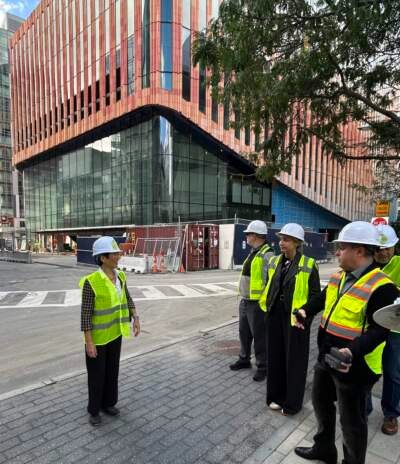
    A massive complex rises in Kendall Square with an ascending orange-to-blue exterior made of pleated terracotta panels that cascade up like a rising theater curtain.

    This is the new arts complex that the Cambridge nonprofit Global Arts Live will open in the fall of 2026. It has officially been named “The Platform,” which is also the name of the nonprofit responsible for operating the space. Previously, both the space and nonprofit were known as 585 Arts, Inc.

    Global Arts Live CEO Connie C. Chin speaks with visitors before a walkthrough of The Platform, which is under construction. (Courtesy Global Arts Live)

    “We always say, ‘Come for the art, stay for the people,’” Connie C. Chin, CEO of Global Arts Live, said at a walkthrough this week.

    The Platform will create a multilevel home base for Global Arts Live to put on its programming of international music and dance. Global Arts has been bringing live performance to venues around Boston and Cambridge since 1990, but it has yet to have its own dedicated performing arts center. This season Global Arts Live is hosting artists spanning from the national dance company of the Republic of Guinea to a Celtic folk band based in Quebec.

    The Platform comprises 45,000 square feet, including a main stage, a rehearsal space and a ground floor welcome center with space for gathering. The center also includes a 125-seat cabaret style stage, creating the opportunity for multiple performances to occur in one day. A grand staircase leads visitors from the first floor to the second.

    BioMed Realty purchased the land at 585 Third St. in 2018 for lab and office space, but the city had previously designated that the plot would have a theater or cinema space developed on it.

    Salvatore Zinno, vice president of development at BioMed Realty, said that when his company acquired the space, it was the “community expectation” for it to incorporate a performing arts center, and BioMed wanted to make sure it fulfilled that. He described the partnership with Global Arts Live as a “match made in heaven.”

    BioMed budgeted $45 million to build and equip the performance space, and Global Arts Live committed to raising $15 million in operating funds to launch and sustain it, according to BioMed.

    The new arts complex in Kendall Square is slated to open in the fall of 2026. The Cambridge nonprofit Global Arts Live will operate the space. (Anna Albrecht for WBUR)

    Takeda, a global pharmaceutical company and Massachusetts’ largest life science employer, will occupy the lab and office space upstairs from The Platform. The company has agreed to a $3 million, multi-year sponsorship of the main stage, thus naming it the Takeda Theater at The Platform.

    Maure Aronson, founder and director of artistic programs at Global Arts Live, said the space will be “a highly active performance space,” boosting the organization’s programming from about 60 events per year to 140.

    In collaboration with developer BioMed Realty, Global Arts Live is creating a space that aims to address the need for midsize theaters, said Chin, with the main stage at The Platform holding 400 people. The rehearsal space will match the dimensions of the main stage, she said, furthering the recovery of rehearsal spaces in Boston after a decline in recent years.

    Global Arts Live has been bringing an international arts scene to the Boston and Cambridge areas since 1990 through a mix of dance and music. Aronson said the audience can expect more contemporary dance and jazz performances to perform on this stage, with a grand opening season planned for September 2026.

    Chris Arendt and Connie C. Chin stand on the roof terrace of BioMed Realty’s 585 Kendall project. The terrace adjoins Takeda’s future lab space. (Courtesy Global Arts Live)

    The dynamic elements of the space will promote a welcoming atmosphere, with big glass windows representing “transparency to the community,” Chin said.

    “I think of a theater space like a rocketship,” she said, “so many small parts coming together to work.”

    Global Arts Live intends to bring its youth mentorship and community initiatives home to The Platform as well, Aronson said. Two hundred nights will be available for renters to use the performance space.

    The unlikely partnership between the pharmaceutical company and performance arts nonprofit was born out of shared “interests for the community,” Chin said.

    Chris Arendt, Takeda’s chief scientific officer, said the building at 585 Kendall will centralize the lab and office space for the company in Cambridge.

    “As our labs grow and change, this space will be very adaptable,” said Arendt, speaking of the 14th floor, one of the spaces dedicated to lab space.

    Chin said she envisions the partnership upholding “cultural integrity” of Kendall Square, while drawing more visitors to the public space of The Platform, enhancing the community surrounding the building.

    “We have scientists conducting research to benefit human health,” Arendt said, “right above an artistic space benefitting the human spirit.”

    This article was originally published on September 26, 2025.