Author: Jamie Perkins

  • South Coast lawmakers lay out priorities for fiscal 2027 state budget

    South Coast lawmakers lay out priorities for fiscal 2027 state budget

    From playgrounds to addiction treatment, New Bedford legislators are advocating for money for their communities in the state’s fiscal 2027 budget. Each lawmaker is pursuing earmarks for his district as negotiations over the spending plan unfold this spring. 

    The Massachusetts House is working on its own version of the next state budget, which should go into effect July 1. Gov. Maura Healey launched the process with her proposed version on Jan. 28, setting her priorities in a year where federal cuts and policy changes are creating uncertainty.

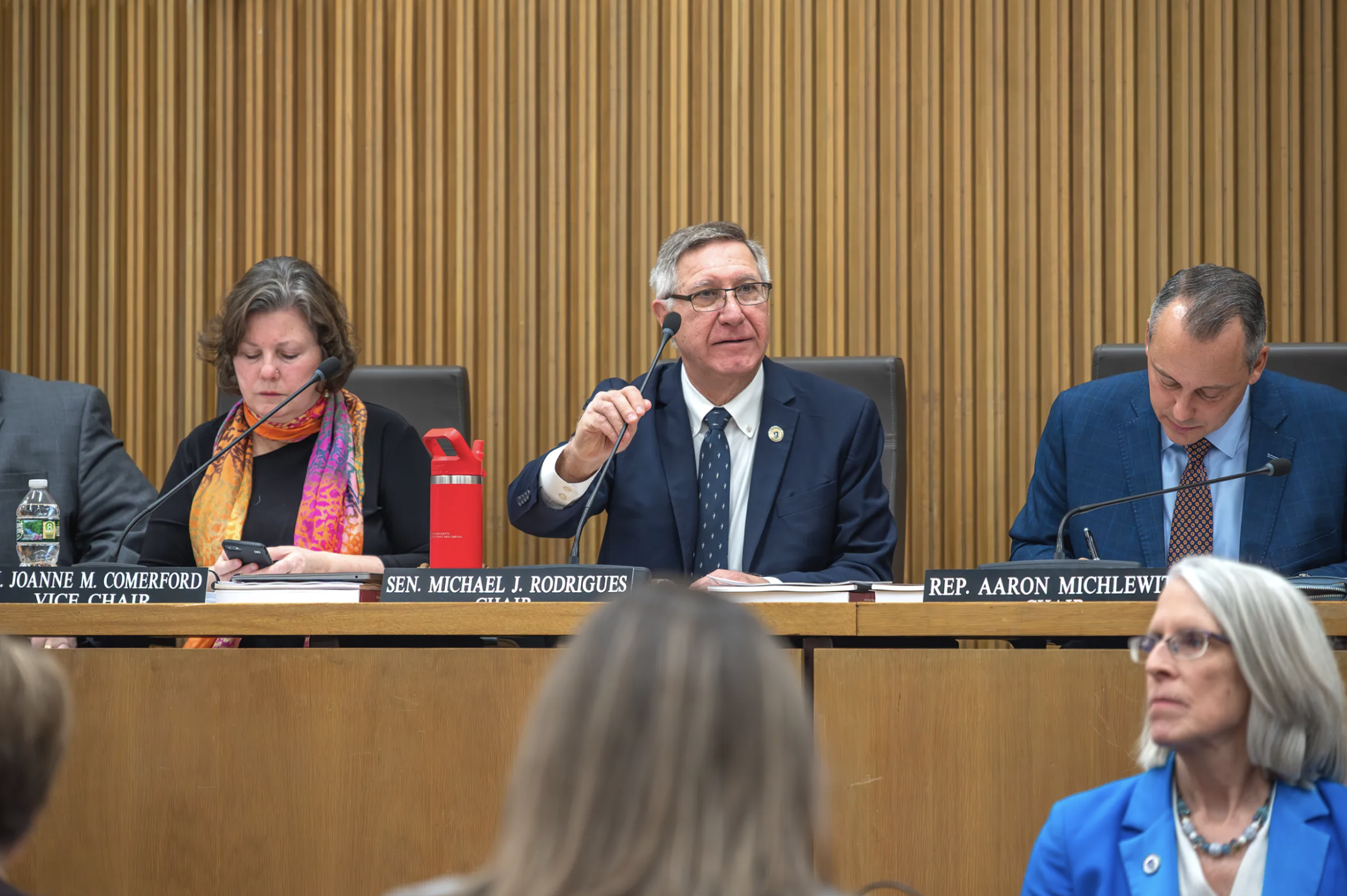
    The Legislature’s Ways and Means Committee met on Feb. 11 to discuss Gov. Maura Healey’s proposed FY27 budget. From left to right: Senate Vice Chair Joanne Comerford, Senate Chair Michael Rodrigues, and House Chair Aaron Michlewitz. Credit: Jamie Perkins / The New Bedford Light

    New Bedford lawmakers’ earmarks for their districts

    Rep. Christopher Hendricks, D-New Bedford, said a four-term lawmaker like himself usually gets three local earmarks in the annual budget. 

    The first budget amendment that Hendricks plans to file to a House Ways and Means Committee budget, due out in April, is for the Leduc Center for Civic Engagement at University of Massachusetts Dartmouth to provide transportation for the America Reads/Counts program. 

    University students in the program tutor and mentor struggling and at-risk students in community centers, elementary schools and preschools. Last year’s budget provided $75,000 for the program. 

    His second earmark is for Girls Design Academy in New Bedford, an after-school program for third through fifth grade students that focuses on life skills and STEAM education (science, technology, engineering, arts and mathematics). The fiscal 2026 budget allotted $50,000 to the program. 

    Hendricks also plans to request funding for Positive Action Against Chemical Addiction, a New Bedford organization that offers youth programs, housing initiatives, employment support and community outreach. Hendricks secured $25,000 for PAACA in fiscal 2026. 

    Rep. Steven Ouellette, D-Westport, said he’s looking for a new floating dock at the state boat ramp in Westport and a “revamp” of the playground at Desmarais Park in Fall River. 

    Ouellette is also weighing options to address the failing HVAC system at Acushnet Elementary School. Last April, the town of Acushnet voted down a temporary tax increase (a debt exclusion) for up to $4.2 million in air quality improvements due to a mold infestation. He said he hopes to secure around $10,000 for replacement air filters. 

    Last year, Rep. Mark Sylvia, D-Fairhaven, earmarked $40,000 for Coastal Foodshed to support food security issues in Greater New Bedford, $25,000 for the Whitfield-Manjiro Friendship Society, and $25,000 for a Fairhaven Council on Aging kitchen upgrade. 

    In fiscal year 2027, Sylvia said he plans to file amendments for Coastal Foodshed and the Whitfield-Manjiro Friendship Society again. He noted that he is still speaking with his constituents to identify additional requests. 

    “I look forward to co-sponsoring a number of different New Bedford-specific earmark requests, and will be working with the other members of the delegation on that,” Sylvia said. 

    Rep. Christopher Markey, D-Dartmouth, said he plans to earmark money for the South Coast LGBTQ+ Network to fund programming for high school students and older adults. He wants to fund UMass Dartmouth law school’s Justice Bridge program, in which recent law school graduates provide reduced-cost services. 

    And he wants to fund a digital sign for UMass Dartmouth to be placed between I-195 and Route 6. The sign would announce events and other activities, and Markey said he hopes it will strengthen the connection between the school and the town. He is requesting $75,000 for each amendment and plans to sign on to other lawmakers’ earmarks. 

    Rep. Antonio F.D. Cabral, D-New Bedford, is looking to earmark funding for youth programming at the Dennison Memorial Community Center and opioid treatment services at the New Bedford Community Health Center. 

    He is also focused on arts and cultural organizations such as AHA! and the New Bedford Festival Theatre, noting that they are not only important institutions but also economic drivers for the city. 

    “[The budget] is one of the most important pieces of legislation that we do every year, so it’s important to me,” Cabral said. “It’s always important to stay focused, stay engaged, and talk to all the stakeholders.”

    Sen. Mark Montigny, D-New Bedford, told The Light that he “probably [has] as many earmarks as most delegations combined” because of his seniority and past experience as the Senate Ways and Means chair. 

    He said it’s too early in the Senate’s budget process to list his exact earmarks, but noted that he tends to focus on services for children and older adults. 

    Over his 33 years on Beacon Hill, Montigny said, he has earmarked millions of dollars for children’s programming in the New Bedford area, including for the Boys and Girls Club, Youth Opportunities Unlimited and NorthStar Learning Centers, where he funded an “extensive” music program.  

    “[Children] shouldn’t rely on the lucky ZIP Code they’re born into, or the school district they’re born into or the means of their family,” Montigny said. 

    South Coast lawmakers share statewide priorities

    Some South Coast lawmakers also told The Light about statewide changes they’ll advocate to include in the budget. 

    Markey suggests adding two policy changes to the budget bill. 

    He wants to implement a carbon credit system, enabling businesses to earn credits for adopting environmentally friendly electrification practices and sell unused credits for profit. Similar programs exist in California, Oregon, Washington and New Mexico. 

    He says carbon credits would help create a smoother transition to clean energy. “People are unrealistic that you just turn on and turn off a switch and it’s just going to be fine — like, go shut the pipelines down and everything’s fine,” Markey said. “This is a way to make sure that we continue on that transition without having huge economic devastation to companies. And it would incentivize clean companies to come to Massachusetts, where they know that they can not only produce their products, but they can also create a source of revenue through the credits.” 

    Markey’s second policy targets “street takeovers,” where groups — often children and teenagers — swarm the street in cars and ATVs, blocking intersections and harassing other drivers. The proposal would penalize participants by seizing their vehicles.

    Ouellette said his priorities include keeping school lunches free. Massachusetts made school lunch and breakfast free for all students starting in the 2022-2023 school year. “And [I want to] make sure our public safety and our schools stay up there,” Ouellette said. 

    Ouellette noted that each of his towns’ departments of public works is seeking additional funding “so there’s no shortage of need.” 

    Cabral said he will push for increased local aid for cities and towns. He added that he has been working to improve the formula for allocating unrestricted local aid, including filing legislation to create a commission to evaluate the formula and provide recommendations. 

    Sylvia says he hopes to increase funding for school districts under the state’s Student Opportunity Act. 

    Montigny said that because of an experience with his father’s nursing home, he files a legislative proposal each budget season requiring nursing homes to hold patients’ beds for 20 days if they are hospitalized. According to Audra Riding, general counsel for Montigny, the bed-hold policy succeeds every budget. Because the annual budget is only valid for a fiscal year, Riding said Montigny has a bill to “permanently enshrine” the policy into law. 

    He also said he plans to continue funding a stroke-prevention program, including billboards that raise awareness of stroke symptoms. He added that he has an idea to address human trafficking that he plans to advance in the budget, but declined to share the details.   

    Montigny said he also hopes to include a “major subsidy” to address the high cost of energy. 

    He also said he hopes for increased local aid. 

    “I’m hearing across the board, people are frustrated with the formula, and they don’t feel that they’re getting enough back from the state,” he said. “I have never seen as much consensus from the people I represent that the cost of living is exceedingly difficult, and they’re angry as hell about it.”

    Montigny added that every budget has room for cuts and tighter spending. As Ways and Means chair, he once cut every earmark in an effort to push lawmakers to advocate for what they truly wanted. 

    Healey’s proposed budget 

    The House budget will amend Healey’s fiscal year 2027 budget plan, which totals $63 billion, a 3.8% increase over the 2026 fiscal year. This includes $2.7 billion in Fair Share tax spending — the additional tax on income over $1 million. 

    Healey’s budget depends on an estimate that Massachusetts will collect $45 billion in tax revenue in fiscal year 2027, a 2.9% increase over the current fiscal year’s expected amount. 

    At the Legislature’s Ways and Means Committee hearing on Feb. 11, Administration and Finance Secretary Matthew Gorzkowicz said the administration attempted to limit the growth of accounts and cut costs rather than eliminate programs. He said he expects health care costs to be the greatest challenge in managing the budget in fiscal year 2027. 

    Healey proposed $10.4 billion across local aid accounts, a 4.4% increase over fiscal year 2026. Cities and towns rely heavily on the state’s local aid, as it is the second largest source of municipal revenue, behind property taxes. Much of it is tied to specific mandates and services.

    Healey’s plan includes a 2.5% increase in unrestricted general government aid. This falls short of the Massachusetts Municipal Association’s request for an increase of 26.5% above fiscal 2026. 

    The association wrote that such a boost “would restore a measure of balance to a state-local fiscal partnership that has drifted out of alignment for more than a decade.”

    Healey’s budget fully funds the final year of the Student Opportunity Act, offering $7.6 billion in Chapter 70 aid. That would guarantee a minimum per-pupil aid of $75 for all school districts, in addition to what the current Chapter 70 formula provides. This is a 50% cut from the current fiscal year’s minimum of $150.

    Federal actions impact the budget  

    The budget comes at a “challenging time,” Healey said at the February hearing. In the past year, the Trump administration stripped $3.7 billion in federal funding from Massachusetts, including $1 billion in health care cuts, according to Healey. The federal government also made cuts to food programs, public safety and emergency response, public health and disease prevention, broadband access and energy supply, she said. 

    “In the past year, Donald Trump has essentially taken a hatchet to state budgets across the country,” Healey said. 

    Evan Horowitz, executive director of the Center for State Policy Analysis at Tufts University, said that while the federal government’s actions will affect the budget, he would “not put [his] faith” in the $3.7 billion figure.

    “These cuts are coming in so many strange ways, through so many different channels, and with so much uncertainty,” Horowitz told The Light. “On the one hand, it’s sort of undeniable, I think, that we’re getting less money from the feds. Some of that is grants for programs that we run, but they’re also changing the rules for the programs.” 

    He noted that Trump’s “One Big Beautiful Bill Act” changed the qualification requirements for SNAP and for Medicaid, known as MassHealth in Massachusetts. The federal government will owe the state less money because fewer people will qualify.

    “In some sense, it’s a lot harder for budget writers than if we just could say, ‘oh, there’s going to be a shortfall in this account,’” Horowitz said. “We know there’s gonna be a shortfall, but we can’t judge how big it is, and it may show up in weird places. That’s really the challenge.”

    The Healey administration is also attempting to address the federal government’s shortfalls through legislation, including a proposal for a refundable tax credit of up to $5,000 for farms that donate their products to food banks and pantries. 

    Lawmakers will spend the next several months debating the budget, with the House budget typically passed in April and the Senate’s in May. Fiscal year 2027 begins July 1, but Massachusetts often misses the deadline and is one of the last states to file its final budget. 

  • Advocates and lawmakers at odds over transparency ballot questions

    Asking the Legislature to support changes to its procedures has proven an uphill battle, leading to tense hearings and prickly exchanges this month.

    BOSTON — Advocates for increased transparency in the state Legislature are turning to voters in November with two potential ballot measures — to rework how legislators are paid and to apply public records laws to the Legislature and the governor’s office. 

    Asking the Legislature to support changes to its procedures has proven an uphill battle, leading to tense hearings and prickly exchanges this month. 

    Multiple New Bedford lawmakers told The Light they support reforming the public records law but disagreed with adjusting legislators’ leadership pay — a sentiment echoed by legislators across the state. 

    Legislative stipend regulation 

    Being a legislative leader comes with rewards: anywhere from $7,776 to $119,000 in addition to lawmakers’ base pay of $82,046. And leadership positions are easy to come by on Beacon Hill. Out of 200 state senators and representatives, 150 receive leadership stipends. 

    Leadership roles range from Senate president to vice chairs of little-known committees, some of which rarely hold hearings. 

    Critics claim this system places too much power in the hands of the House speaker and Senate president, who expect loyalty in return. A ballot campaign led by several transparency advocates and former legislators is seeking to rework the system. 

    The ballot measure would reduce the stipends of high-ranking lawmakers, capping leadership pay based on position. Additional rules would reduce stipends for legislators who are leaders on multiple committees. 

    To increase transparency in the Legislature, the measure would guarantee only half of eligible committee chairs’ stipends. The other half would be contingent on two conditions: their committees would have to hold both a public hearing and a public markup session on every bill by a certain date, and any committee recommendation must result from a majority vote in a public session with a quorum present. 

    Many committee chairs would receive stipends only if their committee is deemed “eligible” — meaning it is a joint committee, and the House and Senate refer at least 50 bills to it by March 1 of the first year of the two-year term. 

    The House speaker, Senate president, and several other leaders would also forfeit part of their stipends for every panel that fails to meet the transparency requirements. 

    Transparency advocates push for change

    At a contentious hearing on Tuesday, advocates, including several former legislators, urged the Legislature’s Special Committee on Initiative Petitions to advance the measure. 

    Former Rep. Denise Provost said that at the beginning of her 15 years on Beacon Hill, leaders polled representatives on how they would vote on an upcoming bill. If members had concerns, votes might be postponed, bills might be redrafted, or there might be floor debates — “a real legislative process.” 

    Then, in 2017, the Legislature passed a law expanding legislative stipends and giving them to all committee vice chairs. That year, Provost said, the then-speaker’s margin of votes became “so comfortable” that polling stopped. Those who voted against the speaker saw demotions, less desirable committee assignments and downgrades in office space. 

    “With more members in leadership positions, the House became more hierarchical and less collegial. Dissent lessened, dissidents became more conspicuous and marginalized,” Provost said. 

    “I do not imply that members of the Legislature are venal or unprincipled,” she added. “It’s demoralizing, though, to have to work in such a frankly manipulative system, and embarrassing to have to explain it to constituents who want to know how and why particular decisions are made.” 

    Jonathan Hecht, who served as a representative for 12 years, stressed the importance of the transparency conditions written into the ballot measure. He said committees no longer hold open meetings to discuss, amend and vote on bills, and now meet only for hearings to take public testimony.

    “This is not normal, and it’s not healthy,” Hecht said. “The inability of the public to observe and understand how bills are being shaped in committee, and to see committee members debating and voting in public, feeds cynicism and distrust in the legislation.” 

    Lawmakers defend the system 

    Attempting to persuade lawmakers to cut their own salaries proved difficult. Provost’s claim that stipends affect votes did not sit well with the committee. 

    “I think Representative Provost said she wasn’t intending to demean the public service of our colleagues here, but our votes are being bought?” Rep. Michael Day, D-Stoneham, said. “I’d be curious to see how we would be more demeaned.”

    House Committee Chair Alice Peisch, D-Wellesley, said she “resent[s] the implications that every chair here does not think for themselves.”

    Day grilled Hecht on the ballot campaign’s funding and spending, including about $300,000 used to pay signature gatherers, a common practice. He suggested that the campaign paid people to sign the petition, which Hecht rebutted. 

    Hecht later told The Light that he found Day’s “attitude” to be “troubling.” 

    “I think [the suggestion] shows a lot of contempt, frankly, for the people who signed,” Hecht said. “It sort of suggests that they’re stupid, or they’re easily fooled by somebody who’s asking them to sign.” 

    Three New Bedford-area representatives told The Light they also disapprove of the ballot measure on legislative pay.

    Rep. Steven Ouellette, D-Westport, and Rep. Christopher Markey, D-Dartmouth, do not receive leadership pay, but both defended the system. 

    Ouellette said it’s “not necessarily true” that leadership pay is based on loyalty. He added that committee chairs “keep very busy.” 

    Markey called the ballot measure “inappropriate.” He chaired the House Committee on Ethics from 2015 to 2020 and said he was not “unduly influenced” by receiving extra pay. 

    Markey added that he doesn’t believe the Legislature has a transparency issue. 

    “I think that having elections every two years is a very important aspect of accountability. And as far as transparency, I think we’re pretty transparent in relation to how laws are written,” Markey said. “It would be nice to have a little bit more time to see a final bill and vote on it, but that would really be the only thing that I would want to change.”

    Rep. Antonio F.D. Cabral, D-New Bedford, co-chairs the Joint Committee on State Administration and Regulatory Oversight, earning $44,861.93 in extra pay. Cabral said his committee has heard over 360 bills and held over 14 public hearings this session. 

    “Chairing a committee adds additional responsibility, and, of course, additional work. I’m not complaining about that. I enjoy very much what I do,” Cabral said, noting this includes engaging with the public and political subdivisions outside of the Legislature. “That’s what the stipend, I believe, is for.” 

    The claim that leadership pay buys loyalty “undermines” the work that committee chairs do, Cabral added. 

    Sen. Mark Montigny, D-New Bedford, and Rep. Mark Sylvia, D-Fairhaven, did not grant interviews with The Light. Rep. Christopher Hendricks, D-New Bedford, did not respond to repeated requests for comment. Hendricks and Montigny both receive legislative stipends. 

    Montigny receives $75,068.96 in stipends as chairman for two committees and vice chairman of one. Yet the Light reported in August and January that the committees Montigny leads rarely consider bills. Neither committee he chairs — the Senate Committee on Intergovernmental Affairs and the Senate Committee on Post Audit and Oversight — held hearings this fall. 

    The post audit panel did hold a hearing on Feb. 3, and the intergovernmental affairs committee held a hearing on Feb. 4. They were the first hearings since a joint hearing of the two committees on July 30. That hearing took place a month after The Light began asking Montigny’s aides about his committee hearings. 

    The Legislature’s website did not have a record of the last time before 2025 that a committee Montigny chaired held a hearing. A Montigny aide told the Light last summer that he’d held several high-profile hearings in his previous stint as chair of Post Audit and Oversight in 2011 and 2012.

    Montigny is not the only lawmaker who earns extra pay for chairing committees that rarely meet. Over 20% of the Legislature’s committees did not hold a single hearing or consider a single bill during the 2023-2024 session. 

    Public records reform 

    Massachusetts is the only state where the Legislature, the judiciary and the governor’s office are all exempt from the law guaranteeing access to public records, and one of only two states where both the Legislature and the governor are exempt. 

    A November ballot initiative started by the Coalition for Healthy Democracy 2026 seeks to address this gap. Under the proposal, the Legislature’s committee votes, final bill drafts and amendments, legislative expenditures, attendance records, public meeting minutes and public testimony submitted to committees would become public records. 

    Several supporters of the ballot measure testified earlier this month before the Special Committee on Initiative Petitions. 

    “Transparency is not a partisan issue; it is a democratic one,” said Coalition for Healthy Democracy campaign manager Jesse Littlewood. “It is one of the ways public institutions earn and sustain trust, and we are in a moment where public trust is strained.” 

    Scotia Hille, executive director of Act on Mass, told committee members that the ballot question “is not about punishing the Legislature or the governor’s office or making a mockery of elected officials.” 

    “It’s about affirming the public’s fundamental right to know what’s being done on our behalf … It’s also about safeguarding our democracy for future generations,” Hille said. “Governments are made of humans, after all, and although you may trust yourselves and your colleagues to do your jobs faithfully, I would ask, can you confidently say the same for every person that will hold your job in the future? For every future employee of the executive branch?” 

    A panel of transparency advocates and former lawmakers testifies before the Special Committee on Initiative Petitions in support of a ballot measure to rework the leadership stipend system. Credit: Jamie Perkins / The New Bedford Light

    Multiple New Bedford lawmakers said they support expanding the public records law to include the Legislature. 

    Cabral said he has been attempting to improve the public records law for many years, most recently by filing legislation that would create a division within the Secretary of State to oversee and regulate public records access. 

    Ouellette said the ballot measure makes sense “on the surface,” adding during his eight terms on the Westport Select Board, “everything executive was available unless it was a legal matter.” 

    Markey said he doesn’t support the measure as written because it lacks sufficient exemptions, but said the principle behind it is important.

    poll of 642 Massachusetts residents commissioned by the Pioneer Institute this month found that 86% of respondents believe legislators should be subject to state public records laws, while 84% believe the law should extend to the governor’s office and management of the judicial branch.

    The poll also found that only 28% of respondents had a very or somewhat favorable opinion of the state Legislature, down from 49% who approved of the Legislature’s job performance in a November 2025 Suffolk poll.

    Just over 87% of respondents said government transparency is extremely important to “achieve the ideals of a democracy.”

    Committee raises concerns 

    Some lawmakers, including Senate President Karen Spilka, have spoken out against expanding the public records law, citing privacy concerns. Committee members echoed these concerns at the hearing.

    In addition to the existing public records law exemptions, the measure would exempt communications and documents related to “developing policy positions” of legislators and the governor. Littlewood said that the exemption would apply to draft legislation, communications among legislators, and policy development discussions. Another exemption would apply to communications related to individual constituent services.

    Sen. Barry Finegold, D-Andover, asked proponents whether the ballot measure could allow the Trump administration to access conversations between local lawmakers and universities about funding cuts. Sen. Paul Feeney, D-Foxborough, questioned whether an individual who calls their state lawmaker to lobby a bill would be protected.

    Are these questions constitutional?

    Critics question whether the two ballot measures violate the state constitution. 

    Boston University law professor Sean Kealey told the committee on Tuesday that the legislative stipend reform proposal is an “end run around the Constitution.” He argued that the measure dictates legislative rules by requiring public votes and markup sessions. 

    The committee went in circles with Hecht on whether the measure infringes on the Legislature’s right to create its own rules. Hecht insisted that it only relates to extra money. 

    “The Legislature can choose to do its business any way it likes, but the people don’t have to pay extra if the Legislature chooses to do it in a way that doesn’t meet what the people are looking for,” he said. 

    Political scientist Jerold Duquette testified against the public records ballot measure at the hearing in early March. Duquette co-founded the Massachusetts Law and Politics Project, which he described as bringing academic expertise to “efforts to misuse the Commonwealth’s initiative and referendum process.” Duquette, who teaches at Central Connecticut State University, argued the ballot question would require an amendment to the state constitution. 

    “[The petition] violates the separation of powers as well as the Legislature’s exclusive constitutional authority to ensure faithful execution of the law,” he said. 

    Last week, the Senate voted to seek advisory opinions from the state Supreme Judicial Court on whether the two ballot questions are constitutional. The last time the legislative or executive branch sought such an opinion was in 2016. 

    The attorney general has already determined the initiative petitions meet the constitutional requirements to appear on the ballot. 

    What comes next?

    If lawmakers do not pass the measures as filed, the ballot campaigns must collect an additional 12,429 signatures for the question to be placed on the November ballot. 

    Hecht told The Light he’s “very confident” that the stipend question is widely supported by the public and will make it onto the ballot. He doesn’t expect the Legislature to pass it. 

    “The makeup of that committee itself was kind of indicative of the problem. There were no rank-and-file members of that committee,” Hecht said. “Those are all people who are chairs and leaders, and sometimes both. So they have a vested interest, both personally and professionally, in the system as it stands. It’s not surprising that they weren’t very happy to hear it criticized.”

    Jamie Perkins is a graduate student in journalism covering state government for The Light as part of the Boston University Statehouse Program. Email them at jperkins@newbedfordlight.org.

  • Mass. Senate wants ballot campaigns to report donors year-round

    Mass. Senate wants ballot campaigns to report donors year-round

    The Massachusetts Statehouse. Credit: Jamie Perkins / The New Bedford Light

    November’s election may include 12 ballot questions. The bill would require more transparency around the money behind them.

    Ahead of a record 12 potential ballot questions in the November election, the Massachusetts Senate has passed legislation that would require monthly disclosure of statewide ballot campaigns’ finances. Multiple New Bedford lawmakers support the bill, but some advocates say it misses the mark. 

    The current reporting schedule leaves eight months — between January and September in a November election year — when ballot question committees are not required to disclose financial information. Instead, a report filed 60 days before the election lists all donations and spending for the year so far.

    The Senate proposal aims to close that gap. It would require ballot question committees to file monthly financial reports until two months before an election. After that, they would follow existing law, filing twice monthly during the final stretch, then sending post-election reports on Nov. 20 and Jan. 20. 

    The bill has an emergency preamble, meaning it could take effect immediately after the governor signs it into law. The first filing under the new law would require committees to retroactively disclose any previously unreported finances for 2026.

    The bill would hold ballot question committees to the same standard as legislative candidates, who regularly report their finances throughout the year

    New Bedford’s Democratic Reps. Antonio F. D. Cabral and Steven Ouellette said they would vote in favor of the bill if it reaches a full House hearing. Sen. Mark Montigny, D-New Bedford, supported the measure during a Senate hearing but did not grant an interview. Democratic Reps. Christopher Hendricks, Christopher Markey and Mark Sylvia also did not grant interviews.

    “It is only fair and proper to require state ballot question committees to abide by the same campaign finance and disclosure requirements that candidates for public office must adhere to,” said Sen. Michael Rodrigues (D-Westport) in a Senate press release. “This commonsense reform legislation will level the playing field and empower voters to make better choices and be more informed on the advocacy groups behind these ballot question referendums.”

    Rodrigues declined to comment further to The Light. 

    “I think [ballot question committees] should be subject like any other person on the ballot in terms of who’s supporting, who’s donating and how that money is being spent,” Cabral said. “It’s pretty simple.”

    The Senate press release claims that the bill “guards against a rise in special interests paying millions to put their own priorities on the ballot,” a claim Cabral and Ouellette backed. 

    Ouellette also pointed to the proposed rent control initiative, noting that voters should know if an opposition committee is funded by “a company that owns all the housing in the city.”  

    Advocates split on the bill

    Geoff Foster, executive director of Common Cause Massachusetts, which endorsed the bill, pointed to several ballot measures backed by special interests from both within and outside the state. Among them was the 2024 question that eliminated MCAS tests as a graduation requirement. Lyft spent $13 million on a 2022 question that would’ve asked voters to classify rideshare and delivery drivers as independent contractors; the state’s high court rejected it as improperly written. 

    But Scotia Hille, executive director of the advocacy group Act on Mass, questioned whether ballot campaign transparency should be the Legislature’s priority. She said increased transparency is “always good,” but argued that the focus should be on legislative transparency. 

    “I think if Beacon Hill is concerned about the impacts of money in politics, they should really look in the mirror and ask themselves why spending on lobbying at the Legislature seems to be so much more effective at seeing policy outcomes than spending on ballot question campaigns,” Hille said. 

    According to an Act on Mass newsletter, approximately $43.5 million was spent across the five ballot questions considered in 2024. The same year, special interest groups spent $104.1 million lobbying Beacon Hill. 

    Act on Mass is supporting two potential ballot measures for the November election. One would scale back lawmakers’ leadership stipends, while the other would reform the state’s public records laws.

    The committee that filed the leadership stipend ballot question, Legislative Effectiveness and Accountability Partnership, reported an end balance of $18,237 in January. Coalition for Healthy Democracy 2026, the committee backing the public records reform question, had an end balance of $116,956. 

    The bill received a hearing in October, passed the Senate unanimously on Jan. 15, and was referred to the House Ways and Means Committee on Jan. 22. House Speaker Ron Mariano has praised the bill and indicated the House plans to take it up soon.

    Hille suggested that lawmakers are moving the bill quickly because they dislike ballot questions and view them as a way to circumvent the Legislature.  

    “We would like to see them moving with that kind of urgency on a number of other issues that are of more importance to Bay Staters than whether or not someone is being paid to gather signatures or not,” Hille said.

    She pointed to immigration enforcement, workers’ rights, climate action and higher taxes on wealthy corporations as more pressing priorities.

    Mariano and Senate President Karen Spilka criticized the ballot question process at a Feb. 25 event hosted by MASSterList and State House News Service. According to Mariano, the “whole system is fraught with peril.” The two leaders stopped short of suggesting the state eliminate the process entirely. 

    “If the Legislature is pissed about 12 questions being on the ballot, it’s their own fault,” Hille said. “We’re seeing fewer and fewer bills being passed each year, fewer and fewer recorded votes. Many of the issues that may be on the ballot this year have been through the legislative cycle several times and never managed to get a vote.”

    Other advocates, however, support the measure. Doug Rubin, chair of the Coalition for Healthy Democracy 2026 ballot question committee, said increased reporting might “take a little more on our part,” but that he “imagine[s] the benefit would be significantly worth it for the voters.” 

    Coalition for Healthy Democracy 2026 is supporting two ballot questions: the public records reform ballot proposal and a question seeking to eliminate political party primaries for state elections. 

    “I think that we could use more transparency around all kinds of campaign-related issues, both on the candidate side and on the ballot campaign side,” Rubin said. “I’ve been working in politics in Massachusetts for close to 30 years now, and I’ve seen a lot of different campaigns. I generally think that more transparency is better for the voters and better for democracy.” 

    Evan Horowitz, executive director of the Center for State Policy Analysis at Tufts University, said he does not expect greater transparency to curb special-interest money. He said there’s “nothing wrong” with increasing transparency around ballot campaign finances, but he doubted that voters’ “inability to know where the money is coming from is changing ballot trajectories in the state in any meaningful way.” 

    The bill proposes several additional transparency measures. It would require ballot committees to disclose whether they employ paid signature gatherers and would prohibit paying workers based on the number of signatures collected. It would also require disclosure within 72 hours of any contribution over $500 made shortly before an election.

    Jamie Perkins is a graduate student in journalism at Boston University, covering state government for The Light as part of the Boston University Statehouse Program. Email them at jperkins@newbedfordlight.org.

  • Mass. House bill seeks protections for immigrants

    Mass. House bill seeks protections for immigrants

    Six months ago, Brenda Romero’s husband called her from a courthouse, crying tears of joy. He had just been approved for political asylum. The celebration didn’t last long, however. As Romero’s husband walked out of the courthouse, he was detained by immigration agents.

    “In a matter of minutes, our joy turned into trauma,” Romero, who has lived in Chelsea for 12 years, said in Spanish at a Statehouse hearing Wednesday. She and the translator were both in tears. 

    The arrest of Romero’s husband brings up another dilemma for her. Romero said her daughter was the victim of a “horrific crime” that’s now the subject of a pending court case.

    “I am agonizing over whether to continue pursuing justice … not because I do not want justice, but because I am afraid to walk into a courthouse,” Romero said. “Because the last time that my family walked out of a courthouse with hope, my husband was taken away.” 

    Romero’s story is not unique. Last year, 614 people were arrested by federal agents in courthouses across the state, according to Black and Latino Legislative Caucus Chair Andy Vargas, D-Haverhill. 

    Romero, along with dozens of other immigrants, advocates, law enforcement officers, sheriffs and lawmakers, testified during Wednesday’s public forum, held by the Committee on Public Safety and Homeland Security on a bill called the PROTECT Act. The room was overflowing with people, prompting employees to remove the wall between two hearing rooms to create more seating.

    The bill, which members of the Legislature’s Black and Latino Caucus filed in January, aims to strengthen protections for immigrant communities across the state. It focuses on courthouse protection, due process rights, detention facility conditions and law enforcement regulations. 

    Corinn Williams, director of the Community Economic Development Center of Southeastern Massachusetts, said in an interview with The Light that ICE has arrested several people at New Bedford District Court. 

    In one case, ICE detained Candelaria Natalia Tzunux Pu of New Bedford after a hearing in New Bedford District Court in December. She spent a week at the U.S. Immigration and Customs Enforcement Office in Burlington and was released after a medical emergency. 

    A staircase in the Massachusetts State House. Credit: Jamie Perkins / The New Bedford Light

    Courthouse protections

    The bill aims to prevent situations like Romero’s by protecting immigrants in and around courthouses. It states that the fear of civil immigration enforcement at courthouses “undermines access to justice.” 

    The PROTECT Act would ban the state’s court officers and trial court employees from arresting, detaining, or holding someone because of a civil immigration matter; allowing immigration agents into nonpublic courthouse areas without a warrant; or initiating contact with immigration agents to help carry out a civil arrest. The Executive Office of the Trial Court would be required to file a quarterly public report on immigration enforcement activity on courthouse grounds.

    The bill also seeks to prohibit civil immigration arrests in or around courthouses, including while someone is traveling directly to or from court, unless there is a judicial warrant or court order signed by a judge. It’s one of several bills in state legislatures across the country that seek to restrict the actions of federal law enforcement.

    Rep. Christopher Markey, D-Dartmouth, said he thinks some parts of the bill are “nearly impossible to enforce.” This includes protecting immigrants traveling to and from courthouses from arrest, which “puts local law enforcement in conflict with ICE,” he said. He also questioned how immigration enforcement agents would know an individual is going to or from court. 

    However, Markey said some protections are necessary to ensure immigrants’ rights and safety.

    “I think the expectation of the average citizen is that we would be aggressively going after the most violent individuals who are in jails or out of jails, who are predators,” Markey said. “But I don’t think [the expectation is] going into schools or going into churches, where people — but for their legal status in the United States — have not committed a crime. And I think that most people agree with due process and the need to make sure that rights are protected, people are safe, and families know where others are.” 

    The PROTECT Act doesn’t include protections for schools or places of worship, but a bill proposed by Gov. Maura Healey does.

    Rep. Christopher Hendricks, D-New Bedford, said he “wholeheartedly” supports the PROTECT Act. 

    “I think the record that ICE has of trampling on people’s rights, trampling on the Constitution, violating people’s Second, Fourth, Sixth and Fifth Amendment rights routinely — I think we should have a very, very strong response to this,” Hendricks said. 

    He also suggested additions to the bill, noting that the state should provide guidance on what to do if the “street is flooded with ICE agents and they don’t have warrants, and they kick in people’s doors.”

    Hendricks added that the bill should protect local and state police if they intervene when immigration agents are acting “unlawful[ly].” He emphasized the difference between local law enforcement and ICE, which he called “a rogue group operating without warrants.”

    Rep. Steven Ouellette, D-Westport, and Sen. Mark Montigny, D-New Bedford, declined to comment on the bill. Rep. Antonio F.D. Cabral, D-New Bedford, did not respond to multiple requests for comment. Rep. Mark Sylvia, D-Fairhaven, did not grant an interview. 

    The Massachusetts State House. Credit: Jamie Perkins / The New Bedford Light

    Due process and detention facility conditions

    The PROTECT Act aims to reform due process and conditions in immigration detention facilities. 

    The Plymouth County Correctional Facility is the only state facility in Massachusetts holding detainees on behalf of ICE. At the public forum, Plymouth County Sheriff Joseph McDonald reported that there are 474 men in ICE custody in his facility. He added that they typically stay around 20 days, and 243 of them list an address in Massachusetts as their primary residence. 

    Under the bill, immigration detainees in state facilities would receive written notice of their rights and instructions for contacting an attorney in their primary language. They would have access to confidential, unmonitored phone calls with their attorney and one phone call to whomever they choose within two hours of intake. 

    The bill would also increase transparency about detainees’ locations. It would require detention facilities to maintain an electronic locator system, provide a telephone hotline for callers to obtain the location of and contact information for the detainees, and inform designated contacts within six hours of transferring the person to or from the facility.   

    The bill requires facilities to provide translated intake materials and interpretation for medical, mental health, disciplinary, legal and grievance interactions. It would require facilities to provide transportation to, or remote access for, mandatory government appointments. 

    Law enforcement regulations 

    The bill would create new limits to local law enforcement’s cooperation with federal immigration agents.

    Sheriff’s offices across the state are cooperating with ICE, even without formal contracts or partnerships, The Light reported in October. Local jails have shared a mix of information with federal immigration agents — booking logs, court dates, and release times. 

    The bill would ban much of this cooperation, prohibiting sheriffs and other Massachusetts law enforcement from providing federal immigration agents advance notice of a person’s release date, time or location. (Bristol County Sheriff Paul Heroux restricted information-sharing with ICE in November.)

    The bill would also prohibit law enforcement agents from asking about someone’s immigration status unless it’s required by law, they have a judicial warrant or court order, or it’s necessary to prove a state crime. 

    The legislation would also ban future 287(g) agreements, which allow local law enforcement to perform the duties of federal immigration officers. It includes an exception that allows agencies to collaborate with federal enforcement agents on serious criminal cases. Barnstable County Sheriff Donna Buckley told lawmakers at the hearing that this exception “doesn’t make any sense.” 

    Under the PROTECT Act, police officers seeking certification or recertification in Massachusetts would have to disclose whether they worked for ICE or U.S. Customs and Border Protection, “for purposes of assessing training needs and ensuring compliance with the commonwealth’s standards for de-escalation and bias-free policing.”

    The bill would also make it easier for immigrant victims of serious crimes who cooperate with law enforcement to obtain documents to apply for protections through a federal visa program. 

    Local advocates support bill 

    Lisa Maya Knauer, co-founder of the New Bedford-based Centro Comunitario de Trabajadores, said it is important for immigrant communities to know that people in office represent them, even if they cannot vote. Still, she questioned the bill’s impact, saying that immigration enforcement agencies don’t follow the law. 

    Knauer said that courthouses are among ICE officers’ “favorite locations.” Because of this, she said the bill is “extremely important.”

    “We see people are fearful about going to court,” Knauer said. “If they don’t keep their court date, then they get cited and are eligible for deportation. If they do keep their court date, they might be picked up by ICE.”

    Knauer said she spoke on her own behalf, not on behalf of the Centro Comunitario de Trabajadores.

    The CEDC’s Williams also stressed the importance of courthouse protections. 

    “ICE is weaponizing public institutions like courthouses to undermine trust and to erode our community’s access to justice,” she said. “We should all be very worried about this.” 

    Jamie Perkins is a graduate student in journalism at Boston University, covering state government for The Light as part of the Boston University Statehouse Program. Email them at jperkins@newbedfordlight.org.

  • Ballot push seeks to ‘legalize starter homes’ statewide

    Ballot push seeks to ‘legalize starter homes’ statewide

    A fence opens onto a vacant parking lot at 420 Court St. in New Bedford. Credit: Eleonora Bianchi / The New Bedford Light

    Amid Massachusetts’ housing shortage, a potential measure on the November ballot aims to “legalize starter homes” by altering zoning laws across the state. Although local planners say the measure would likely have limited impact on New Bedford, it would significantly change zoning in parts of Dartmouth and Fairhaven. 

    The measure would permit building single-family homes in any residentially zoned area, provided the lot is at least 5,000 square feet, has access to public sewer and water, and has at least 50 feet of frontage — the length of the lot facing the roadway. 

    It’s similar to a change that Maine’s legislature adopted last June. 

    Andrew Mikula, the chair of the Legalize Starter Homes ballot committee, said large minimum lot size requirements “raise home costs, raise home sizes, reduce the rate of new production and exacerbate existing patterns of segregation by race and income,” according to academic literature.

    Mikula, who’s also a senior housing fellow at the Pioneer Institute, defined a starter home as “a small, owner-occupied, low-maintenance, and relatively low-cost home that’s suitable for young families, downsizing seniors and first-time home buyers of all ages.” 

    He added that the proposed law would still allow cities and towns to set “reasonable regulations,” including height restrictions, wetlands protections, parking requirements and whether houses can be used for short-term rentals. 

    Ben Forman, the director of MassINC’s Policy Center, compared the proposed law to state laws that have also overridden local zoning laws: Chapter 40B and the MBTA communities law

    “Zoning is a power that the state has given to communities, and communities have horrendously abused that power,” Forman said. “Deciding who gets to live where, based on minimum parcel size, is against any sort of conception of a free market, equal opportunity economy that I think is fundamental to our values.” 

    According to Mikula, the response to the Legalize Starter Homes ballot measure has been “quite positive.” Although he hasn’t seen an organized opposition campaign emerge, Mikula said he expects to hear concerns about traffic, density and school capacity. 

    A 2025 statewide poll conducted by MassINC on behalf of Abundant Housing Massachusetts — an organization involved in the Legalized Starter Homes coalition — found that 78% of voters support allowing homes on smaller lots, and 72% support subdividing large lots into smaller ones. 

    Mikula noted that the coalition’s internal polling indicates that approximately 65% of voters support the specific ballot question.

    But a new poll released Feb. 24 by the University of New Hampshire Survey Center shows 36% of Bay Staters supporting the ballot measure, 17% opposed, and 48% neutral or not sure.

    New Bedford legislators are divided on the ballot measure. Some support it, while others say cities and towns should make zoning decisions. One representative predicted some Massachusetts towns will challenge the proposed law if it passes.

    Rep. Christopher Markey, D-Dartmouth, said he does not support the measure. 

    “I just think that you cannot have one big, generic zoning exception or plan that’s going to accommodate the needs of everybody in the Commonwealth,” Markey said. “Trying to wedge homes into areas that really don’t need them can make it very difficult to keep up with things on the infrastructure side.”

    According to Markey, the only area with development potential in New Bedford is the North End.  

    “I think [voters] should know that one size doesn’t fit all, and the needs of one community can’t be resolved through something that could be beneficial to another community,” said Markey, who represents Dartmouth and parts of New Bedford’s North End and is running for Bristol County District Attorney in the fall. 

    The ballot measure would significantly alter neighborhoods in wealthy suburbs that have water and sewer systems and large minimum lot sizes. Despite this, Forman said he doesn’t expect widespread pushback. 

    “I think it’s hard for people to be against starter homes at this moment in time,” Forman said. “When you look at polling on the housing crisis, I think people understand the impact that it’s having on our economy and the ability of young people to achieve the American dream, so someone’s got to give.” 

    The Massachusetts Municipal Association’s executive director, Adam Chapdelaine, disagrees. 

    “The MMA supports efforts to give cities and towns real tools to improve production and meet local affordable housing needs, but a statewide, one-size-fits-all approach is not effective,” Chapdelaine said in a statement to The Light. “The MMA strongly opposes any unnecessary preemption of local decision-making authority, especially one promoted and paid for by the for-profit development industry.”

    How might this impact New Bedford and its suburbs?

    Jennifer Carloni, New Bedford’s director of city planning, said the ballot measure likely won’t have much impact on the city. That’s because the city is already working on a similar change to its lot sizes.

    “I think [Legalize Starter Homes] is a very Boston-centric ballot initiative,” Carloni said. “I think it’s intended to get towards getting more single-family development on smaller scales in the suburbs.”

    New Bedford’s current zoning ordinance restricts single-family homes to lots of at least 8,000 square feet with 75 feet of frontage. But the mayor has proposed a dimensional amendment that would reduce the minimum lot sizes to 3,000 or 4,500 square feet and minimum frontages to 45 feet in three of the city’s four residential districts.  

    Another part of the zoning overhaul, an “infill” ordinance, would go further. Under this ordinance, meant to “fill in” empty lots, infill development would be permitted in the same three districts on parcels of at least 3,000 square feet, subject to a citysite‑plan review. A special permit from the Planning Board would be required to build on lots smaller than 3,000 square feet. 

    In the remaining residential district (“Residential A” on the city’s zoning map), the minimums of 8,000 square feet and 75 feet of frontage would remain, but infill development would be allowed on parcels of at least 3,000 square feet with a special permit from the Planning Board.

    Carloni estimated that the city will adopt these amendments in one to two months. The Planning Board gave a positive recommendation on the zoning amendments at its Nov. 12 meeting. Next, the proposal goes to the ordinance committee for a March 10 public hearing, then to the full City Council, which will hold two meetings to vote, and finally to the mayor’s desk.

    The ballot measure would have a more significant impact on surrounding towns. 

    In Fairhaven, single-family homes are permitted in seven districts, five of which are connected to public sewer. The smallest minimum lot size across those districts is 15,000 square feet with 150 feet of frontage. 

    In Dartmouth, the ballot measure would affect two zoning districts bordering New Bedford that permit single-family homes and have public sewer. The minimum lot sizes in those districts are 15,000 and 40,000 square feet, with 150 feet of frontage for a single-family home.

    Fairhaven resident Will Gardner, founder of South Coast Places for People, said the group supports any measure that will make it legal to “build things that match local people’s incomes.”

    The organization has previously advocated for zoning changes in New Bedford. 

    “Healthy cities are able to grow gradually, and small builders should be able to add small homes over time,” Gardner said. 

    New Bedford legislators divided

    Rep. Antonio F. D. Cabral, D-New Bedford, said he hasn’t decided whether he supports the ballot measure. Although he acknowledged that some communities need to address why their minimum lot size is so large, he said these questions should be raised at the local level. 

    “I’m not sure if we need to go all the way as it’s being proposed,” Cabral said. “The ramifications of this actually could be challenging. And certainly, I’m sure there will be some communities that could even challenge the law.” 

    (The 2021 MBTA communities law, which requires local zoning changes, has faced opposition from several towns; state Attorney General Andrea Campbell sued nine of them in January.) 

    Cabral added that the lack of affordable housing should be addressed not only by increasing access to single-family homes but also by building more condominiums, apartments and multifamily homes. 

    Rep. Steven Ouellette, D-Westport, has reservations about the ballot question.

    “I’m concerned because those zoning rules are in place for a reason, and that’s what the towns voted for, particularly those with open town meeting,” Ouellette said. “People are getting annoyed with the government because they keep pushing things that they want over what the communities want.”

    Ouellette added that Westport’s town meeting also rejected a sewer project because they “fear[ed] buildout.” Westport restricts single-family homes to a minimum lot size of 60,000 square feet with 150 feet of frontage. The ballot proposal would not change that, because Westport has no sewer system.

    Democratic Reps. Christopher Hendricks and Mark Sylvia were more optimistic about the measure. 

    In a statement to The Light, Sylvia, D-Fairhaven, said he supports the intent of the measure and that if it qualifies for the November ballot, he “look[s] forward to speaking with residents, local housing advocates, town and city officials and members of the real estate community to better understand the impacts of this proposal.”

    Although Hendricks, D-New Bedford, hasn’t done a full policy review, he said he supports the measure in principle. 

    “Anything that spurs more housing development in a place like New Bedford is warranted in my book,” Hendricks said. 

    He added that it might be “a little tricky” to deal with issues that come with increased development, such as parking, but called that problem a “luxury.”  

    In a statement to The Light, Sen. Mark Montigny, D-New Bedford, said that affordable housing “does not exist for most people.” 

    “All options should be on the table, including significant zoning reforms to combat NIMBY resistance in communities that have consistently dodged affordability mandates through restrictive zoning,” Montigny said. 

    The Legalize Starter Homes ballot campaign gathered 84,343 certified signatures and has advanced to the Legislature. If lawmakers do not pass the measure as filed, the committee must collect an additional 12,429 signatures for the question to be placed on the November ballot.